
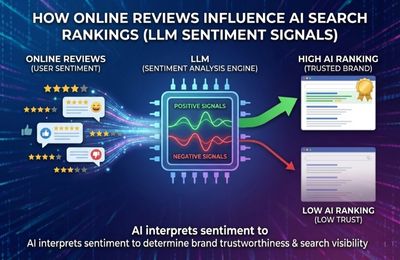
Online reviews are no longer just for human trust they are machine-readable trust signals. Modern AI-powered search engines and LLMs analyze review sentiment, patterns, consistency and authenticity to decide whether a brand deserves visibility. This article explains how reviews AI ranking works, which review behaviors strengthen authority, which red flags suppress AI visibility and how businesses in healthcare, legal and home services can optimize reviews for generative local SEO.
Reviews & AIO
Online reviews have quietly become one of the strongest authority signals in AI-driven search ecosystems. While traditional SEO treated reviews mainly as conversion assets or local pack boosters, AI systems now use them as contextual trust data.
Large language models (LLMs) trained on public web content, including review platforms, learn how users talk about brands, services, outcomes and reliability. When someone asks an AI assistant for a “trusted dentist near me” or “reliable HVAC company,” the model doesn’t just look at keywords or backlinks. It evaluates collective sentiment, recurring language patterns and consistency across review ecosystems.
This is where the reviews AI ranking diverges from classic SEO. AI does not count stars the way humans do; it interprets meaning. Reviews become signals of real-world performance, customer outcomes and brand credibility at scale.
For businesses investing in generative local SEO, reviews are no longer optional reputation assets; they are part of the AI authority layer that determines whether your brand is mentioned, summarized, or ignored.
How AI evaluates review sentiment
AI systems evaluate reviews very differently from traditional algorithms. Instead of focusing solely on averages, LLMs analyze language, context and distribution.
1. Sentiment beyond star ratings
AI sentiment analysis looks at tone, emotional markers and outcome-based language. A 4-star review stating “the issue was resolved quickly and professionally” often carries more authority than a generic 5-star “great service.”
This is where AI sentiment becomes critical. Models identify:
- Positive outcome language (resolved, improved, recovered)
- Service-specific context (treatment results, legal clarity, repair durability)
- Emotional consistency (confidence, relief, trust)
2. Cross-platform reinforcement
LLMs compare sentiment across multiple sources. Reviews from platforms like Yelp, Google My Business and Trustpilot are often read together, not in isolation.
If tone and claims align across platforms, AI interprets this as credibility. If messaging conflicts, trust is diluted.
3. Domain-specific interpretation
AI evaluates reviews differently depending on industry context:
- Healthcare: outcome clarity, bedside manner, follow-up care
- Legal: communication, case understanding, transparency
- Home services: timeliness, durability of work, professionalism
This contextual reading is why customer review signals matter more than raw volume.
Review patterns that boost authority
Certain review behaviors consistently strengthen AI trust models. These patterns show up repeatedly in brands that surface well in AI-generated answers.
1. Consistent review velocity
A steady flow of reviews over time signals operational stability. AI is skeptical of long review gaps followed by sudden spikes, which may indicate artificial manipulation.
2. Natural language variation
Authentic reviews vary in length, phrasing and focus. AI favors:
- Mixed sentence structures
- Unique personal experiences
- Specific service references
Repetitive templates weaken credibility, even if the sentiment is positive.
3. Outcome-driven narratives
Reviews that explain what changed after using a service strongly influence AI interpretation.
- Healthcare example:
Instead of “good clinic,” reviews mentioning reduced pain, clear diagnosis, or recovery timelines provide stronger authority signals. - Legal example:
AI favors reviews that mention clarity of advice, case handling process, and responsiveness, not just “won my case.” - Home services example:
Mentions of long-term results (“still working perfectly after 6 months”) reinforce reliability.
These narratives help AI models confidently summarize and recommend brands.
Red flags for AI
AI systems are highly sensitive to manipulation patterns. Several review behaviors actively suppress visibility in AI-driven results.
1. Over-optimized review language
If multiple reviews repeat identical phrases or keywords, AI flags them as unnatural. This mirrors issues seen in thin content AIO, where repetition signals low informational value.
2. Sentiment mismatch across platforms
A business with glowing reviews on one platform but neutral or negative sentiment elsewhere creates confusion for AI. Inconsistent narratives weaken authority.
3. High ratings with low textual depth
Five-star ratings without meaningful descriptions are weak signals. AI prefers fewer detailed reviews over many shallow ones.
4. Sudden reputation shifts
Rapid sentiment changes, especially from negative to overwhelmingly positive, raise credibility concerns unless supported by contextual explanations (new management, service upgrades, etc.).
These red flags don’t just affect rankings; they influence whether AI chooses to mention your brand at all.
How to optimize reviews for AI search
Optimizing reviews for AI does not mean scripting customers. It means creating systems that encourage authentic, experience-driven feedback.
1. Ask experience-based prompts
Instead of “Please leave a review,” prompt users with:
- What problem were you facing?
- What improved after our service?
- What stood out in the experience?
These prompts naturally generate AI-readable context.
2. Encourage platform diversity
A balanced presence across major review ecosystems strengthens generative local SEO. AI trusts brands that are discussed consistently in multiple public spaces.
3. Respond with substance
AI reads owner responses too. Thoughtful replies that acknowledge specifics reinforce trust and demonstrate accountability.
4. Align reviews with brand reality
Operational consistency matters. AI cross-checks reviews against website content, service claims and brand messaging. This is where working with an AIO consultant helps ensure alignment across content, reputation and entity signals.
5. Monitor sentiment trends, not just ratings
Track recurring themes: speed, clarity, results, support quality. These themes often show up in AI-generated summaries of your business.
FAQs
Do reviews impact AI rankings?
Yes. Reviews influence AI rankings by providing sentiment, trust and real-world performance signals that LLMs use to evaluate brand credibility.
What type of reviews help AI visibility the most?
Detailed, outcome-focused reviews with natural language variation and industry-specific context help AI systems understand and trust a brand.
Do star ratings matter more than review text?
No. AI prioritizes review text, sentiment patterns and consistency over star averages alone.
Can fake or templated reviews hurt AI rankings?
Yes. AI can detect unnatural repetition and inconsistencies, which can suppress visibility or credibility in AI-generated answers.