
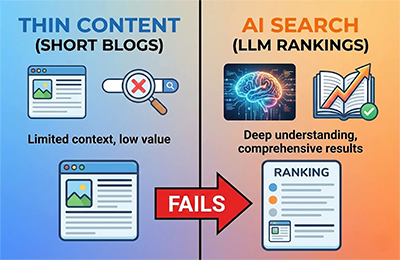
Short, surface-level blogs struggle in AI-powered search because large language models (LLMs) don’t rank pages that select knowledge. Thin content lacks depth, context, and authority signals, making it unreliable for AI answers. To win in modern search, brands must focus on content depth, topic clusters and AIO content standards that align with how LLMs evaluate and reuse information.
Thin Content vs AI Search
Traditional SEO rewarded brevity when it satisfied intent quickly. AI-powered search has changed that equation entirely.
Large language models like ChatGPT, Gemini, Claude and Perplexity don’t scan pages the way search engines used to. They synthesize, summarize, and reuse information as training signals or live answer sources. In this environment, thin content doesn’t just rank poorly it often disappears altogether.
This article breaks down why thin content AIO strategies fail, how LLMs judge content depth and what modern brands must do to stay visible in AI-driven search results.
Why short blogs fail
Short blogs typically fail for one core reason: they optimize for completion, not comprehension.
A 400–600-word article may answer a basic query, but it rarely:
- Explains why something works
- Covers edge cases or variations
- Establishes topical authority
- Provides enough context for reuse
LLMs are trained to reduce uncertainty. When content is shallow, AI systems cannot confidently rely on it as a source.
From an AIO perspective, thin content usually shows:
- Limited semantic coverage
- Weak entity relationships
- Minimal contextual signals
- No supporting subtopics
According to Nielsen Norman Group research on information depth and usability, users and, by extension, AI systems trained on user behavior prefer content that answers primary questions and anticipates follow-ups. This same principle now applies to AI search selection.
In short, if your blog answers only the headline question, AI will look elsewhere.
How LLMs evaluate depth
LLMs don’t measure depth by word count alone. They evaluate knowledge completeness.
When an AI model processes content, it looks for:
- Concept expansion (definitions, explanations, implications)
- Semantic variety (related terms, synonyms, contextual phrases)
- Logical structure (cause → effect → outcome)
- Entity clarity (who, what, why it matters)
This is where LLM ranking differs fundamentally from classic SEO ranking.
A short blog that says:
“Thin content is bad for SEO because Google prefers long articles.”
Provides almost no reusable knowledge.
A deeper article that explains:
- What thin content is
- Why does it fail in AI systems?
- How AI evaluates reliability
- When short content can still work
Creates structured knowledge that an LLM can confidently reuse in answers.
This is why content depth has become a primary trust signal in AI search.
Topic clusters & authority
Single, isolated blogs struggle in AI environments. LLMs prefer networks of meaning, not standalone pages.
Topic clusters signal authority by showing that a brand:
- Understands a subject holistically
- Covers multiple angles and intents
- Maintains consistency across content
For example, one short blog on thin content provides limited value. But a cluster covering:
- Thin vs comprehensive content
- AIO content standards
- LLM evaluation models
- AI search optimization strategies
Creates an authority footprint.
From an AIO standpoint, topic clusters help LLMs:
- Associate your brand with a subject
- Cross-reference related explanations
- Reduce hallucination risk when citing or summarizing
This is why modern AI visibility strategies prioritize clustered depth over isolated posts.
Content length vs value
This is where many teams get confused.
Longer content does not automatically mean better content.
What matters is value density:
- Does each section add new insight?
- Does it reduce ambiguity?
- Does it likely have follow-up questions?
A 1,200-word article that repeats itself is still thin.
A 900-word article that:
- Explains concepts clearly
- Uses examples
- Covers implications
- Adds practical interpretation
Can outperform a longer piece.
In AIO content standards, length is a byproduct of depth, not the goal itself.
The best-performing AI-visible content balances:
- Structured sections
- Clear explanations
- Logical progression
- Minimal fluff
Good vs bad examples
Let’s make this concrete.
Bad example (thin content):
“Thin content is short content that doesn’t rank well. To fix it, write longer blogs and add keywords.”
Why this fails:
- No definition clarity
- No explanation of AI behavior
- No actionable insight
- No authority signal
Good example (AI-ready content):
“Thin content refers to pages that lack sufficient context, semantic coverage, or explanatory depth for both users and AI systems. In AI search, such content fails because LLMs require comprehensive signals to safely reuse information in generated answers.”
Why this works:
- Defines the concept
- Explains the mechanism
- Aligns with LLM evaluation logic
- Adds reusable knowledge
This difference is why shallow posts are ignored while deeper ones surface repeatedly in AI answers.
Conclusion
AI search has fundamentally redefined what “good content” means.
Thin content fails not because it is short but because it is incomplete. LLMs prioritize clarity, depth and authority over speed and brevity. Brands that continue publishing surface-level blogs risk becoming invisible in AI-driven discovery.
To succeed in modern search, content must meet AIO content standards: structured depth, semantic coverage and topical authority. The goal is no longer ranking pages; it’s becoming a trusted source of knowledge that AI systems rely on.
FAQs
Does word count matter for AI search?
Word count alone does not matter. What matters is whether the content provides enough depth, context and clarity for LLMs to reuse it confidently in answers.
Why does AI ignore shallow content?
AI ignores shallow content because it lacks sufficient semantic signals, explanations and authority markers needed to reduce uncertainty in generated responses.
Can short content ever rank in LLMs?
Yes, but only when the topic is narrow and fully addressed. Most complex topics require more depth to meet AI evaluation standards.
How do I upgrade thin content for AIO?
Expand explanations, add contextual subtopics, connect related ideas and structure content so it answers both primary and follow-up questions clearly.