
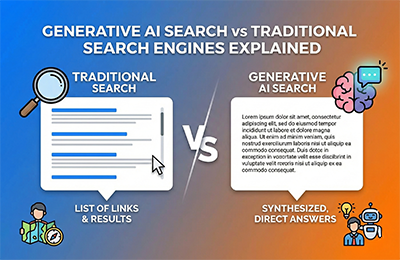
Generative AI search represents a major shift from traditional search engines by producing conversational, synthesized answers instead of returning a list of blue links.
While Google Search relies on indexing, ranking, and keyword-driven relevance, LLM-powered systems like SGE and AI overviews generate real-time summaries using learned patterns and semantic relationships.
This blog explains how both systems work, why ranking signals differ, what generative answers mean for visibility and what businesses must change to stay competitive across both ecosystems.
Generative Search vs Traditional Search
Search is entering its most significant transformation since the rise of mobile.
As conversational search, AI overviews and generative answers expand across Google and independent LLMs, users now receive answers not links.
Understanding the differences is essential for marketers, SEO teams and brands adapting their content strategies for AI-powered discovery.
How Google Search Works vs LLM Answers
Traditional search engines and generative AI search systems operate on fundamentally different architectures. While both serve user intent, how they gather, process and output information diverges sharply.
How Traditional Google Search Works (In Simple Terms)
Google pulls answers from the live web using:
- Crawling (discovering pages)
- Indexing (storing and categorizing pages)
- Ranking (ordering results using algorithms like PageRank, E-E-A-T signals and relevance models)
Every result in a Google SERP is a document retrieved from its index. Nothing is “generated”; it’s ranked.
How Generative AI Search Produces Answers
LLMs like ChatGPT, Gemini and Claude use:
- Neural network training on large text corpora
- Semantic understanding instead of keyword matching
- Real-time synthesis to produce one cohesive answer
- Conversational context to refine responses
SGE and Google’s AI Overviews blend both methods pulling index data, interpreting it through generative models and presenting a synthesized answer on top of SERPs.
Comparison
|
Feature |
Traditional Google Search |
Generative AI Search (SGE, ChatGPT, Gemini) |
|
Source of the answer |
Indexed webpages |
Trained neural model + contextual retrieval |
|
Output format |
List of ranked links |
Cohesive, conversational generative answers |
|
Intent handling |
Keyword-driven |
Semantic + contextual + conversational |
|
Personalization |
Limited to search history |
Adaptive and dynamic per query |
|
Reliability |
High based on published content |
High, but depends on training & retrieval |
|
Verification |
URLs visible |
Often abstracted unless citations are provided |
|
Ideal for |
Research, transactions, navigation |
Summaries, explanations, multi-step queries |
Differences in Ranking, Output and User Intent
Generative AI changes not just what shows up but how answers are constructed.
1. Ranking Signals Operate Differently
Traditional search ranking is based on:
- Backlinks
- Domain authority
- On-page SEO
- E-E-A-T
- Page speed, UX, engagement
Generative search ranking depends on:
- Entity understanding
- Topical authority
- Semantic relevance
- Sentiment and trust signals
- Model familiarity with your brand
An article may rank in Google but be ignored by an LLM if it lacks entity clarity or structured data.
2. Output Format Is Entirely Different
Traditional search provides 10–20 results.
Generative search gives one synthesized response.
This shifts the competition from link ranking to inclusion inside the generative overview.
3. User Intent Is Interpreted More Broadly
Users ask AI questions the way they speak:
“Explain SGE like I’m new to SEO. Also compare it to regular Google.”
Generative systems handle layered, multi-step queries naturally, while traditional search struggles with conversational intent unless broken into separate queries.
Pros & Cons of Generative Search
Generative AI search introduces powerful advantages but also new risks.
Pros
- Faster learning for users through summarized answers
- Better handling of complex or multi-part questions
- Conversational follow-ups refine intent
- Higher accessibility for non-experts
- Reduced need for multiple clicks
Cons
- Visibility cannibalization for publishers if links aren’t clicked
- Potential hallucinations in synthesized responses
- Less transparency around ranking factors
- Reduced brand visibility unless entity-optimized
- Fewer opportunities for organic traffic
As AI overviews expand, businesses must assume visibility may occur inside the AI result, not on their website.
What Businesses Must Do Differently
Adapting to generative AI search requires more than SEO. It requires AIO (AI Optimization) principles focusing on entities, structured clarity and machine understanding.
Here’s what changes:
1. Strengthen Entity-Based Optimization
LLMs rely on entity relationships. Your brand, product names, people and categories must be clearly defined through:
- Organization schema
- Person schema
- Product schema
- AQ schema
- Internal linking that reinforces semantic structure
2. Prioritize Topical Authority Over Keyword Density
LLMs select sources based on subject completeness.
You must create:
- Comprehensive topic clusters
- Long-form guides
- High-depth content explaining concepts thoroughly
3. Format Content for AI Overviews
Google AI Overviews reward content that is:
- Structured
- Contextually rich
- Supported by credentials
- Easy for AI to quote or summarize
Link to trusted sources like the Google AI Overviews Docs when referencing technical details.
4. Shift KPIs: From “Ranking” to “Inclusion.”
Your new goals include:
- Being cited in AI overviews
- Appearing in conversational search responses
- Improving brand recall inside LLMs
- Increasing retrieval visibility across ChatGPT, Gemini and Perplexity
5. Create Content for Humans AND Machines
Modern content must be:
- Easy to scan
- High-authority
- Rich in facts and examples
- Structured with clear question–answer formats
This dual optimization ensures visibility across both classical search and generative platforms.
Final Thoughts
Generative AI search is not replacing traditional search. It is layering itself on top of it. Google continues to refine ranking systems, while LLMs rewrite how answers are produced. Businesses must prepare for a dual ecosystem where visibility requires SEO + AIO + entity strategy to remain competitive. The brands that adapt early will gain disproportionate reach in both blue-link SERPs and conversational AI environments.
FAQs
How does generative AI search actually work?
Generative AI search uses large language models (LLMs) to analyze a query, understand its context and produce a synthesized answer based on patterns learned during training and retrieval.
Does generative search replace Google?
No. Generative search complements traditional search. Google still relies on indexing and ranking, while generative systems offer summaries and conversational insights.
How is generative AI search different from traditional search engines?
Generative AI search creates a direct, conversational summary using LLMs, while traditional search engines retrieve and rank links from the web. AI models synthesize information; Google Search lists pages based on relevance and ranking signals.
How can businesses optimize their content for generative search?
Businesses must focus on entity optimization, structured data, topic depth and authoritative content clusters. Generative systems favor clear entities, strong topical authority and well-structured information that is easy to summarize.