
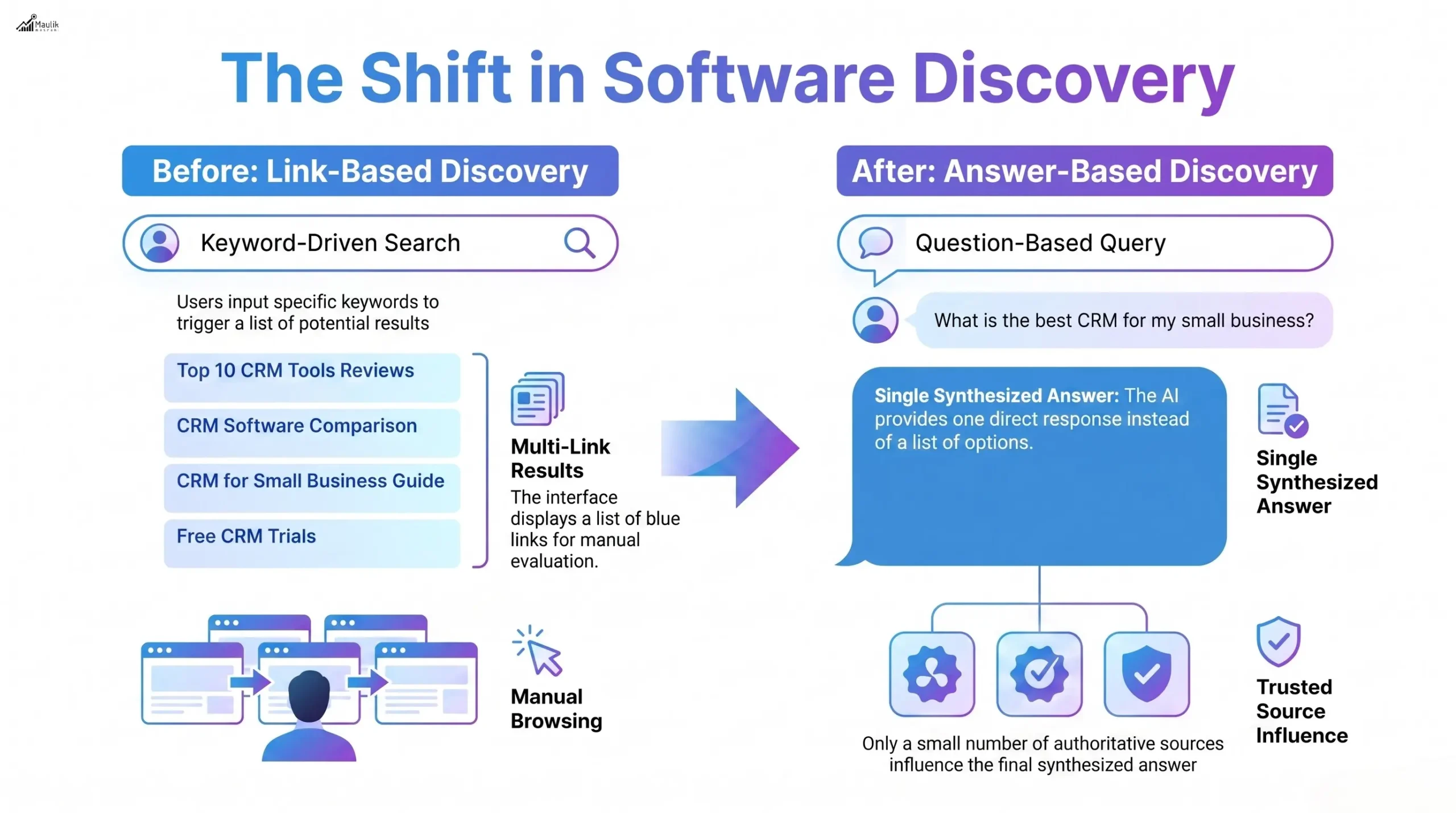
Search behavior is evolving from link-based discovery to answer-based discovery. Buyers increasingly ask AI assistants to recommend tools instead of browsing search results. This means SaaS companies must optimize for AI understanding, not just search rankings. AI SEO for SaaS focuses on making product knowledge structured, trustworthy and retrievable by AI systems. A strong SaaS GEO strategy ensures your software becomes part of the knowledge base AI models reference when answering questions about tools, workflows and solutions.
AI SEO For SaaS
For years, SaaS marketing teams measured success through search rankings.
Ranking first for a keyword like “project management software” or “CRM for startups” could drive thousands of monthly visitors. Entire marketing strategies revolved around climbing Google’s results page.
But the way professionals discover software is changing.
Today, product managers, founders, and operations leaders often begin research by asking AI assistants questions such as:
- Which SaaS tools help manage distributed teams
- Best platforms for subscription analytics
- What CRM works best for SaaS startups
Instead of presenting a list of links, AI platforms generate a synthesized answer. Only a few sources influence that answer. This shift means visibility is no longer only about ranking pages; it is about being part of the knowledge AI systems rely on.
That is the foundation of AI SEO for SaaS.
Rather than focusing only on keyword placement, this approach ensures that a SaaS product’s knowledge, documentation and expertise are structured in ways that AI models can interpret and retrieve.
SaaS Visibility in AI Tools
AI-driven search systems evaluate information differently from traditional search engines.
Classic ranking algorithms relied heavily on:
- backlinks
- page authority
- keyword signals
AI assistants analyze information through semantic reasoning. They look for reliable knowledge sources and patterns of credibility.
For SaaS companies, this means visibility is influenced by how clearly the product’s expertise is communicated across the web.
A SaaS platform that explains its technology, use cases and workflows in detail gives AI models more material to learn from.
For example, consider a SaaS company offering customer onboarding automation.
If the company publishes practical resources like:
- onboarding workflow templates
- documentation explaining onboarding automation
- case studies about reducing churn
AI systems can better understand where the software fits within the SaaS ecosystem.
This is where AIO (Artificial Intelligence Optimization) becomes relevant inside an AI SEO for SaaS strategy.
AIO focuses on shaping content in a way that aligns with how AI systems interpret knowledge. Instead of simply optimizing for a keyword, the goal becomes answering meaningful questions.
When SaaS companies consistently publish structured knowledge around their product category, they strengthen their chances of appearing in AI-generated recommendations.
Product-Led Authority Building
SaaS companies often overlook their strongest marketing asset: product knowledge.
Every SaaS platform contains a wealth of expertise that can establish authority, including:
- feature documentation
- user guides
- implementation tutorials
- API documentation
- troubleshooting resources
These assets are not just support materials. They can become powerful discovery engines when used strategically.
Product-led authority building involves transforming internal knowledge into public educational resources.
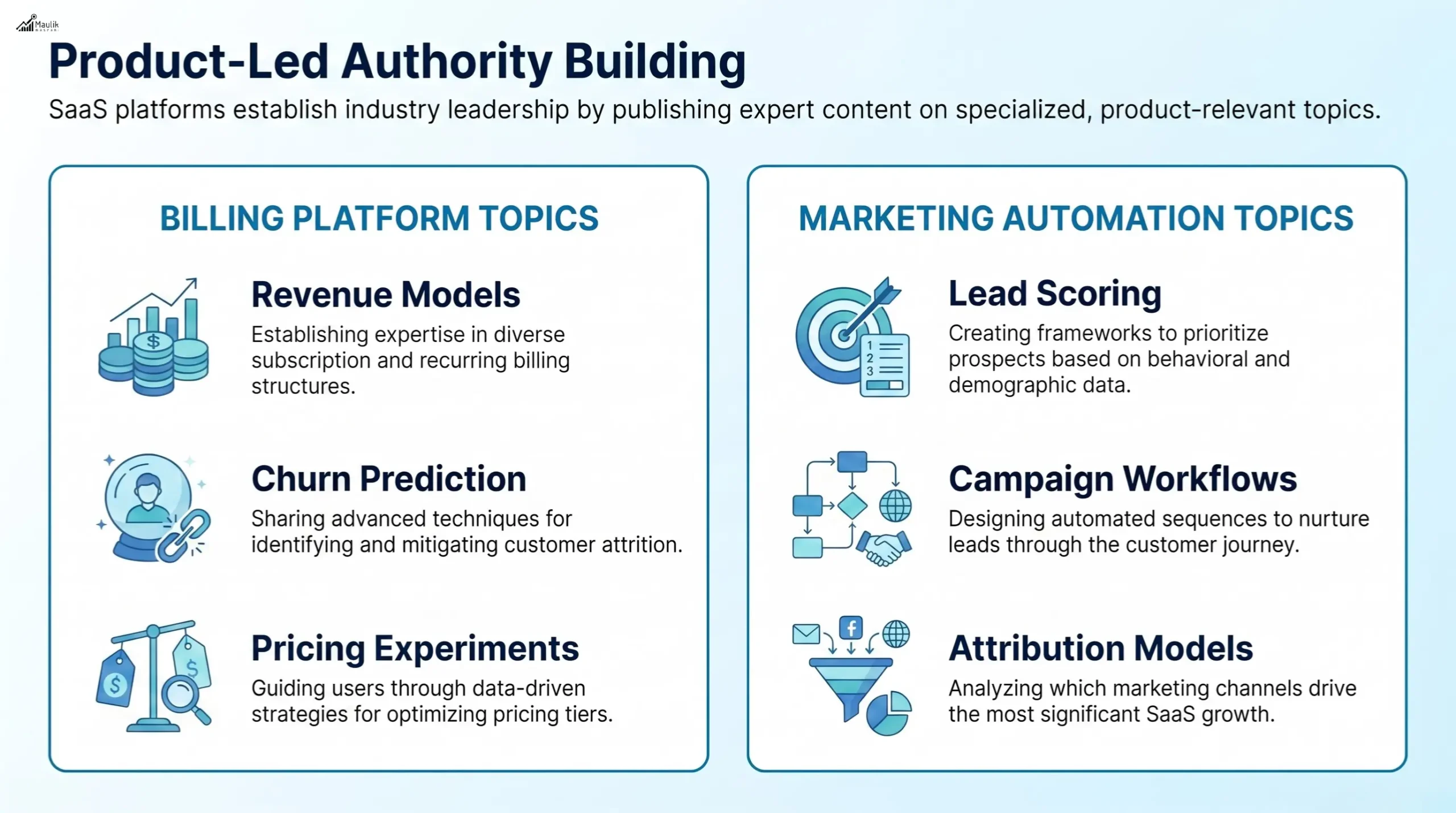
For example, a SaaS billing platform might create content explaining:
- subscription revenue models
- churn prediction techniques
- pricing experimentation strategies
Similarly, a marketing automation platform could publish guides about:
- lead scoring frameworks
- campaign automation workflows
- attribution models for SaaS growth
These resources accomplish two things.
First, they help potential users understand the product category.
Second, they build topical authority that AI systems can recognize.
When AI assistants analyze knowledge about a particular software category, they look for consistent expertise signals. If a SaaS brand repeatedly provides reliable information about a specific domain, it becomes associated with that topic.
This association is a key component of a long-term SaaS GEO strategy.
Over time, the brand becomes part of the trusted knowledge graph surrounding that product category.
LLM Retrieval Framework
Large language models retrieve information through patterns of meaning rather than traditional indexing alone. SaaS companies that want consistent AI visibility must design content with this retrieval process in mind.
A practical framework includes three structural layers.
Knowledge Clarity
The first layer focuses on clarity.
AI systems perform better when information is presented in a clear and consistent format. SaaS websites should ensure that key topics are explained logically.
For example, every SaaS product should clearly describe:
- What the software does
- Who the product is designed for
- Which problems it solves
- How it integrates with other tools
Ambiguous messaging makes it difficult for AI models to understand where the product belongs.
Clear definitions strengthen AI retrievability.
Context Depth
The second layer focuses on context.
AI assistants favor content that explains not only what a product does, but also why it matters.
Instead of writing surface-level promotional content, SaaS companies should explain industry challenges and workflows.
For instance:
- How SaaS companies manage product analytics
- How subscription billing systems reduce revenue leakage
- How onboarding automation improves retention
These explanations help AI models connect the product with real-world problems.
When users ask questions about those problems, the AI system is more likely to reference sources that explain them thoroughly.
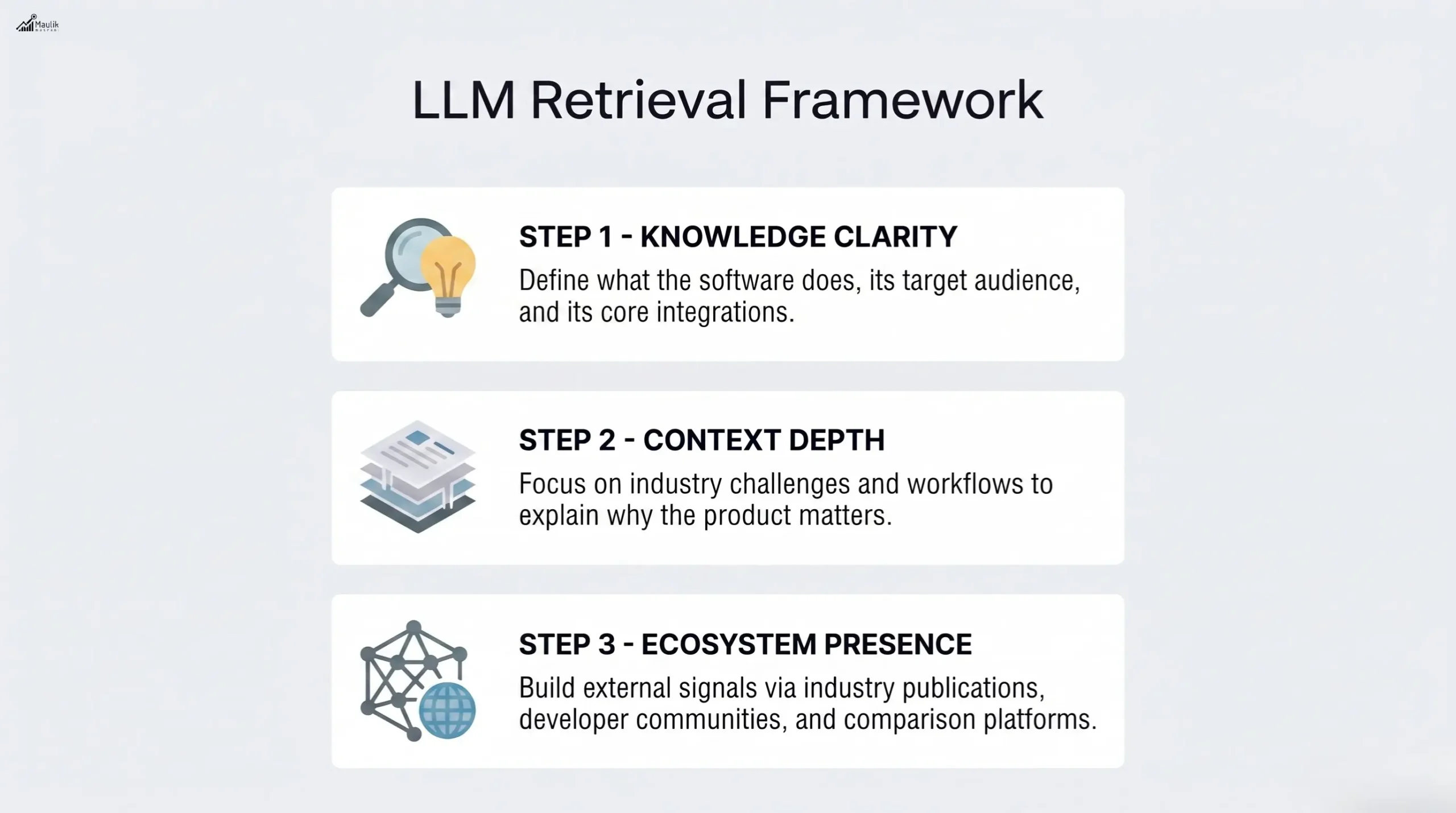
Ecosystem Presence
The third layer focuses on ecosystem visibility.
AI systems rarely rely on a single source when generating answers. They cross-reference multiple signals across the internet.
For SaaS companies, this means authority must exist beyond the company website.
Examples include:
- mentions in industry publications
- technical discussions in developer communities
- educational resources shared by analysts
- presence in software comparison platforms
Each additional reference strengthens the product’s knowledge footprint.
Over time, these signals contribute to a more robust AI SEO for the SaaS ecosystem, where the product becomes recognizable across different knowledge sources.
FAQs
How do SaaS Brands Win AI Search?
SaaS brands win AI search by structuring their product knowledge so AI systems can easily interpret it. This includes publishing educational resources, maintaining clear product definitions, and strengthening authority signals across trusted platforms.
What is a SaaS GEO Strategy?
A SaaS GEO strategy focuses on optimizing content and product knowledge for generative AI engines rather than only traditional search engines. The goal is to ensure AI assistants recognize and reference the SaaS product when answering user queries.
Why is AI Visibility Important for SaaS Companies?
Many professionals now ask AI assistants for product recommendations instead of browsing search results. SaaS companies that appear in these AI responses gain early influence during the software evaluation process.
How do I optimize for AI buyer journeys?
Traditional SEO focuses on ranking pages in search engines. AI SEO for SaaS focuses on making product knowledge understandable and retrievable by AI systems that generate answers.
Can Smaller SaaS Startups Compete in AI Search?
Yes. AI assistants often prioritize clear expertise over brand size. Startups that publish practical, problem-focused knowledge can appear in AI-generated answers even when competing with larger brands.
Conclusion
The discovery process for software is gradually shifting from search results to AI-generated answers. Buyers no longer rely solely on ranking pages; they rely on synthesized insights from AI assistants. For SaaS companies, this means visibility depends on whether AI systems recognize and understand their expertise.
Adopting AI SEO for SaaS and developing a structured SaaS GEO strategy allows companies to adapt to this shift. By turning product knowledge into authoritative educational resources and ensuring information is easy for AI systems to retrieve, SaaS brands can remain discoverable in the next generation of search.