
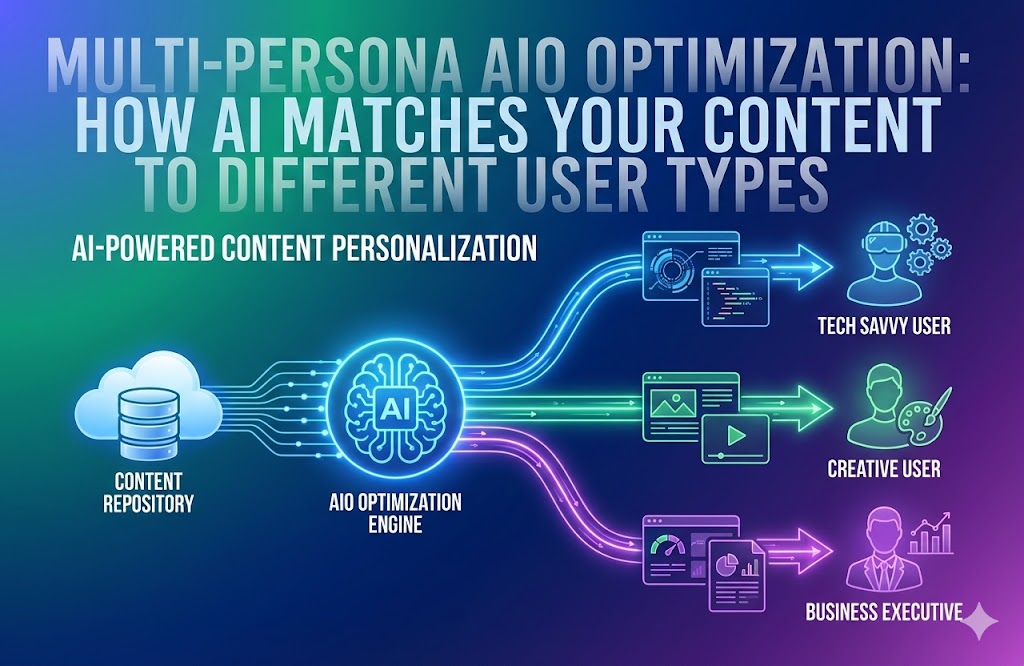
Multi-Persona AIO Optimization is about designing content so AI systems can adapt the same core information to different user types like CEOs, students and marketers based on intent, context and behavior signals. By structuring content for persona diversity, you improve user experience, increase AI visibility and ensure LLMs return answers that feel personalized without rewriting everything from scratch.
Multi-Persona AIO
Multi-Persona AIO (Artificial Intelligence Optimization) focuses on how AI systems interpret, adapt and present your content to different user types asking similar questions for different reasons.
In traditional SEO, one page targeted one keyword and one audience. In AI-driven environments, the same query “What is AIO optimization?” can surface different answers depending on whether the user is a CEO, a student, or a marketer.
Persona optimization AI ensures your content is structured so AI systems can dynamically map it to multiple user needs without diluting clarity or authority.
How AI Identifies User Types
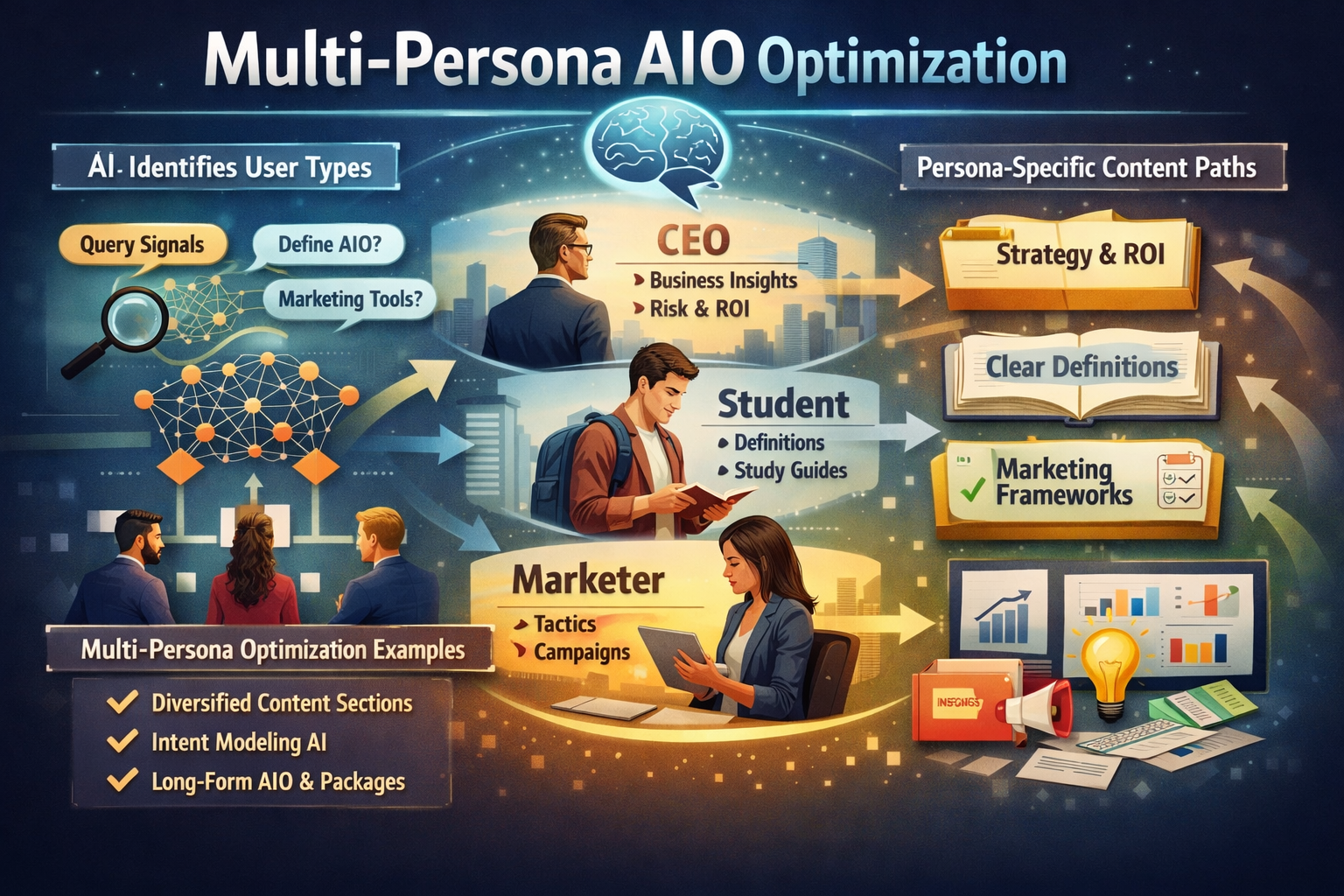
AI does not explicitly label users as “CEO” or “student.” Instead, it infers personas through layered signals and intent modeling.
Key signals AI uses
- Query framing: strategic vs. educational vs. tactical phrasing
- Follow-up behavior: depth, specificity and progression of questions
- Contextual patterns: device type, language complexity, session flow
- Historical intent clusters: previously seen user journeys with similar prompts
This process, often referred to as intent modeling AI, allows systems like ChatGPT, Gemini, Claude and Perplexity to match responses to inferred user needs rather than serving a one-size-fits-all answer.
For example:
- A CEO asking about AIO is usually looking for business impact and risk
- A student wants definitions and conceptual clarity
- A marketer wants frameworks, tools and execution steps
Well-structured content gives AI the raw material to perform this matching accurately.
Why Persona Diversification Matters
Most brands unknowingly optimize for a single dominant persona. This limits how AI systems reuse, remix and recommend their content.
Benefits of multi-persona AIO
- Higher relevance across AI answers
- Better conversational UX for diverse users
- Reduced the need for duplicate pages
- Stronger authority signals across intent layers
From a UX perspective, this aligns with research from Nielsen Norman Group, which consistently shows that users interpret and value information differently based on goals, expertise and cognitive load.
Multi-audience AIO ensures your content can scale across those differences without losing coherence.
Persona-Specific Content Paths
AI systems look for internal content paths and logical sections that serve different depths of understanding. You don’t need separate pages for each persona; you need clearly segmented layers.
Example: One topic, three personas
Core Topic: Multi-Persona AIO Optimization
CEO Path
- High-level framing
- Strategic risks and ROI
- Competitive advantage narrative
Student Path
- Clear definitions
- Simple examples
- Conceptual explanations
Marketer Path
- Tactical frameworks
- Execution checklists
- Measurement signals
By structuring sections with clear intent signals (headings, transitions, examples), AI user personas can be satisfied from the same content source.
This is where persona optimization AI thrives; it extracts, summarizes and reorders based on perceived user type.
Multi-Persona Optimization Examples
Let’s look at how AI might reuse the same content differently.
Example 1: CEO
AI highlights:
- Why persona diversification reduces AI misrepresentation
- How multi-persona AIO improves brand consistency
- Strategic implications for visibility and trust
Example 2: Student
AI highlights:
- What personas are
- How AI identifies intent
- Simple analogies and explanations
Example 3: Marketer
AI highlights:
- How to structure sections for personas
- Where to place frameworks and examples
- How to test multi-persona performance
None of these require separate article. They require intentional structuring that supports multi-audience AIO.
Checklist
Use this checklist to validate whether your content supports multi-persona AIO optimization:
- Clear H2/H3 sections mapped to different intent depths
- Definitions followed by applications and implications
- Examples that span beginner to advanced use cases
- Neutral, authoritative tone that scales across personas
- Logical internal linking to deeper AIO resources
- External validation from recognized UX or research bodies
If AI can “slice” your content cleanly, you’ve done persona optimization correctly.
FAQs
How does AI adapt responses to personas?
AI adapts responses using intent modeling, analyzing query structure, follow-up behavior and contextual signals to infer what type of information the user needs.
What are AI user personas?
AI user personas are inferred profiles based on user intent, expertise level and interaction patterns, not explicit demographic labels.
Is multi-persona AIO better than creating separate pages?
Yes. Multi-persona AIO reduces duplication while allowing AI systems to personalize answers dynamically from a single authoritative source.
How can marketers design for multiple personas?
By structuring content into layered sections, definitions, examples, frameworks and implications, AI can match the right layer to the right user.
Conclusion
Multi-Persona AIO Optimization is not about writing more content; it’s about writing smarter content. When your pages are structured for persona diversity, AI systems can adapt your message for CEOs, students and marketers without distortion.
As AI becomes the primary interface between users and information, persona optimization AI will determine not just if your content appears, but how it’s interpreted.