
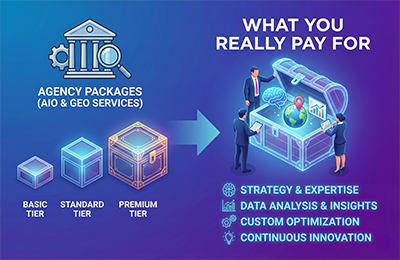
Most AIO packages appear similar on the surface, but the real difference lies in the depth of strategy, technical clarity for AI systems, content designed for reuse, and how visibility is measured without relying on rankings. This guide explains what agencies truly deliver, how AIO pricing works, what’s often overhyped and how GEO service packages compare to traditional SEO. So you know exactly what you’re paying for.
How Agencies Package AIO/GEO
As AI-powered search engines like ChatGPT, Gemini, Claude and Perplexity reshape how information is discovered, agencies have begun repackaging services under labels such as AIO, GEO, or AI SEO.
While the names vary, credible AIO packages follow a consistent structure. They are designed to make your brand understandable, reusable and trustworthy to AI systems, not just visible in traditional search results.
Understanding how agencies break these services down helps buyers separate substance from sales language.
Strategy deliverables
Strategy is the foundation of every legitimate AIO engagement, even though it’s often the least visible component.
In most GEO service packages, strategy deliverables include:
- Entity mapping for the brand, products, services and authors
- Topic clustering aligned to AI intent rather than keyword volume
- Competitive analysis based on AI-generated answers
- Query intent modeling across informational and commercial prompts
This phase defines what AI systems should associate your brand with and why it should be selected as a source. Agencies that underprice or skip strategy often compensate later with excessive content or technical fixes that fail to influence AI selection.
Technical deliverables
Technical work ensures that the strategy is interpretable by AI systems.
Within AIO packages, technical deliverables typically focus on:
- Structured data and schema implementation for entities and FAQs
- Semantic content hierarchy and section clarity
- Source consistency across owned and third-party properties
- Crawl and index clarity for AI-assisted retrieval
Unlike traditional SEO, this work prioritizes comprehension over speed or link equity. AI models rely heavily on structure and consistency when selecting sources, which is why this layer often requires ongoing refinement rather than one-time fixes.
Content deliverables
Content remains central, but the rules have changed.
Modern AI SEO deliverables prioritize:
- Topical depth over content volume
- Answer-ready sections that AI can reuse
- Reinforcement of entities across related pages
- Consistent tone, facts and positioning across the site
Instead of publishing dozens of shallow articles, agencies delivering real AIO focus on fewer, more authoritative assets designed for recall and reuse.
Measurement deliverables
Measurement is where AIO diverges most clearly from SEO.
Because AI platforms do not provide traditional analytics, AIO packages rely on alternative measurement approaches such as:
- AI visibility and answer inclusion tracking
- Prompt-based testing across AI platforms
- Citation and mention frequency audits
- Assisted discovery and influence analysis
Reputable agencies are transparent about these limitations. Platforms like Clutch and UpCity frequently highlight agencies that clearly explain what can and cannot be measured in AI-driven search.
What’s included vs overhyped
Not all AIO offerings are created equal.
Included in real AIO packages
- Strategic entity and intent frameworks
- Technical structure for AI readability
- Purpose-built, AI-ready content
- Manual AI testing and interpretation
Often overhyped or misleading
- Guaranteed AI rankings
- Fully automated AI optimization
- Massive content output promises
- Claims of exclusive AI partnerships
AI systems reward consistency and credibility, not shortcuts.
AIO vs Traditional SEO Packages: What’s Actually Different
Strategic Focus Comparison
|
Aspect |
Traditional SEO Packages |
AIO Packages |
|
Core Objective |
Rank webpages |
Be selected by AI answers |
|
Optimization Target |
Search algorithms |
LLMs and generative systems |
|
Primary Focus |
Keywords and links |
Entities and intent clarity |
|
Success Signal |
Rankings |
AI answer inclusion |
|
Content Goal |
Traffic |
Reuse and recall |
Deliverables Comparison
|
Area |
SEO Packages |
AIO Packages |
|
Research |
Keyword-focused |
Prompt and entity-driven |
|
Technical |
Speed and indexing |
Schema and semantic clarity |
|
Content |
Ranking-focused blogs |
Answer-ready content blocks |
|
Linking |
Authority flow |
Topic reinforcement |
|
Reporting |
Traffic and rankings |
AI visibility patterns |
Measurement Differences
|
Metric Type |
SEO Packages |
AIO Packages |
|
KPIs |
Rankings, CTR |
AI mentions and reuse |
|
Tools |
GSC, GA4 |
Manual AI testing |
|
Attribution |
Click-based |
Influence-based |
|
Certainty |
High |
Directional |
What’s Included vs Overhyped
|
Area |
Real AIO Packages |
Overhyped Claims |
|
Strategy |
Entity frameworks |
“AI secrets” |
|
Content |
Depth and structure |
Mass AI blogs |
|
Automation |
Selective tooling |
Fully automated AIO |
|
Guarantees |
Process-based |
Guaranteed results |
Pricing Philosophy Comparison
|
Factor |
SEO Packages |
AIO Packages |
|
Cost Driver |
Task volume |
Expertise depth |
|
Pricing Model |
Output-based |
Strategy-led |
|
Scalability |
More content |
More authority |
|
Buyer Fit |
Traffic-focused |
Authority-focused |
Pricing tiers explained
Once the differences between SEO and AIO are clear, pricing becomes far easier to understand.
Agencies charge more for AIO packages not because they are trendy, but because the work shifts from execution volume to strategic precision, manual validation, and ongoing refinement.
Entry-Level AIO Packages (Foundational Alignment)
Typically includes:
- Entity and intent mapping
- AI-readiness audit
- Priority recommendations
- Limited AI prompt testing
Best for: Brands transitioning from SEO to AI search.
Pricing logic: Strategy-heavy work led by senior expertise.
Mid-Tier AIO Packages (Active Optimization)
Typically includes:
- Ongoing content and entity optimization
- Technical improvements for AI clarity
- Regular AI testing and reporting
- Intent-based content expansion
Best for: Growth-stage brands seeking consistent AI selection.
Pricing logic: Continuous refinement replaces volume-based SEO retainers.
Advanced / Enterprise AIO Packages (Authority Engineering)
Typically includes:
- Full topic ecosystem development
- Cross-platform AI visibility monitoring
- Brand consistency management
- Executive-level reporting
Best for: Enterprises and category leaders.
Pricing logic: Long-term authority ownership rather than deliverables counts.
FAQs
What’s in an AIO package?
A typical AIO package includes strategy planning, technical optimization for AI readability, content designed for AI reuse and alternative measurement methods focused on AI visibility rather than rankings.
What am I paying for with AIO pricing?
You’re paying for expertise, structured systems and ongoing refinement, not automation or shortcuts. Most costs reflect strategic and editorial labor.
Are GEO service packages different from traditional SEO?
Yes. GEO focuses on how AI engines select and reuse information, while traditional SEO focuses on rankings and links.
How long does it take to see results from AIO packages?
Initial signals can appear within weeks, but meaningful AI visibility typically compounds over several months of consistent optimization.