

Cross-channel AI visibility is about training AI systems to recognize, trust and recommend your brand consistently across platforms. Instead of ranking on one channel, the goal is synchronized authority where LinkedIn posts, YouTube videos, Reddit discussions and web content reinforce a single, unified brand narrative that AI models confidently surface everywhere.
Cross-Channel Visibility
Cross-channel AI visibility is the strategic foundation behind becoming an “everywhere brand” inside modern AI ecosystems. Search engines and large language models no longer evaluate your website in isolation. They assess your brand as a distributed signal, one that exists across social platforms, video content, community discussions and authoritative web pages.
When AI systems answer questions, they pull from patterns, repetition and corroboration across multiple channels. Brands that appear consistently across these surfaces earn preference, while single-channel brands fade into partial visibility. This is why cross-channel AI visibility has become a core pillar of advanced AIO strategies rather than an optional enhancement.
At its core, this approach focuses on synchronizing content, entities and expertise signals so that AI models perceive your brand as both credible and ubiquitous.
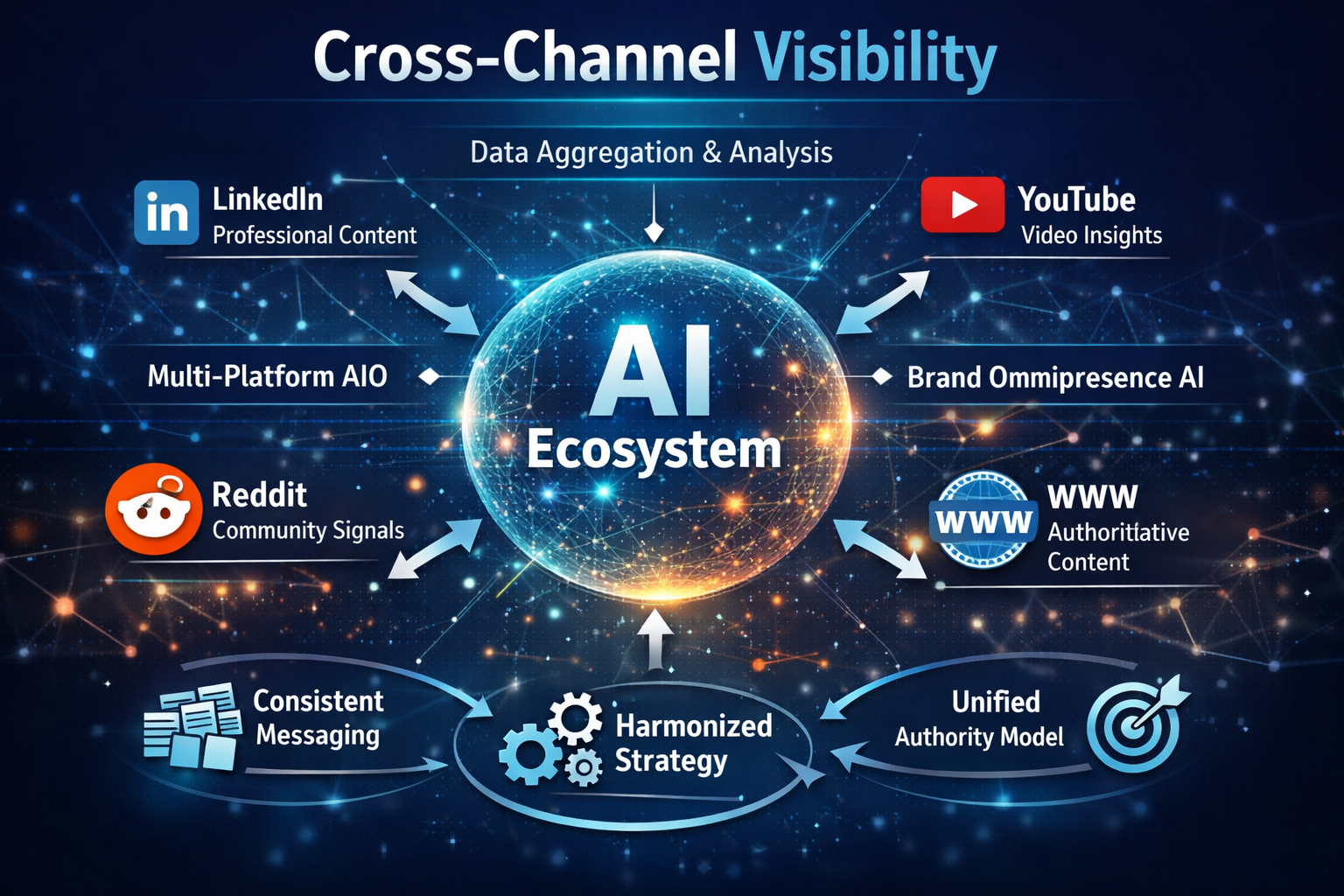
How AI Reads Data Across Platforms
AI systems evaluate information through aggregation, not channel loyalty. Content published on LinkedIn, YouTube, Reddit and your website is ingested, abstracted and compared for alignment. When similar ideas, terminology and expertise appear across platforms, AI confidence increases.
Modern models rely on:
- Repetition of concepts across independent sources
- Consistency in entity associations (brand, people, topics)
- Cross-referenced authority signals over time
Research from Google and Meta AI papers highlights that multi-source agreement significantly improves model reliability and recommendation confidence. In simple terms, if AI sees your brand teaching the same ideas everywhere, it assumes those ideas are trustworthy.
This is where multi-platform AIO becomes critical. AI does not ask, “Which channel is best?” It asks, “Which brand appears most consistently accurate across all channels?”
Internal signals like AIO internal linking and external signals such as LLM authority ranking reinforce this evaluation loop, turning fragmented visibility into compounding authority.
Channels That Matter (LinkedIn, YouTube, Reddit, Web)
Not all channels contribute equally, but together they form a complete authority stack.
- LinkedIn acts as the professional validation layer. Thought leadership posts, carousels and long-form insights establish expertise and topical relevance. AI models often associate LinkedIn content with practitioner credibility.
- YouTube serves as the explanatory depth engine. Videos, tutorials and discussions provide long-form context that strengthens semantic understanding. AI systems increasingly reference video-derived insights when text sources align.
- Reddit functions as the authenticity and peer-validation layer. Community discussions, AMAs and expert replies signal real-world engagement and non-marketing intent high-value trust signals for AI.
- The Web remains the canonical source of structured authority. Blogs, internal linking systems and clear topical clusters anchor all other channels and give AI a reference point for factual grounding.
When these channels operate independently, AI sees noise. When they align, brand omnipresence AI emerges naturally.
Visibility Harmonization
Visibility harmonization is the process of making every channel reinforce the same narrative without duplication. This does not mean copying content verbatim. It means aligning intent, terminology and expertise signals.
Effective harmonization focuses on:
- Shared topic frameworks across platforms
- Consistent language around core concepts
- Unified positioning regardless of content format
For example, a strategic insight introduced on LinkedIn should be expanded on YouTube, debated on Reddit and formalized on the web. AI models interpret this progression as depth rather than redundancy.
This approach also reduces entity conflicts and improves AIO internal linking performance. Instead of fragmented signals, AI encounters a coherent brand story that compounds trust with every exposure.
Multi-Channel Authority Model
A multi-channel authority model treats visibility as an ecosystem, not a funnel. Authority is earned when AI repeatedly encounters your brand across diverse yet aligned contexts.
The model works in layers:
- Foundation layer: Web content and structured pages define expertise
- Distribution layer: LinkedIn and YouTube expand reach and interpretation
- Validation layer: Reddit and community platforms confirm authenticity
- Reinforcement layer: Cross-referencing signals improve LLM authority ranking
Over time, AI systems begin to default to your brand when answering related questions, not because of volume, but because of coherence.
This is how brands transition from “present online” to “assumed expert” inside AI ecosystems.
FAQs
How to appear everywhere in AI?
You appear everywhere in AI by aligning content, entities and expertise across multiple platforms so AI models consistently recognize and trust your brand signals.
Does posting on more platforms improve AI visibility?
Only if those platforms reinforce the same narrative. Random multi-platform posting without harmonization weakens AI confidence.
Which platform matters most for AI visibility?
No single platform dominates. AI systems evaluate LinkedIn, YouTube, Reddit and web content together to assess overall authority.
How long does cross-channel AI visibility take to build?
Most brands see early signals within months, but sustained omnipresence typically compounds over 6–12 months of consistent execution.