
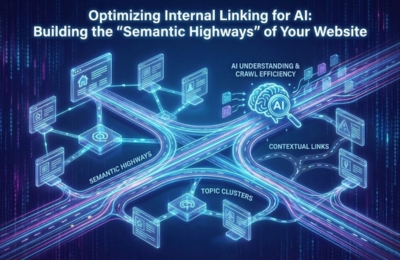
AIO internal linking is no longer just about distributing PageRank; it’s about building semantic highways that help AI systems understand context, relationships, and topical authority across your website. By structuring links around meaning (not just navigation), brands can train AI models, improve AI-driven visibility, and strengthen performance across AIO, AEO and GEO surfaces.
Internal Linking for AIO
Internal linking has quietly evolved from a classic SEO tactic into a core Artificial Intelligence Optimization (AIO) lever. Search engines and large language models (LLMs) don’t just crawl pages; they interpret how ideas connect across your site.
When done correctly, AIO internal linking creates a structured knowledge environment where AI can easily follow meaning, validate authority and reuse your content in answers, summaries and generative outputs.
Think less in terms of “link juice” and more in terms of AI comprehension.
How AI Uses Internal Links
Modern AI systems, including search engines and generative models, consume content as connected graphs, not isolated URLs.
Internal links help AI understand:
- Topical relevance: Which pages explain core concepts vs. supporting ideas
- Hierarchy: What is foundational, what is advanced and what is contextual
- Entity relationships: How topics, subtopics and definitions reinforce each other
- Confidence signals: Pages that are frequently referenced internally are often treated as more authoritative
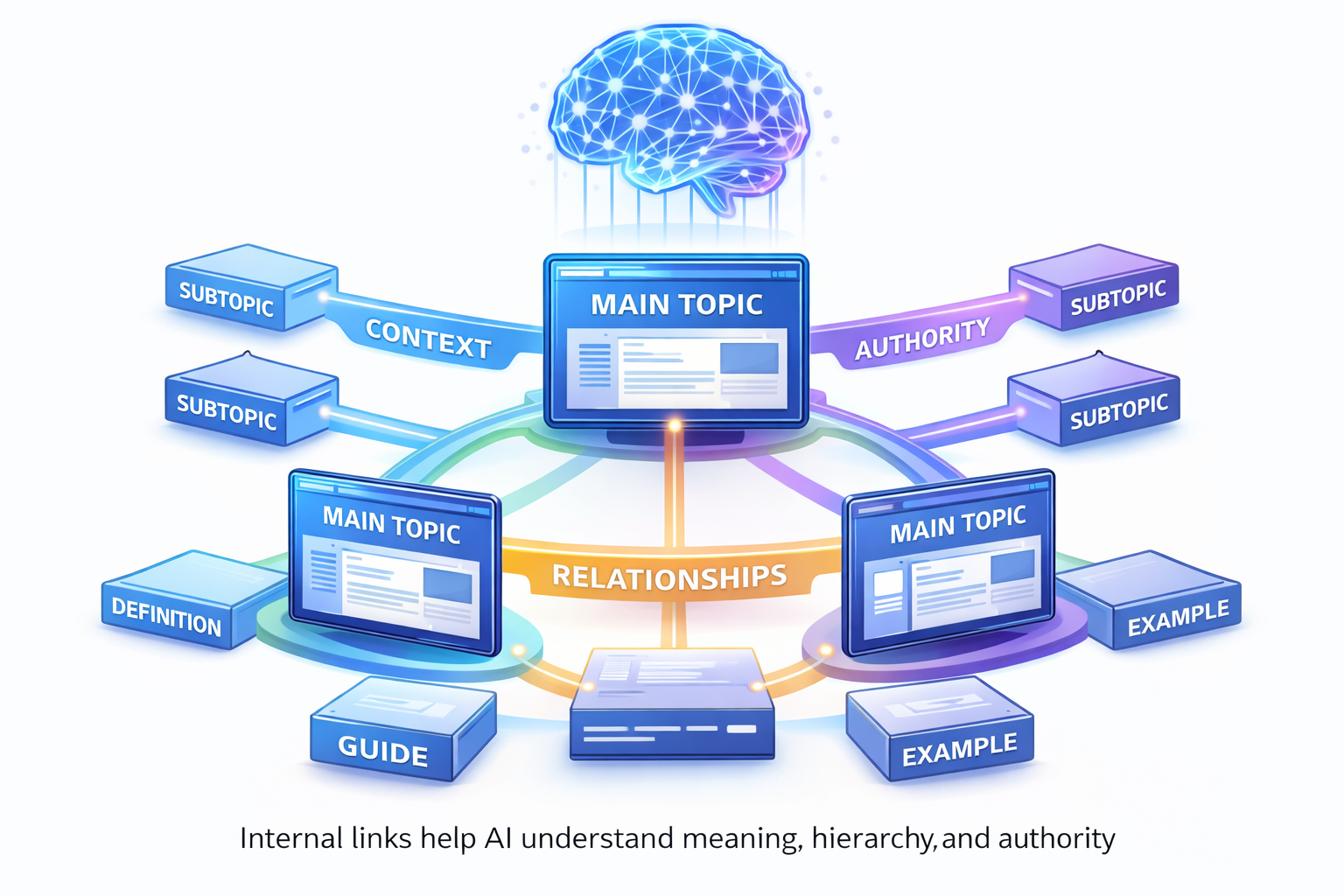
From an AI perspective, internal links act like training signals. They tell the system, “This page explains the core idea,” or “This page expands on that concept.”
Without a deliberate internal linking strategy, even strong content becomes fragmented hard for AI to summarize or reuse accurately.
Semantic Highways Concept
The most effective way to understand internal linking for AI is through the idea of semantic highways.
A semantic highway is a deliberate, high-signal path of links connecting:
- Core topic pages
- Supporting subtopics
- Definitions, examples and implementation guides
Instead of random cross-linking, you create predictable, logical pathways that AI can follow end-to-end.
Why “highways” matter to AI
AI models prefer clarity over creativity in structure. When pages are linked consistently and contextually:
- AI can infer topic clusters
- Content gets grouped into coherent themes
- Models reduce ambiguity when summarizing or citing information
This is how AIO topic clustering actually becomes machine-readable, not through keywords alone, but through intentional internal connections.
How to Structure Internal Linking
To build semantic highways, internal linking must follow a top-down, meaning-first structure.
1. Define a Core Topic Page
Each major subject should have a central, authoritative page. This page acts as the anchor of your AI link graph.
Characteristics:
- Broad coverage
- Clear definitions
- Linked outward to deeper subtopics
2. Build Supporting Subtopic Pages
These pages go deeper into specific aspects of the core topic and should:
- Link back to the core page using consistent, descriptive anchor text
- Link laterally to closely related subtopics where context overlaps
3. Use Contextual Anchors (Not Generic Ones)
AI evaluates anchor text as a semantic hint.
Avoid anchors like “click here” or “read more.”
Instead, use:
- Concept-based anchors
- Definition-style phrases
- Natural language that mirrors how users ask questions
4. Maintain Directional Consistency
Semantic highways work best when links flow in both directions:
- Core → Subtopic (expansion)
- Subtopic → Core (confirmation)
This loop reinforces topical authority and helps AI validate relationships.
Internal Linking Templates
To make AIO internal linking scalable, templates matter.
Core Page Template
- Introductory definition section
- Links to all primary subtopics within the first 40–60% of content
- Summary section linking to advanced or use-case content
Subtopic Page Template
- Short contextual reference back to the core topic early
- One or two lateral links to closely related subtopics
- Optional link to implementation or checklist content
Editorial Linking Rule
Before publishing any new content, ask:
“Which existing page gives this page meaning and which page does this page strengthen?”
This question alone dramatically improves the internal linking strategy for AI.
Audit Checklist
Use this checklist to evaluate whether your internal links are AI-ready:
- Do all major topics have a clear core page?
- Are subtopics consistently linking back to that core?
- Are anchor texts descriptive and concept-driven?
- Can a reader (or AI) navigate the topic without jumping categories?
- Are older pages updated to link into newer clusters?
If the answer is “no” to more than two of these, your AI link graph is likely underperforming.
For usability and information architecture principles that align closely with this approach, research from Nielsen Norman Group reinforces the importance of clear content relationships and predictable navigation for comprehension principles that translate directly into AI understanding.
FAQs
Does internal linking matter for AI?
Yes. Internal linking helps AI systems understand topic relationships, hierarchy, and authority. Well-structured links reduce ambiguity and increase the likelihood that AI will reuse or reference your content accurately.
How do I build an AIO link graph?
Start with core topic pages, connect all related subtopics back to them and ensure consistent, descriptive anchor text. Think in terms of semantic pathways rather than isolated links.
Is internal linking more important than backlinks for AI?
For AI comprehension, internal linking often matters more. Backlinks signal external trust, but internal links define meaning and structure, which AI relies on heavily.
How often should internal links be updated?
Internal links should be reviewed whenever new content is added or when a topic cluster expands. Continuous updates keep semantic highways current and reliable for AI systems.