
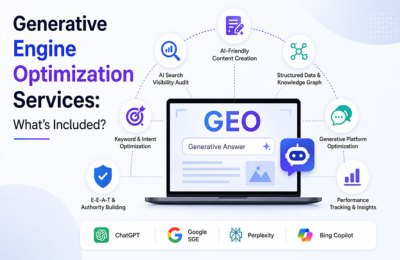
Generative engine optimization services help brands become visible inside AI-powered search engines such as ChatGPT, Gemini, and Perplexity. Instead of optimizing only for traditional rankings, GEO focuses on how AI systems interpret, structure and retrieve information. A typical GEO agency delivers services like entity engineering, schema architecture, AI retrievability testing, and performance reporting with AI-specific KPIs. These structured deliverables ensure that a brand’s content is recognized as authoritative, retrievable and trustworthy by generative engines.
What GEO Services Include
Search visibility is evolving rapidly as generative engines transform how people access information. Instead of typing a query and browsing through ten blue links, users increasingly rely on AI-generated answers that synthesize information from multiple sources.
This shift has created the need for generative engine optimization services, a specialized discipline designed to help brands appear in AI-generated responses. GEO focuses on structuring knowledge so AI models can understand entities, relationships and authority signals.
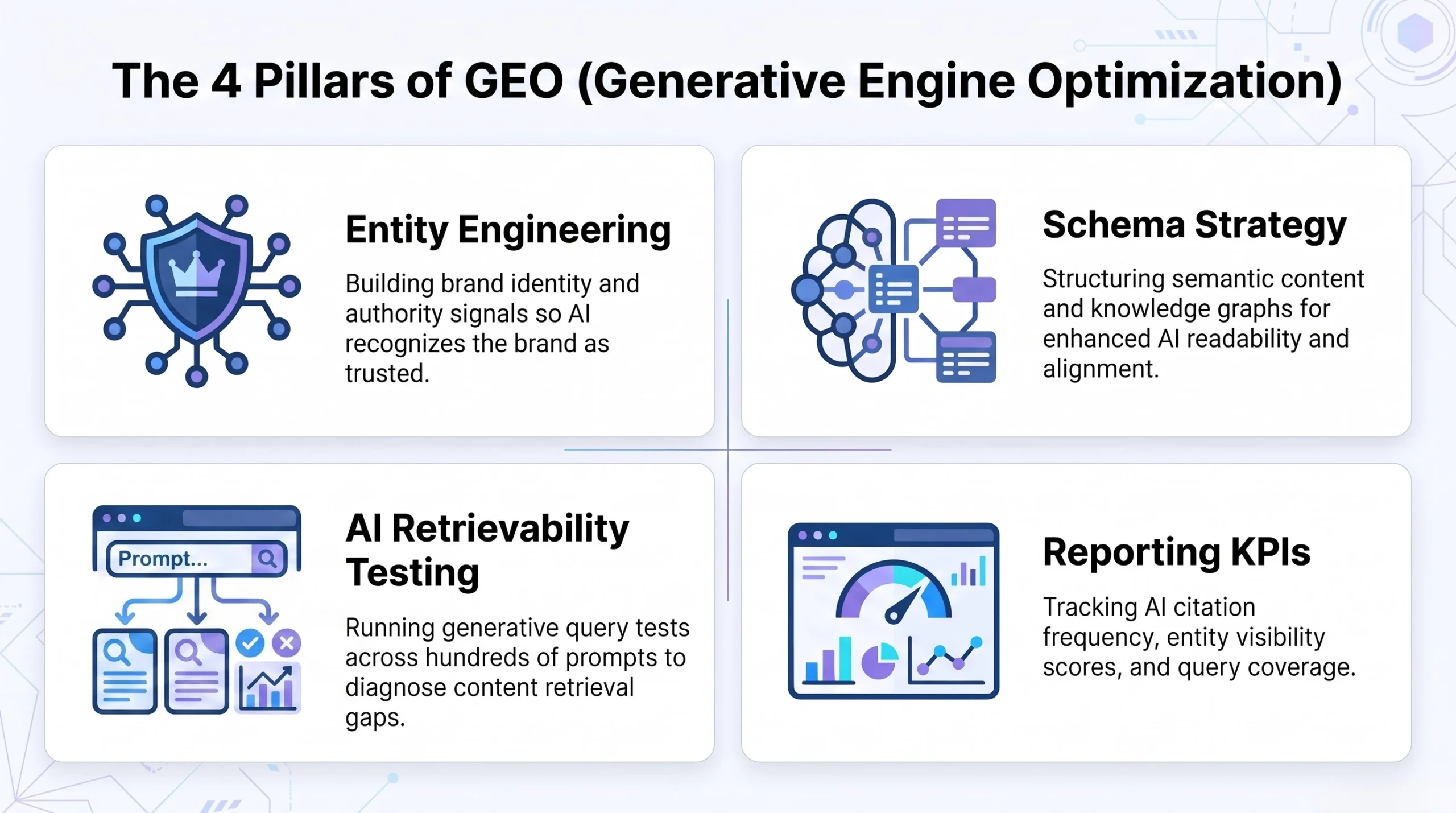
A professional GEO agency typically delivers several core components as part of its service framework. These include entity engineering, schema strategy, AI retrievability testing and detailed reporting. Each element works together to ensure that a brand’s digital presence is structured in a way that generative engines can recognize, trust, and cite.
Below is a closer look at the structured deliverables typically included in modern AI optimization services.
Entity Engineering
Entity engineering is the foundation of most generative engine optimization services. In generative search systems, entities represent identifiable concepts such as companies, people, products and topics.
Unlike traditional SEO, where keywords drive visibility, generative engines rely heavily on entity relationships. If your brand is not clearly defined as an entity within the web’s information graph, it becomes difficult for AI models to recognize it as a trusted source.
Entity engineering typically includes:
Entity Definition
A GEO agency begins by defining a brand’s core entity profile. This involves mapping the organization, services, leadership and domain expertise so that AI systems can clearly understand what the brand represents.
For example, a cybersecurity company might define entities such as:
- digital forensics
- incident response
- threat intelligence
- cybersecurity training
Each of these entities becomes part of the brand’s knowledge footprint.
Entity Relationship Mapping
AI models evaluate how entities connect across the internet. GEO services, therefore, establish relationships between:
- brand and industry topics
- brand and expertise areas
- brand and authoritative sources
This helps generative engines understand that the brand is not just publishing content but actively participating in a knowledge ecosystem.
Authority Signals
Entity engineering also includes strengthening signals that demonstrate expertise and credibility. These signals may include structured author profiles, knowledge panel alignment, and cross-platform consistency.
The result is a clearly defined digital identity that generative engines can retrieve and reference when generating answers.
Schema Strategy
Schema markup plays a critical role in generative engine optimization services because it provides machine-readable context for content.
While traditional SEO has long used structured data for rich results, generative engines rely even more heavily on structured information to interpret meaning.
A well-designed schema strategy ensures that AI systems understand the relationships between entities, topics, and content.
Content-Level Schema
Content-level schema structures individual pages so generative engines can extract clear meaning.
Common examples include:
- Article schema
- FAQ schema
- Organization schema
- Person schema
These schemas help AI systems identify authoritative explanations and factual statements within content.
Knowledge Graph Alignment
Many AI optimization services focus on aligning schema with broader knowledge graph signals. This ensures that the same entity definitions appear consistently across the website and external sources.
For instance, a company’s organization schema may include structured references to its founders, services and industry categories. These relationships reinforce the brand’s identity across generative systems.
Semantic Content Structure
Schema strategy also influences how content is structured internally. GEO agencies often redesign page frameworks so headings, FAQs, and definitions align with AI-friendly formats.
Generative engines frequently extract answers from clearly structured sections such as:
- definition paragraphs
- FAQ blocks
- step-based explanations
This structured approach increases the likelihood that content will be used as a source in AI-generated responses.
AI Retrievability Testing
Publishing optimized content does not automatically guarantee AI visibility. Generative engines continuously evaluate and synthesize information from multiple sources.
This is why generative engine optimization services include retrievability testing, an ongoing process that evaluates whether AI systems can actually discover and reference your content.
Generative Query Testing
A GEO agency tests hundreds of prompts across generative engines to evaluate whether the brand appears in AI-generated answers.
Example prompts may include:
- industry questions
- service comparisons
- educational queries
- solution-oriented prompts
If a brand’s content is structured effectively, it becomes more likely to appear in synthesized answers.
Citation Monitoring
Another important aspect of retrievability testing involves monitoring when generative engines cite or reference a brand.
This process helps identify which content pieces are being used as AI sources and which topics need stronger authority signals.
Content Retrieval Diagnostics
Testing often reveals gaps in content structure or entity clarity. GEO teams then refine the content architecture to improve retrieval probability.
For example, a page might be expanded with definitions, structured summaries, or FAQ sections to improve AI readability.
Reporting KPIs
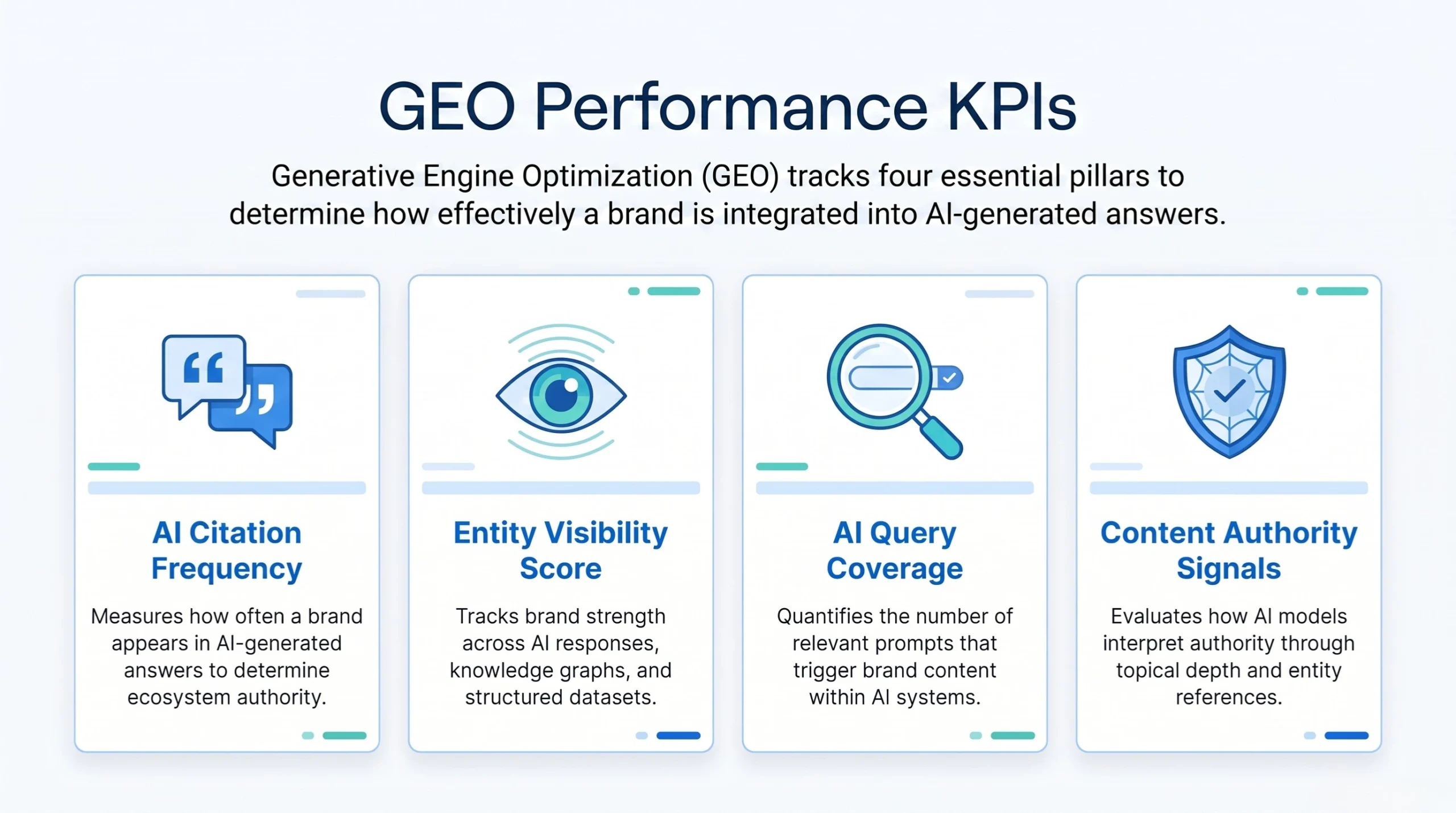
Traditional SEO reports focus on rankings, impressions, and organic traffic. However, generative engine optimization services introduce a new layer of performance metrics.
A modern GEO agency tracks AI-specific KPIs that measure visibility inside generative systems.
AI Citation Frequency
One of the most important GEO metrics is how often a brand appears in AI-generated answers. Tracking citation frequency helps measure the brand’s authority within generative search ecosystems.
Entity Visibility Score
This KPI measures how strongly a brand’s entities appear across AI responses, knowledge graphs and structured datasets.
Higher entity visibility indicates that generative engines consistently recognize the brand as a relevant authority.
AI Query Coverage
Query coverage evaluates how many relevant prompts trigger the brand’s content within AI systems.
For example, a GEO campaign may track hundreds of prompts related to a service category and measure how often the brand appears in AI-generated responses.
Content Authority Signals
Another reporting metric focuses on how AI models interpret the authority of the content. Signals such as structured citations, topical depth, and entity references contribute to this metric.
Together, these KPIs provide a clear picture of how well a brand is performing in the generative search ecosystem.
FAQs
What deliverables come with GEO?
GEO services typically cover entity engineering, schema implementation, AI retrievability testing, and AI visibility reporting. Together, these deliverables help brands get recognized and cited by AI search tools.
What does a GEO agency do?
A GEO agency organizes your brand’s content and data so AI models can easily understand it. This makes it easier for tools like ChatGPT and Gemini to pull your information into their answers.
How are AI optimization services different from SEO?
Traditional SEO chases search engine rankings, while GEO focuses on how AI systems interpret and use your content. The end goal shifts from “rank higher” to “get quoted by AI.”
Why is retrievability testing important?
Good content alone doesn’t guarantee AI visibility; it needs to actually be findable by AI systems. Retrievability testing checks this and flags where structure or clarity needs improvement.
How long does it take to see GEO results?
Most brands start noticing early signs within a few months as AI systems pick up on stronger entity and schema signals. Full results, though, build gradually as authority and citations grow over time.
Conclusion
As AI-driven search grows, visibility is no longer limited to traditional rankings. Generative engine optimization services help brands structure their content so generative engines can clearly understand and retrieve their expertise. By combining entity engineering, schema strategy, retrievability testing, and AI-focused reporting, a GEO agency ensures that businesses remain discoverable in the evolving AI search landscape.
As generative search platforms continue to expand, brands that organize their knowledge for AI interpretation gain a stronger advantage in digital visibility. Investing in structured AI optimization services today helps companies build long-term authority in the new era of AI-powered search.