

Structured data is no longer just an SEO enhancement; it is the backbone of AIO schema and AI visibility. Search engines and large language models rely on schema markup to understand entities, relationships, credibility and context. If your content is not clearly structured, AI systems struggle to interpret it accurately, reducing your chances of appearing in AI-generated answers, summaries and recommendations.
Why Schema Matters in AIO
Artificial Intelligence Optimization (AIO) shifts the goal of SEO from “ranking pages” to “being understood.” Traditional SEO focused on keywords and backlinks. AIO focuses on clarity, context and machine-readable meaning.
This is where the AIO schema becomes critical.
Schema markup for AI acts as a translation layer between your content and AI systems. It explains what your content is, who it is about and how it should be interpreted. Without structured data, AI models must infer meaning from raw text an error-prone process at scale.
From Google AI Overviews to ChatGPT-style answer generation, structured data improves:
- Content comprehension
- Entity recognition
- Trust and authority signals
- Accuracy of AI-generated responses
In short, schema is no longer optional if AI visibility is a goal.
How AI Interprets Structured Data
AI systems do not “read” pages the way humans do. They process information through patterns, labels and relationships. Structured data SEO provides those labels in a standardized format.
Schema helps AI engines:
- Identify entities (brands, people, products, services)
- Understand relationships between entities
- Distinguish facts from opinions
- Validate content against known knowledge graphs
For example, an article without a schema might mention a company name, product and author. With schema, AI clearly understands:
- This is an article
- Written by a verified author
- Published by a specific organization
- About a defined topic
This clarity improves AI understanding signals, making your content safer and easier for AI to cite, summarize, or recommend.
To understand this ranking logic deeper, reference your internal resource on how LLMs rank content.
Types of Schema Needed for AIO
AIO is not supported by a single schema type. It requires a structured ecosystem.
Core schema categories that support AI interpretation include:
- Content schema (articles, FAQs)
- Entity schema (organization, person)
- Commercial schema (products, services)
- Trust schema (publisher, author, reviews)
AI models cross-reference these signals to decide whether content is reliable enough to include in AI answers.
For a deeper breakdown, link internally to schema types AI to map schema usage across different content formats.
FAQ Schema & AI Answer Engines
The FAQ schema is one of the most powerful tools for AIO.
AI answer engines thrive on concise, structured question–answer formats. When implemented correctly, the FAQ schema:
- Highlights authoritative answers
- Reduces ambiguity
- Improves answer extraction accuracy
- Increases chances of being cited in AI-generated responses
Example of readable FAQ schema markup:
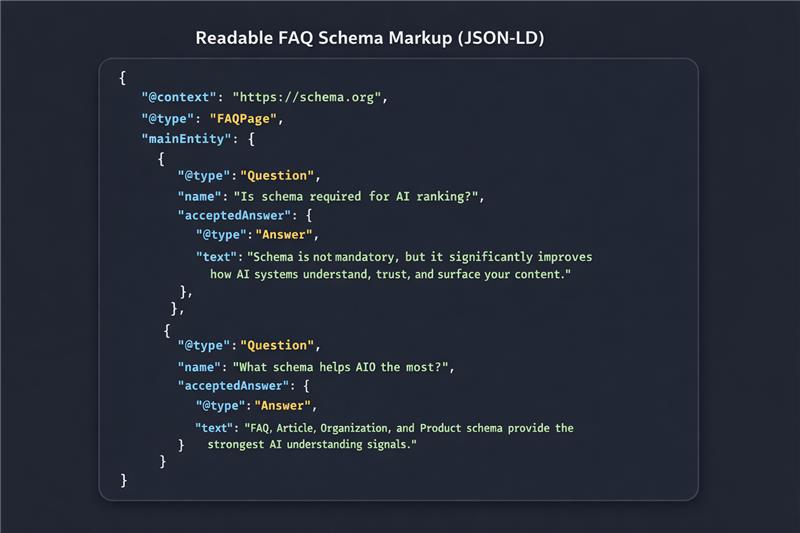
This structure tells AI systems exactly what the question is and which answer is authoritative, no guessing required.
Product, Article & Organization Schema
Different content types require different schemas to maximize AIO impact.
Article Schema
Article schema clarifies:
- Content type
- Author identity
- Publication date
- Topic relevance
This is foundational for AI summarization and citation.
Organization Schema
Organization schema establishes:
- Brand identity
- Official website
- Social proof connections
- Authority validation
AI systems use this to differentiate real brands from low-trust sources.
Product Schema
For commercial and SaaS content, the product schema explains:
- What is being offered
- Key attributes
- Pricing or availability context
- Intended audience
Together, these schemas create a clear entity graph that AI systems can confidently reference.
Use official references from Schema.org and Google Structured Data to validate implementations.
Schema Mistakes to Avoid
Even a well-intentioned schema can damage AI visibility if implemented incorrectly.
Common AIO-breaking mistakes include:
- Using irrelevant schema types
- Marking promotional content as factual
- Mismatching page content and schema
- Duplicate or conflicting schema entities
- Overloading pages with unnecessary markup
AI systems penalize inconsistency. If the schema claims something that the content does not support, trust signals drop immediately.
Accuracy matters more than volume.
Implementation Checklist
Use this checklist to align schema with AIO goals:
- Identify primary entities on the page
- Apply the correct schema type per content format
- Ensure schema content matches visible content
- Validate markup using official testing tools
- Maintain consistency across pages
- Update schema when content changes
- Avoid auto-generated or templated schema errors
Schema implementation is not a one-time task; it is part of ongoing AI optimization.
FAQs
What schema helps AIO the most?
Article, FAQ, Organization and Product schema provide the strongest AI understanding signals when implemented accurately.
Is a schema required for AI ranking?
Schema is not mandatory, but AI systems strongly prefer structured data for clarity, accuracy and trust validation.
Does schema guarantee AI visibility?
No. Schema improves interpretation, not authority. It must be combined with high-quality, credible content.
Can too much schema hurt SEO or AIO?
Yes. Excessive or irrelevant schema can confuse AI systems and reduce trust signals.