
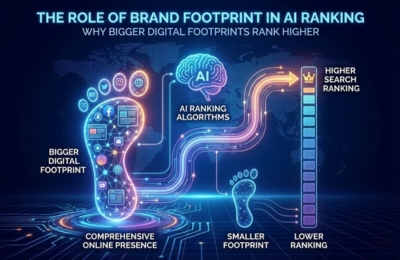
AI-powered search engines do not rank content in isolation; they evaluate brand footprint. Brands with larger, consistent, multi-platform digital footprints are easier for AI systems to recognize, trust and reuse in answers. This article explains how AI measures footprint size, why bigger brands appear more often in AI results and how SMEs can strategically expand their footprint without needing enterprise-level budgets.
Brand Footprint in AI
Search visibility has entered a new phase. Rankings are no longer determined only by keywords, backlinks, or page-level optimization. AI-powered systems, Google AI Overviews, ChatGPT, Gemini, Claude and Perplexity evaluate brands as entities, not just pages.
At the center of this shift is brand footprint AI, the cumulative digital presence a brand leaves across the web. AI systems consistently favor brands with larger, clearer and more distributed footprints because they are easier to understand, verify and recall.
This is why established brands dominate AI answers even when smaller competitors publish technically stronger content. AI does not simply ask, “Which page is best?” It asks, “Which brand is most established in this topic space?”
What is a digital footprint?
A digital footprint is the total surface area of a brand’s presence across the internet. This includes owned, earned, and referenced signals that collectively define how visible and recognizable a brand is to AI systems.
A modern digital authority footprint includes:
- Core website content and internal structure
- Brand mentions across articles, forums and communities
- Presence on platforms like LinkedIn, YouTube, Reddit and industry portals
- Consistency of brand naming, descriptions and expertise signals
- Repeated association with specific topics or problem spaces
From an AI perspective, a digital footprint is not about traffic volume alone. It is about distribution, repetition, and clarity.
Research on online presence and behavior patterns, such as findings from Pew Digital Footprint Research, consistently shows that entities with broader and more consistent digital exposure are easier for systems and people to recognize, recall, and trust.
AI models inherit the same bias.
How AI measures footprint size
AI does not calculate footprint size the way traditional SEO tools measure backlinks or domain authority. Instead, it evaluates entity density and recurrence across its training, retrieval and inference layers.
Key signals AI systems use include:
1. Entity Frequency
How often does your brand name appear across reliable sources in relevant contexts?
2. Contextual Association
How consistently your brand is associated with specific topics, industries, or problems.
3. Cross-Platform Presence
Whether your brand exists only on its website or across multiple ecosystems.
4. Semantic Reinforcement
Whether descriptions of your brand align across platforms or contradict each other.
5. Recall Confidence
How confidently can an AI describe your brand without hallucinating or hedging?
This is why AI brand size ranking often favors brands that feel “everywhere,” even if their individual pages are not always the most optimized.
AI systems are risk-averse. When uncertain, they default to entities with the largest and clearest footprints.
How to expand footprint
Expanding your footprint does not mean publishing more blog posts on your website alone. It means expanding where and how your brand exists.
Effective footprint expansion strategies include:
- Publishing insights beyond your blog (LinkedIn posts, expert commentary, Q&A platforms)
- Participating in topic-specific discussions where your audience already gathers
- Earning mentions through collaborations, interviews and thought leadership
- Repeating core brand narratives consistently across channels
This is where AIO internal linking becomes critical. Internally connected content strengthens topic ownership, while external references reinforce brand recognition beyond your site.
For SMEs, the goal is not scale for scale’s sake. It is signal amplification, ensuring AI encounters your brand repeatedly in meaningful contexts.
Multi-platform brand building
AI systems do not live inside one platform. Neither should your brand.
Multi-platform brand building creates redundant confirmation signals for AI. When the same brand narrative appears across different environments, AI confidence increases.
High-impact platforms for footprint expansion include:
- Professional networks (for expertise and authority cues)
- Video platforms (for explanatory depth and human reinforcement)
- Community-driven platforms (for real-world usage and trust signals)
- Knowledge-sharing ecosystems (for repeated citation and retrieval)
This is where AIO, AEO & GEO strategies intersect. Each platform contributes a different type of signal authority, relevance, credibility, or recall.
A brand visible only on its own website is fragile in AI systems. A brand visible across ecosystems becomes structurally embedded.
Footprint vs accuracy vs trust
A common misconception is that accuracy alone determines AI visibility. In reality, AI balances three factors:
- Footprint – How big and visible the brand is
- Accuracy – How reliable the information appears
- Trust – How safe it feels to reference the brand
Large brands sometimes rank higher despite minor inaccuracies because their footprint and trust outweigh precision. Smaller brands can still compete, but only if they compensate with consistent, repeated presence and clarity.
This does not mean accuracy is optional. It means accuracy withouta footprint often goes unnoticed.
The strongest AI-visible brands align all three:
- A large digital authority footprint
- High factual reliability
- Clear, repeatable brand positioning
FAQs
Why do big brands rank higher in AI?
Because AI systems trust entities with larger, consistent digital footprints. Big brands appear more frequently across platforms, making them easier to recognize and safer to reference.
Does traffic size matter more than brand footprint?
Traffic helps, but footprint matters more. AI prioritizes distributed presence and repeated mentions over raw visit counts.
Can small brands compete with large brands in AI ranking?
Yes. SMEs can compete by expanding their footprint strategically across platforms and reinforcing consistent expertise signals.
Is brand footprint more important than backlinks?
For AI systems, yes. Backlinks are one signal, but footprint includes mentions, context, repetition and cross-platform presence.
Conclusion
AI ranking is no longer just about content quality; it is about brand gravity. Bigger digital footprints create stronger gravitational pull inside AI systems.
For SMEs, this shift is not a disadvantage. It is an opportunity. Footprints can be engineered intentionally through multi-platform presence, consistent messaging, and strategic visibility.
Brands that understand this early will not just rank better. They will become the default answers AI systems rely on.