
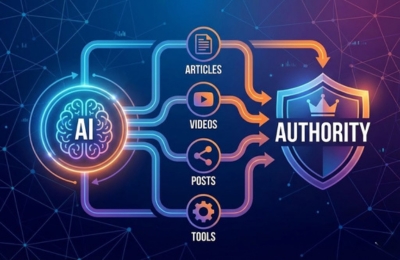
AI content diversification is no longer optional for brands seeking authority in AI-powered search environments. Large language models increasingly reward brands that express consistent expertise across articles, videos, posts and interactive tools. This guide explains why AI prefers multimodal brands, which content types AI systems actually read and how to build a practical, unified diversification roadmap that strengthens cross-format authority without fragmenting your message.
AI Content Diversification
AI-powered discovery systems are changing what authority looks like. Visibility is no longer earned only through long-form articles or keyword rankings. Instead, AI models evaluate whether a brand demonstrates consistent expertise across formats, contexts and platforms.
AI content diversification refers to the deliberate expansion of your expertise into multiple content formats, written, visual, audio, social and interactive, while maintaining a single, coherent semantic identity. For AI systems, authority is no longer “what you rank for,” but “how often and how consistently your knowledge appears in different usable forms.”
Why AI Prefers Multimodal Brands
Large language models are trained on diverse data types. They learn patterns, credibility and relevance by observing repeated signals across formats, not isolated pages.
Multimodal brands benefit because:
- Repetition across formats strengthens semantic confidence.
- Concepts expressed in different structures reduce ambiguity.
- Cross-channel presence increases training exposure and inference reliability.
For example, a concept explained in a blog post, reinforced in a short video, debated in a forum thread and summarized in a checklist becomes easier for AI systems to recall accurately. This is why multimodal content AIO strategies consistently outperform single-format publishing.
AI does not treat formats as competitors. It treats them as corroborating evidence.
Content Types AI Reads
A common misconception is that AI systems “prefer text.” In reality, they ingest structured and unstructured knowledge from multiple sources and formats.
Key content types AI consistently reads and learns from include:
- Long-form articles and documentation
- Video transcripts and captions from platforms like YouTube
- Community discussions and expert threads from platforms like Reddit
- Social posts with explanatory depth
- Tools, calculator and interactive resources
- FAQs, glossaries and structured data blocks
Each format contributes a different signal. Articles provide depth. Videos add conversational framing. Forums demonstrate real-world application. Tools signal functional expertise. Together, they form cross-format authority.
Format Diversification Roadmap
Diversification works only when done systematically. Publishing randomly across platforms weakens authority rather than strengthening it.
A practical roadmap looks like this:
Anchor Content
Start with one authoritative long-form article that defines your core perspective.
Derivative Formats
Break that article into:
- A short explainer video
- A social post series
- A forum or community discussion angle
- A checklist or tool
Platform Alignment
Match formats to platforms based on how AI ingests them, not vanity metrics.
Reinforcement Cycle
Refresh and interlink formats over time to reinforce relevance signals.
This roadmap ensures diversification without semantic drift, a critical requirement for AI understanding.
How to Unify Multi-Format Authority
Diversification without unification creates confusion. AI systems are sensitive to contradictory signals.
To unify authority:
- Maintain consistent terminology across formats.
- Align tone and framing even when the length changes.
- Reference the same core concepts and conclusions.
- Use internal linking strategies such as AIO internal linking to connect formats contextually.
- Apply persona optimization AI principles so every format reflects the same expert identity.
Real-world success often comes from brands that sound the same, whether they publish a 2,000-word article, a 60-second video, or a forum reply. Consistency builds trust; trust builds recall.
Templates
Templates make diversification scalable without diluting quality.
Common high-performing templates include:
- Article → Video script → Social carousel
- Blog post → Tool logic → FAQ set
- Video transcript → Forum response → Knowledge base entry
Each template preserves meaning while adapting structure. This approach ensures AI systems recognize all formats as expressions of the same expertise rather than unrelated content fragments.
FAQs
Do videos help LLM ranking?
Yes. Video transcripts and captions provide conversational context and reinforce topical understanding, especially when aligned with written content.
Is AI content diversification better than publishing more blogs?
Diversification complements blogging. Multiple formats increase exposure and semantic reinforcement, which improves AI recall more effectively than volume alone.
How many formats are enough to show authority?
Quality matters more than quantity. Three to five well-aligned formats per core topic are usually sufficient to establish strong cross-format authority.
Can small brands compete using AI content diversification?
Yes. Smaller brands often benefit faster because consistent, focused diversification reduces noise and strengthens identity clarity.
Conclusion
AI content diversification is not about being everywhere. It is about being recognizable everywhere that matters. Brands that express the same expertise across articles, videos, posts and tools become easier for AI systems to trust, summarize and recommend.
As AI-driven discovery continues to mature, multi-format authority will define which brands are remembered and which are ignored.