
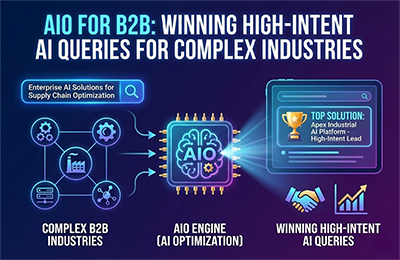
AIO for B2B is not about chasing keywords; It’s about influencing how AI systems understand, trust and recommend enterprise solutions during long, multi-stakeholder buying cycles.
By aligning expertise-heavy content, authority signals, schema and multi-touch journeys, B2B brands can win high-intent AI queries across ChatGPT, Gemini and other generative engines.
AIO for B2B
Artificial Intelligence Optimization (AIO) is rapidly becoming a competitive necessity for B2B organizations operating in complex, high-consideration industries. As AI-powered search engines and large language models (LLMs) reshape how information is discovered, summarized and recommended, traditional B2B SEO alone is no longer sufficient.
In B2B, buying decisions are rarely impulsive. They involve multiple stakeholders, long research cycles and a heavy reliance on expert validation. AIO for B2B focuses on ensuring your brand, expertise and solutions are consistently surfaced when AI systems answer high-intent, research-driven queries, often before a buyer ever visits your website.
How B2B Buyers Use AI Search
B2B buyers are increasingly using AI tools as research accelerators rather than simple search replacements. Instead of scanning dozens of vendor websites, they rely on AI to synthesize complex information into concise, decision-ready insights.
Typical B2B AI-driven queries include:
- “Best enterprise AI optimization platforms for regulated industries”
- “How do large enterprises approach generative research?”
- “Top B2B SEO frameworks for long sales cycles”
According to insights shared by Gartner, a majority of B2B buyers now complete a significant portion of their research digitally before engaging with sales. AI search compresses this journey even further by acting as an early-stage advisor.
For B2B brands, this means visibility must exist inside AI-generated answers, not just on page one of Google.
Ranking Factors for B2B AI Results
AI ranking systems evaluate B2B content differently from traditional search algorithms. While keywords still matter, AI models place greater emphasis on credibility, consistency and contextual relevance.
Key ranking factors include:
- Entity authority: How well your brand is understood as a subject-matter expert
- Topical depth: Coverage across strategic, technical and operational dimensions
- Source reliability: Consistency across owned content, third-party mentions and citations
- Intent alignment: Matching complex, research-heavy B2B queries with nuanced answers
- Structured clarity: Content that is easy for AI to parse and summarize
Unlike transactional B2C searches, enterprise AI optimization favors depth over speed and explanation over promotion.
Expertise-Heavy Content Clusters
One-off blog posts rarely perform well in B2B AI search environments. Instead, AI systems prefer interconnected content ecosystems that demonstrate sustained expertise.
An effective AIO for a B2B strategy builds:
- Pillar pages addressing core industry problems
- Supporting articles exploring use cases, frameworks and methodologies
- Thought leadership content explaining strategic implications
- Educational resources aligned with generative research behavior
For example, a company offering enterprise AI optimization services should not only explain what the service is, but also how it impacts governance, scalability, compliance and ROI across departments.
This cluster-based approach reinforces semantic authority and increases the likelihood that AI models reference your brand when answering complex questions.
Case Studies & Authority Signals
B2B AI systems rely heavily on proof signals. Claims without validation are often ignored or deprioritized in generative responses.
Authority signals that strengthen AIO performance include:
- Detailed case studies showing measurable outcomes
- Industry-specific examples rather than generic success stories
- Consistent brand mentions across trusted publications
- Executive bylines and expert commentary
- Clear articulation of methodologies and frameworks
Case studies act as trust anchors for AI models, helping them associate your brand with real-world results rather than abstract promises. This is especially critical in high-stakes industries such as enterprise software, cybersecurity and regulated services.
Schema for B2B
Structured data plays a foundational role in helping AI systems understand B2B content accurately. While a schema alone does not guarantee visibility, it significantly improves interpretability.
For B2B AIO, schema helps:
- Define organizational expertise and services
- Clarify relationships between solutions, industries and use cases
- Surface FAQs and key explanations in AI-generated answers
- Improve eligibility for rich results and summaries
Applying BlogPosting and FAQPage schema ensures your insights are not only readable by humans but also machine-readable for generative engines analyzing enterprise-level queries.
Multi-Touch AIO Model
B2B buying journeys are rarely linear and AIO strategies must reflect that complexity. A multi-touch AIO model recognizes that AI exposure happens at multiple stages, not just at the point of conversion.
This model includes:
- Early-stage educational visibility in AI research queries
- Mid-funnel validation through comparisons, frameworks and expert insights
- Late-stage reinforcement via case studies and authority signals
When combined with services like internal AIO packages and Generative Engine Optimization, this approach ensures your brand remains present throughout the entire AI-influenced decision cycle.
Rather than optimizing for a single answer, B2B AIO optimizes for sustained influence.
Conclusion
AIO for B2B represents a strategic shift in how enterprise brands approach visibility, authority and demand generation. As AI becomes a primary research interface for decision-makers, the brands that win are those that invest in depth, credibility and structure, not shortcuts.
By aligning expertise-heavy content clusters, authority signals, schema and a multi-touch engagement model, B2B organizations can position themselves as trusted answers in AI-driven search ecosystems. The result is not just traffic, but influence where it matters most.
FAQs
How can B2B companies rank in AI search results?
B2B companies rank in AI results by building topical authority, publishing expertise-driven content clusters, applying structured data and reinforcing trust through case studies and consistent brand mentions.
Does AIO help B2B businesses with long sales cycles?
Yes. AIO supports B2B sales cycles by influencing early research, mid-funnel validation and late-stage decision-making within AI-generated answers.
Is AIO different from traditional B2B SEO?
AIO goes beyond traditional SEO by optimizing for how AI systems interpret, summarize and recommend content, especially for complex, research-heavy queries.
What type of content performs best for B2B AIO?
Content that demonstrates depth, expertise and real-world outcomes, such as frameworks, case studies and thought leadership, performs best in B2B AIO.