
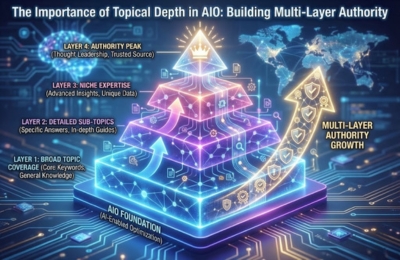
Topical depth is the foundation of visibility in AI-powered search. Instead of ranking single pages, AI systems evaluate how deeply and consistently your brand covers an entire subject. By structuring content into layered topic clusters and authority tiers, you increase reuse inside AI answers, improve trust signals and build long-term dominance across Google AI Overviews and LLM platforms.
Topical Depth & AI
Topical depth is no longer a “nice-to-have” in modern SEO. In an AI-first search environment, it is a core ranking and reuse signal. Large Language Models (LLMs) do not reward isolated content. They reward comprehensive subject mastery.
In topical depth AIO, authority is established when AI systems can clearly see:
- What topic do you own
- How deeply you cover it
- Whether your explanations remain consistent across multiple layers
Instead of asking “Does this page rank?”, AI systems ask:
“Is this brand a reliable source on this subject?”
That shift changes everything about how content must be planned, structured and scaled.
Why AIO Requires Deep Topic Coverage
Traditional SEO allowed websites to rank with thin or narrowly focused pages. AIO does not. AI systems synthesize answers by pulling from multiple documents, entities and perspectives.
Deep topic coverage matters because LLMs:
- Cross-validate facts across related pages
- Compare definitions, frameworks and examples
- Detect topical gaps and inconsistencies
- Prioritize sources that explain concepts holistically
When a site publishes only one or two articles on a subject, AI treats it as surface-level knowledge. When a site publishes structured clusters with depth, AI interprets it as domain authority.
This is why topic clusters AI strategies consistently outperform isolated keyword targeting. Depth increases:
- AI trust
- Answer reuse
- Visibility inside generative responses
- Long-term ranking stability
In AIO, authority is cumulative, not page-by-page.
Layers of Topical Authority
To build topical depth correctly, AIO uses a 3-tier pyramid model. Each layer serves a distinct role in AI interpretation.
Tier 1: Core Topic Authority
This is the foundational layer. It defines the main concept clearly and comprehensively.
Examples of Tier 1 signals:
- A definitive guide or pillar page
- Clear terminology and definitions
- Consistent language across sections
This layer answers: “What is this topic?”
Tier 2: Subtopic Expansion
This layer breaks the core concept into logical components and variations.
Examples:
- Comparisons
- Frameworks
- Use cases
- Process explanations
This is where authority stacking begins. AI sees not just understanding, but depth of explanation.
This layer answers: “How does this topic work?”
Tier 3: Applied & Contextual Depth
The final layer proves real-world understanding.
Examples:
- Industry-specific interpretations
- Strategic applications
- Advanced scenarios and edge cases
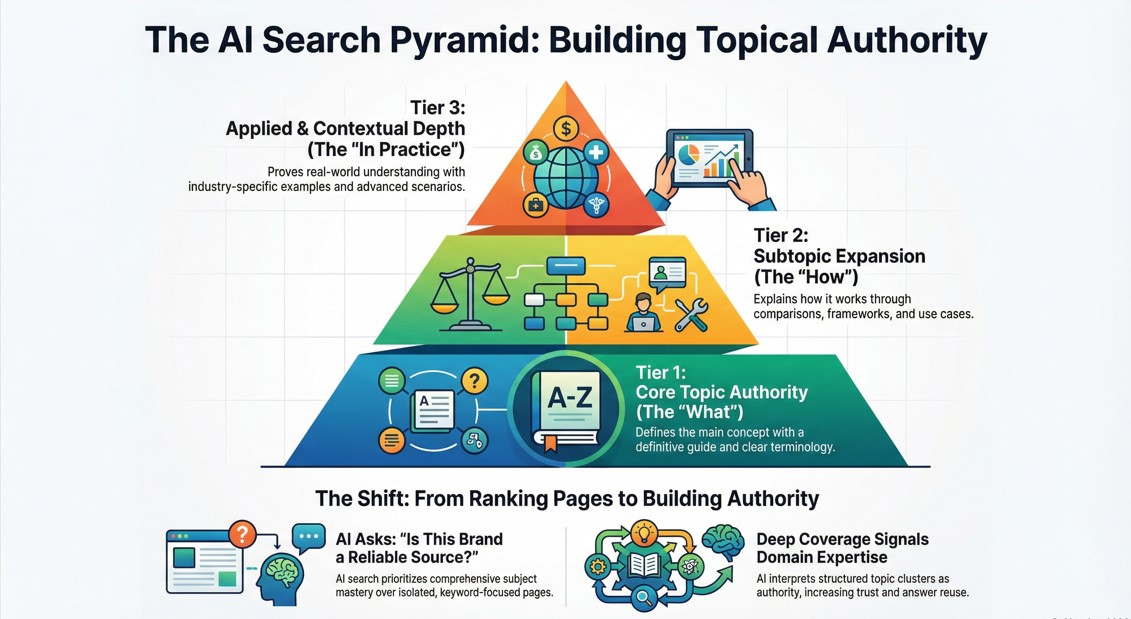 This layer answers: “How is this topic applied in practice?”
When all three layers exist, AI systems confidently classify your brand as a subject-matter authority rather than a content publisher.
Creating a Multi-Cluster AIO Plan
A successful AIO content model does not start with keywords. It starts with topic mapping.
A multi-cluster plan typically includes:
- One primary topic hub
- Multiple supporting clusters
- Interlinked subtopics across layers
Each cluster reinforces the others. This structure allows AI to:
- Understand topic relationships
- Detect expertise continuity
- Reuse your explanations across multiple prompts
This is where AIO content models differ from traditional content calendars. The goal is not volume; it is coverage density.
Strategically, this also strengthens internal frameworks like entity SEO, helping AI associate your brand with specific concepts rather than just pages.
Topic Gap Analysis
Topic gap analysis in AIO is not about missing keywords; it is about missing meaning.
Effective gap analysis focuses on:
- Missing sub-concepts
- Unexplained transitions between ideas
- Shallow explanations of complex topics
- Lack of applied examples
AI models identify gaps by comparing your coverage against:
- Known topic structures
- Common question patterns
- Industry-level explanations
If your content explains what but not why, or why but not how, AI reduces trust.
This is also where understanding AIO vs GEO becomes critical. GEO prioritizes idea reuse, while AIO prioritizes structural completeness. Without topical depth, neither performs optimally.
Industry Examples
High-performing digital products and platforms consistently demonstrate deep topic layering in their content ecosystems.
Research-driven UX and content organizations often structure knowledge bases around:
- Foundational principles
- Behavioral models
- Applied frameworks
For example, usability research platforms aligned with NNGroup organize their content to guide readers from theory to application. This layered structure mirrors how AI evaluates authority progressive, contextual and consistent.
The lesson is simple: depth signals expertise faster than volume.
FAQs
How many blogs do I need for topical depth?
There is no fixed number. Topical depth depends on coverage completeness, not post count. Some topics require 10 pieces; others require 50+. AI evaluates structure, not quantity.
Does content depth matter more than backlinks in AIO?
In AIO, depth and consistency often outweigh the importance of backlinks. AI prioritizes trustworthy explanations over external validation when generating answers.
Can one long guide replace multiple cluster articles?
No. AI prefers distributed understanding across multiple focused pages rather than a single oversized document.
How long does it take to build topical authority?
Most sites begin seeing AI recognition within 3–6 months if clusters are structured correctly and published consistently.