
AI-powered search engines such as Google’s AI Overviews and generative answer platforms are transforming how information is discovered. Traditional ranking-based SEO is no longer enough for large organizations managing complex digital ecosystems.
Enterprises must adopt enterprise AI SEO frameworks that combine structured content, entity clarity, governance systems and enterprise GEO strategy to ensure their information is retrievable across multiple AI models. Organizations that fail to adapt risk losing visibility, brand authority, and demand capture in an AI-dominated search landscape.
Enterprise SEO In The AI Era
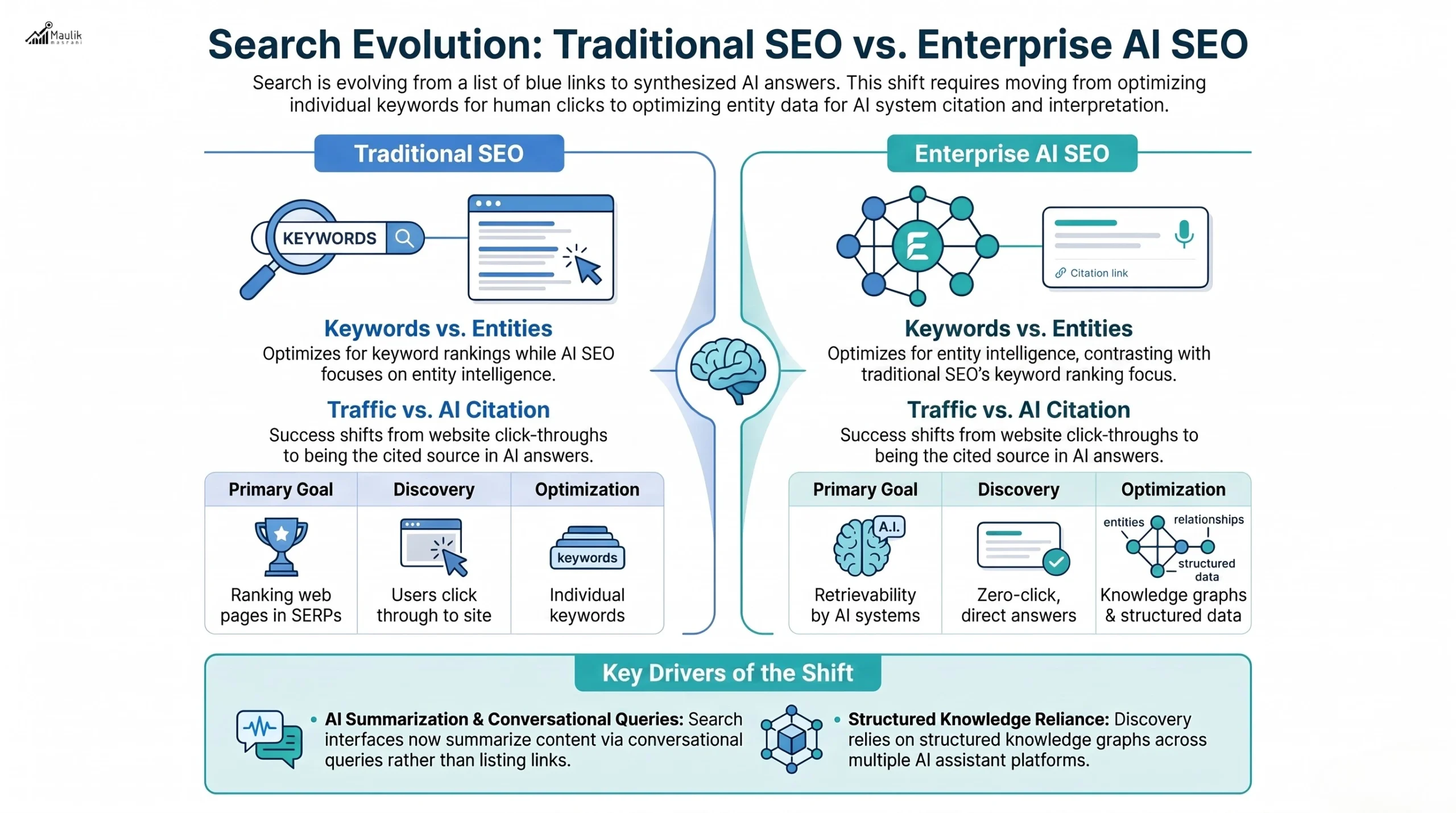
Enterprise search optimization has entered a new phase. For more than two decades, SEO has primarily focused on ranking web pages in search engine results pages (SERPs). Today, AI systems increasingly summarize, synthesize, and deliver information directly to users.
Instead of ten blue links, users often see AI-generated answers that pull information from multiple sources. These answers are constructed using structured data, entity relationships and trusted knowledge sources.
For large organizations with thousands of pages, multiple business units and international audiences, this shift changes the entire visibility equation.
This is where enterprise AI SEO becomes essential.
Enterprise AI SEO focuses on ensuring that company knowledge can be retrieved, interpreted, and cited by AI systems. It combines traditional SEO with structured information architecture, semantic content engineering, and cross-platform discoverability.
Several trends are driving this transformation:
- AI search interfaces summarize information instead of listing links
- Increased reliance on structured knowledge graphs
- Conversational search queries replacing keyword-based queries
- Multi-platform discovery across AI assistants, search engines, and recommendation systems
Large enterprises that adapt their content architecture to AI retrieval systems can maintain authority and brand presence in these evolving environments.
Risk Of Ignoring AI Search
Ignoring AI search is not just a technical oversight; it is a strategic risk.
Enterprises that continue relying solely on traditional SEO may notice a gradual decline in visibility even if their rankings remain stable. This happens because AI search often provides answers without requiring users to click through to websites.
This phenomenon is commonly referred to as zero-click discovery.
When AI systems synthesize answers from multiple sources, brands that are not structured properly may not be included in those responses.
Several risks emerge for organizations that fail to adopt enterprise AI SEO practices.
Loss of Brand Visibility
AI-generated responses frequently cite authoritative sources. If an enterprise’s content lacks clear entity definitions, structured schema, or authoritative topical coverage, AI models may bypass it entirely.
Decreased Demand Capture
Users increasingly ask AI tools complex questions, such as:
- “What is the best enterprise AI strategy for SEO?”
- “How should large companies adapt to AI search?”
If the organization’s content cannot be retrieved by these systems, competitors may dominate the conversation.
Fragmented Knowledge Across Teams
Enterprises often produce content across departments, marketing, product teams, support documentation, and research divisions. Without governance, AI systems struggle to interpret this fragmented knowledge.
Competitive Displacement
Companies that implement an enterprise GEO strategy early can position their data and expertise as authoritative sources across multiple AI models.
This creates a compounding advantage.
As AI systems repeatedly reference these sources, they strengthen the organization’s digital authority.
Governance & Dashboards
Adapting enterprise SEO to AI search requires governance frameworks, not just tactical optimization.
In large organizations, visibility is often determined by coordination across teams rather than individual pages.
This is where governance and analytics dashboards become essential.
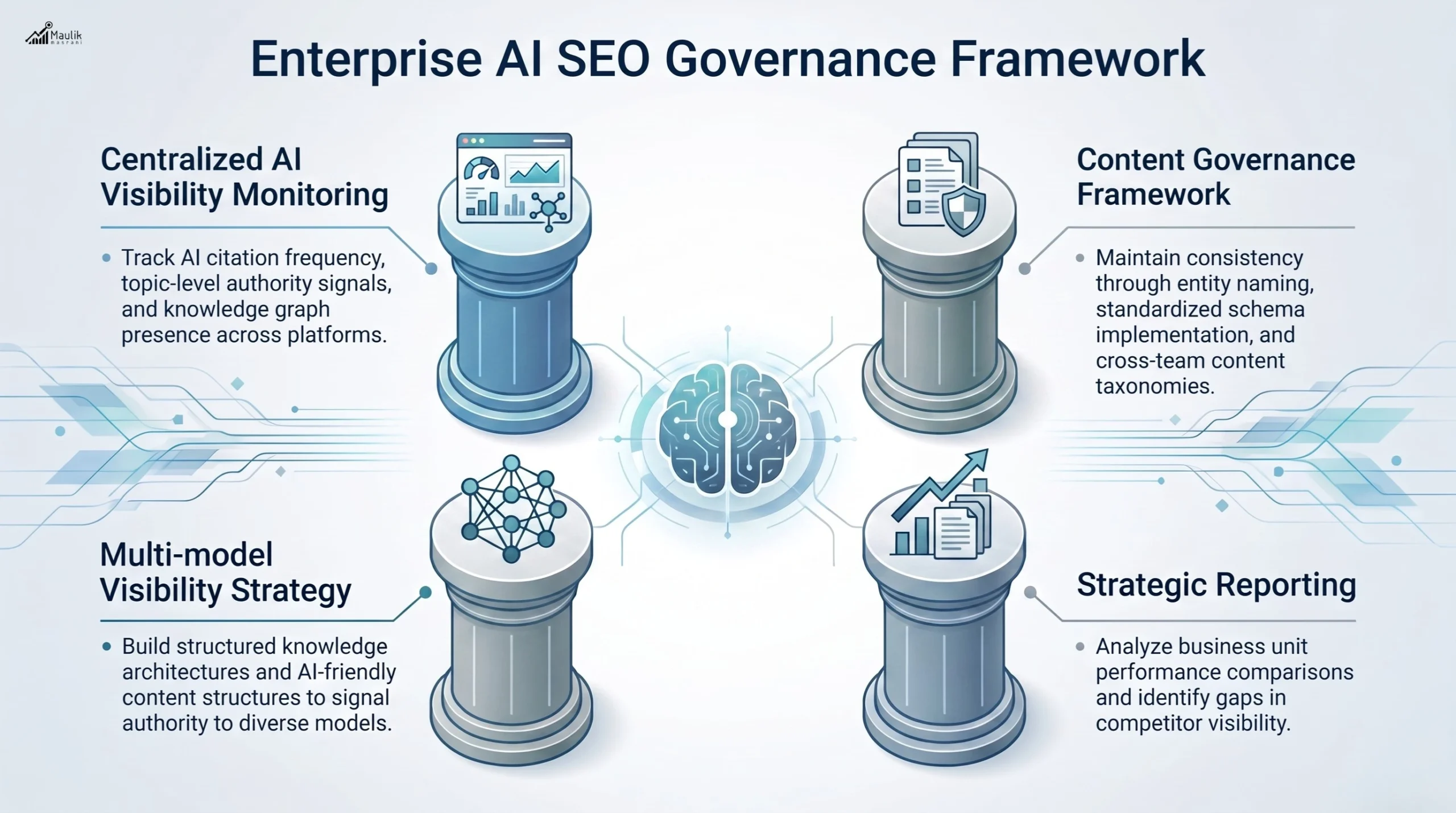
Centralized AI Visibility Monitoring
Executives need clear dashboards showing how their organization appears in AI-generated answers.
Key metrics may include:
- AI citation frequency across platforms
- Topic-level authority signals
- Knowledge graph presence
- Structured data coverage across domains
These insights help organizations identify where they are visible and where competitors dominate.
Content Governance Framework
Enterprise teams must align around shared content standards.
This includes:
- consistent entity naming
- structured definitions of products and services
- standardized schema implementation
- cross-team content taxonomy
Without governance, enterprise content becomes inconsistent, reducing its retrievability by AI systems.
Strategic Reporting
For executive leadership, dashboards should translate technical signals into strategic insights.
Examples include:
- Which topics are AI systems referencing our brand for?
- Which business units generate the highest AI citations?
- Where are competitors gaining visibility?
These reports enable decision-makers to allocate resources toward high-impact content initiatives.
Multi-Model Visibility Strategy
AI search is no longer limited to one platform.
Users now interact with multiple AI systems to discover information.
Examples include conversational assistants, generative search interfaces and specialized knowledge engines.
Because of this, organizations must build a multi-model visibility strategy.
This is where enterprise GEO strategy becomes critical.
GEO (Generative Engine Optimization) focuses on ensuring information can be retrieved across multiple AI environments rather than a single search engine.
Structured Knowledge Architecture
Enterprises must treat their content ecosystem as a knowledge base rather than a collection of pages.
This means:
- organizing information around entities
- building clear topical relationships
- ensuring definitions and explanations are easily extractable
AI-Friendly Content Structure
AI systems prefer content that is clear, well-structured and factual.
Effective enterprise content typically includes:
- concise explanations
- hierarchical headings
- well-defined concepts
- credible references
This structure increases the likelihood of inclusion in AI responses.
Cross-Platform Content Signals
A multi-model strategy also considers signals beyond a company website.
These may include:
- authoritative publications
- expert commentary
- structured knowledge sources
When multiple sources reinforce the same information, AI models are more likely to treat the organization as an authoritative reference.
FAQs
Why must Enterprises Adapt to AI search?
AI search engines increasingly generate answers instead of listing websites. Enterprises must adopt enterprise AI SEO strategies to ensure their knowledge can be retrieved, interpreted and cited by AI systems.
What is Enterprise AI SEO?
Enterprise AI SEO is an advanced search optimization framework that focuses on making organizational knowledge accessible to AI-driven search engines. It combines structured content, entity optimization and multi-platform discoverability.
What is an Enterprise GEO strategy?
An enterprise GEO strategy focuses on optimizing content for generative AI systems rather than traditional ranking algorithms. It ensures visibility across multiple AI models and conversational search platforms.
How can Enterprises measure AI Search Visibility?
Organizations can monitor AI visibility using dashboards that track citation frequency, entity presence, structured data coverage and topic authority across AI search platforms.
What happens if Enterprises ignore AI Search Trends?
Companies that ignore AI search risk losing visibility, authority and customer discovery as AI systems increasingly become the primary interface for information retrieval.
Conclusion
AI search is fundamentally redefining digital visibility. Enterprises can no longer rely solely on traditional ranking strategies to maintain market presence. Instead, they must design their content ecosystems for AI retrieval, structured knowledge representation and cross-platform discoverability.
Organizations that invest in enterprise AI SEO and implement a strong enterprise GEO strategy will position themselves as authoritative sources within AI-driven information systems. Those who delay this transition risk becoming invisible in a search landscape increasingly shaped by intelligent machines.