
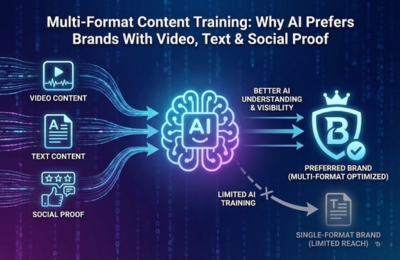
AI systems do not learn from blogs alone. Modern large language models are trained on video transcripts, captions, social content, reviews and structured text together. Brands that publish consistently across formats create stronger signals of authority, context and trust, making them more likely to be referenced, summarized and surfaced by AI-powered search engines.
Multi-Format Content & AI
Multi-format AI training refers to how AI systems learn brand authority from a combination of text, video, social content and engagement signals, not from a single content type. Unlike traditional SEO, where ranking was page-centric, AI-driven discovery evaluates cross-format consistency to decide which brands are reliable enough to reuse in generated answers.
Large language models operate in a multimodal environment. They connect written explanations with spoken language, visual context, user reactions and repetition across platforms. Brands that limit themselves to blog-only publishing are increasingly invisible inside AI-generated answers.
This shift explains why brands with YouTube channels, long-form blogs and active social profiles are disproportionately referenced in AI summaries even when their websites are not the most backlink-heavy.
Why AI Prefers Multimodal Content
AI systems are trained to reduce uncertainty. When the same brand message appears across multiple formats, the model gains confidence in its accuracy and relevance.
Multimodal signals help AI answer three core questions:
- Is this brand real and active?
- Does this brand explain the topic consistently?
- Do users engage with this brand across environments?
For example, a written article explains a concept structurally, while a video provides conversational clarity. Social posts add contextual reinforcement and comments or shares act as validation signals.
Research from Google’s multimodal systems shows that combining language, vision and audio improves comprehension accuracy across AI models. This is why AI systems do not treat text, video and social media as separate channels; they are merged during interpretation.
Multimedia content AIO works because it mirrors how humans learn: reading, watching, listening and validating through peers.
Types of Formats LLMs Use (Video, Blogs, Social Posts)
Large language models rely on different content formats for different layers of understanding.
- Text content provides definitions, structure and factual grounding. Blogs, guides, FAQs and documentation help AI extract clear explanations and reusable phrasing.
- Video content adds contextual richness. Transcripts, captions, and descriptions help AI understand tone, emphasis and real-world application. A brand that explains a topic on YouTube reinforces its written authority through spoken language.
- Social content adds frequency and sentiment. Short-form posts, replies and discussions show how a brand engages with real users. These interactions act as credibility signals rather than ranking signals.
A practical example: YouTube captions help AI understand brands not just by what they say, but how they explain topics repeatedly. When a concept appears in blog text, video transcripts and social snippets together, it becomes a stable training reference.
This is the foundation of cross-format authority.
How Brands Can Diversify Formats
Diversifying formats does not require publishing everywhere at once. The goal is alignment, not volume.
Brands can start by converting one core idea into multiple expressions:
- A long-form blog becomes a video script.
- Video captions become short social posts.
- Social discussions inform FAQ sections.
- FAQs reinforce blog clarity.
This creates a loop where each format strengthens the others. Over time, AI systems learn the brand’s topical identity through repetition across environments.
From an AIO consultant perspective, the strongest brands do not chase platforms they standardize explanations across formats. This consistency allows LLMs to confidently summarize the brand without hallucination or distortion.
For brands pursuing multi-format AI training, the key is message alignment, not content duplication.
Impact on AIO & GEO
Artificial Intelligence Optimization (AIO) and Generative Engine Optimization (GEO) depend heavily on how AI models select source material during answer generation.
When a brand appears across formats:
- AIO improves because AI systems detect stable, repeatable explanations.
- GEO strengthens because generative engines prefer brands with cross-context validation.
- AEO benefits because consistent phrasing improves answer extraction.
- Entity recognition improves as brand-topic associations repeat.
Multimodal presence also reduces AI error risk. When text, video and social content agree, models are less likely to misquote or misrepresent the brand.
This is why brands with diversified content footprints dominate AI summaries even without aggressive link-building.
Checklist
Use this checklist to align your content strategy with AI learning behavior:
- Publish structured blog content with clear definitions.
- Add video explanations with accurate captions and descriptions.
- Repurpose key insights into social posts consistently.
- Maintain message consistency across all formats.
- Reinforce FAQs using real audience questions.
- Track brand mentions across platforms, not just rankings.
- Align content updates across formats when messaging changes.
This checklist supports both LLM multimodal signals and long-term authority building.
FAQ
Do videos help AI ranking?
Yes. Videos help AI understand concepts through transcripts, captions and contextual language. They reinforce written content and improve brand confidence signals.
How does multimodal AI work?
Multimodal AI combines text, audio and visual data into a single understanding layer. It learns from how information appears across formats rather than isolating one source.
Is text still important for AI visibility?
Absolutely. Text provides structure and definitions. Multimodal strategies enhance text; they do not replace it.
How many formats does a brand need?
At minimum, brands should combine structured text with one additional format, such as video or social content, to establish cross-format authority.