
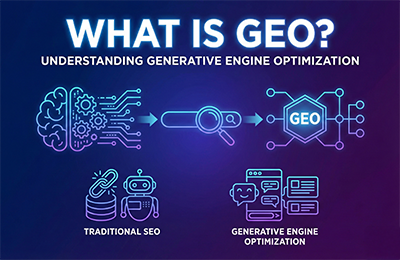
Generative Engine Optimization (GEO) is the new discipline of optimizing your content so generative engines like ChatGPT, Gemini, Claude and Perplexity reuse your ideas inside their answers.
Unlike traditional SEO, which focuses on ranking on Google SERPs, GEO focuses on visibility inside AI-generated output. Businesses, especially B2B, ecommerce and SaaS, must understand how generative search works, how LLMs select and prioritize information and how to shape content formats that AI systems prefer.
GEO requires clean definitions, reusable frameworks, authority signals, entity alignment and structured content. This guide explains how GEO works, who needs it most and how to implement GEO today.
What Is GEO?
Generative Engine Optimization (GEO) is the practice of structuring your content so generative AI systems can easily detect, interpret and reuse your insights when producing answers.
As platforms like ChatGPT, Gemini, Claude and Perplexity become primary discovery channels, GEO ensures your brand appears not as a link, but as part of the answer.
If SEO helped you win search rankings, GEO helps you win AI rankings. The new layer of visibility inside generative search ecosystems.
Generative engines evaluate content not only for relevance but for clarity, structure, factual reliability and conceptual transferability.
Brands that publish frameworks, templates, definitions and structured insights are significantly more likely to be cited or referenced by AI models.
Why Generative Engines Matter
Generative engines are no longer side tools, they are becoming primary search interfaces. More than 60% of marketing teams now use LLMs weekly for research, ideation or competitive intelligence.
Consumers increasingly ask AI systems for product recommendations, comparisons and buying advice.
In this shift:
- Search results become answers, not hyperlinks.
- Brands compete for visibility inside AI responses.
- Content must be formatted for LLM comprehension and retrieval.
Generative engines matter because they sit between your business and the user’s decision-making moment. Whether someone is looking for a SaaS tool, comparing ecommerce products, or researching B2B providers, AI engines arbitrate what insights surface.
GEO closes the gap between your expertise and AI’s ability to interpret and reuse it.
How Generative AI Produces Answers
Generative AI platforms don’t index content the same way Google does. Instead, they rely on:
- Pre-training on public datasets
- Retrieval from real-time search
- Re-ranking using semantic relevance
- Verification using authority signals
- Answer assembly using internal reasoning patterns
When an LLM creates a response, it draws on structures it understands and recombines. This is why GEO focuses on shaping content in formats AI can reliably interpret like clear definitions, step-by-step logic, entity-rich writing and repeatable frameworks.
Ranking Inputs (Authority, Sentiment, Entity Match)
Generative engines weigh several inputs before inserting your content into an answer:
1. Authority Signals
LLMs evaluate whether your content appears trustworthy based on:
- Brand mentions
- Expert-style writing
- Consistency across platforms
- External references
- Topical specialization
This is similar to SEO authority but applied to LLM contexts.
2. Sentiment Profiles
Generative engines avoid recommending brands with:
- Negative sentiment
- Reputation issues
- Conflicting reviews
This makes Online Reputation Management (ORM) more strategically important in the GEO era.
3. Entity Match & Clarity
LLMs rely heavily on entity recognition of names, industries, product types, categories, problems and outcomes.
Clear, precise entity usage dramatically increases the likelihood of being reused in generative answers.
Example:
“Email marketing software for SaaS teams” is more reusable than
“Solutions that help teams grow with email.”
Generative engines need definable entities, not vague phrasing.
GEO vs SEO
While SEO and GEO are related, they work in different ways.
|
SEO |
GEO |
|
Optimizes for Google SERP rankings |
Optimizes for AI-generated answers |
|
Keyword-driven |
Entity-driven |
|
Backlinks are major signals |
Authority + clarity + structure |
|
Success = clicks |
Success = brand inclusion in AI output |
|
Ranking systems are known |
LLM ranking signals are probabilistic |
SEO alone no longer guarantees visibility.
GEO is the missing layer that ensures your content survives the generative search shift.
Businesses that combine SEO + GEO outperform brands relying on SEO alone.
Who Needs GEO (B2B, Ecommerce, SaaS)
Generative Engine Optimization is especially critical for industries where:
B2B Brands
Buyers now consult AI engines for:
- Vendor evaluations
- Product comparisons
- Strategy insights
- Pricing models
High-ticket decisions rely on perceived authority and AI engines shape that perception.
Ecommerce Brands
Generative engines influence:
- Product recommendations
- Buying guides
- Pros/cons
- Shortlists
If AI doesn’t understand your product attributes, it cannot recommend them.
SaaS Companies
Software buyers ask AI tools:
- “Best CRM for mid-size teams”
- “Top AI-writing tools for agencies”
- “Alternatives to X software”
SaaS brands depend on GEO to appear in comparative AI-generated outputs.
How to Implement GEO Today
GEO is already actionable. Here’s how businesses can start:
1. Publish Clearly Defined Concepts
LLMs reuse content that offers:
- Definitions
- Frameworks
- Explanatory models
- Templates
- Step-by-step breakdowns
Think “reusable knowledge blocks.”
2. Structure Content for Retrieval
Use:
- Bullet lists
- Subheadings
- Clean explanations
- Entity-rich writing
- Minimal ambiguity
GEO rewards clarity over creativity.
3. Strengthen Brand Authority
LLMs favor brands with:
- High topical consistency
- Strong digital reputation
- Mentions on authoritative sites
This reduces hallucinations and increases citation frequency.
4. Align With Generative Search Experiences
Platforms like Perplexity and Gemini cite sources. Tools like ChatGPT rely more on internal reasoning and entity clarity.
Publishing content aligned with these patterns improves visibility.
5. Implement Hybrid SEO + GEO Workflows
Future content teams will operate on both fronts:
- SEO for ranking
- GEO for inclusion in AI answers
This dual strategy becomes essential and goes beyond.
FAQs
1. How does GEO help my brand show up inside AI-generated answers?
GEO structures your content so generative engines can understand, retrieve and reuse your insights directly inside their responses.
2. What type of content performs best for Generative Engine Optimization?
Clear definitions, frameworks, templates, comparisons and structured explanations content AI can easily interpret and repurpose.
3. Can GEO improve conversions or just visibility?
Both. When AI repeatedly cites or reuses your insights, it builds authority and drives users to trust your brand, improving conversions.
4. How long does it take to see results from GEO?
Most brands see impact in 30–90 days as LLMs start recognizing your entities, clarifying your expertise and reusing your structured content.
5. Do I need GEO if I already have strong SEO?
Yes. SEO ranks webpages; GEO determines whether AI engines reuse your brand’s insights. Strong SEO alone won’t secure AI-era visibility.