
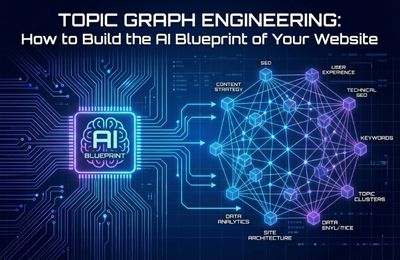
Topic Graph Engineering is the process of structuring your website’s content as an interconnected semantic network instead of isolated pages. For topic graph AIO, this approach helps AI systems understand topical depth, relationships and authority signals across your site. When done correctly, topic graphs improve AI trust, internal linking efficiency and visibility in AI-generated answers across modern search engines and LLMs.
Topic Graph Engineering
Topic Graph Engineering is becoming a foundational discipline for AI-optimized websites. Traditional SEO focused on keywords and pages. AI systems now evaluate relationships, how concepts connect, how consistently they appear, and how deeply a topic is covered.
A topic graph acts as the AI blueprint of your website, defining what you cover, how ideas connect and where authority lives. Instead of ranking individual URLs, AI systems increasingly assess whether your site demonstrates a coherent and complete understanding of a subject area.
This shift makes topic graph AIO essential for brands targeting visibility in AI-powered search, answer engines and large language model responses.
What is a topic graph?
A topic graph is a structured representation of topics, subtopics and entities connected through semantic relationships. Each node represents a concept and each edge represents how concepts relate to each other.
In practical SEO terms, a topic graph maps:
- Core topics your website owns
- Supporting subtopics that deepen coverage
- Contextual relationships between concepts
- Authority signals are tied to each cluster
This goes beyond traditional silo or hub-and-spoke models. While clusters focus on navigation and content grouping, semantic graphing focuses on meaning and relevance as interpreted by AI systems.
A strong topic graph shows:
- Clear topical boundaries
- Logical depth progression
- Minimal redundancy
- Strong contextual continuity
This is why topic graphs are often discussed alongside knowledge graph SEO, where structured understanding matters more than surface-level keyword usage.
How AI uses topic graphs
AI systems rely on graphs to model knowledge efficiently. Whether evaluating a website or answering a query, AI prefers structured semantic relationships over isolated facts.
When AI processes your site, it looks for:
- Repeated topic co-occurrence across pages
- Consistent definitions and terminology
- Predictable internal linking paths
- Reinforcement of concepts across clusters
Topic graphs help AI answer questions like:
- What is this site about overall?
- Does it demonstrate depth or just breadth?
- Which page represents the most authoritative node?
From an AIO perspective, topic graph AIO helps AI assign:
- Topical authority scores
- Confidence thresholds for citation
- Trust signals across related pages
This directly supports internal concepts such as AI trust score, where clarity and consistency across your semantic network determine how confidently AI systems reference your content.
Research literature on graph-based knowledge modeling supports this approach, showing that graph-structured data improves inference, relevance scoring and contextual recall in AI systems. This is why knowledge graph research papers frequently emphasize semantic connectivity over document-level ranking.
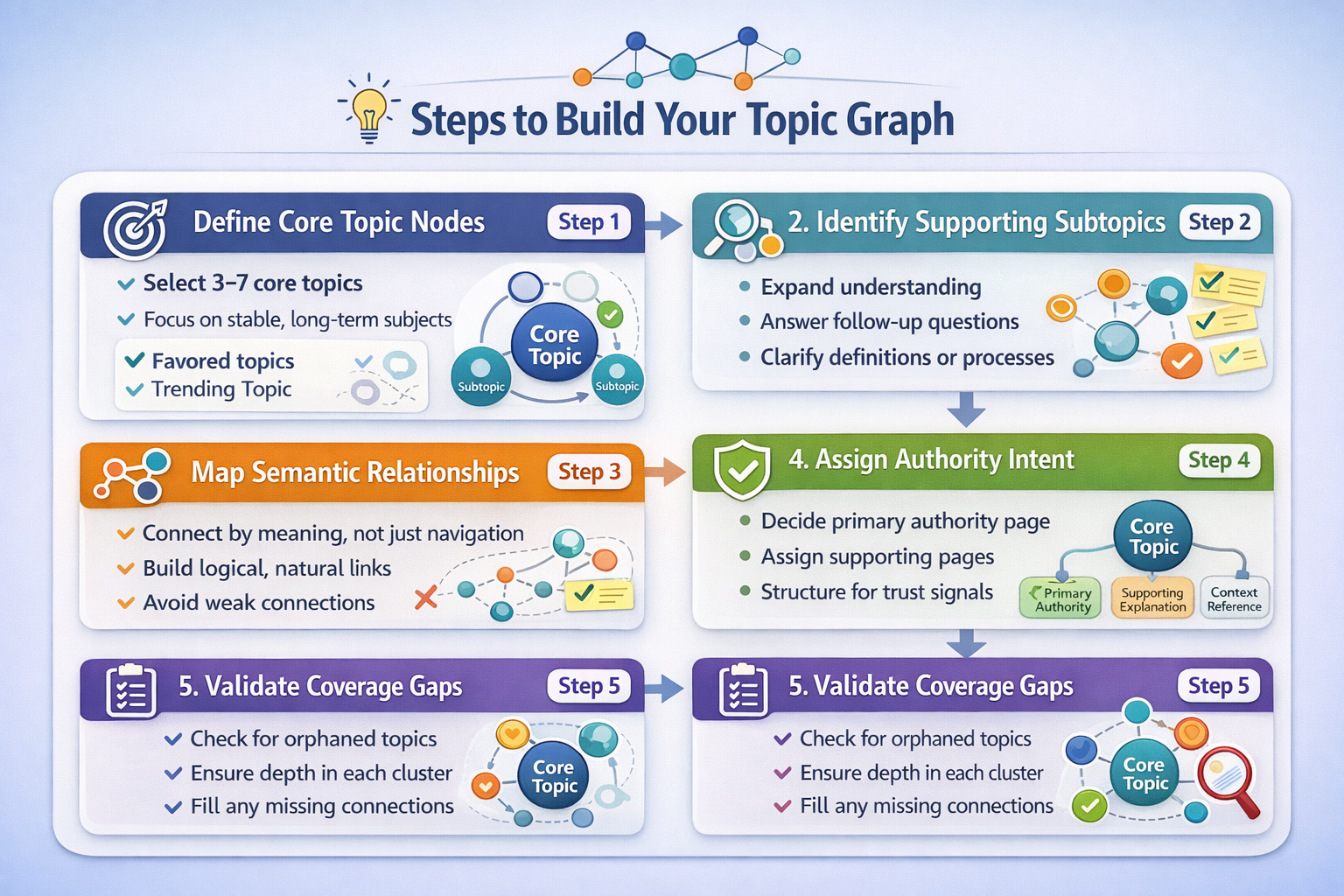
Steps to build your topic graph
Building a topic graph is a structured engineering process, not a creative exercise. The goal is clarity, not volume.
Step 1: Define your core topic nodes
Start with 3–7 core topics that represent what your website should be known for. These should be stable, long-term subjects, not trending keywords.
Step 2: Identify supporting subtopics
For each core topic, list subtopics that:
- Expand understanding
- Answer follow-up questions
- Clarify definitions or processes
This is where cluster mapping becomes critical. Each supporting page should have a clear purpose and relationship to its parent node.
Step 3: Map semantic relationships
Connect topics based on meaning, not navigation. Ask:
- Which concepts naturally reference each other?
- Which topics depend on others for context?
Avoid circular or weak connections. Strong graphs have intentional directionality.
Step 4: Assign authority intent
Decide which pages act as:
- Primary authority nodes
- Supporting explanation nodes
- Contextual reference nodes
This helps AI understand where trust and expertise reside within your graph.
Step 5: Validate coverage gaps
A complete topic graph minimizes orphan concepts. If a topic appears but lacks depth or connections, AI may interpret it as thin or unreliable.
Internal linking based on graphs
Internal linking is the physical implementation of your topic graph.
Instead of linking based on:
- Keyword anchors alone
- Random contextual mentions
Graph-based internal linking follows semantic intent.
Best practices include:
- Linking from broad concepts to specific explanations
- Reinforcing parent-child relationships
- Avoiding excessive cross-topic linking that dilutes meaning
Each internal link should answer a simple question:
Does this link strengthen the semantic relationship AI should understand?
This approach improves:
- Crawl efficiency
- Topic reinforcement
- AI confidence in content hierarchy
Over time, consistent internal linking aligned with your topic graph strengthens AI’s perception of your site as a cohesive knowledge source rather than a collection of articles.
Example graph
Imagine a website focused on AI optimization.
A simplified topic graph might look like:
- Core node: Topic Graph Engineering
- Subtopic: topic graph AIO
- Subtopic: semantic graphing
- Subtopic: cluster mapping
- Subtopic: internal linking strategy
- Subtopic: AI trust signals
Each subtopic expands the parent concept without drifting into unrelated territory. Cross-links exist only where semantic dependency is clear, not for convenience.
This type of structure allows AI to:
- Identify the main authority page
- Understand how supporting content adds depth
- Confidently reuse explanations in AI-generated responses
Simple graph diagrams like this help teams visualize gaps, overlaps and authority distribution before content is published or restructured.
FAQs
How to build a topic graph?
Start by defining core topics, mapping supporting subtopics and connecting them based on semantic relevance rather than navigation. Validate that each node adds depth and clarity to the overall subject.
Is a topic graph different from content clusters?
Yes. Content clusters focus on structure and navigation, while topic graphs focus on meaning, relationships, and how AI interprets topical authority across your site.
Does topic graph AIO help AI rankings?
Topic graph AIO improves how AI systems understand, trust and reuse your content. While it does not guarantee rankings, it significantly increases citations and visibility in AI-generated answers.
How often should a topic graph be updated?
Topic graphs should evolve as your expertise grows. Updates are needed when adding new subtopics, expanding authority areas, or correcting semantic overlaps.