
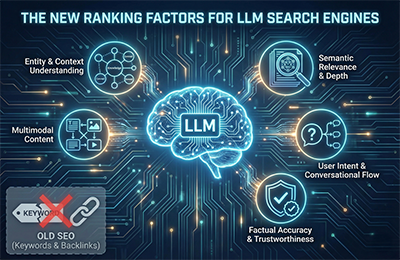
AI search engines powered by large language models (LLMs) don’t rank pages the way Google’s traditional algorithms do. Instead of links and keyword density, they prioritize entity strength, topical depth, source consistency, structured data and real-world trust signals.
This guide explains the LLM ranking factors that matter most today, how AI evaluates content credibility and how brands can align with emerging AI ranking signals and generative SEO factors to stay visible in AI-powered search results.
New Ranking Factors
Search is no longer just about ranking ten blue links. LLM-based search engines such as ChatGPT, Gemini, Claude and Perplexity generate answers by selecting, synthesizing and reusing trusted sources. This means visibility now depends on how AI models understand, trust and recall your content.
Below are the core ranking factors shaping AI-first discovery today.
Entity Strength
Entity strength refers to how clearly and consistently an LLM can identify who you are, what you do and why you matter.
Strong entities have:
- A well-defined brand or author identity
- Consistent naming across platforms
- Clear associations with topics, products, or expertise
Unlike classic SEO, where pages compete individually, LLMs evaluate entities as a whole. If your brand or author entity is weak or ambiguous, even high-quality content may be ignored.
Example insight:
LLMs are more likely to cite brands that appear repeatedly as the same entity across websites, knowledge graphs and authoritative content sources.
Scoring impact (Entity Strength):
- Clear entity definition: 4/5
- Repeated authoritative mentions: +1
Total possible score: 5/5
Topical Depth
Topical depth measures how comprehensively you cover a subject, not just on one page, but across your content ecosystem.
LLMs favor sources that:
- Address a topic from multiple angles
- Cover beginner to advanced questions
- Demonstrate subject-matter continuity
A single article rarely establishes authority on its own. Instead, LLMs look for interconnected content that proves long-term expertise.
Why this matters:
Shallow content may rank briefly in traditional search but fails to supply enough semantic context for AI systems.
Scoring impact (Topical Depth):
- Surface-level coverage: 2/5
- Clustered, in-depth coverage: 5/5
This is one of the most influential generative SEO factors today.
Source Consistency
Source consistency is about alignment. Does your messaging stay stable across platforms, formats and time?
LLMs evaluate:
- Consistent claims and facts
- Matching language across blog posts, social platforms and citations
- Low contradiction risk
If your content conflicts with itself or with trusted sources, AI systems downgrade confidence.
Practical insight:
LLMs prefer sources that “agree with themselves” over time. Consistency builds predictability, which builds trust.
Scoring impact (Source Consistency):
- Inconsistent messaging: 1–2/5
- Consistent multi-source alignment: 5/5
Social Trust Signals
Social trust signals act as external validation for AI systems.
These include:
- Engagement on professional platforms
- Expert discussions referencing your content
- Brand mentions in trusted communities
Unlike traditional social media metrics, AI systems focus less on vanity numbers and more on contextual credibility.
Example:
A niche expert cited in thoughtful LinkedIn discussions may outweigh a viral but shallow post elsewhere.
Scoring impact (Social Trust Signals):
- Low-signal presence: 2/5
- Contextual authority signals: 4–5/5
These signals increasingly influence AI ranking signals in conversational search.
Schema & Structure
Structure is how AI reads efficiently.
LLMs rely on:
- Clear headings and logical flow
- Structured data for context extraction
- Predictable formatting patterns
Schema doesn’t “rank” content directly, but it dramatically improves interpretation accuracy.
Recommended structures include:
- BlogPosting schema
- FAQPage schema
- Clear H1–H3 hierarchy
For deeper reference, see OpenAI Docs on content clarity and source reliability.
Scoring impact (Schema & Structure):
- Unstructured content: 2/5
- Schema-supported clarity: 5/5
User Intent Precision
LLMs prioritize precision over breadth. Content must answer exactly what users are asking, no filler, no detours.
High-performing content:
- Matches query intent tightly
- Uses clear definitions and explanations
- Avoids unnecessary keyword padding
Unlike traditional SEO, over-optimization can reduce clarity and trust.
Key insight:
AI systems reward helpfulness density, how quickly and accurately an answer delivers value.
Scoring impact (User Intent Precision):
- Generic answers: 2/5
- Intent-aligned responses: 5/5
Freshness for AI
Freshness for AI is about relevance, not just recency.
LLMs evaluate:
- Updated facts and examples
- Alignment with current terminology
- Ongoing content maintenance
Stale information weakens recall probability, especially in fast-changing industries.
Important nuance:
Freshness signals work best when combined with established authority not as a replacement for it.
Scoring impact (Freshness for AI):
- Outdated references: 1–2/5
- Regularly refreshed content: 4–5/5
LLM Ranking Scoring Model (Summary)
|
Factor |
Max Score |
|
Entity strength |
5 |
|
Topical depth |
5 |
|
Source consistency |
5 |
|
Social trust signals |
5 |
|
Schema & structure |
5 |
|
User intent precision |
5 |
|
Freshness for AI |
5 |
|
Total Possible Score |
35 |
High-visibility AI sources consistently score above 28/35.
FAQs
What is the LLM ranking?
LLM ranking refers to how AI-powered search engines select, prioritize and reuse content when generating answers, based on trust, relevance, and semantic understanding rather than traditional rankings.
How can I rank in AI search?
To rank in AI search, focus on entity clarity, topical depth, structured content and consistent trust signals across the web instead of relying solely on backlinks.
Are backlinks still important for LLMs?
Backlinks still matter indirectly, but they are less influential than entity authority, content consistency and semantic relevance in AI-driven search systems.
How is generative SEO different from traditional SEO?
Generative SEO focuses on making content understandable and reusable by AI models, while traditional SEO optimizes for crawler-based indexing and link-based ranking.