
The debate around SEO vs GEO vs AEO reflects the evolution of search itself. Traditional SEO focuses on ranking webpages in search engines, AEO focuses on becoming the direct answer in search results and voice queries, and GEO focuses on optimizing content for generative AI engines such as ChatGPT, Gemini and Perplexity.
Each strategy serves a different purpose in modern digital visibility. Businesses choosing between them should evaluate cost, ROI, speed, and audience behavior. In practice, many organizations combine all three to maintain visibility across traditional search results, AI-generated answers, and voice interfaces.
SEO vs GEO vs AEO
Search behavior has changed dramatically in the last few years. People no longer rely solely on traditional search results. Increasingly, users are asking questions to AI assistants, voice devices, and generative engines that produce summarized answers instead of lists of links.
This shift has introduced three distinct optimization strategies:
- SEO (Search Engine Optimization)
- AEO (Answer Engine Optimization)
- GEO (Generative Engine Optimization)
Understanding SEO vs GEO vs AEO is essential for companies trying to maintain digital visibility across both traditional search engines and AI-powered platforms.
While SEO remains the foundation of search marketing, AEO and GEO represent the next evolution of discoverability. Businesses that understand the differences between these approaches can allocate budgets more effectively and create a balanced strategy that works across multiple discovery channels.
Core Differences Explained
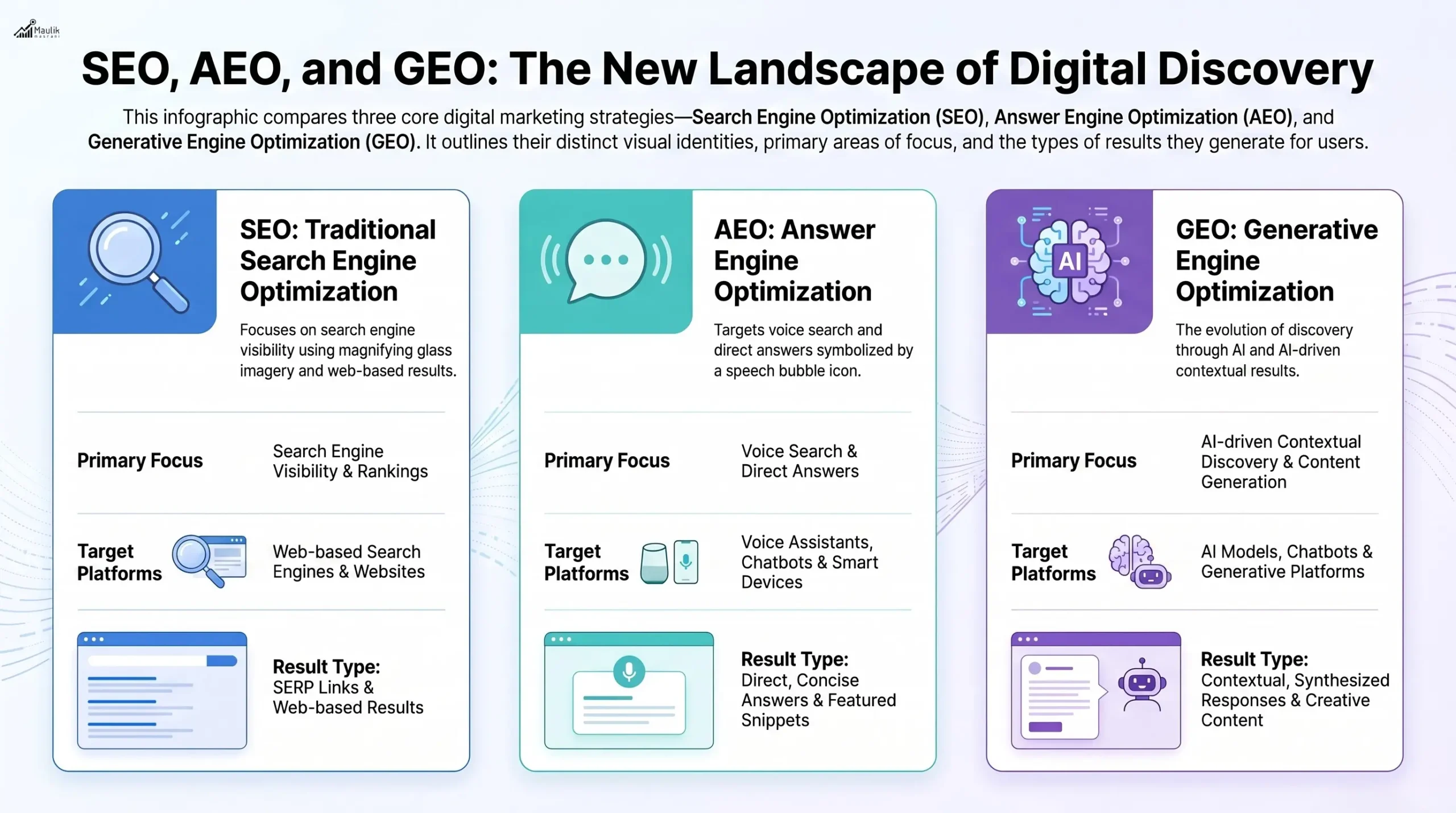
At a high level, the difference between SEO, GEO, and AEO lies in how search engines deliver information to users.
Traditional SEO focuses on ranking pages in search engine results pages (SERPs). GEO and AEO focus on being included in AI-generated answers or direct responses.
| Optimization Type | Primary Focus | Target Platforms | Result Type |
| SEO | Website rankings | Google, Bing | Search results page |
| AEO | Direct answers | Voice search, featured snippets | Instant answers |
| GEO | AI-generated responses | ChatGPT, Gemini, Perplexity | Generative summaries |
SEO works by optimizing website content, technical performance, backlinks and user experience. When a user searches for something on Google, optimized pages appear higher in the results.
AEO takes this concept further. Instead of just ranking a page, the goal is to become the exact answer that search engines display in snippets or voice responses. For example, voice assistants often read a single answer instead of showing multiple results.
GEO focuses on something even newer: ensuring that AI systems reference, summarize, or cite your content when generating responses. In the context of AI SEO comparison, GEO helps brands remain visible even when users interact directly with AI systems rather than traditional search engines.
This shift is why generative optimization is rapidly becoming a strategic priority for companies that rely on digital discovery.
Cost Comparison Table
Budget considerations play a significant role when businesses compare SEO vs GEO vs AEO. Each approach requires different resources, tools, and timelines.
Below is a simplified comparison of typical cost structures.
| Strategy | Typical Investment | Key Resources | Cost Drivers |
| SEO | Moderate to high | Content, backlinks, and technical optimization | Link building, site improvements |
| AEO | Moderate | Structured data, Q&A content, knowledge panels | Content structuring |
| GEO | Emerging investment | entity optimization, AI citation monitoring | AI visibility tracking |
SEO campaigns typically require long-term investments in content production, technical improvements, and link acquisition. For established industries, competitive keywords can require significant time and budget before measurable ranking improvements occur.
AEO campaigns often cost less because they focus on structuring existing content to provide clear answers. Businesses can improve their chances of appearing in featured snippets or voice responses by creating well-organized FAQs, structured data markup, and concise explanations.
GEO strategies introduce new elements such as entity optimization, AI citation monitoring, and generative content alignment. Because generative engines pull information from multiple sources, GEO investments often involve authority-building and semantic clarity rather than purely keyword-driven optimization.
ROI Model Breakdown
Return on investment varies significantly across the three strategies. When comparing SEO vs GEO vs AEO, the biggest difference lies in how quickly visibility improvements occur and how traffic converts.
SEO generally delivers long-term value. Ranking improvements may take several months, but once achieved, they often generate sustained traffic and brand authority.
AEO tends to produce faster visibility gains in specific queries. When a business wins a featured snippet or voice answer, it can immediately capture a large share of user attention for that question.
GEO’s ROI model is still emerging. Generative engines increasingly influence how users gather information, especially for research-oriented queries. If a brand becomes part of the sources AI systems rely on, it can maintain visibility even when users never click traditional search results.
In the broader AI SEO comparison, businesses increasingly recognize that different optimization models influence different stages of the customer journey.
SEO supports discovery through search results.
AEO captures users seeking immediate answers.
GEO supports brand presence in AI-generated explanations and recommendations.
Companies that rely heavily on organic search traffic typically start with SEO and gradually expand toward AEO and GEO as search behavior evolves.
Decision Matrix By Business Type
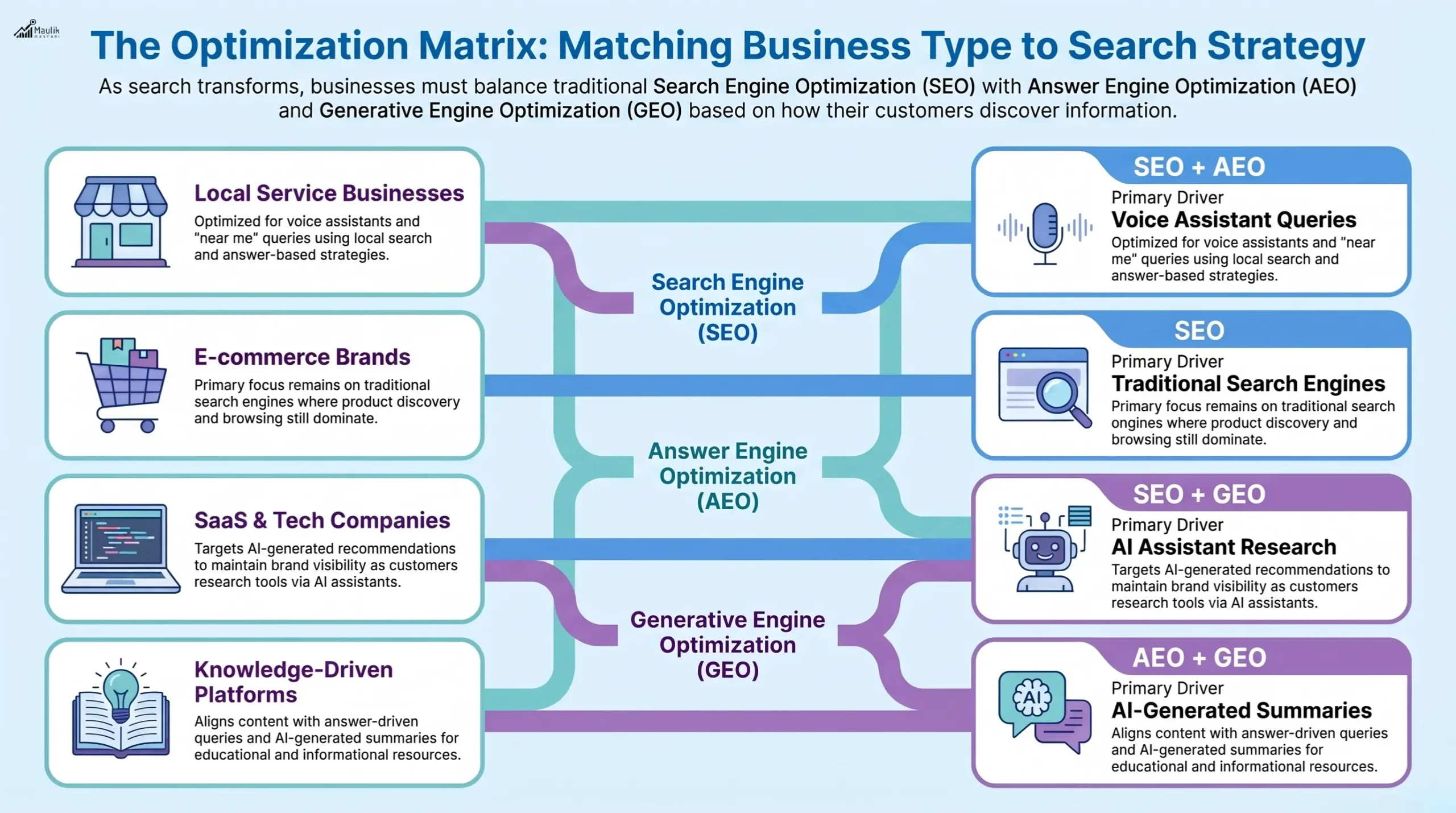
Different types of businesses benefit from different optimization strategies. When deciding between SEO vs GEO vs AEO, companies should evaluate their industry, customer behavior, and marketing objectives.
Business Type | Recommended Focus |
Local service businesses | SEO + AEO |
SaaS and technology companies | SEO + GEO |
E-commerce brands | SEO |
Knowledge-driven platforms | AEO + GEO |
Local service businesses often benefit from SEO combined with AEO because customers frequently ask voice assistants questions such as “best dentist near me” or “plumber open now.”
SaaS and technology companies increasingly benefit from GEO strategies. Many potential customers now research tools through AI assistants, making generative optimization a useful method for maintaining brand visibility in AI-generated recommendations.
E-commerce brands typically rely heavily on SEO because product discovery still occurs primarily through search engines.
Knowledge-driven platforms, educational resources, and informational publishers benefit strongly from AEO and GEO strategies because their content naturally aligns with answer-driven queries and AI-generated summaries.
Understanding these distinctions helps businesses prioritize investments while adapting to the ongoing transformation of search.
FAQs
Which service is best for SMBs?
For most small and medium businesses, traditional SEO remains the best starting point because it builds long-term search visibility and drives consistent traffic. However, adding AEO elements such as structured FAQs can significantly improve results for question-based searches.
Which delivers the fastest ROI?
AEO often delivers the fastest ROI because featured snippets and voice answers can appear quickly once content is structured correctly. SEO typically requires more time but generates sustainable long-term traffic.
Is GEO replacing SEO?
No. GEO complements SEO rather than replacing it. Traditional search results still drive a large portion of web traffic, while GEO focuses on visibility within generative AI responses.
Can businesses use all three strategies together?
Yes. Many modern digital strategies combine SEO, AEO, and GEO to ensure visibility across traditional search engines, answer engines, and generative AI platforms.
Conclusion
The discussion around SEO vs GEO vs AEO reflects a broader shift in how people find information online. Traditional search engines remain critical for discovery, but answer engines and generative AI systems are reshaping how users receive information. Businesses that rely solely on traditional SEO may miss opportunities to appear in AI-generated answers or voice responses.
AEO helps organizations capture visibility in direct answers, while GEO prepares brands for the growing influence of generative search experiences. The most resilient digital strategies often combine these approaches to ensure a consistent presence across multiple discovery channels. As AI-driven search continues to evolve, companies that understand and adapt to these optimization models will maintain stronger long-term visibility and competitive advantage.