
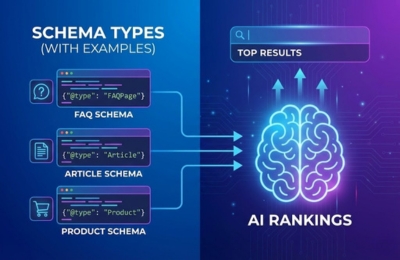
Schema is no longer just for rich results; it actively shapes how AI systems evaluate, trust and reuse your content. This guide explains the schema types AI models rely on most (FAQ, Article, Product, Organization, Author), shows structured data examples and shares AIO schema templates you can implement today to strengthen authority signals across Google and LLM-driven search.
Schema Types That Help AIO
Artificial Intelligence Optimization (AIO) depends on clarity, consistency, and machine-readable meaning. Schema markup provides that meaning by labeling entities, relationships and intent in a standardized format (JSON-LD). For AI-powered search (Google AI Overviews, ChatGPT-style retrieval and other LLM answer engines), schema helps answer three core questions:
- What is this content about?
- Who created it and why should it be trusted?
- How stable and reusable is the information?
Below are the schema types that most directly influence AI interpretation and ranking behavior; used correctly, they amplify authority signals; used poorly, they create confusion.
FAQ Schema
The FAQ schema is one of the strongest contributors to AI answer extraction because it mirrors how LLMs structure responses: concise questions with definitive answers.
Why AI values the FAQ schema
- Clearly defines user intent and expected output
- Reduces ambiguity during answer synthesis
- Increases the likelihood of inclusion in AI summaries and conversational results
Best use cases
- Explainers, comparisons, eligibility, pricing logic and process questions
- Content designed for featured snippets and AI answers
Structured data example (JSON-LD):

AIO insight:
AI systems often prefer FAQ-marked content when generating direct answers because it minimizes interpretation errors.
Article Schema
Article schema provides context, freshness and topical framing critical for AI systems that must decide which source to trust when multiple pages discuss the same topic.
Why it matters for AI
- Establishes content type (educational vs promotional)
- Signals publication date and updates
- Supports content provenance and topical authority
Key properties AI evaluates
- headline
- datePublished and dateModified
- author
- publisher
Structured data example (JSON-LD):

AIO insight:
Consistently updated articles with stable schema metadata tend to be reused more often by AI summaries.
Product Schema
For commercial and comparison-driven queries, the product schema is essential. AI engines use it to understand tangible offerings versus informational content.
Why AI relies on Product schema
- Identifies transactional intent
- Extracts pricing, availability and features
- Helps distinguish products from reviews or blogs
Best use cases
- SaaS tools, courses, ecommerce listings, subscriptions
Structured data example (JSON-LD):

AIO insight:
AI systems frequently combine Product schema with FAQ schema to answer “what is it,” “how much does it cost,” and “is it available” in one response.
Organization Schema
Organization schema anchors your brand as a first-class entity. Without it, AI systems may understand your content but not who stands behind it.
Why it’s foundational
- Connects content to a real-world organization
- Supports knowledge graph alignment
- Reinforces trust and legitimacy signals
Key properties
- name
- url
- logo
- sameAs (social profiles)
Structured data example (JSON-LD):

AIO insight:
Strong Organization schema improves AI confidence when attributing answers to your brand instead of generic sources.
For implementation standards, reference the official guidance from Google Structured Data Docs.
Author Schema
Author schema clarifies expertise ownership, an increasingly important signal as AI systems weigh credibility and experience.
Why AI cares about authorship
- Links content to a real or verified individual
- Supports expertise modeling over time
- Reduces anonymity penalties in AI trust scoring
Best practices
- Use consistent author names across articles
- Link authors to the organization or profiles
Structured data example (JSON-LD):

AIO insight:
AI engines favor authors with consistent topical output and stable schema signals across multiple pieces of content.
Best Practices & Mistakes
Best practices
- Use JSON-LD (preferred by search engines and AI parsers)
- Keep schema consistent across pages
- Match schema to actual on-page content
- Combine multiple schema types logically (e.g., Article + FAQ + Author)
Common mistakes
- Over-marking irrelevant schema
- Using conflicting organization or author details
- Copy-pasting templates without customization
- Forgetting to update dateModified
AIO takeaway:
Schema is not about volume; it’s about precision and consistency. Fewer, accurate schema types outperform bloated implementations.
FAQs
What schema is best for AI?
The FAQ schema is often the most effective because it aligns directly with how AI systems structure and deliver answers.
Do schema types influence AI rankings directly?
Yes. Schema helps AI interpret content intent, authority and reusability, which influences visibility in AI-generated results.
Can multiple schema types be used together?
Absolutely. Combining Article, FAQ, Author and Organization schema creates stronger, layered authority signals.
How often should the schema be updated?
Update schema whenever content changes, especially dates, authorship, pricing, or availability.