
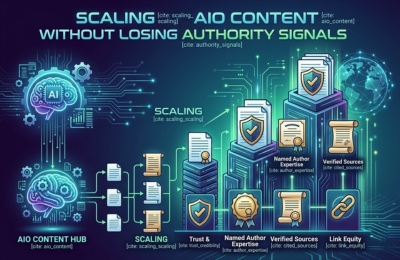
Scaling AIO content is not about producing more; it’s about expanding intelligently. When agencies and SaaS teams prioritize authority scaling through entity discipline, topic graph control, and cross-channel synchronization, they can scale AIO content without weakening AI trust signals. The key is operational structure before velocity.
Scaling AIO Content
Every agency and SaaS team eventually faces the same pressure: publish more, expand faster, dominate search visibility.
But scaling content in the AI era is fundamentally different from scaling in the traditional SEO era.
Today, when you scale AIO content, you are not just increasing URLs; you are feeding large language models, influencing entity associations and reinforcing (or weakening) your brand’s authority profile across systems.
This creates a paradox:
- Scale increases reach.
- But an uncontrolled scale reduces authority.
Authority isn’t built on volume. It’s built on coherence.
The difference between brands that scale successfully and those that collapse under their own content weight is structure.
Let’s examine where scaling breaks and how to engineer it properly.
Why Scaling Breaks Authority
Authority fractures when scale outpaces strategic control.
Here’s what happens operationally:
- New writers reinterpret positioning.
- Topic clusters expand without reinforcement.
- Messaging shifts subtly across channels.
- Product narratives evolve without documentation.
- Supporting content lacks entity anchoring.
Individually, these seem minor. Collectively, they create AI ambiguity.
Modern search systems evaluate:
- Entity relationships
- Topical reinforcement
- Consistency of brand references
- Cross-platform alignment
When signals conflict, systems lower their confidence.
A SaaS brand may scale from 20 to 200 blog posts in a year but if those posts drift semantically, citation frequency drops and AI answer visibility becomes unstable.
Authority scaling requires deliberate reinforcement loops.
Scaling without feedback control introduces entropy. Scaling with governance compounds trust.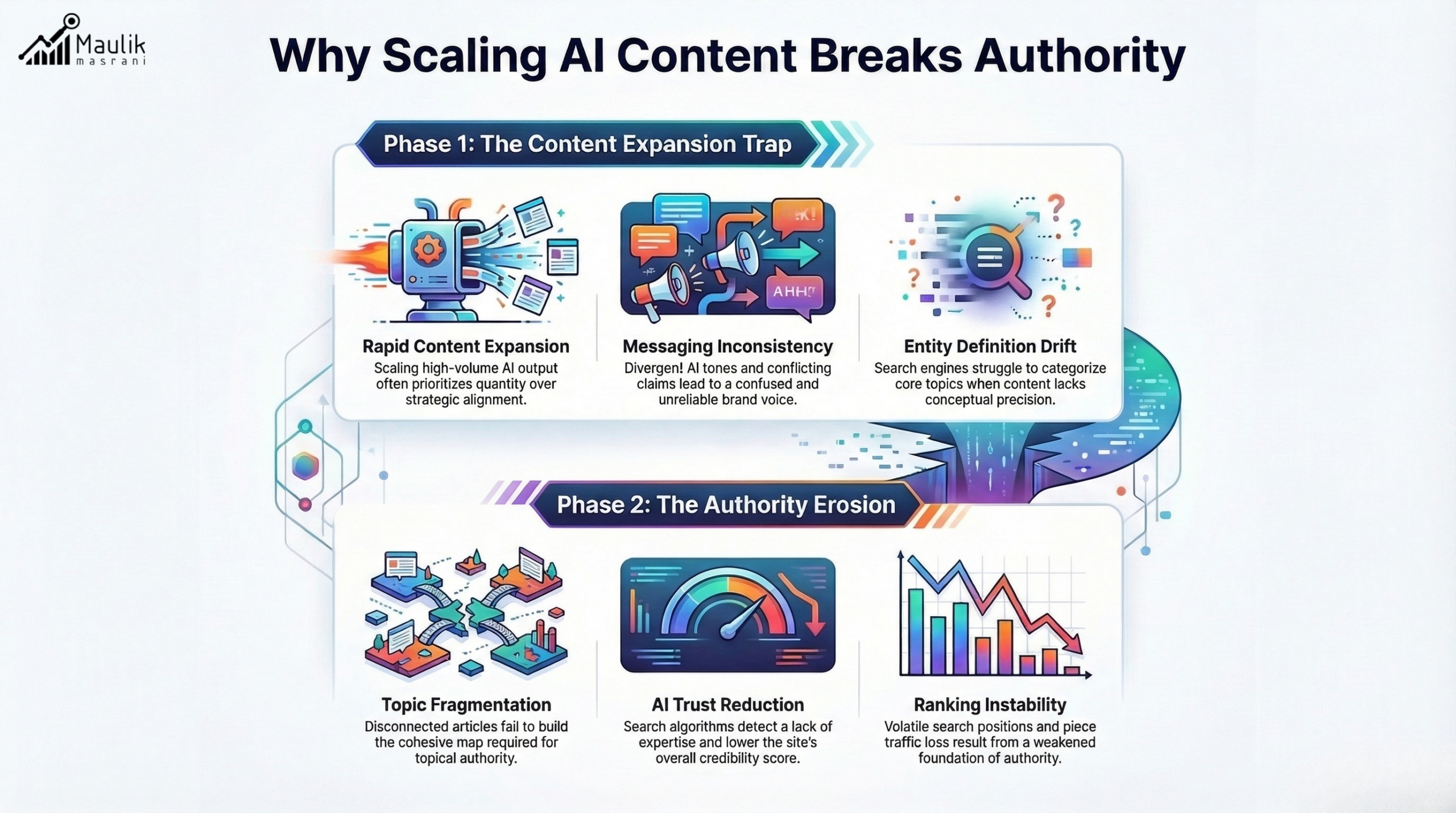
Maintaining Entity Clarity at Scale
At the core of safe scaling is entity clarity.
Every brand operates within a structured knowledge ecosystem:
- Organization entity
- Product entities
- Framework entities
- Supporting conceptual entities
If definitions vary across content, authority weakens.
To scale AIO content effectively, agencies should implement:
1. Entity Registry
A centralized database defining:
- Approved product descriptions
- Core positioning statements
- Strategic terminology
No improvisation. No variation in key definitions.
2. Controlled Language Model
Establish a standardized messaging framework:
- Problem framing
- Solution articulation
- Differentiation points
When teams expand content production, this becomes the guardrail.
3. Structured Reinforcement
Apply schema consistently:
- Organization schema
- Article schema
- FAQ schema
Structured data strengthens AI comprehension and reduces ambiguity.
An AI-first scaling system ensures that as content grows, entity clarity strengthens instead of diffusing.
Clarity at 10 articles is easy.
Clarity at 300 requires systemization.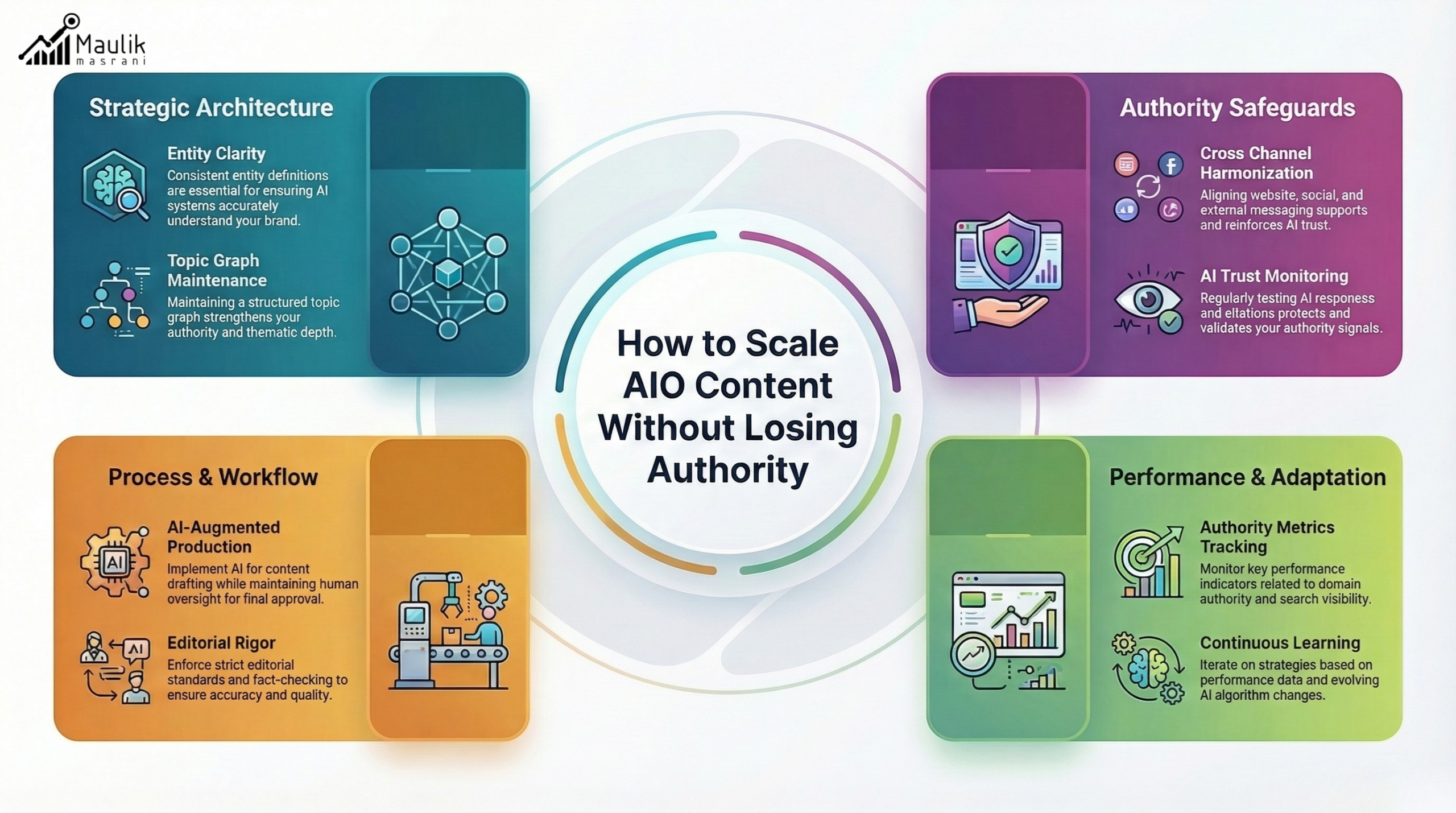
Topic Graph Maintenance
Scaling horizontally, adding more content does not automatically increase authority.
Authority deepens when your topic graph expands intentionally.
Think in terms of semantic architecture:
- Pillar entity
- Sub-entities
- Supporting micro-topics
- Reinforcement loops
For example:
If your core domain centers on AI operational systems, then:
- Every supporting piece should map back to that entity.
- Internal links should reinforce hierarchy.
- Anchor text should remain strategically consistent.
Random expansion dilutes semantic gravity.
Strategic expansion increases entity salience.
Research on search quality guidelines consistently emphasizes topical depth and user-focused relevance over surface-level breadth.
When agencies pursue authority scaling, they maintain a live topic graph document. Every new article must:
- Strengthen an existing node
- Expand a defined cluster
- Reinforce an entity relationship
If it doesn’t pause it.
Scale is structural. Not spontaneous.
Cross-Channel Harmonization
Authority is no longer built on-site alone.
LLMs learn from distributed signals:
- Website content
- Social messaging
- Public mentions
- Structured metadata
- Community discussions
When scaling content, agencies often focus exclusively on blog expansion while neglecting ecosystem alignment.
This creates signal fragmentation.
Cross-channel harmonization means:
- Consistent positioning across the website and social platforms
- Uniform product definitions across press and blog
- Aligned keyword framing across campaigns
- Stable brand narrative across every touchpoint
If LinkedIn messaging evolves independently from website messaging, AI systems detect narrative drift.
And drift weakens trust.
Scaling safely requires:
- Quarterly messaging audits
- Cross-channel keyword consistency checks
- Brand narrative documentation
- Monitoring AI-generated summaries of your brand
When AI describes your brand consistently across platforms, your authority scaling strategy is working.
Scale Checklist
Below is a strategic + operational checklist for agencies and SaaS teams:
Entity Governance
- Centralized entity registry
- Canonical product descriptions
- Messaging framework documentation
Topic Architecture
- Maintained topic graph
- Clear pillar-to-cluster mapping
- Internal linking reinforcement
AI Monitoring
- AI-answer testing across models
- Citation tracking
- Narrative consistency evaluation
Cross-Channel Alignment
- Website-social narrative sync
- Press messaging standardization
- Unified positioning statement
Workflow Controls
- Structured editorial templates
- Pre-publication QA review
- Authority reinforcement validation
Scaling without this system is reactive.
Scaling with this system is strategic.
An AI-first scaling system transforms content growth into authority growth.
FAQs
Can I scale without losing AI trust?
Yes. You can scale safely if you maintain entity consistency, topic graph integrity, and cross-channel alignment. AI trust decreases only when messaging becomes fragmented or contradictory.
What is authority scaling?
Authority scaling is the practice of increasing content volume while strengthening semantic coherence, entity clarity, and structured trust signals across search and generative systems.
Why does scaling often reduce rankings?
Scaling reduces rankings when content expands without structural alignment, causing semantic dilution and weakened entity relationships.
What is an AI-first scaling system?
An AI-first scaling system integrates entity governance, structured data, workflow controls, and AI visibility monitoring to ensure that growth enhances authority rather than destabilizes it.
Conclusion
Scaling AIO content is not a volume game; it’s a systems game. Agencies and SaaS teams that focus only on output risk fragmenting their authority signals, weakening entity clarity, and confusing AI systems that rely on consistency to assign trust.
True growth happens when structure scales alongside content. When entity definitions remain stable, topic graphs stay intentional, and cross-channel messaging aligns, expansion becomes an amplifier of authority rather than a threat to it. In the AI era, sustainable visibility belongs to brands that treat scaling as disciplined infrastructure, not uncontrolled acceleration.