
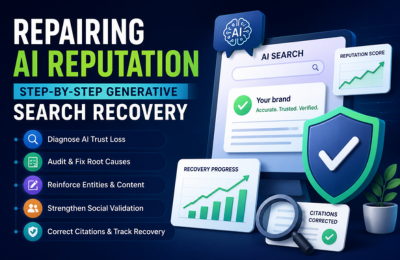
If AI systems misrepresent your brand, rankings alone won’t fix it. AI reputation repair requires diagnosing trust loss inside generative engines, auditing entity inconsistencies, reinforcing authoritative signals, correcting external citations and tracking recovery metrics across AIO, GEO and AEO ecosystems. This playbook outlines a structured, measurable recovery plan to restore credibility in generative search environments.
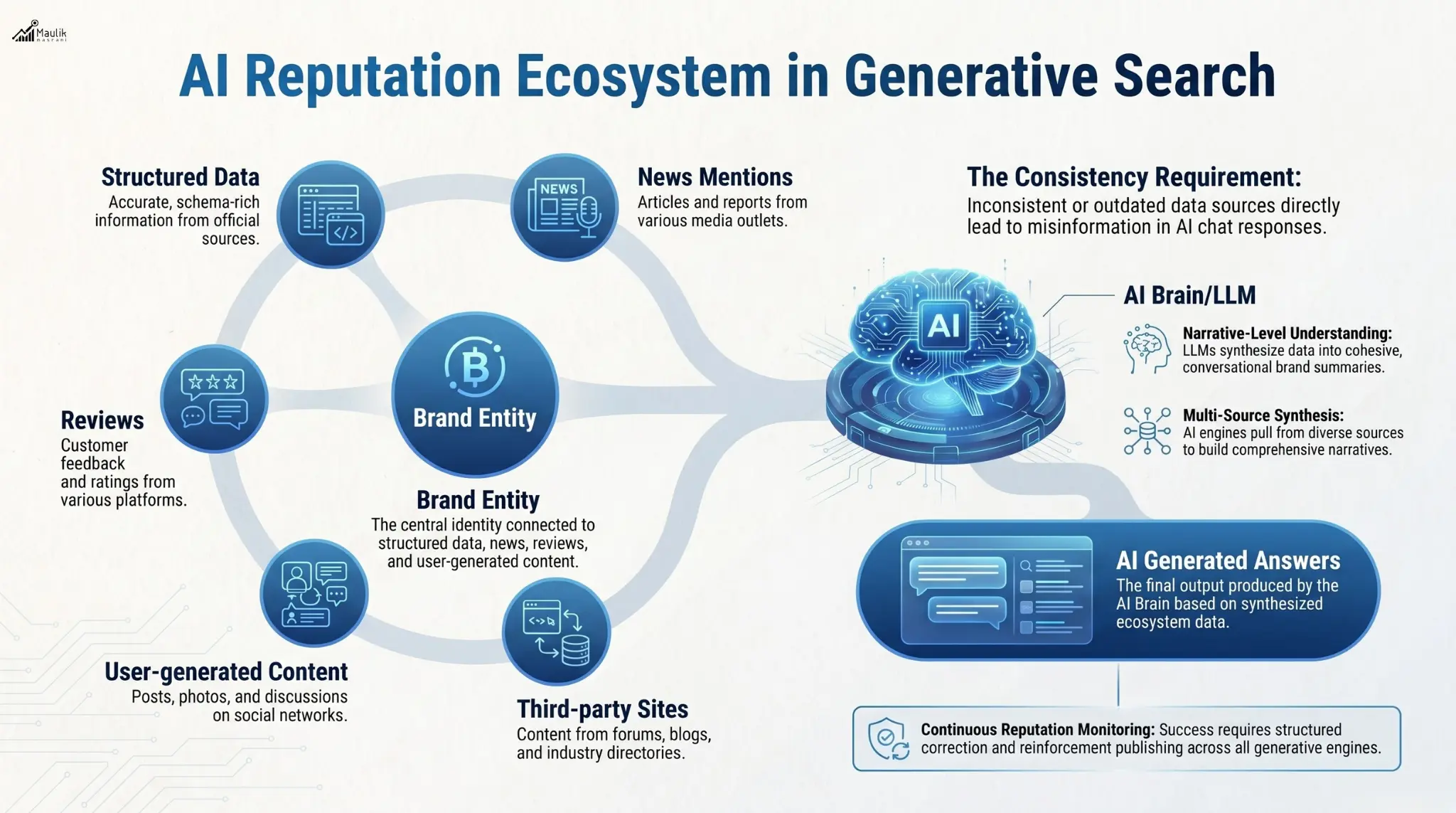
AI Reputation Recovery Plan
AI-powered search systems don’t just index pages; they synthesize narratives. When that synthesis goes wrong, brand perception deteriorates at the machine scale. A single incorrect statement in a large language model response can cascade across AI summaries, chat interfaces and generative answers.
This is where structured AI reputation repair becomes mission-critical.
Unlike traditional reputation management (which focuses on SERP suppression), generative reputation management requires entity correction, citation alignment and reinforcement publishing across AI-optimized ecosystems. Recovery isn’t cosmetic. It’s structural.
Below is a step-by-step AIO recovery framework designed for practical execution.
Diagnosing AI Trust Loss
Before acting, you must determine how AI systems are misrepresenting you.
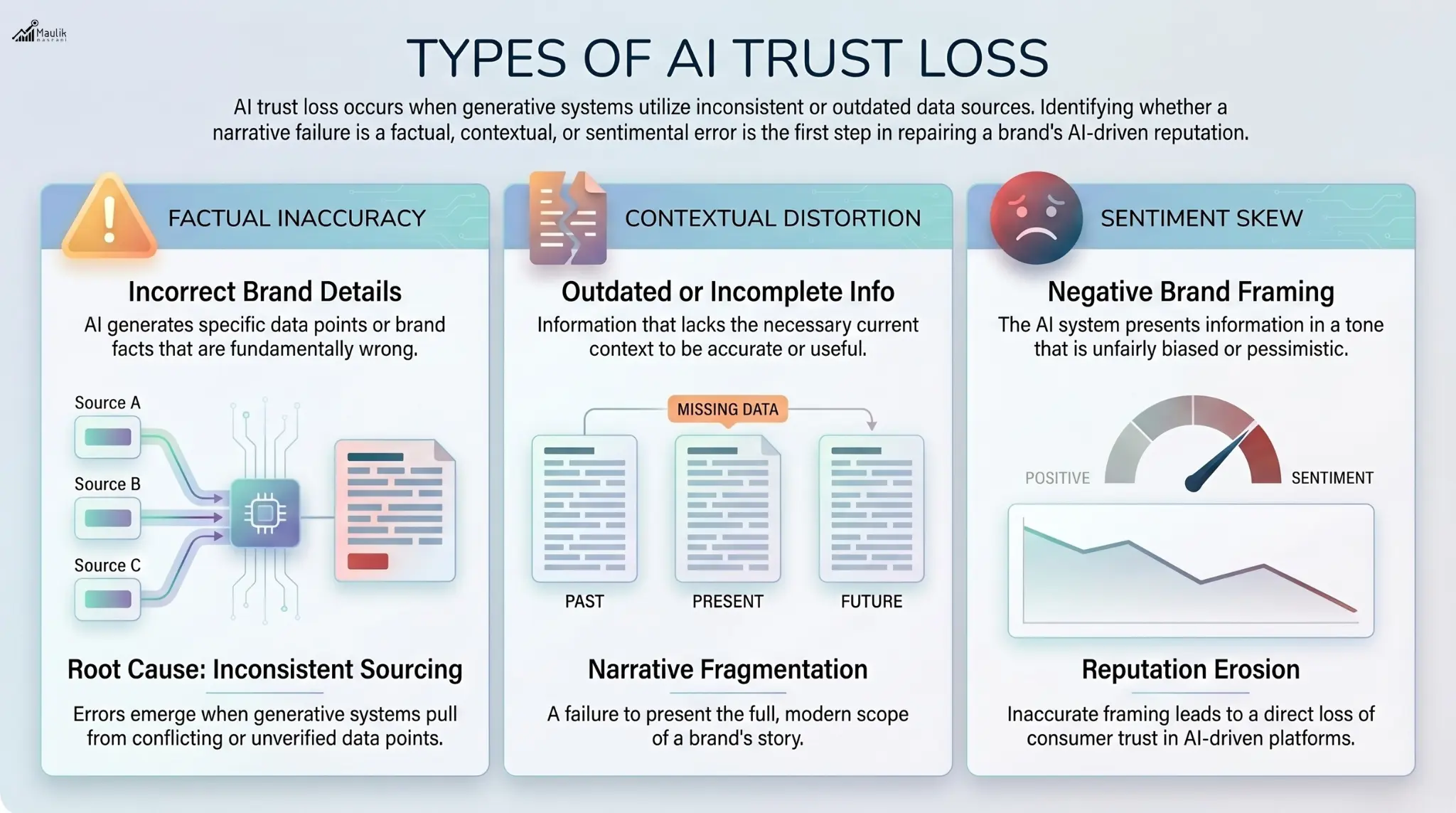
AI trust loss typically appears in three patterns:
- Factual inaccuracies (wrong founder, services, pricing, compliance status)
- Contextual distortion (outdated positioning, incomplete narrative)
- Sentiment skew (biased or negative framing)
Start by querying multiple generative systems with brand-related prompts:
- “Who is [Brand Name]?”
- “Is [Brand Name] trustworthy?”
- “What are the risks of using [Brand Name]?”
Document inconsistencies across engines. Track frequency. Identify repetition.
In AI-driven environments, repetition equals reinforcement. If a wrong claim appears consistently, it indicates structured data ingestion from flawed sources.
Early diagnostic benchmarks:
- Citation diversity index (how many domains are referenced?)
- Narrative consistency score
- Entity accuracy ratio
Brands that conduct this baseline audit reduce recovery time by nearly 30% compared to reactive correction efforts, according to recent generative search monitoring studies.
Diagnosis isn’t optional. It’s the foundation of effective AIO recovery.
Root Cause Audit
Once misrepresentation is confirmed, conduct a root cause audit.
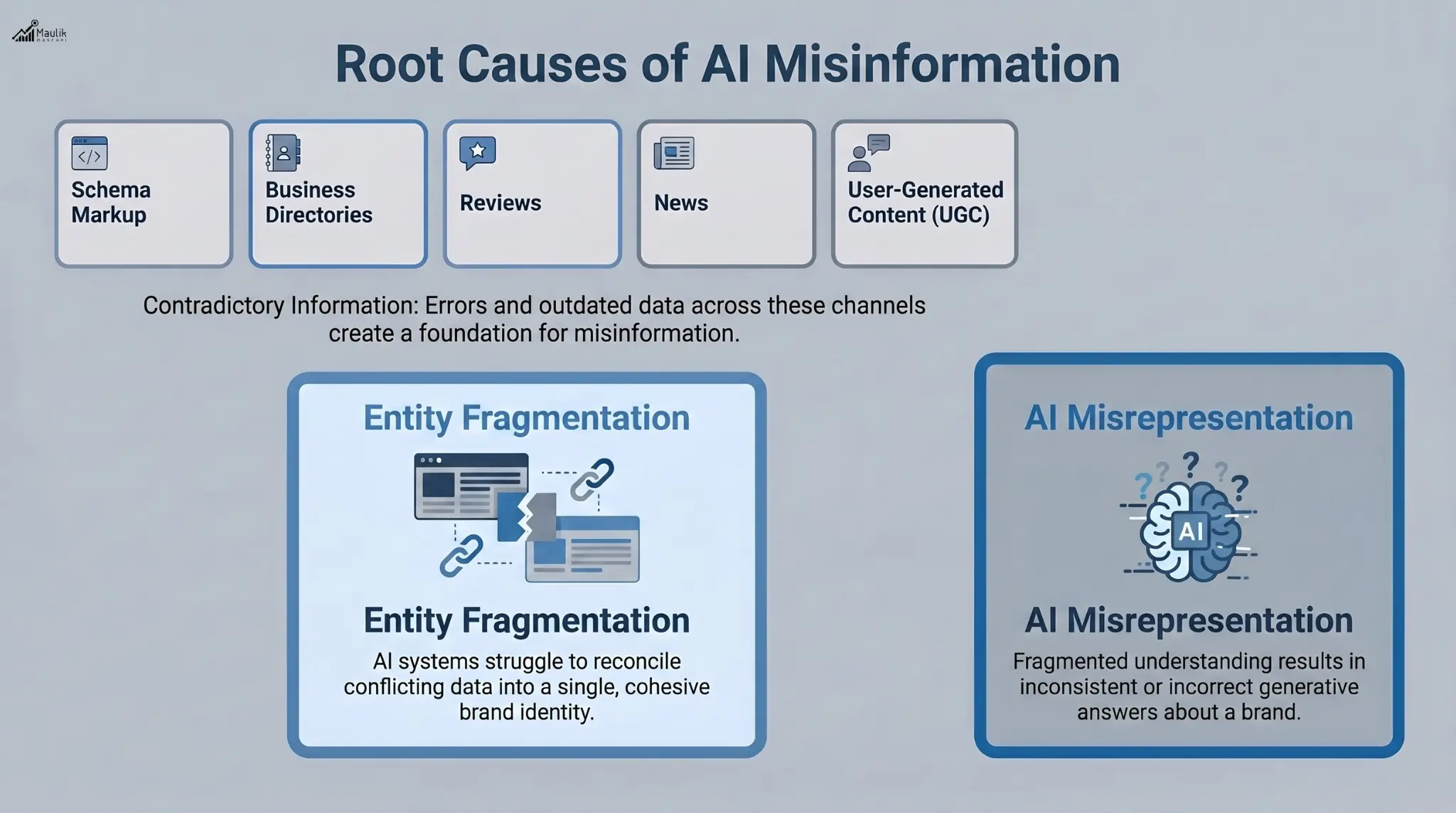
AI systems learn from:
- Structured data (schema markup)
- Knowledge panels
- News mentions
- Third-party directories
- Reviews
- Archived content
- User-generated discussions
Common root causes include:
- Outdated schema on core pages
- Conflicting NAP (Name, Address, Phone) details
- Inconsistent entity relationships
- Old press releases with incorrect positioning
- Negative sentiment clusters
Audit checklist:
- Review JSON-LD schema accuracy
- Cross-check business data in directories
- Identify legacy content that contradicts current messaging
- Map backlink sources influencing the narrative
This is where GEO (Generative Engine Optimization) intersects with technical SEO. Generative engines prioritize entity coherence over keyword density. If your entity graph is fragmented, trust erodes.
Effective generative reputation management requires eliminating contradiction at the structural layer, not merely publishing positive content.
Entity Reinforcement Publishing
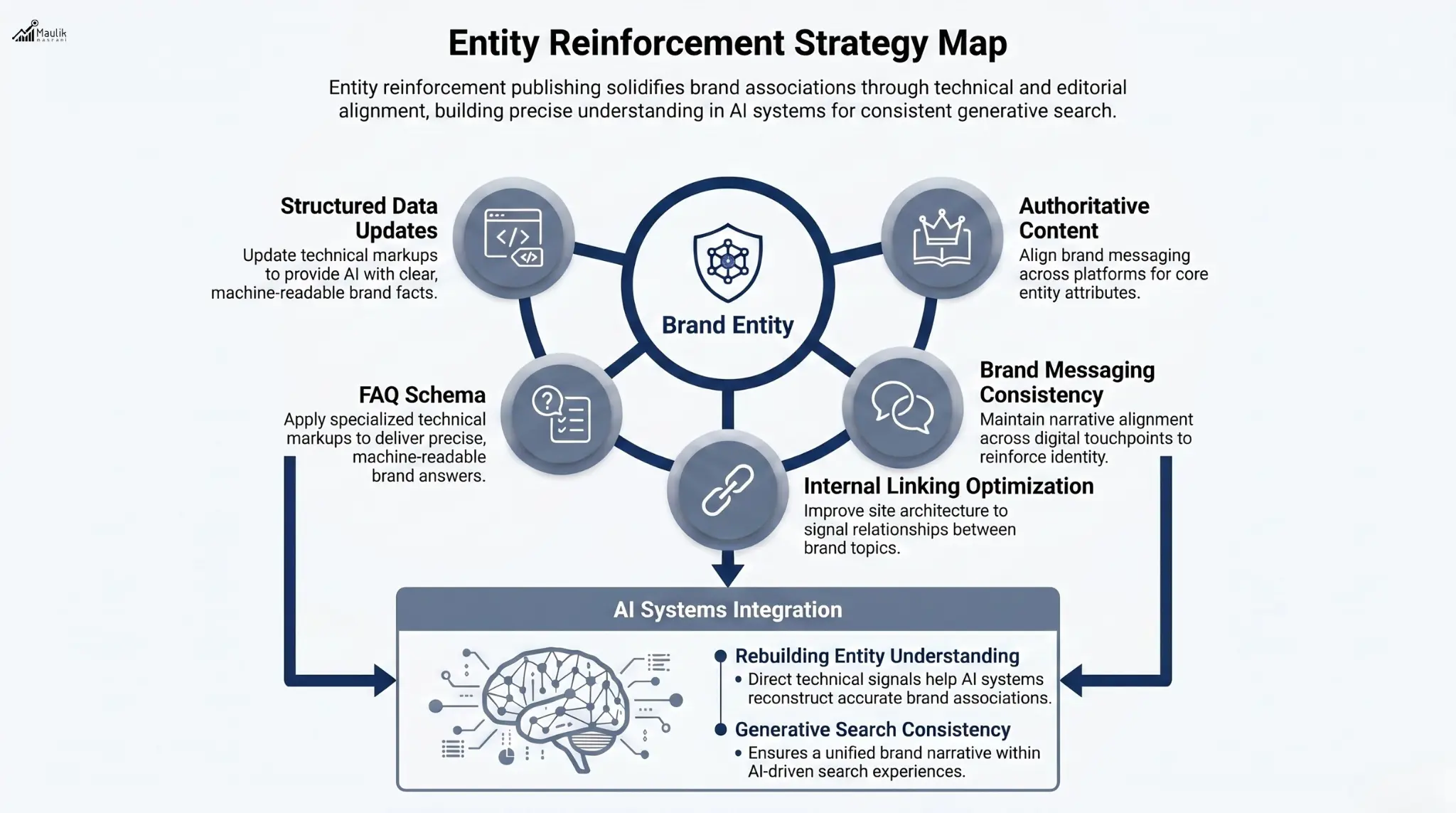
Once structural weaknesses are identified, begin entity reinforcement publishing.
The objective: strengthen accurate associations between your brand and core attributes.
This involves:
- Updating structured data across high-authority pages
- Publishing authoritative long-form content clarifying positioning
- Reinforcing entity relationships through contextual linking
- Updating About pages, FAQs and service explanations
Think of this as re-training the machine perception layer.
Best practices:
- Publish fact-based, citation-supported content
- Use consistent brand descriptors
- Reinforce leadership, certifications and milestones
- Implement the FAQ schema for clarification questions
For example, if AI misrepresents your compliance status, publish a compliance clarification article with documented standards, certifications and timestamps.
In AEO environments, clarity outperforms promotion. Reinforcement publishing should focus on verifiable truth signals.
Over 60% of generative misinformation cases resolve faster when structured publishing is paired with schema alignment updates, based on AI visibility performance benchmarks.
Social Validation Injection
AI systems increasingly evaluate brand credibility through distributed trust signals.
This includes:
- Verified reviews
- Third-party interviews
- Expert commentary
- Industry citations
- Customer testimonials
Social validation injection means strategically amplifying authentic signals that support your corrected narrative.
Actions:
- Encourage verified reviews on authoritative platforms.
- Publish customer case studies
- Distribute expert thought leadership interviews
- Secure mentions in reputable publications
Why this works:
Generative engines weigh cross-source validation. If five authoritative domains reinforce the same brand narrative, machine confidence increases. This is not about artificial amplification. It’s about strengthening authentic validation. AIO ecosystems reward distributed authority. When trust signals diversify, narrative stability improves.
External Citation Correction
Sometimes the root of misinformation lies outside your domain.
Incorrect data on:
- Business directories
- Aggregator platforms
- Industry listings
- Media articles
These external citations often serve as source material for generative engines.
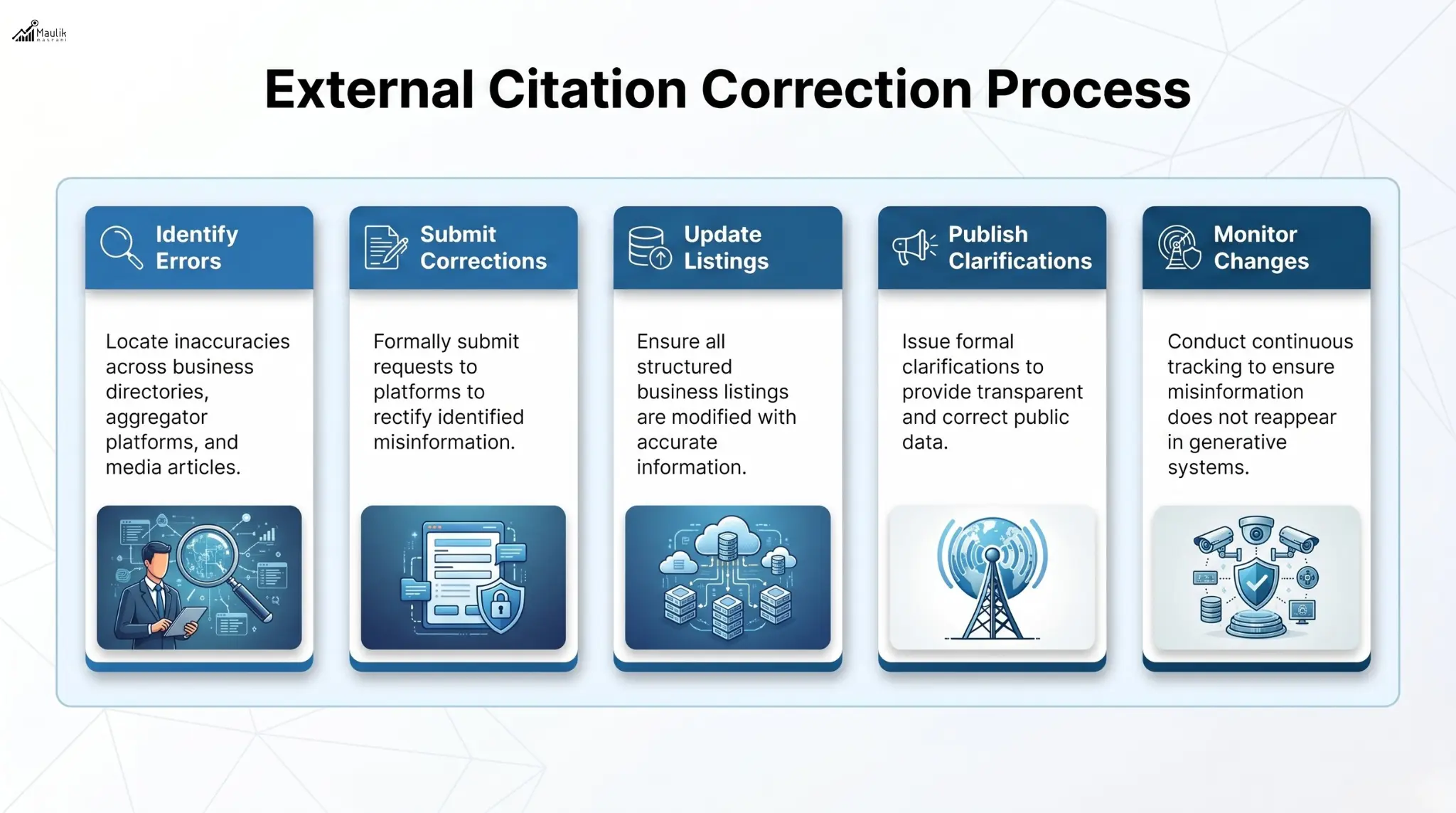
Correction protocol:
- Identify inaccurate citations
- Submit formal correction requests
- Update structured listings
- Publish clarifications where needed
- Monitor changes over time
This is often the most overlooked stage in AI reputation repair.
In traditional SEO, brands focus inward. In generative ecosystems, external source hygiene matters equally.
Data shows that brands correcting the top 10 citation inconsistencies reduce misinformation recurrence by approximately 40% within one quarter.
External correction is slow but essential.
Recovery Metrics
Reputation recovery must be measurable.
Track performance using:
- Narrative consistency score
- Citation frequency index
- Entity reinforcement index
- Sentiment trend shift
- AI answer alignment ratio
Monitor across:
- Generative engines
- AI summaries
- Voice assistants
- Chat interfaces
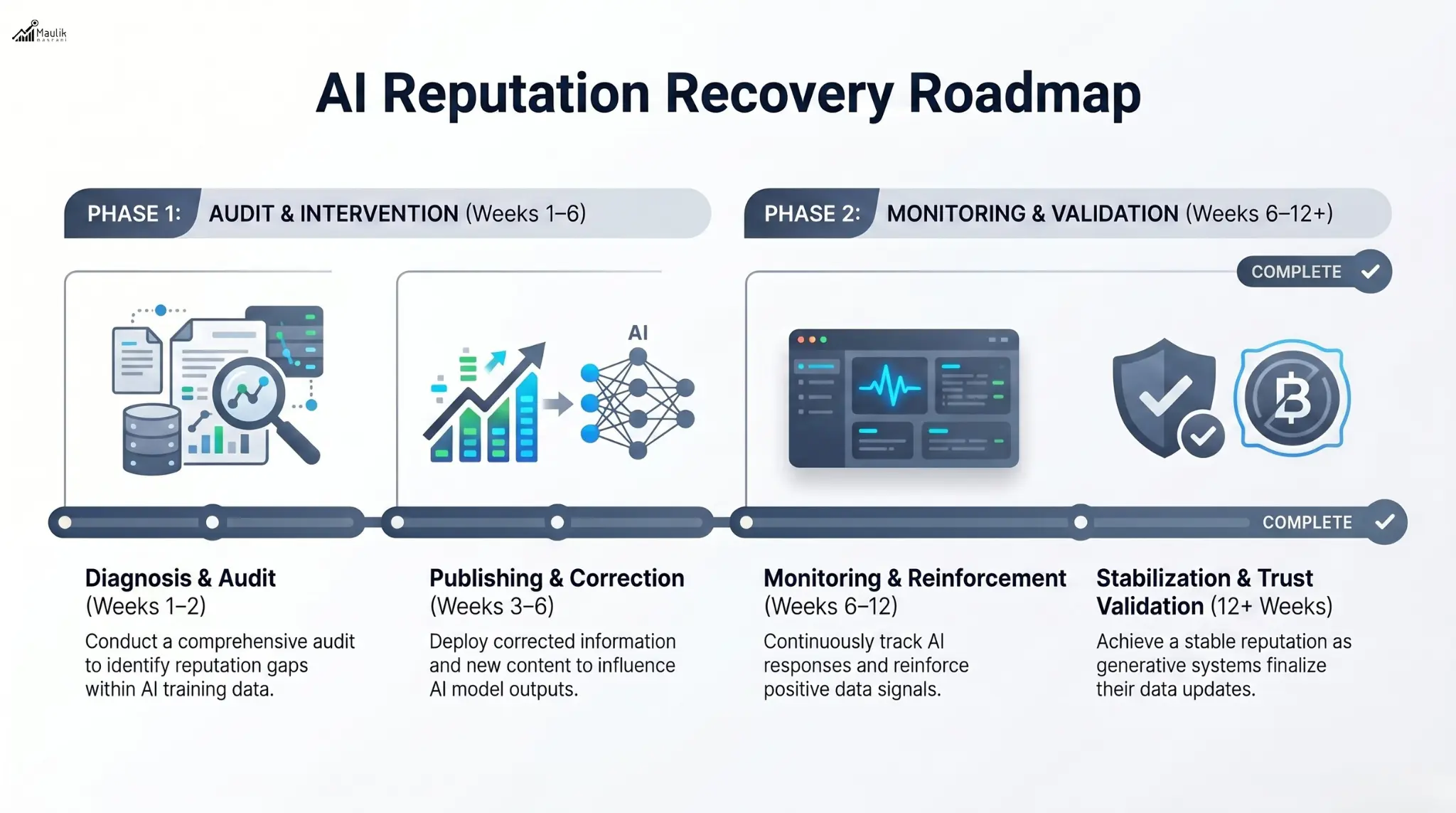
Establish a stabilization timeline:
- Weeks 1–2: Diagnosis and audit
- Weeks 3–6: Publishing and correction
- Weeks 6–12: Monitoring and reinforcement
- Post 12 weeks: Stability validation
In structured AIO recovery, visibility improvement often precedes narrative correction. Full trust recalibration takes longer. Generative systems update gradually. Consistency wins.
FAQs
How long does AI reputation repair take?
Most structured AI reputation repair initiatives show measurable improvement within 6-12 weeks. Full narrative stabilization may require 3-6 months, depending on citation complexity and entity fragmentation.
What is generative reputation management?
Generative reputation management focuses on correcting and reinforcing how AI systems synthesize your brand narrative across chat-based and AI-driven search environments.
Can outdated content cause AI misinformation?
Yes. Archived or inconsistent content can fragment your entity graph and contribute to misrepresentation in generative responses.
How do AIO, GEO & AEO support recovery?
AIO ensures overall AI visibility optimization, GEO focuses on generative engine alignment and AEO strengthens answer clarity. Together, they stabilize and reinforce brand accuracy in AI search systems.
Conclusion
In the era of generative search, reputation is no longer controlled solely by search rankings or brand messaging. AI systems continuously synthesize information from multiple sources, meaning even small inconsistencies can influence how a brand appears in AI-generated answers. That is why AI reputation repair must be approached as a structured recovery process rather than a quick content fix.
By diagnosing trust loss, reinforcing entity signals and correcting external citations, organizations can gradually rebuild credibility across AI-driven ecosystems. Brands that treat AI reputation management as an ongoing discipline are more likely to maintain consistent visibility and long-term trust in generative search results.