
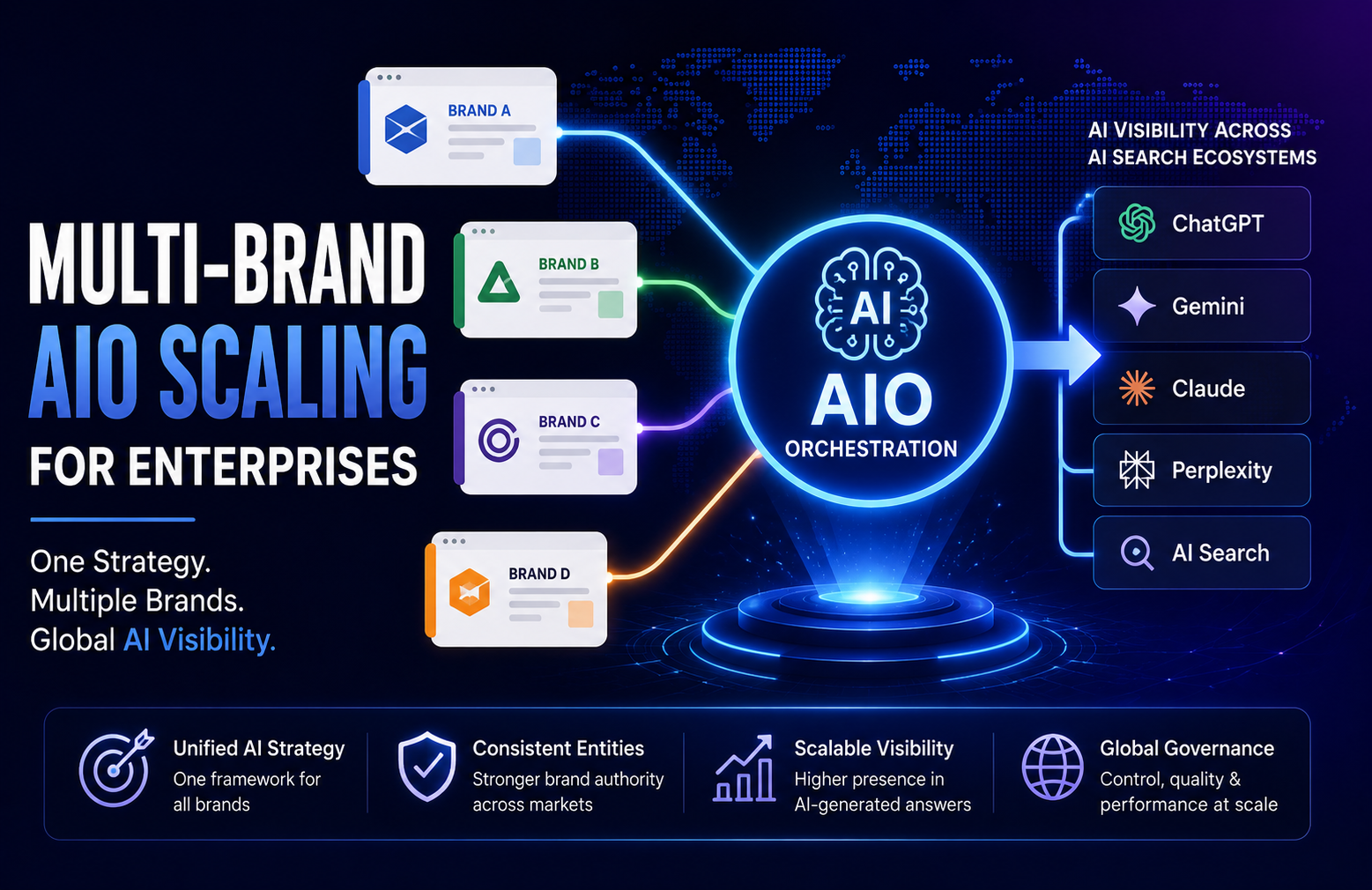
Multi-brand AIO scaling requires more than duplicating content across regions. Enterprises must architect a unified yet adaptable enterprise AIO framework that balances centralized strategy with regional execution, aligns entities across markets, layers structured data locally, runs cross-market visibility tests and governs AI performance globally. Done right, it enables consistent AI visibility, brand authority and scalable AI global scaling without narrative fragmentation.
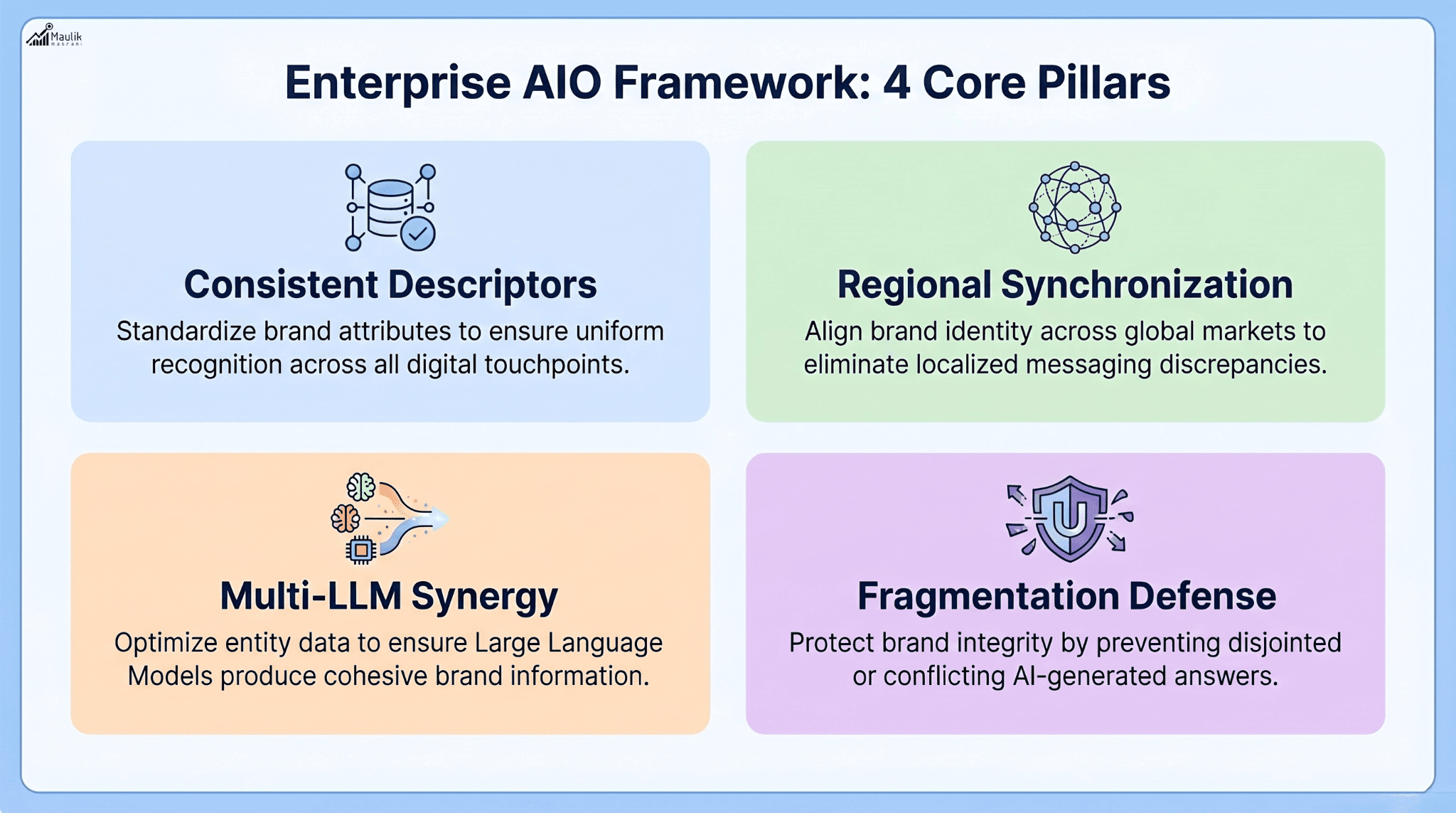
Scaling AIO Across Brands
Enterprises operating across multiple brands or geographic regions face a new optimization challenge. Traditional SEO scaling relied on duplicating keyword playbooks and localizing landing pages. AI-driven search environments demand something more sophisticated.
Large language models do not simply rank pages. They synthesize answers. They interpret brand entities. They evaluate trust signals across regions. That means multi-brand AIO scaling must focus on entity coherence, citation frequency, schema clarity, and cross-market consistency.
If one region describes your company as a “cloud AI solutions provider” and another positions it as a “digital transformation consultancy,” generative systems may fragment your brand identity. That inconsistency reduces authority in AI answers.
An effective enterprise model ensures:
- Unified entity definition across brands
- Localized authority signals
- Standardized AI performance measurement
- Central governance with regional agility
This is not just content scaling. It is operational scaling.
Centralized vs Decentralized AIO
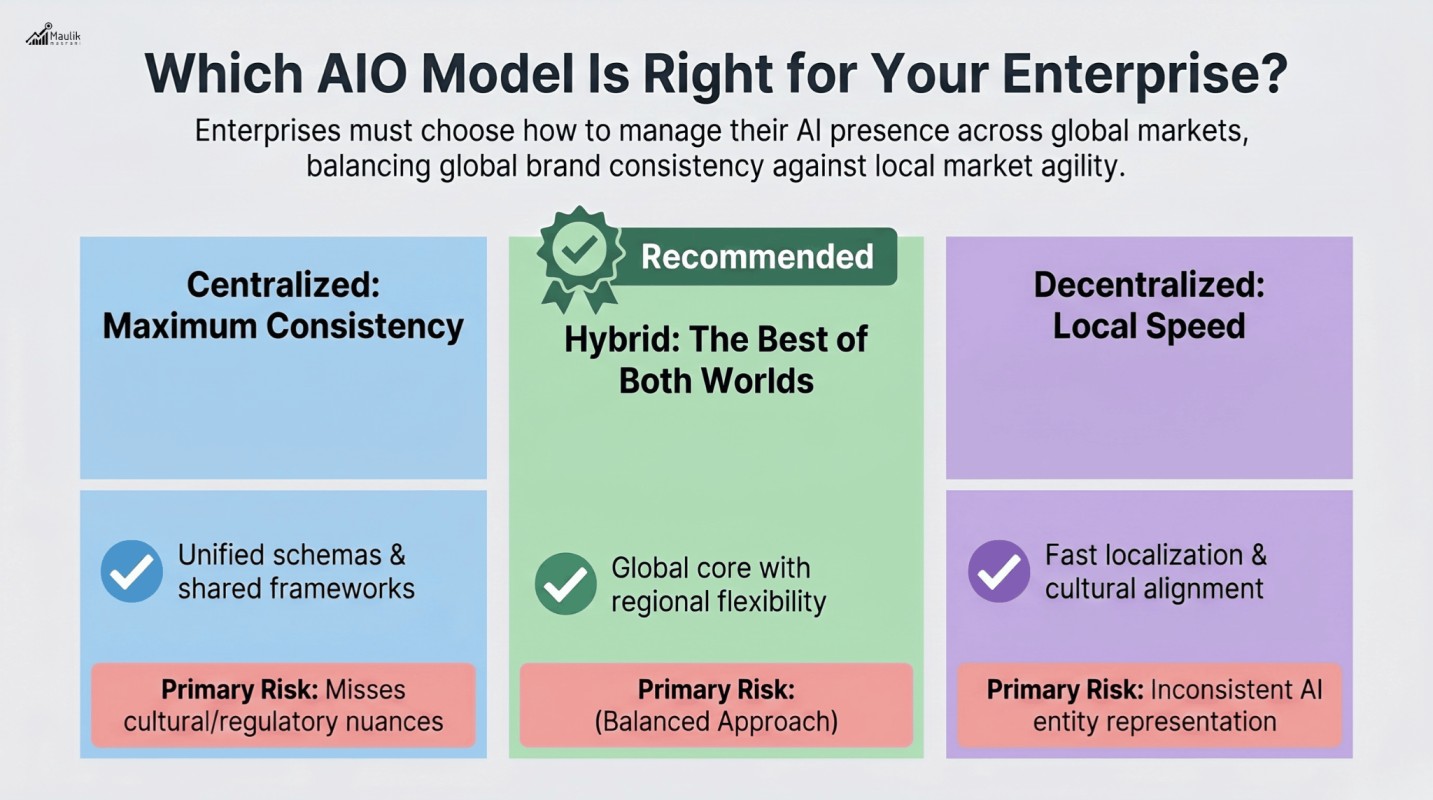
One of the first architectural decisions in multi-brand AIO scaling is structural: should AIO be centralized or decentralized?
Centralized AIO Model
A centralized structure places strategic ownership at the global level. Benefits include:
- Standardized entity definitions
- Unified schema architecture
- Consistent messaging across regions
- Shared experimentation frameworks
This works well for enterprise groups with strong brand coherence and centralized marketing teams.
However, over-centralization risks missing local nuances in regulatory environments, language and cultural signals.
Decentralized AIO Model
In a decentralized model, regional teams manage their own AIO implementation. Benefits include:
- Faster localization
- Stronger regional authority building
- Agile response to market trends
The risk? Narrative fragmentation and inconsistent entity representation.
Hybrid Enterprise Model
Most global organizations adopt a hybrid enterprise AIO framework:
- Global team defines entity core, schema templates, testing standards and governance
- Regional teams execute local optimization and authority building
This preserves brand consistency while enabling market-specific growth.
For enterprises exploring foundational AI optimization systems, structured approaches like generative engine optimization (GEO) and broader AEO, GEO & AIO frameworks provide strategic scaffolding.
Regional Entity Alignment
Generative AI evaluates brands as entity clusters, not isolated pages. Therefore, scaling across markets requires regional entity alignment.
What Is Regional Entity Alignment?
It ensures that:
- Core brand descriptors remain consistent globally
- Local offices reinforce parent-entity authority
- Sub-brands reference the same knowledge graph structures
For example, a multinational enterprise should:
- Maintain an identical company description schema across regions
- Use consistent industry taxonomy
- Align product naming conventions
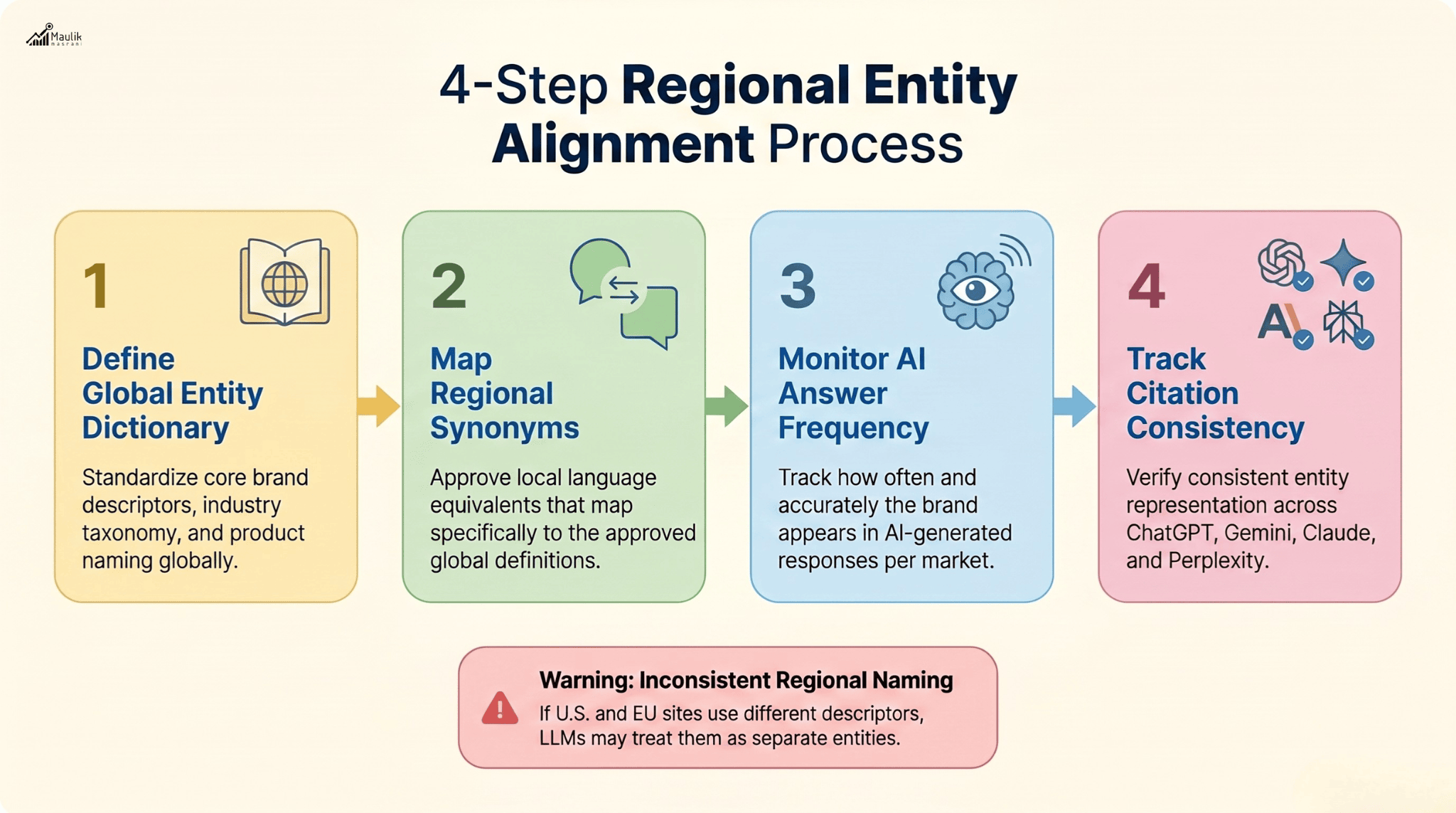
If a U.S. site references “enterprise AI analytics platform” while a European site calls it “predictive intelligence SaaS,” LLMs may interpret these as separate entities.
Practical Implementation
- Define the global entity dictionary
- Map regional synonyms to approved descriptors
- Monitor AI answer frequency by region
- Track citation consistency
In AI-driven environments, entity salience often determines answer inclusion. Enterprises that align terminology across markets see higher answer consistency in generative responses.
This is where AI global scaling becomes measurable rather than theoretical.
Local Schema Layering
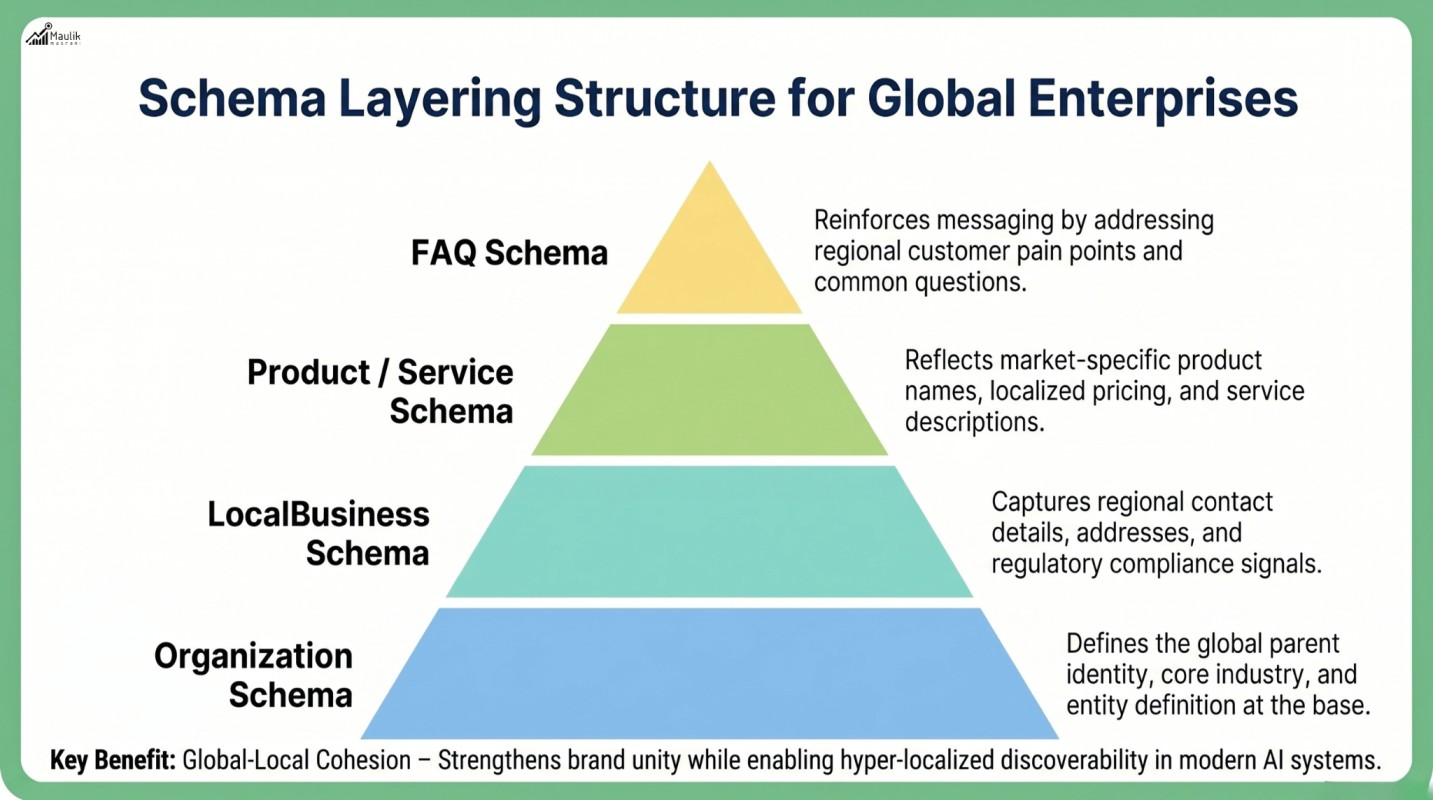
Structured data becomes more critical as brands scale internationally. Local schema layering ensures that global authority and regional specificity coexist.
Why Schema Layering Matters
Generative models rely on structured clarity. Schema improves:
- Entity disambiguation
- Organizational authority
- Location-specific signals
- Industry categorization
For global enterprises, the schema should include:
- Organization schema at the parent level
- LocalBusiness schema at the regional level
- Product/Service schema customized per market
- FAQ schema reinforcing consistent messaging
Example Scenario
A global enterprise offering enterprise AI consulting should:
- Use a consistent Organization schema globally
- Add regional address, contact and regulatory compliance signals
- Include localized FAQ schema reflecting regional pain points
This layered structure strengthens entity cohesion while enabling localized discoverability.
Structured implementations complement broader documentation systems. Enterprises managing this complexity often maintain formalized documentation processes within their AIO documentation system to ensure consistent deployment.
Cross-Market Visibility Testing
Scaling requires measurement. Without cross-market testing, organizations operate on assumptions.
Cross-market visibility testing evaluates:
- AI answer inclusion rates
- Citation frequency across models
- Regional narrative consistency
- Brand mention accuracy
Key Testing Dimensions
- Cross-LLM comparison (ChatGPT, Gemini, Claude, Perplexity)
- Regional query simulation
- Entity consistency validation
- Citation source tracking
For example:
- Run identical brand queries across the U.S., Europe and Asia variants
- Measure answer accuracy and narrative alignment
- Identify entity drift
Enterprises using structured visibility scorecards often detect up to 20-30% variation in AI answer phrasing between markets before alignment interventions.
External industry research on enterprise AI adoption trends consistently highlights the importance of governance and structured oversight in AI deployment environments.
Without cross-market testing, scaling becomes guesswork.
Global Governance Model
Operational scale requires governance.
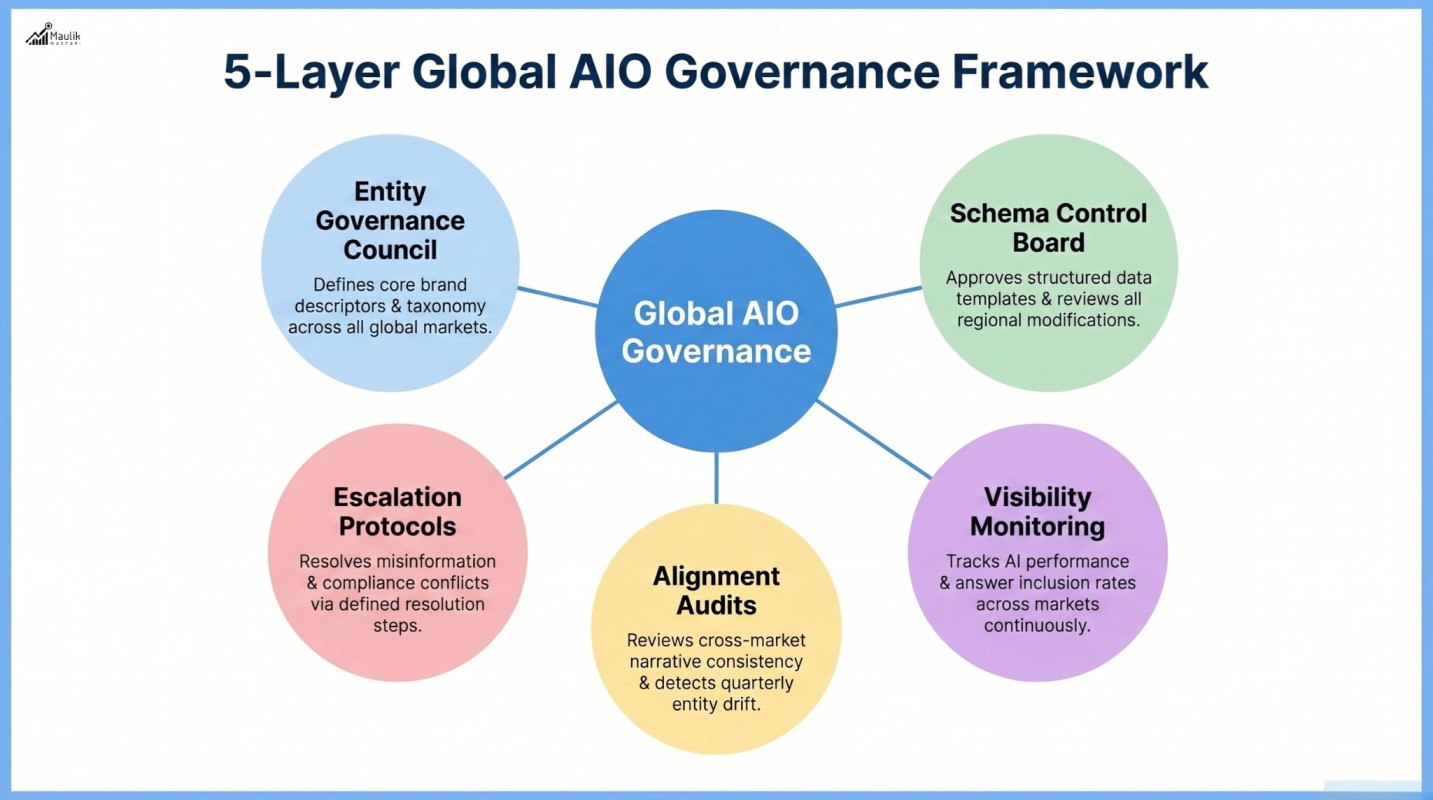
A mature global governance model for multi-brand AIO scaling includes:
1. Entity Governance Council
Defines and updates core brand descriptors, taxonomy and positioning.
2. Schema Control Board
Approves structured data templates and regional modifications.
3. Visibility Monitoring Framework
Tracks AI performance measurement across markets.
4. Quarterly Alignment Audits
Reviews cross-market narrative consistency.
5. Escalation Protocols
- Addresses misinformation, entity drift, or compliance conflicts.
- Governance does not mean bureaucracy. It means a predictable, repeatable scale.
- Enterprises that treat AI optimization as an operational discipline rather than a marketing tactic gain sustained visibility advantages.
- An effective enterprise AIO framework transforms scaling from campaign-based execution into infrastructure-based advantage.
FAQs
How to scale AIO internationally?
To scale AIO internationally, implement a hybrid model with centralized entity governance and decentralized regional execution. Align brand descriptors globally, layer local schema, test AI visibility across markets and establish formal governance processes.
What is multi-brand AIO scaling?
Multi-brand AIO scaling is the operational process of expanding AI optimization strategies across multiple brands or regions while maintaining entity consistency, structured clarity and AI visibility performance.
Why does regional entity alignment matter?
Regional entity alignment prevents brand fragmentation in AI-generated answers. Consistent descriptors across markets increase citation reliability and improve cross-model visibility.
How do enterprises measure AI global scaling success?
Enterprises measure success through cross-market answer frequency, citation consistency, entity salience tracking and structured performance dashboards comparing regional AI visibility metrics.
Conclusion
Scaling AIO across multiple brands or regions requires a disciplined operational approach rather than isolated marketing initiatives. Enterprises must create a unified framework that maintains consistent entity definitions, structured data standards and brand messaging while still allowing regional teams to adapt content for local markets.
As generative search continues to influence how information is surfaced, businesses that invest in structured alignment and regional entity consistency will gain a significant advantage. Effective multi-brand AIO scaling ensures that a company’s authority and positioning remain intact across global AI ecosystems