
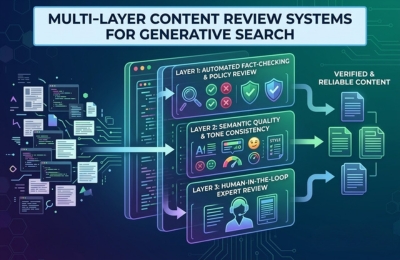
In an AIO and GEO-driven search landscape, content must pass more than a single editorial check. A structured generative content review system built on structural clarity, factual validation, entity alignment, and AI simulation testing ensures governance, protects brand authority, and strengthens AI citation reliability. A layered AI content review pipeline is no longer optional; it is foundational to generative visibility.
Multi-Layer Review Systems
Artificial Intelligence Optimization (AIO) and Generative Engine Optimization (GEO) have fundamentally changed how content is surfaced.
Instead of ranking pages based purely on backlinks and keyword density, generative engines interpret meaning, extract definitions, and synthesize summaries. In this environment, your content is not just indexed; it is reconstructed.
That is why governance-driven generative content review systems are critical.
If AIO is about optimizing for AI interpretation, and GEO is about optimizing for generative engine extraction, then review infrastructure becomes the enforcement layer of that strategy.
A modern review system ensures:
- Structural extractability
- Factual reliability
- Semantic consistency
- AI-safe summarization
This aligns directly with responsible AI principles emphasized in frameworks like OpenAI’s Responsible AI guidelines, which prioritize accuracy, transparency, and risk mitigation.
Operational governance is now part of the search strategy.
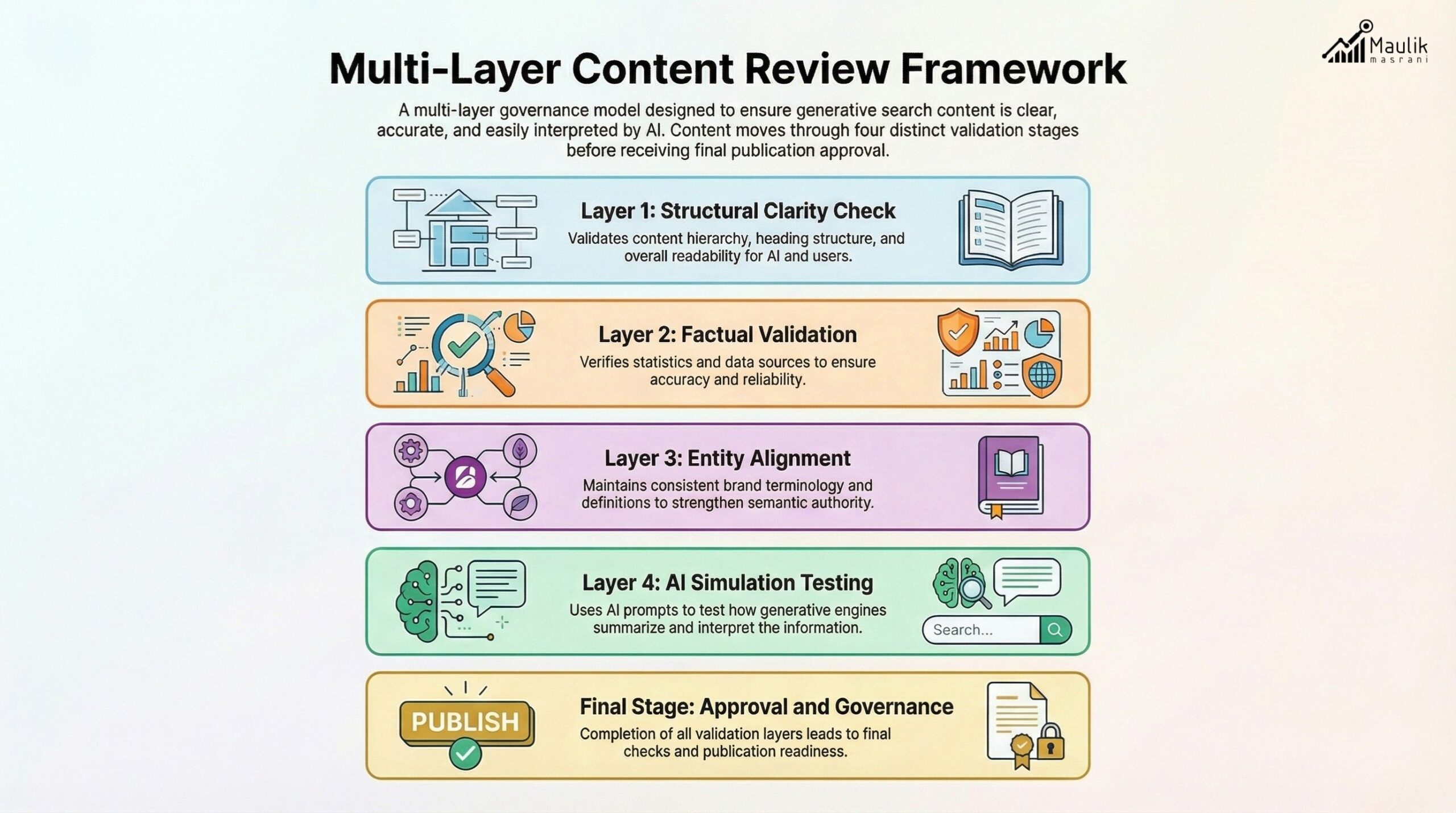
Why single-review models fail
The traditional workflow—Draft → Editor → Publish—breaks in AIO environments.
Here’s why:
1. Generative compression risk
AI engines compress complex information into summaries. If the structure is weak or definitions are unclear, your brand message can be misrepresented.
2. Entity fragmentation
If your content describes the same framework differently across pages, generative engines may treat them as separate entities, weakening authority signals.
3. GEO inconsistency penalties
Generative engines prioritize clarity and coherence. Inconsistent headings, buried definitions, or vague terminology reduce extractability.
4. Governance gaps
Without documented multi-stage QA, factual drift and outdated statistics accumulate over time.
AIO is not just about creation; it is about sustained interpretability.
Single-layer review is reactive. Multi-layer review is systemic.
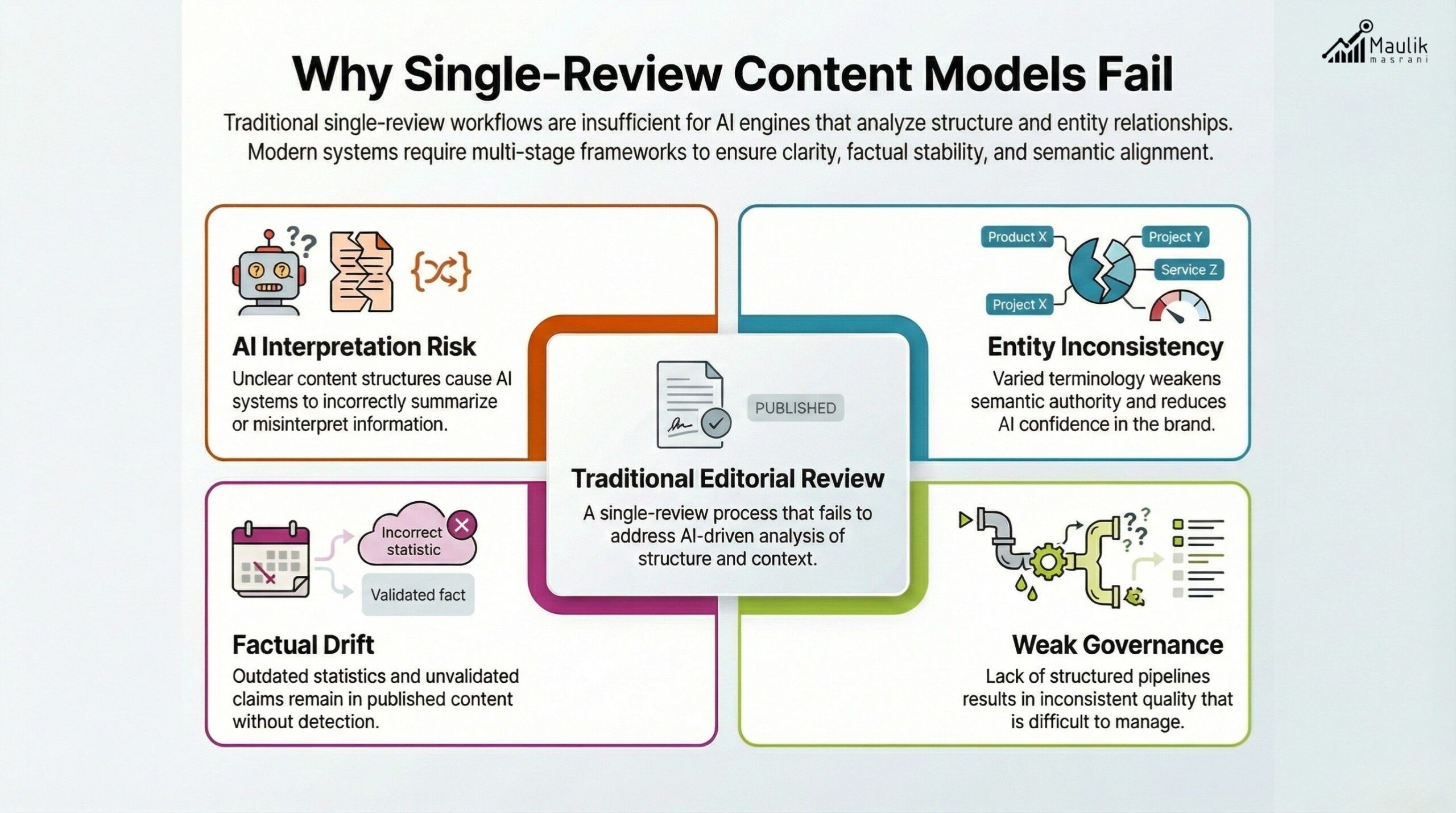
Layer 1: Structural clarity check
AIO begins with structure. Before validating facts or entities, you must ensure AI systems can parse your content hierarchy.
This layer evaluates:
- Clear H1-H3 architecture
- Definition-first writing
- Concise paragraph formatting
- Scannable bullet lists
- Logical content progression
For example, if a page defines “Generative Optimization” halfway through the article instead of near the top, AI extraction engines may misframe the entire topic.
Structural clarity checklist:
- Is the primary concept defined within the first 150 words?
- Are headings descriptive and intent-aligned?
- Does each section stay topically focused?
- Are key insights extractable in 1–2 sentences?
Strong structure increases GEO performance because generative engines favor predictable semantic patterns.
This stage is mandatory in any serious AI content review pipeline.
Layer 2: Factual validation
AIO without accuracy is reputational risk. Generative engines often reuse and propagate existing information.
If your content contains outdated or misinterpreted data, the error may multiply across AI-generated summaries.
A proper generative content review layer includes:
- Source verification
- Date validation
- Statistical accuracy confirmation
- Regulatory and compliance checks
- Context integrity checks
Example scenario:
Your content states that a specific industry is growing at 18% annually. The review must confirm:
- Original source
- Publication year
- Exact interpretation
- No inflated claims
Operational framework:
- Writers attach source documentation.
- Reviewers verify source context.
- Compliance validates regulatory alignment.
- Approved citations are logged for audit.
Factual governance strengthens AI trust signals and reduces long-term AEO risk (Answer Engine Optimization exposure).
Layer 3: Entity alignment
Entity alignment is the backbone of GEO. Generative engines rely heavily on entity graphs and semantic networks.
If your brand terminology varies across articles, AI systems struggle to confidently associate authority.
Common alignment failures:
- Inconsistent product naming
- Multiple descriptions of the same service
- Varying definitions across blogs
- Shifting brand positioning language
An entity alignment review checks:
- Terminology consistency
- Approved brand descriptors
- Standardized definitions
- Messaging coherence across content clusters
Operational best practices:
- Maintain a centralized glossary
- Create an approved messaging vault
- Define canonical descriptions
- Enforce entity consistency via a review checklist
In the AIO strategy, entity clarity equals authority stability. Without this layer, generative engines may fragment your brand identity.
Layer 4: AI simulation testing
This is the most advanced layer and the most underutilized.
AI simulation testing asks:
“How will generative engines interpret this content?”
Instead of only checking grammar or clarity, this layer evaluates interpretability.
Testing methods:
- Summarization prompts
- Featured snippet extraction tests
- Q&A simulation queries
- Entity association checks
- Definition compression tests
Example:
Prompt: “Summarize this article in two sentences.”
If the output distorts positioning, the content requires structural or clarity adjustment.
AI simulation testing ensures:
- Definitions are extractable
- Key takeaways are preserved
- Brand positioning remains intact
- No ambiguous phrasing leads to misinterpretation
This transforms multi-stage QA into proactive generative governance. AIO is incomplete without simulation validation.
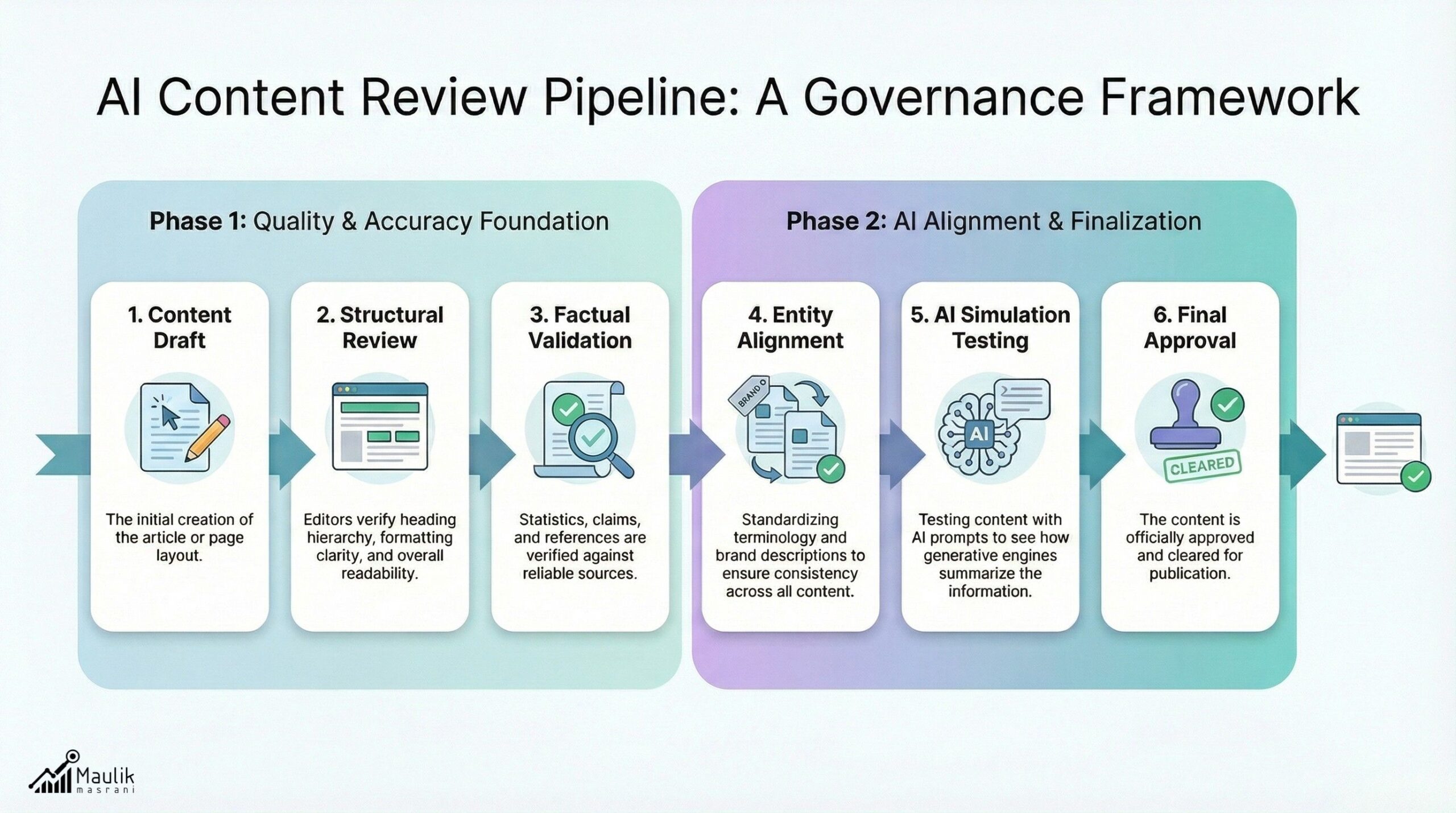
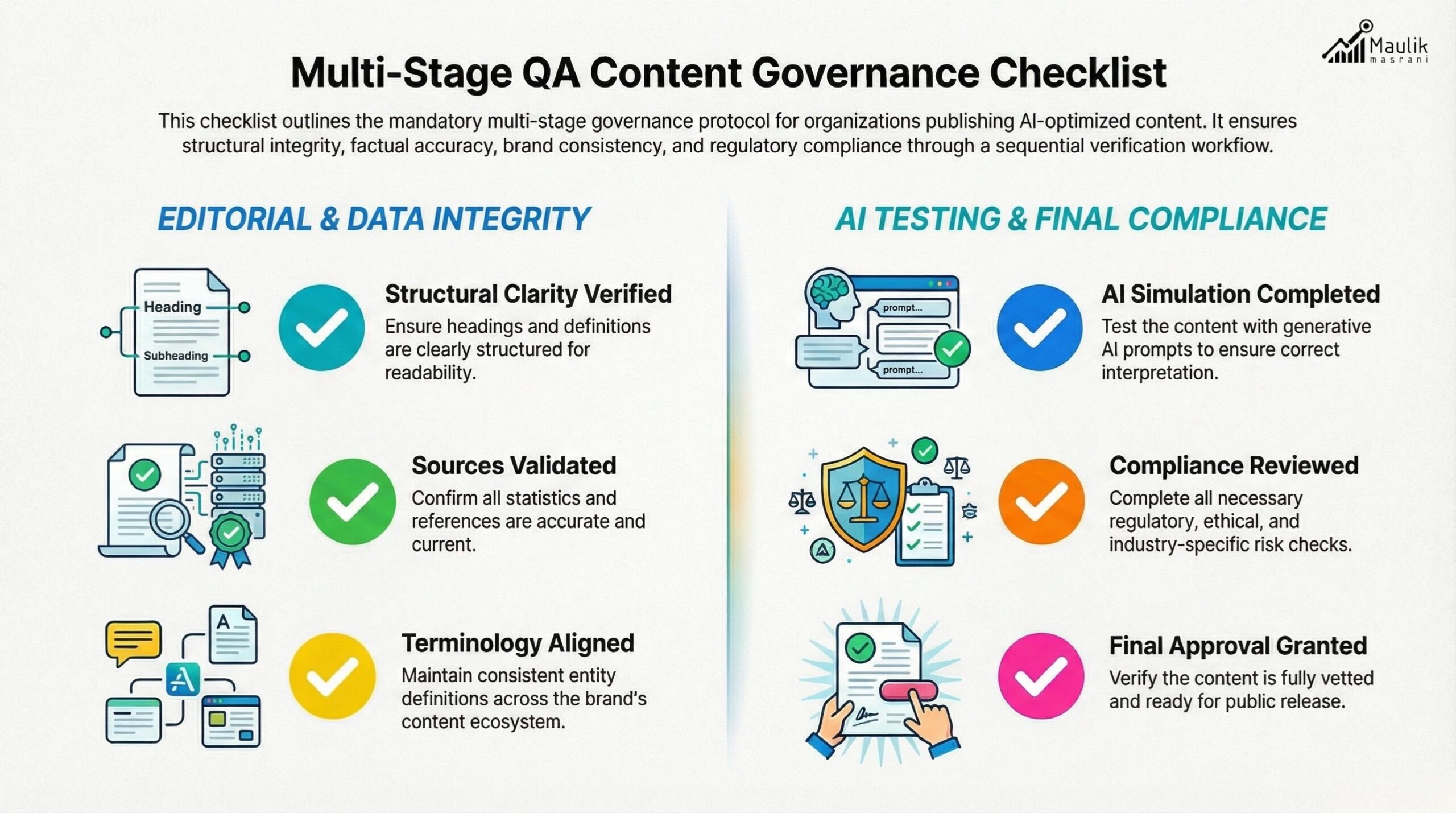
Final approval checklist
Governance must be operational, not theoretical.
Before publishing, confirm:
- Structural clarity approved
- Definition-first placement confirmed
- All data sources validated
- Terminology aligned with the entity glossary
- AI simulation test passed
- Compliance reviewed
- Internal consistency verified
- External references verified
Only then should publication proceed. In AIO and GEO frameworks, governance is not a bottleneck; it is a growth enabler.
FAQs
How to review AI-optimized content?
Review AI-optimized content using a multi-layer governance framework: structural clarity check, factual validation, entity alignment review, and AI simulation testing. This ensures AIO alignment and generative search reliability.
Why is multi-stage QA important for generative search?
Multi-stage QA prevents factual errors, strengthens entity consistency, and improves extractability in generative engines. It protects AI citation reliability and long-term GEO performance.
What is an AI content review pipeline?
An AI content review pipeline is a structured workflow that evaluates content across clarity, accuracy, semantic alignment, and AI simulation layers before publication to ensure governance and AI visibility.
How does AI simulation testing improve content quality?
AI simulation testing evaluates how generative systems summarize and interpret your content. It identifies ambiguity and misalignment before exposure in AI-driven results.
Conclusion
In an AIO and GEO-driven search environment, content governance is no longer optional; it is foundational. A structured, multi-layer generative content review system ensures your content remains accurate, aligned, and interpretable by AI engines.
By operationalizing a disciplined AI content review pipeline, brands protect authority, strengthen generative visibility, and build long-term trust in an ecosystem where interpretation defines impact.