
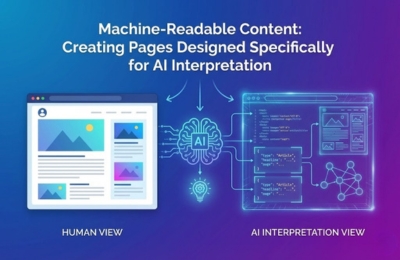
Machine-readable content is written and formatted so AI systems can interpret, extract and reuse information accurately, not just rank it. This guide explains how AI reads differently from humans, the formatting rules that matter and practical templates using bullets, tables and data blocks to improve AIO, AEO and GEO performance.
Machine Readable Content
Machine-readable content is content intentionally structured so that AI systems LLMs, answer engines, and generative search models can parse meaning without ambiguity. Unlike traditional SEO content optimized for scrolling and persuasion, machine-readable pages prioritize clarity, hierarchy, consistency and data structure.
As AI-powered search increasingly replaces classic SERPs, the ability to publish AI-readable pages determines whether your content is quoted, summarized, or ignored.
This is no longer optional. It is foundational to AIO formatting, entity SEO and long-term visibility inside generative answers.
How AI Reads Content Differently From Humans
Humans read contextually. AI reads structurally.
When an LLM scans a page, it does not “understand” tone, persuasion, or storytelling the way a human does. Instead, it looks for:
- Clear semantic boundaries
- Explicit definitions
- Predictable formatting patterns
- Stable relationships between entities, facts and attributes
AI models tokenize content, identify patterns and assign meaning based on structure and repetition not style.
For example:
- A human can infer meaning from a paragraph.
- AI prefers a definition followed by attributes, preferably in lists or tables.
This is why long, flowing prose often performs poorly in AI-generated answers, even if it ranks well traditionally.
Machine-readable content reduces:
- Hallucinations
- Misquoting
- Context collapse
And increases:
- Factual alignment
- Answer reuse
- Generative citation likelihood
Formatting Rules for AI Readability
If you want AI to reuse your content, formatting is not design, it is logic.
The following formatting rules consistently improve AI interpretation:
1. One Concept Per Section
Each heading should answer one specific question. Avoid mixing definitions, opinions and examples in the same block.
2. Predictable Heading Hierarchy
Use a strict H1, H3 structure. AI uses headings as semantic anchors.
3. Declarative Sentences
Statements like:
“Machine-readable content is content structured for AI interpretation.”
are far easier for AI to extract than exploratory or rhetorical phrasing.
4. Minimal Pronoun Dependency
Avoid excessive “this,” “that,” or “it.” AI prefers explicit nouns.
5. Consistent Terminology
If you use “machine-readable content,” do not alternate with multiple creative variants. Consistency improves entity stability.
These principles are core to structured content writing and directly influence how AI summarizes your page.
Using Bullets, Tables, and Data Blocks
AI systems strongly favor content that is pre-structured.
Bullets
Bullets work best for:
- Lists of attributes
- Step-by-step logic
- Comparisons
Example:
- Machine-readable content uses explicit structure
- AI-readable pages avoid ambiguous phrasing
- AIO formatting prioritizes consistency
Tables
Tables are ideal for relational data.
Content Element | Human Benefit | AI Benefit |
Headings | Skimmability | Topic segmentation |
Bullets | Clarity | Attribute extraction |
Tables | Comparison | Relationship mapping |
AI can extract tabular data with far higher accuracy than paragraphs.
Data Blocks
Short labeled blocks act like a pseudo-schema.
Definition: Machine-readable content
Purpose: Enable accurate AI interpretation
Primary Use: AIO, AEO, GEO visibility
These blocks dramatically improve reuse inside generative answers.
Building Machine-Readable Templates
The fastest way to scale AI-readable pages is to use repeatable templates.
Below is a proven machine-readable content template:
Section Template (Example)
Definition:
Clear, single-sentence explanation.
Key Attributes:
- Attribute one
- Attribute two
- Attribute three
Why It Matters for AI:
Short paragraph explaining AI relevance.
Related Concepts:
Internal links to entity SEO, AIO, AEO and GEO.
Templates reduce variability, something AI systems strongly prefer.
This approach also simplifies content governance across large sites and prevents contradictory phrasing that causes hallucinations.
Examples
Below are practical examples of machine-readable formatting applied correctly.
Example 1: Definition Block
Machine-readable content is content written and formatted so AI systems can parse, interpret and reuse information accurately without inference.
Example 2: Structured Comparison
- Human-optimized content prioritizes persuasion
- AI-readable pages prioritize structure and clarity
Example 3: Template-Based Section
Concept: AIO formatting
Goal: Improve AI interpretation
Method: Bullets, tables, stable headings
Each example follows the same structural logic, making it easy for AI to extract and summarize.
For technical standards on structured content and parsing, refer to authoritative documentation from MDN Web Docs.
FAQs
How to make content AI-friendly?
Use clear headings, declarative sentences, bullets, tables and consistent terminology so AI systems can parse meaning without ambiguity.
Why is machine-readable content important for AI search?
AI-generated answers rely on structured extraction. Pages without clear structure are less likely to be reused or cited.
Do bullets and tables really help AI?
Yes. Bullets and tables significantly improve AI’s ability to extract attributes and relationships accurately.
Is machine-readable content different from SEO content?
Yes. Traditional SEO focuses on rankings, while machine-readable content focuses on AI interpretation and reuse.