
Most SEO agencies are still optimizing for Google rankings, not AI answer engines like ChatGPT and Gemini. If your content isn’t structured for entity clarity, retrievability, and AI citations, you’re already losing visibility. This guide helps you audit your agency, identify gaps, and understand what SEO for ChatGPT actually requires in an AIO-driven search landscape.
The shift toward AIO is already reshaping how users discover and trust information. If your strategy isn’t aligned with AI systems, you risk disappearing from high-intent queries where decisions are made. Adapting early gives you a measurable advantage in visibility and authority.
Is Your SEO Agency Optimizing for AI?
There’s a structural shift happening in search, and most agencies are still playing by outdated rules.
Users are no longer just clicking links. They’re asking questions and getting direct answers from AI systems like ChatGPT, Gemini, and Perplexity. These systems don’t “rank” websites in the traditional sense. They retrieve, interpret, and synthesize information.
That’s where AIO (Artificial Intelligence Optimization) comes in.
If your agency isn’t actively optimizing your content for AI retrieval and answer generation, then your brand isn’t just underperforming; it’s being excluded from the environments where decisions are happening.
How AI Search Differs from Google
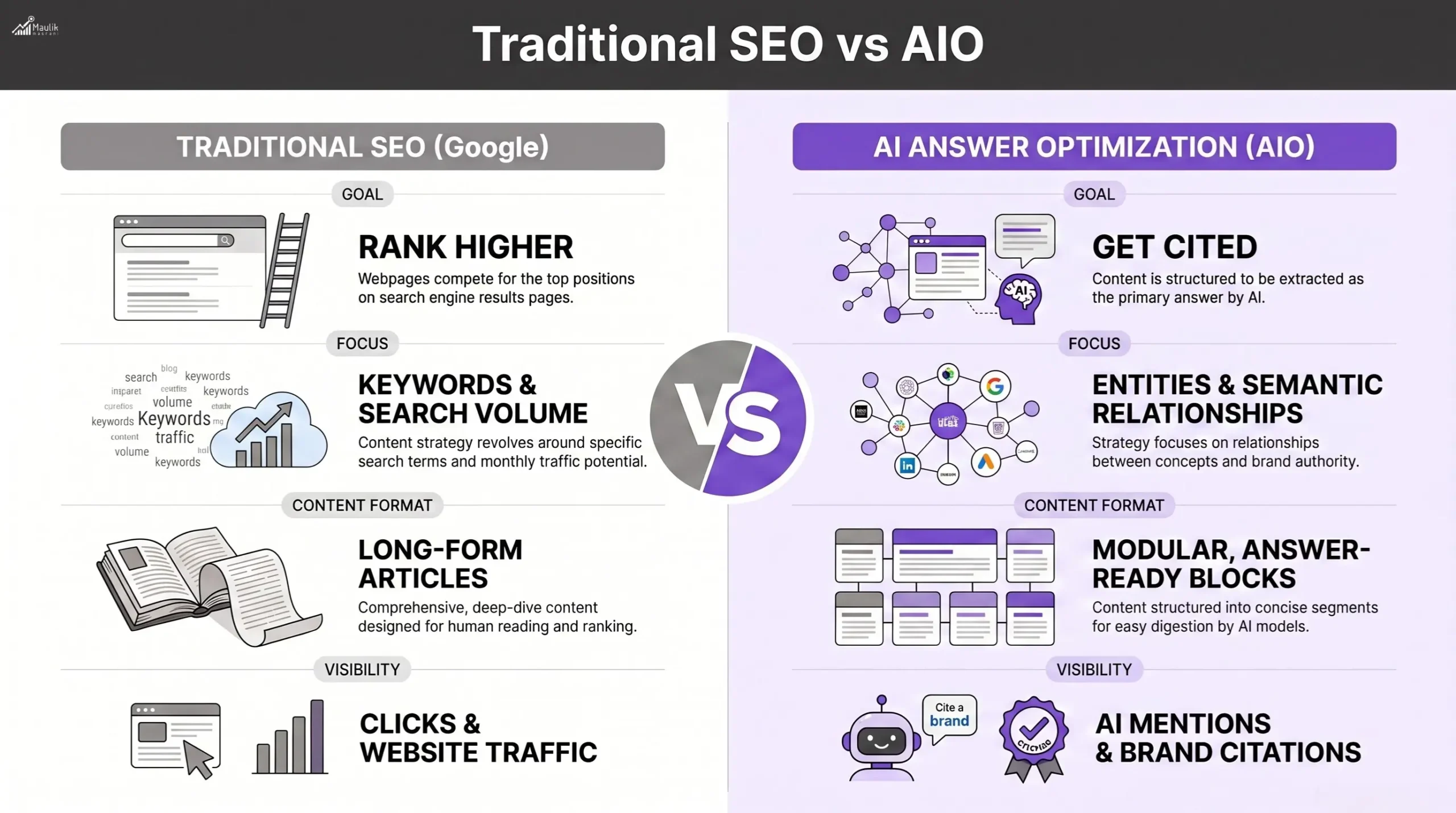
Traditional SEO was built around rankings. AIO is built around answer inclusion.
That distinction changes everything.
Core Differences Between Search and AIO
- Ranking vs Retrieval:
Google ranks pages. AI systems retrieve relevant fragments of content. - Keywords vs Entities:
Traditional SEO focuses on keywords. AIO prioritizes entities, relationships, and semantic clarity. - Clicks vs Citations:
Google drives traffic. AI platforms provide answers; your visibility depends on being cited or referenced.
For example, when a user asks ChatGPT a question, it doesn’t display ten links. It generates a response based on multiple sources. If your content isn’t structured for extraction, it won’t be used.
What This Means for Your Strategy
- Content must be written in answer-ready formats
- Structured data must support AI parsing
- Messaging must remain consistent across all platforms
7 Signs Your Agency Is Behind
If you’re unsure whether your agency understands AIO, these signs will make it clear.
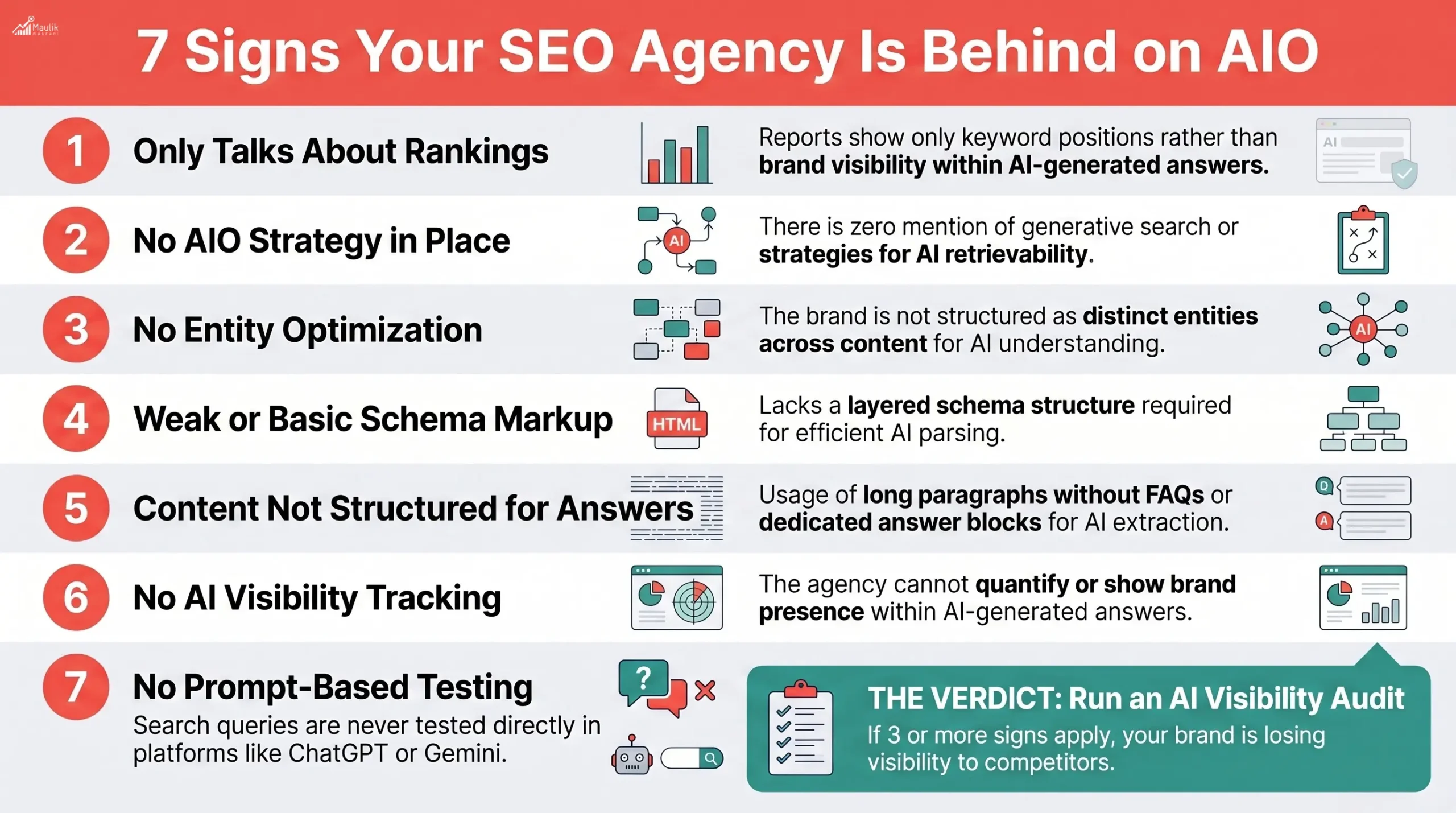
1. They Only Talk About Rankings
If your reports focus only on keyword positions and traffic, you’re missing AI visibility entirely.
2. No AIO Strategy
There’s no mention of AIO, AI retrievability, or generative search optimization. That’s a major red flag.
3. No Entity Optimization
Your brand, services, and expertise are not structured as entities across content. AI systems rely heavily on entity recognition.
4. Weak or Basic Schema
Using only a minimal schema is not enough. AIO requires a layered schema aligned with how AI interprets content.
5. Content isn’t structured for answers.
Long paragraphs without clear sections, summaries, or FAQs reduce your chances of being extracted into AI responses.
6. No AI Visibility Tracking
If your agency cannot show where your brand appears in AI-generated answers, they’re not optimizing for it.
7. No Prompt-Based Testing
Modern AIO workflows include testing prompts in ChatGPT or Gemini. Without this, your strategy is incomplete.
AI Visibility Audit Checklist
Before you invest further in SEO, you need clarity. This checklist helps you evaluate your current AIO readiness.
Content Layer
- Are your pages structured with clear headings and answer-based sections?
- Do you include direct, concise responses to key queries?
- Are FAQs present and optimized for extraction?
Entity Layer
- Is your brand consistently defined across your website and external platforms?
- Are your services clearly connected through semantic relationships?
Technical Layer
- Is the advanced schema implemented beyond the basics?
- Is your content easily crawlable and structured for parsing?
AIO Layer
- Have you tested your presence in ChatGPT or Gemini?
- Are you tracking mentions or citations in AI-generated answers?
What Modern SEO Should Include
Modern SEO is no longer just SEO; it’s AIO-driven.
To compete in AI search environments, your strategy must evolve across multiple layers.
1. Entity Optimization
Your brand must be clearly defined and consistently represented across all digital touchpoints. AI systems prioritize entities they can confidently understand.
2. Schema Engineering
Schema is no longer optional; it’s strategic infrastructure.
You need:
- FAQ schema for direct answers
- Article schema for contextual depth
- Organization schema for authority signals
3. Content Modularization
Content must be designed for extraction. That means:
- Short answer blocks
- Structured sections
- Clear hierarchy
This improves retrievability in AI responses.
4. AI Answer Simulation
Testing real prompts helps you understand:
- Whether your brand appears
- How your content is interpreted
- Where improvements are needed
5. Cross-Platform Consistency
AI models pull data from multiple sources. If your messaging is inconsistent, your authority weakens.
FAQs
Can agencies optimize for ChatGPT?
Yes, through AIO strategies. Agencies optimize content structure, entity clarity, and schema to improve retrievability and inclusion in AI-generated answers.
How do I check if my brand appears in AI answers?
Run real queries in ChatGPT, Gemini, or Perplexity and analyze whether your brand or content is referenced or reflected in the responses.
What is the biggest mistake in AI search optimization?
Treating AI like Google. AI systems don’t rank pages; they extract answers. Without structured content, you won’t be included.
How long does it take to see results?
AIO improvements can take time depending on how quickly your content, schema, and entity signals are updated and recognized by AI systems.
Conclusion
SEO hasn’t disappeared; it has evolved into something far more strategic. If your agency is still optimizing for rankings instead of retrievability, you’re missing where real visibility happens. The brands that succeed are those aligning with AIO principles, ensuring their content is structured, consistent and ready for AI-driven interpretation.
This shift is not optional anymore. It requires a deliberate move toward AI-first thinking, where content is built not just to rank, but to be selected, trusted, and reused by AI systems across platforms.