

AI-powered search and generative answer engines are transforming how users discover brands online. Instead of browsing multiple websites, users now rely on AI-generated summaries that synthesize information from multiple sources. Because of this shift, brand visibility has become more fragile. AI models may misinterpret, omit, or incorrectly associate brand data.
A structured generative visibility defense framework helps organizations protect their reputation across AI ecosystems by strengthening entity signals, monitoring generative responses, and implementing rapid recovery strategies. When deployed properly, this system becomes a powerful AI brand defense system and a practical AIO security blueprint for maintaining consistent brand visibility across modern AI discovery platforms.
Generative Visibility Defense Blueprint
The digital discovery landscape is undergoing a major transformation. Instead of traditional search results pages where users compare multiple websites, AI systems now generate summarized answers that combine information from various online sources.
This change means brands are no longer evaluated only by search rankings. Instead, AI systems interpret brand identity through multiple signals such as entity relationships, semantic context and knowledge graph connections.
Because generative models rely on probabilistic interpretation, even small inconsistencies across digital platforms can influence how a brand appears in AI-generated responses. A company with strong SEO may still experience inaccurate representation if its entity signals are fragmented across the web.
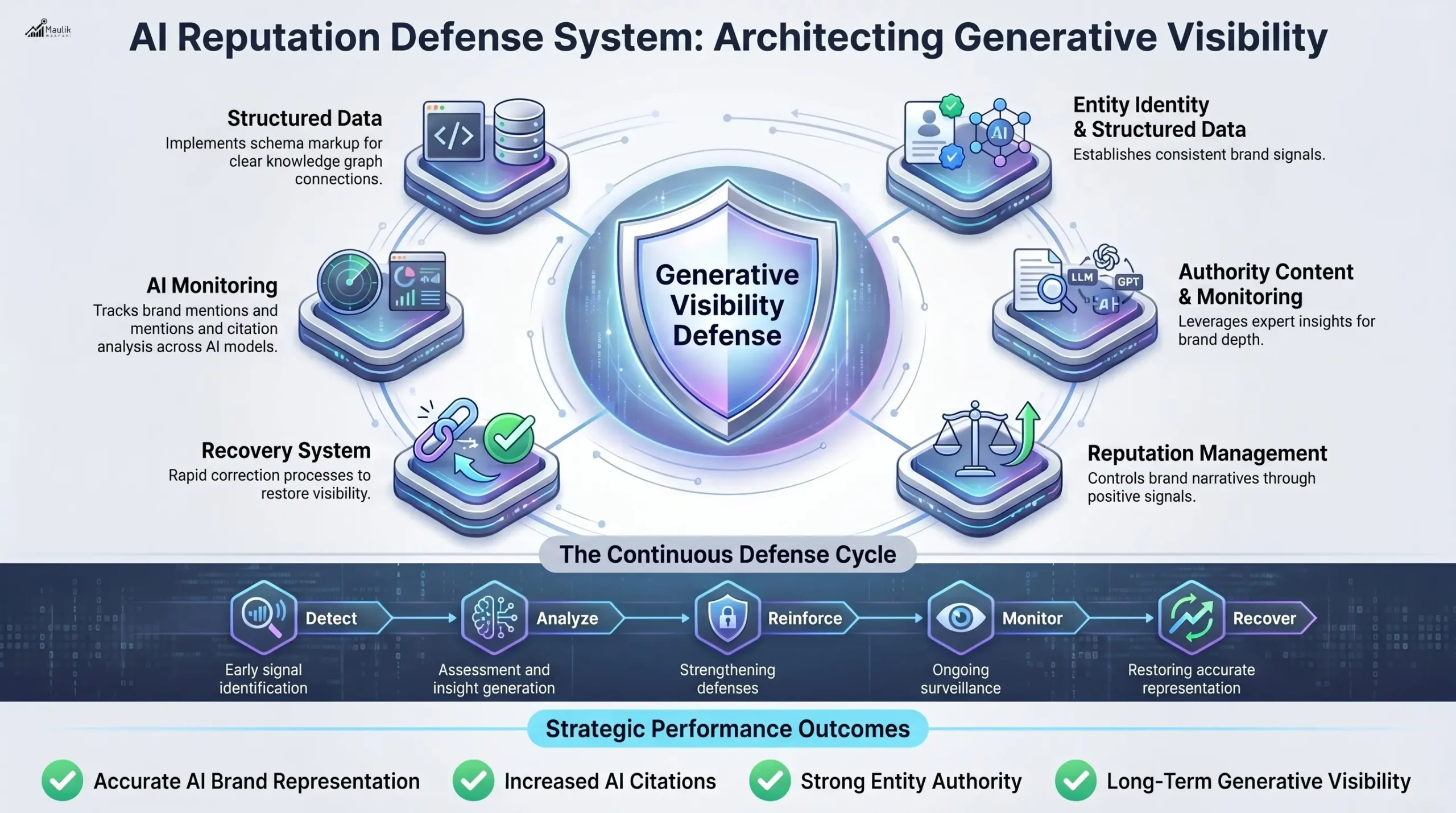
A generative visibility defense framework solves this problem by creating a structured system that protects brand interpretation across AI ecosystems. Instead of focusing only on website optimization, the framework aligns brand authority signals across multiple channels.
This blueprint integrates three critical strategic layers:
- Entity clarity
Ensuring that AI systems clearly understand the brand’s identity, services, and relationships. - Authority reinforcement
Publishing expert content and authoritative references that strengthen credibility. - Monitoring systems
Tracking how AI models describe and recommend the brand across platforms.
When these elements work together, organizations can maintain consistent visibility across AIO, GEO, and AEO environments.
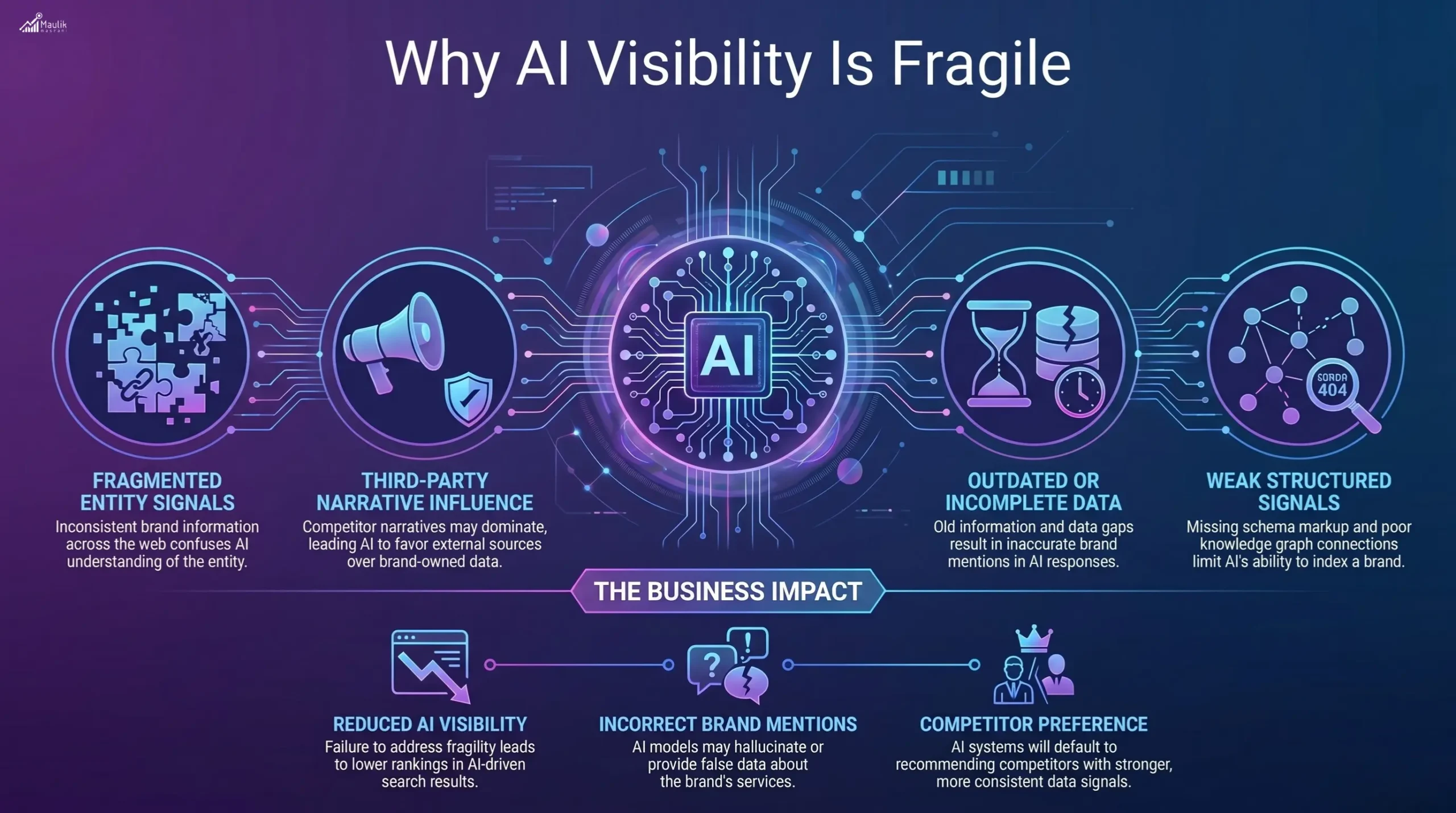
Why AI Visibility Is Fragile
AI-generated answers behave differently from traditional search results. Instead of listing pages, generative systems synthesize information and produce a single consolidated response.
This process introduces several vulnerabilities that can affect brand visibility.
Fragmented entity signals
AI models rely on entity relationships to understand organizations. If brand information differs across directories, media coverage, and websites, AI systems may struggle to interpret the correct entity.
Third-party narrative influence
Generative platforms frequently rely on publicly available information. If competitors dominate industry discussions or authoritative publications, their narratives may influence AI responses more strongly.
Outdated or incomplete data
Even a single outdated source can propagate incorrect information across generative responses, especially if that source appears frequently in training data.
Weak structured signals
Without structured data signals such as schema markup, AI systems may struggle to understand relationships between organizations, services, and expertise areas.
These issues explain why many organizations are now adopting AEO and GEO optimization strategies to strengthen entity clarity and improve generative visibility.
Common symptoms of fragile AI visibility include:
- AI assistants recommending competitors instead of the intended brand
- Incomplete or inaccurate descriptions in AI responses
- Reduced presence in AI-generated industry comparisons
Recognizing these vulnerabilities is the first step toward implementing a comprehensive AI brand defense system.
10-Step Defense Architecture
A robust generative visibility defense framework is built on multiple reinforcement layers. Each layer strengthens the signals that generative platforms use to interpret brand information.
Below is a structured architecture used by organizations implementing an AIO security blueprint.
| Step | Defense Layer | Purpose |
| 1 | Entity Identity Mapping | Define a clear brand identity across digital platforms |
| 2 | Narrative Alignment | Maintain consistent messaging across channels |
| 3 | Structured Data Reinforcement | Help AI models interpret brand relationships |
| 4 | Authority Publishing | Strengthen credibility through expert content |
| 5 | Knowledge Graph Reinforcement | Improve recognition in AI systems |
| 6 | Cross-Model Testing | Evaluate brand perception across AI platforms |
| 7 | AI Citation Monitoring | Track references to the brand in AI answers |
| 8 | Reputation Signal Management | Maintain strong external brand mentions |
| 9 | Content Reinforcement Clusters | Build topical authority through related content |
| 10 | Defensive Publishing | Release authoritative updates regularly |
Rather than operating independently, these layers work together as an integrated defense architecture.
For example:
- Entity mapping strengthens how AI systems identify the brand.
- Authority publishing improves trust signals.
- Monitoring tools detect changes in AI-generated responses.
Over time, these signals form a strong semantic network around the organization, helping generative systems consistently interpret the brand as an authoritative source.
Monitoring & Escalation Systems
Building a defense architecture is only part of the solution. Continuous monitoring ensures that AI systems continue to interpret the brand accurately.
Monitoring systems track how generative platforms respond to brand-related queries. This involves testing prompts across multiple AI systems and analyzing how the brand appears in generated responses.
Organizations typically evaluate questions such as:
- Which companies are leaders in a specific industry
- What services a particular brand provides
- Which organizations are recommended for certain solutions
These queries reveal how AI systems position the brand relative to competitors.
A structured monitoring system typically includes three operational components:
AI response testing
Evaluating how different generative models describe the brand.
Citation frequency tracking
Measuring how often AI systems reference the organization.
Sentiment observation
Identifying whether AI responses describe the brand positively, neutrally, or negatively.
When inconsistencies appear, escalation protocols allow organizations to respond quickly by reinforcing entity signals and publishing corrective content.
Many enterprises now perform quarterly AI reputation audits to ensure their generative visibility defense system remains effective.
Recovery Acceleration Model
Even well-protected brands may experience temporary visibility disruptions when AI models update their training data or interpret new information.
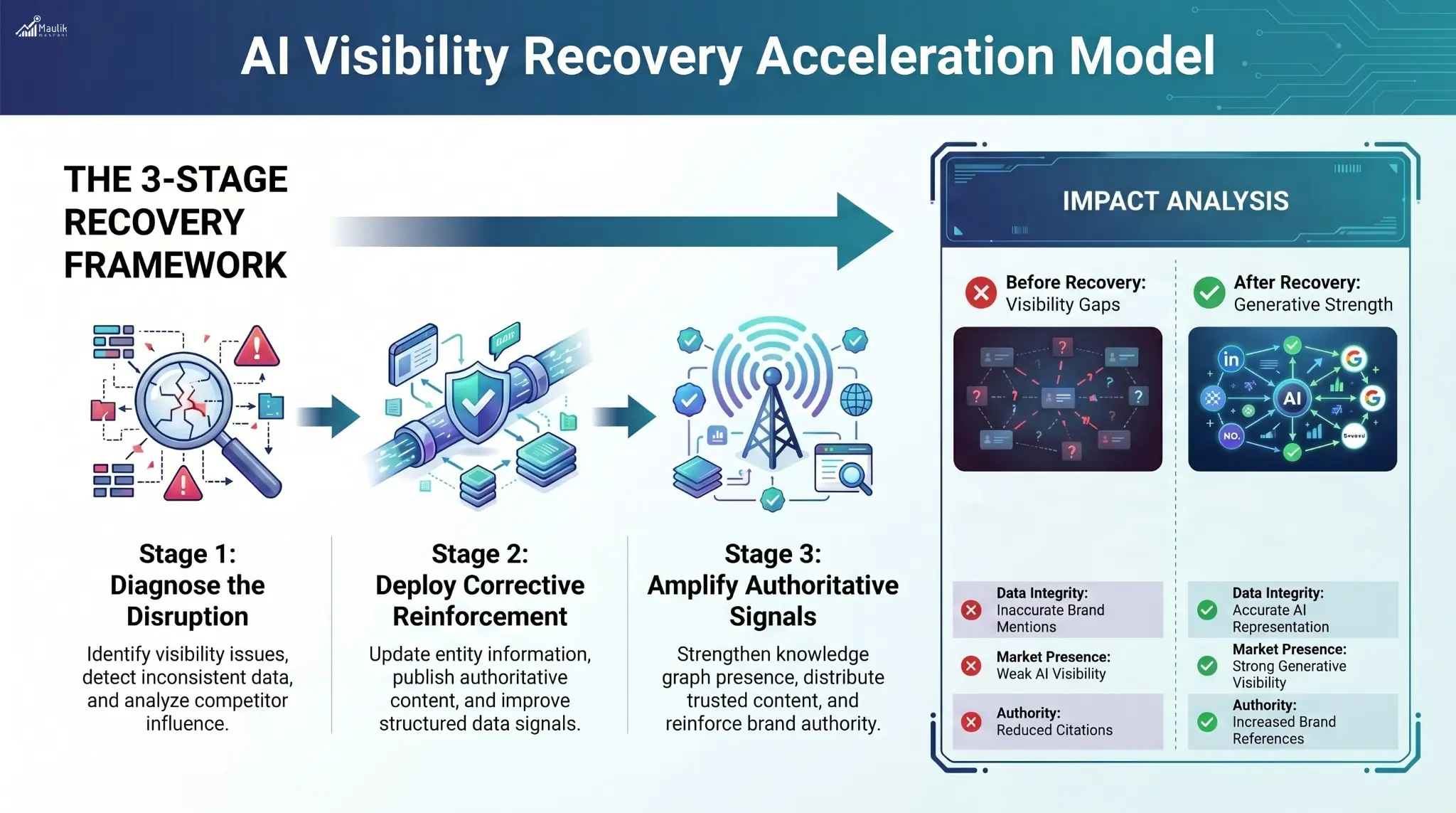
The recovery acceleration model focuses on restoring accurate AI visibility quickly through structured reinforcement.
The process usually unfolds in three stages.
Stage 1 – Diagnose the disruption
Organizations first identify the root cause of the visibility change. Possible factors include inconsistent data, emerging competitor authority signals, or outdated information sources.
Stage 2 – Deploy corrective reinforcement
Corrective content is published to clarify the brand narrative and strengthen entity relationships. This often includes authoritative articles, updated brand descriptions and improved structured data signals.
Stage 3 – Amplify authoritative signals
Corrected information is distributed across trusted platforms and knowledge sources so that AI systems encounter consistent reinforcement signals.
Research in AI visibility optimization suggests that brands implementing structured recovery strategies often restore stable AI mentions significantly faster than those relying on passive SEO alone.
Long-Term Stability Framework
Protecting generative visibility requires continuous governance rather than one-time optimization.
A long-term stability framework integrates AI reputation management into everyday marketing and content strategies.
The framework typically focuses on three ongoing priorities.
Continuous authority building
Publishing research-driven insights and expert commentary strengthens semantic authority across AI systems.
Entity consistency maintenance
Ensuring that brand information remains consistent across directories, media mentions, and websites helps AI models maintain accurate entity associations.
Generative monitoring governance
Regular cross-platform testing allows organizations to detect shifts in AI interpretation early and respond before visibility declines.
Organizations that maintain these practices often experience a steady increase in AI citations and brand references across generative platforms.
Over time, this consistent reinforcement transforms a defensive strategy into a sustainable competitive advantage.
FAQs
What is a generative defense strategy?
A generative defense strategy is a structured system designed to protect how a brand is represented across AI search engines and language models. It combines entity optimization, authority signals, and monitoring tools to stabilize visibility in AI-generated answers.
Why is AI visibility important for businesses?
AI visibility determines how brands appear in generative answers and recommendations. Strong visibility increases credibility, improves discovery, and strengthens customer trust.
How can companies monitor their AI reputation?
Companies can monitor their AI reputation by testing brand-related prompts across multiple AI systems, analyzing generated responses, and tracking citation frequency over time.
How does AEO or GEO help protect brand visibility?
AEO and GEO strategies structure content so that AI systems can easily interpret and reference it. This improves the likelihood that generative platforms represent the brand accurately in their responses.
Conclusion
The shift toward generative search has fundamentally changed how brand reputation is formed online. Visibility now depends not only on rankings but also on how AI systems interpret entity relationships, authority signals, and narrative consistency. A structured generative visibility defense framework helps organizations protect their digital reputation across rapidly evolving AI ecosystems.
By implementing a robust AI brand defense system, businesses can maintain consistent visibility across AIO, GEO, and AEO environments. With strong entity reinforcement, continuous monitoring, and strategic recovery protocols, organizations can ensure that AI platforms accurately represent their brand and expertise in the years ahead.