
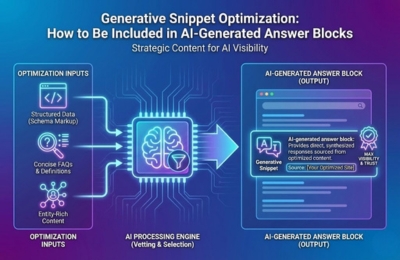
Generative snippet optimization is about structuring and validating your content so AI systems (Google AI Overviews, LLMs, answer engines) can confidently extract, summarize, and cite it in AI-generated answer blocks. Winning these snippets requires clarity, structure, entity consistency, and answer-first formatting, not just rankings.
What Are Generative Snippets?
Generative snippets are AI-generated answer blocks created by large language models (LLMs) and search systems that synthesize information from multiple trusted sources into a single response. Unlike traditional featured snippets that quote one page verbatim, generative snippets rewrite, condense, and contextualize content in real time.
These snippets now appear in:
- Google’s AI Overviews
- Conversational AI tools like ChatGPT, Gemini, and Perplexity
- Voice and assistant-based search results
From an optimization standpoint, this means visibility is no longer tied only to blue links. Instead, LLM summary inclusion depends on how well your content can be understood, verified, and reused by AI systems.
How AI Creates Snippets
AI-generated snippets follow a multi-step evaluation process that goes beyond crawling and indexing.
First, AI systems parse your content semantically. They identify definitions, explanations, steps, and relationships between concepts rather than just keywords. This is why loosely written or overly promotional content rarely qualifies.
Next, the AI compares your information with other indexed sources. If your explanation aligns with the broader consensus and is expressed clearly, it becomes a candidate for reuse.
Finally, the AI synthesizes the answer. Instead of copying your text, it rewrites the information into a neutral, concise summary designed to directly satisfy user intent.
This is where synthetic answer SEO differs from traditional optimization: the AI cares more about accuracy and clarity than originality of phrasing.
Why Some Brands Appear in AI Answers
Not all high-ranking pages are used in AI snippets. Brands that consistently appear in AI answers tend to share a few traits.
They explain topics in a direct, educational manner, often leading with definitions or structured explanations. Their content is also internally consistent, meaning the same concepts are described the same way across blogs, landing pages, and FAQs.
Another major factor is entity trust. When a brand is mentioned across multiple authoritative contexts, AI systems are more confident using its explanations. This is why aligning your content with AIO, AEO & GEO, and machine-readable structures matters more than raw backlink volume.
In short, AI snippet ranking favors brands that act like reference sources, not advertisers.
How to Optimize Your Content for Generative Snippets
Effective generative snippet optimization starts with changing how you write, not just what you rank for.
Begin by answering the core question immediately. The first 40–60 words of a section should clearly define or explain the concept in plain language. Avoid metaphors, fluff, or long introductions before the answer.
Next, structure your content so AI can easily extract meaning. Clear subheadings, concise paragraphs, and logical flow help LLMs isolate usable passages.
You should also reinforce semantic signals through internal linking. Connecting this content to related topics like AIO for small business, AIO, and AEO & GEO helps AI understand topical depth and authority.
Finally, validate your content against authoritative references. Aligning explanations with guidance from sources such as the Google AI Overviews documentation reduces the risk of contradiction and increases reuse confidence.
Formats AI Prefers (Bullets, Definitions, Step-by-Step)
AI systems consistently prefer formats that reduce ambiguity and cognitive load.
Definitions work exceptionally well. A single-sentence explanation followed by a short expansion gives AI both a summary and context.
Bulleted lists help AI break complex ideas into reusable components, especially for comparisons, benefits, or criteria-based answers.
Step-by-step formats are ideal for instructional or process-driven queries. Numbered steps clearly indicate sequence, making them easy for LLMs to paraphrase accurately.
Paragraph-heavy content without visual or structural cues is far less likely to be selected for LLM summary inclusion, even if it ranks well organically.
Examples
Below are examples of content structures that are frequently reused in AI-generated answer blocks.
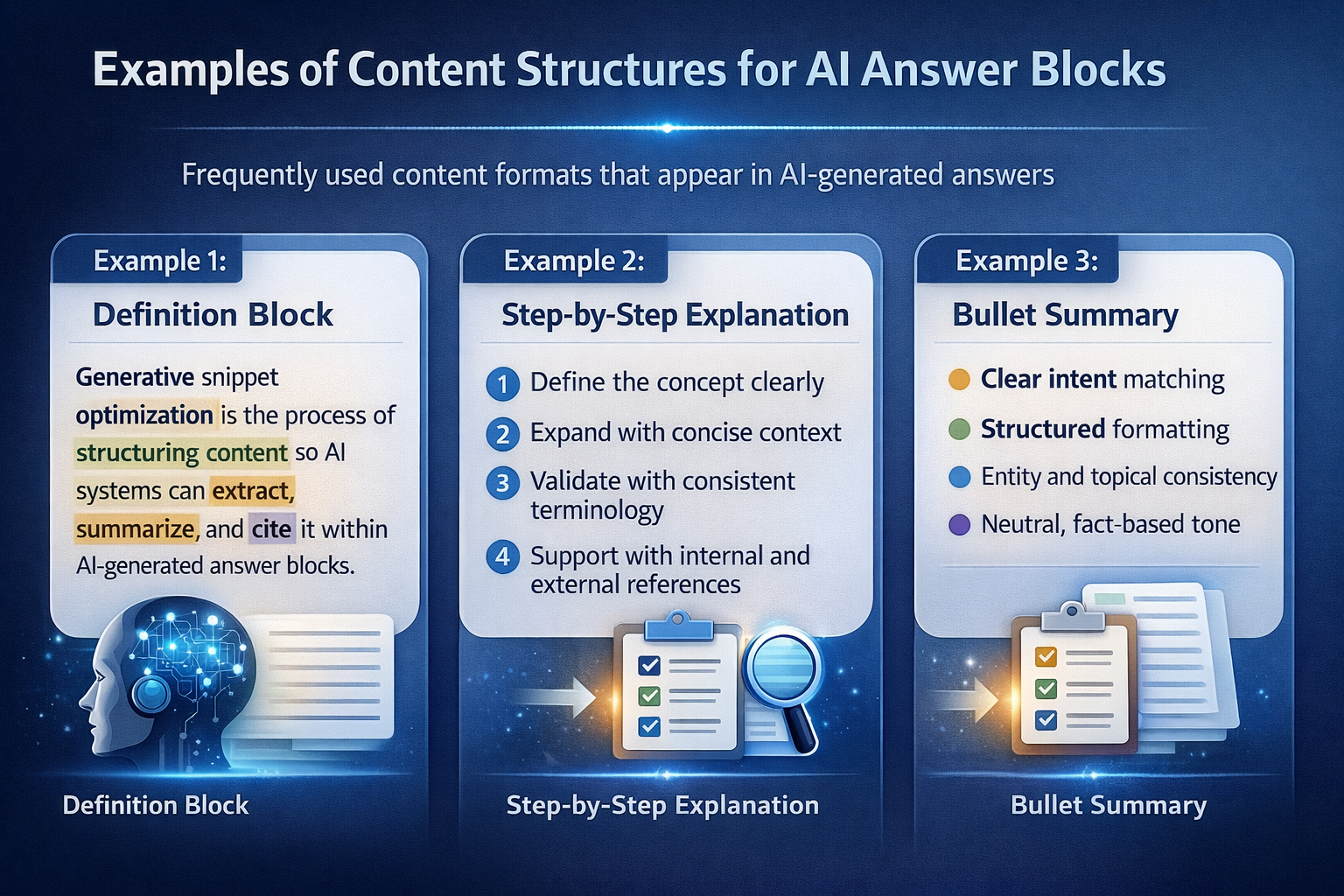
Example 1: Definition Block
“Generative snippet optimization is the process of structuring content so AI systems can extract, summarize, and cite it within AI-generated answer blocks.”
Example 2: Step-by-Step Explanation
- Define the concept clearly
- Expand with concise context
- Validate with consistent terminology
- Support with internal and external references
Example 3: Bullet Summary
- Clear intent matching
- Structured formatting
- Entity and topical consistency
- Neutral, fact-based tone
These formats reduce friction for AI systems and increase the likelihood of inclusion in synthetic answers.
FAQs
How do I appear in AI-generated snippets?
Structure your content with clear definitions, concise explanations, and consistent terminology so AI systems can confidently summarize it.
Are traditional rankings still important for AI snippets?
Yes, but rankings alone are not enough. AI systems prioritize clarity, accuracy, and semantic alignment over position.
Does schema markup help with generative snippets?
Schema improves machine understanding and context, which indirectly supports AI snippet eligibility.
Can small businesses compete in AI snippets?
Absolutely. Clear explanations and focused topical authority often outperform large brands with vague content.