
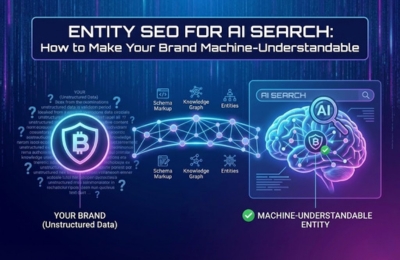
Entity SEO is no longer optional in an AI-first search landscape. Instead of ranking pages purely on keywords, modern search engines and LLMs rely on entities clearly defined by people, brands, organizations and concepts and their relationships.
This guide explains what entity SEO is, how AI uses entities, why they outperform keywords and how to audit, define and strengthen your brand entity for better AI visibility.
What Is Entity SEO?
Entity SEO is the practice of helping search engines and AI systems understand who or what your brand is, rather than just what keywords your pages target.
An entity is a uniquely identifiable concept, such as:
- A brand or company
- A person or expert
- A product or service
- A location or organization
In AI-powered search, your website is no longer interpreted as a collection of keyword-optimized pages. Instead, it is evaluated as a node in a broader knowledge graph, connected to other entities through relationships, attributes and context.
This shift is foundational to modern AI visibility, especially in generative results like AI summaries, conversational answers and overviews.
How AI uses entities
AI systems do not “read” content the way humans do. They model information.
Large language models and search engines:
- Identify entities mentioned in your content
- Map them to known entities in knowledge graphs
- Analyze how those entities relate to one another
- Decide whether your brand is authoritative enough to be referenced or cited
For example, when AI encounters your brand name, it looks for:
- Consistent naming across the web
- Clear classification (company, service provider, software, etc.)
- Connections to recognized topics, industries and people
This is why AIO entities and knowledge graph SEO are now core to AI visibility. AI systems prefer brands that are clearly defined and well-connected, not just keyword-rich.
Why entities matter more than keywords
Keywords describe topics. Entities define meaning.
In traditional SEO, ranking depended heavily on:
- Keyword placement
- On-page optimization
- Backlinks to pages
In AI-driven search, visibility depends more on:
- Entity clarity
- Entity authority
- Entity relationships
A keyword can be ambiguous. An entity is not.
For instance, a keyword like “AI optimization” can mean many things. A defined brand entity associated with AI optimization services, supported by consistent signals, becomes a trusted reference point.
This is why brand entity optimization often outperforms keyword-only strategies in AI answers, summaries and overviews.
How to define your entity
Defining your entity means removing ambiguity.
At a minimum, AI should clearly understand:
- Your official brand name
- What type of entity are you
- What you are known for
- Which industry or domain do you belong to
Practical ways to define your entity include:
- Consistent brand naming across your website
- Clear “about” and positioning language
- Structured data that explicitly declares who you are
- Contextual mentions that reinforce your expertise
This process directly supports entity SEO by making your brand machine-understandable instead of inference-based.
Strengthening entity relationships
Entities gain authority through relationships.
AI evaluates not only what you say about yourself, but also:
- Which entities mention you
- Which topics are you repeatedly associated with
- How closely you align with recognized concepts and domains
To strengthen entity relationships:
- Associate your brand with specific industries and services consistently
- Reference relevant concepts and technologies in a stable, repeatable way
- Build content clusters that reinforce the same entity-topic relationships
Over time, this creates stronger signals for knowledge graph SEO, helping AI confidently position your brand within its understanding of the domain.
How to fix entity conflicts
Entity conflicts occur when AI receives mixed or contradictory signals.
Common causes include:
- Inconsistent brand names or spellings
- Multiple versions of your business identity
- Conflicting descriptions across platforms
- Overlapping positioning with unrelated topics
To resolve entity conflicts:
- Standardize your brand name and descriptors everywhere
- Align your messaging across pages and platforms
- Remove unclear or diluted topical associations
- Ensure one dominant, authoritative representation of your brand
Reducing ambiguity is critical for brand entity optimization, especially when competing for AI-generated answers.
Entity audit checklist
Use this checklist to evaluate your current entity’s SEO readiness:
- Is your brand name consistent across all pages?
- Is your entity type clearly defined (company, service provider, platform)?
- Are your core topics and industries repeatedly reinforced?
- Do your pages reference the same primary concepts and relationships?
- Is structured data supporting entity clarity?
- Are there conflicting descriptions or mixed signals?
An entity audit is often the fastest way to identify why a brand struggles with AI visibility despite strong traditional SEO.
FAQs
How do entities affect AI ranking?
Entities help AI systems understand who is trustworthy. Brands with clearly defined entities and strong relationships are more likely to be referenced, summarized, or recommended in AI-generated results.
How do you build entity authority?
Entity authority is built through consistent identity signals, topical focus, structured data and repeated associations with relevant concepts and industries across content.
Is entity SEO different from traditional SEO?
Yes. Traditional SEO focuses on pages and keywords, while entity SEO focuses on meaning, identity and relationships, making it essential for AI-powered search.
How long does entity optimization take to work?
Entity signals compound over time. Improvements often appear gradually as AI systems gain confidence in your brand’s identity and relevance.