
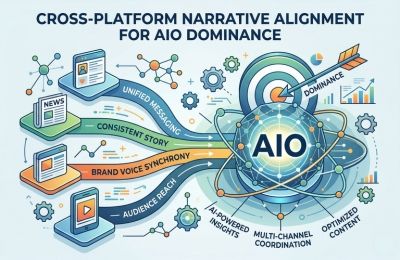
AI systems do not see your brand the way humans do; they assemble it from distributed signals. If your messaging varies across the website, LinkedIn, and YouTube, your entity profile weakens. Narrative alignment AIO creates structured coherence across platforms, strengthening entity optimization, improving generative visibility, and reinforcing AI trust. In the age of AI-driven discovery, consistency is a strategic infrastructure.
Cross-Platform Narrative Alignment
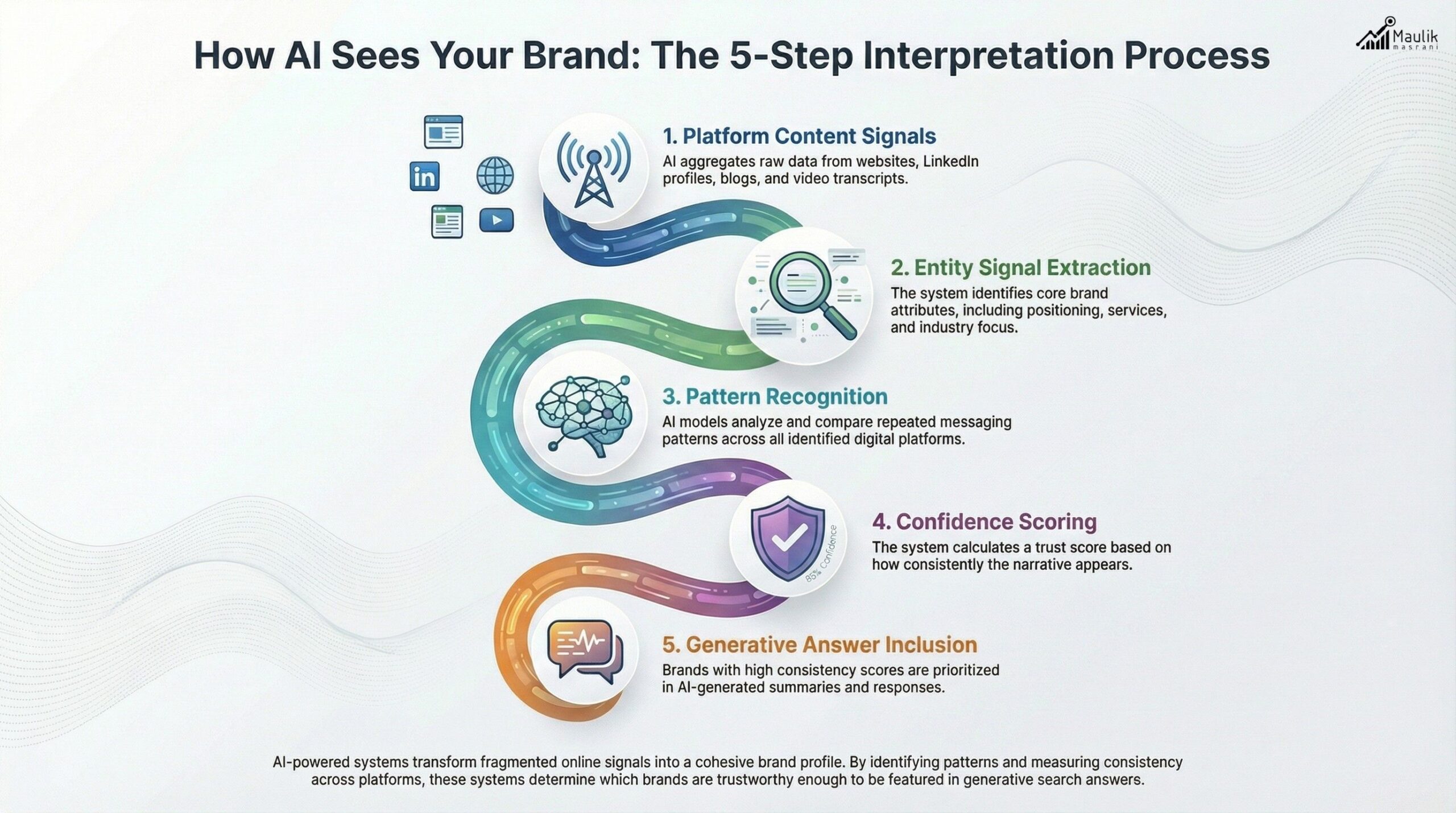
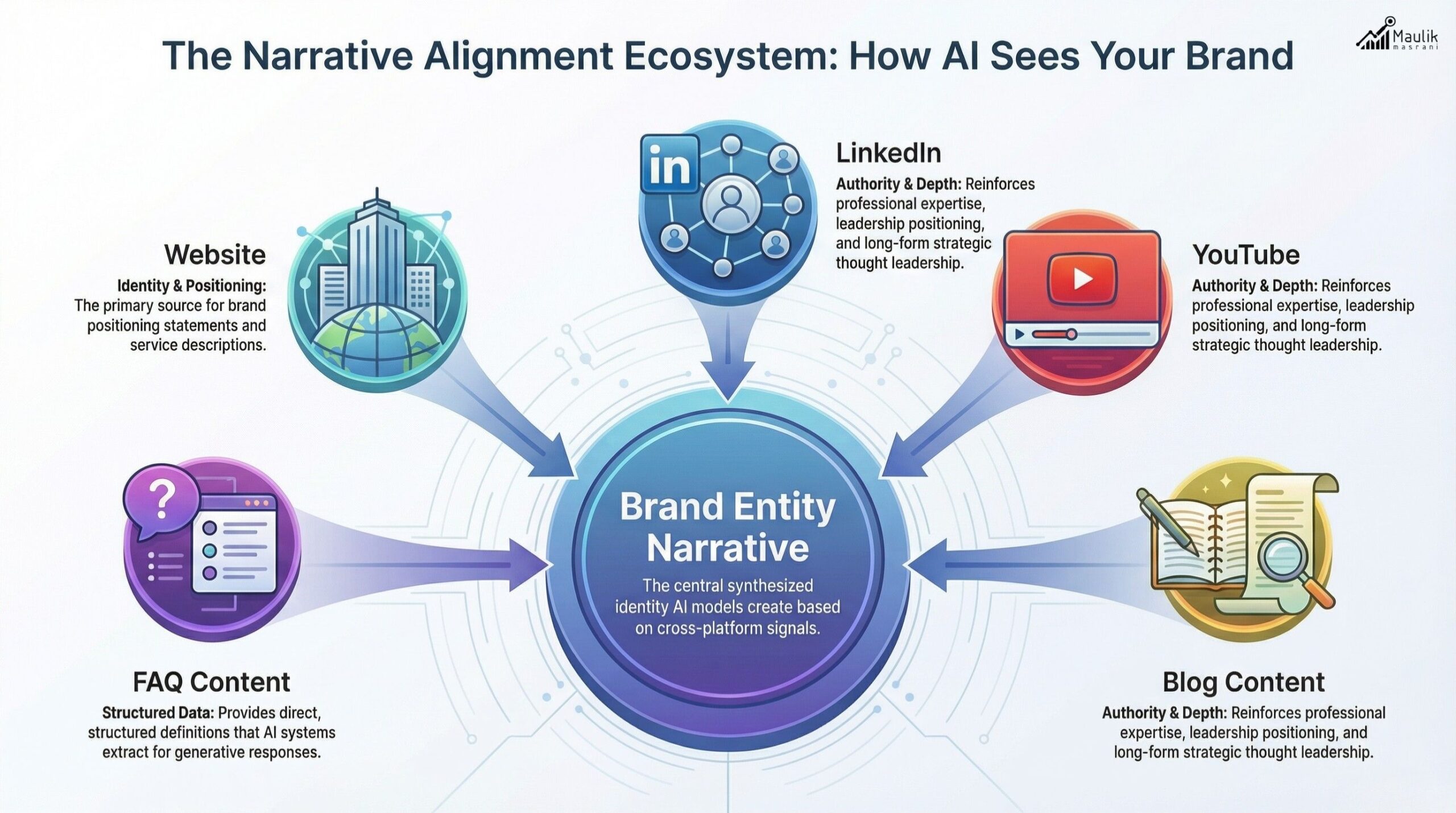
Search has evolved from keyword matching to entity modeling. Large language models now build probabilistic representations of brands based on distributed content signals. Every headline, bio, transcript, FAQ block, and metadata field contributes to how AI interprets your expertise, authority, and specialization.
This is where narrative alignment AIO becomes foundational. Narrative alignment is not repetitive branding. It is controlled semantic reinforcement. It ensures that every public-facing asset contributes to a unified entity definition.
When AI systems detect strong coherence across:
- Core positioning statements
- Service categorization
- Industry focus
- Terminology usage
- Definition structure
They increase entity confidence and retrieval likelihood.
In practical terms, aligned narratives result in:
- Higher inclusion in generative answers
- More stable entity recognition
- Reduced AI misclassification
- Improved contextual citation
Without alignment, AI systems assign diluted confidence scores. With alignment, your brand becomes structurally legible. AIO dominance begins with narrative discipline.
Why inconsistent messaging confuses AI
AI systems prioritize pattern stability. Humans tolerate nuance. Machines penalize divergence.
If your website emphasizes enterprise AI governance, your LinkedIn highlights startup growth hacking, and your YouTube channel centers on generic productivity advice, AI systems struggle to cluster your entity accurately.
The result:
- Reduced topical authority concentration
- Conflicting semantic categorization
- Lower retrieval probability in niche queries
- Fragmented knowledge graph associations
AI models weigh frequency and consistency. When positioning fluctuates, entity salience declines.
In observed generative outputs across industries, brands with synchronized messaging show materially stronger thematic clustering and more precise summaries. Those without alignment often receive diluted or inaccurate descriptions.
This is why cross-channel brand consistency is no longer a branding guideline; it is an AI ranking factor.
AI does not “interpret intent.” It aggregates statistical signals.
Inconsistent signals equal weakened authority.
Aligning website, LinkedIn, YouTube
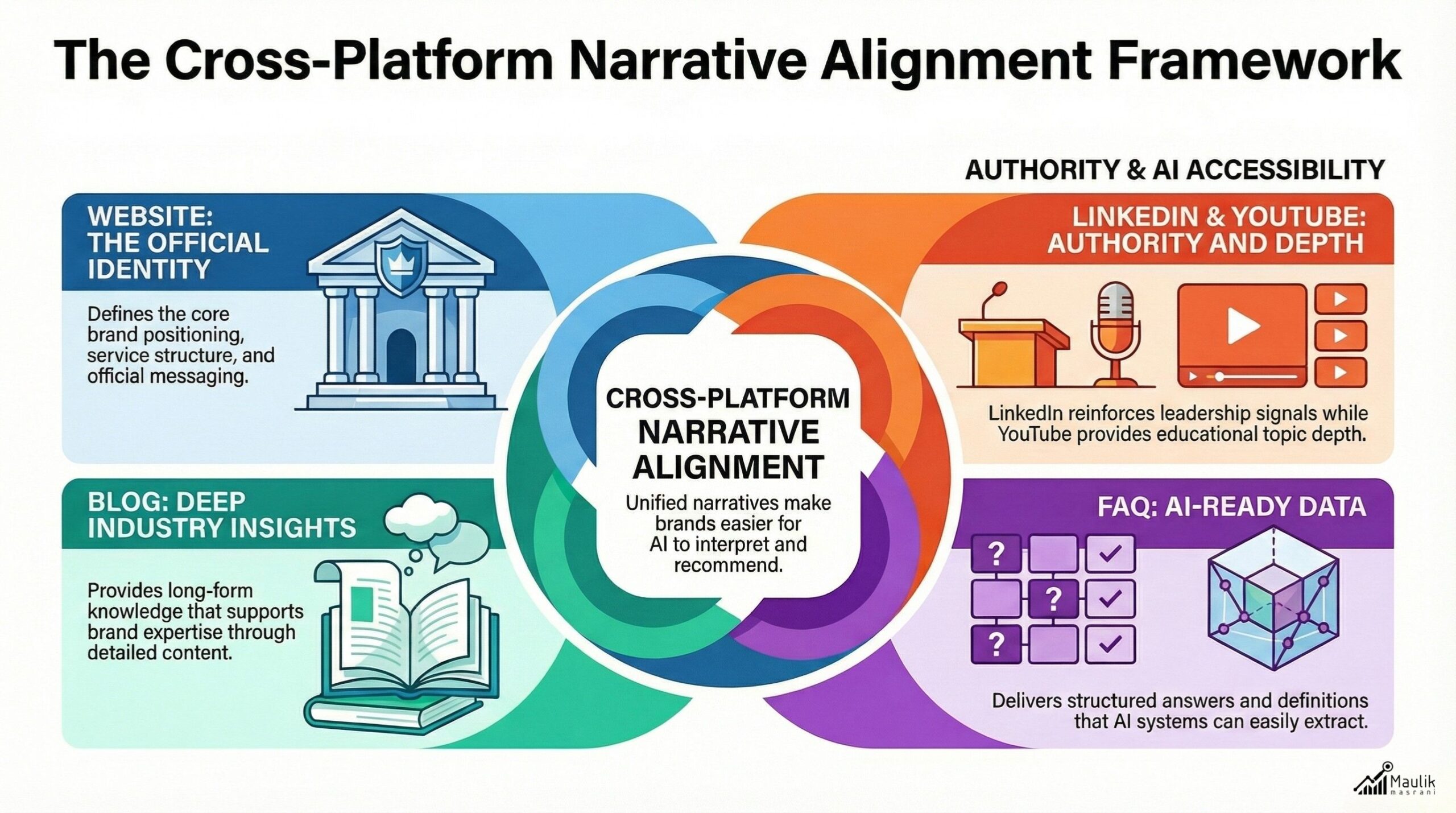
True AI messaging control requires structured orchestration across major platforms. Each channel serves a distinct role within the entity ecosystem.
Website: The Canonical Source
Your website defines the official entity framework.
It should contain:
- A clear, repeatable positioning statement
- Standardized service terminology
- Structured FAQ schema
- Stable definitions for proprietary concepts
This becomes the primary reference layer AI models use to anchor your brand identity.
Avoid introducing alternative positioning language across pages. Minor variations are acceptable; category shifts are not.
LinkedIn: The Authority Signal
LinkedIn influences AI perception of executive credibility and industry alignment.
To maintain narrative alignment:
- Match headline positioning to website positioning
- Use identical terminology for frameworks and services
- Reinforce core industry specialization in the About sections
- Avoid introducing new identity categories
LinkedIn articles should deepen, not redirect your narrative cluster.
AI frequently references LinkedIn content to validate expertise layers. Misalignment here can weaken authority modeling.
YouTube: The Semantic Expansion Layer
Video content introduces depth. But depth must remain within your entity boundary.
Maintain alignment through:
- Consistent terminology in titles
- Stable framework naming
- Repeated definitions in descriptions
- Structured transcripts that echo website positioning
YouTube expands topic authority. It should not fragment it.
When websites, LinkedIn, and YouTube reinforce identical entity structures, AI systems assign higher narrative stability.
This strengthens entity optimization and increases generative visibility.
FAQ reinforcement method
Architecture plays a central role in narrative alignment, AIO.
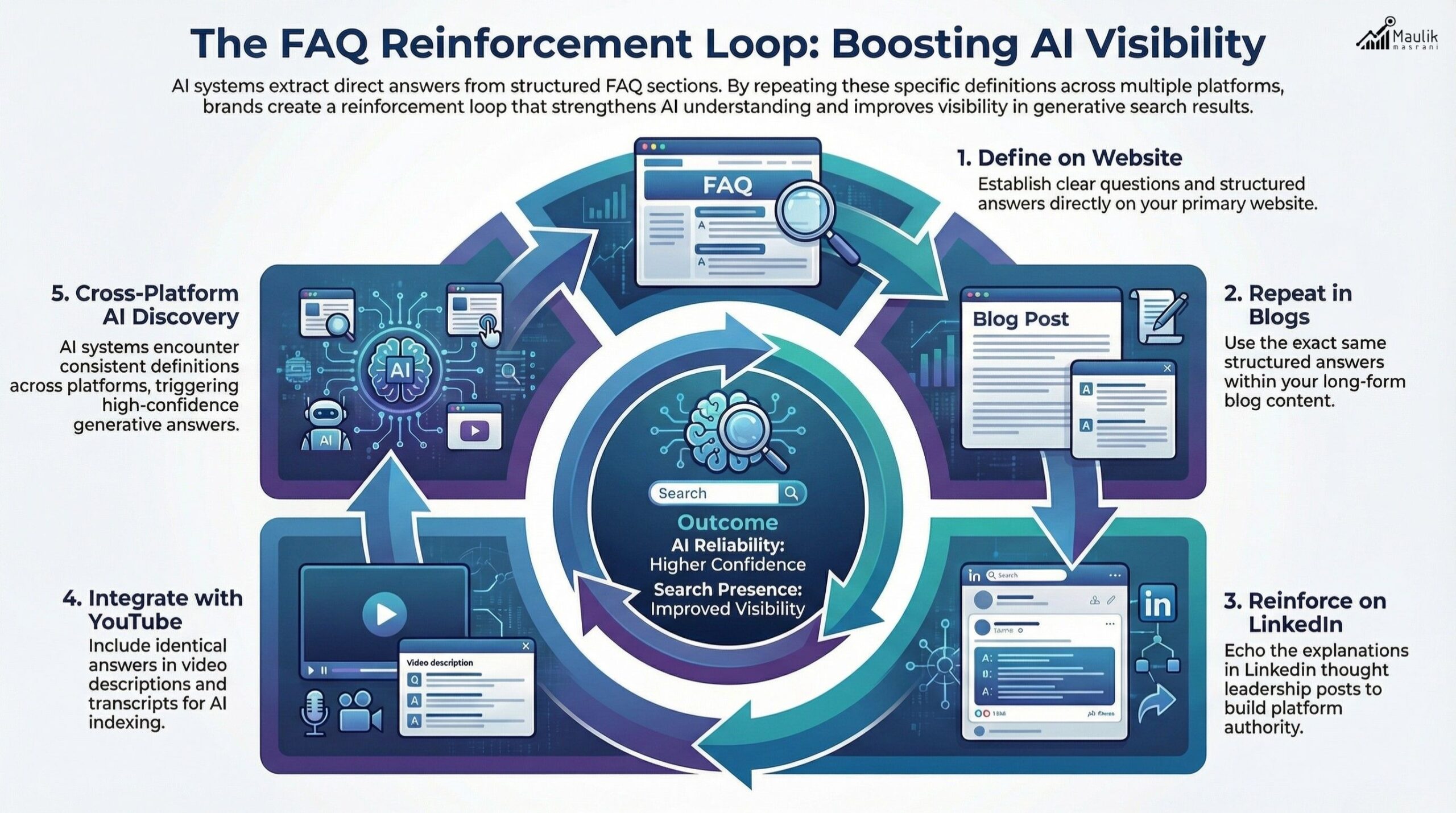
Large language models frequently extract direct answers from FAQ sections because they are structured, concise, and semantically explicit.
The reinforcement strategy works as follows:
- Define key concepts clearly on your website.
- Replicate identical structured answers across high-authority content pieces.
- Maintain wording stability for core definitions.
When AI repeatedly encounters consistent structured answers across platforms, it increases certainty.
For example:
If your brand defines AIO as an entity-driven optimization system focused on AI trust, knowledge graph stability and semantic reinforcement, that structure should remain stable across:
- Blog posts
- LinkedIn thought leadership
- Video descriptions
- Case studies
Repetition of structured clarity compounds machine trust.
FAQ reinforcement supports:
- Generative snippet eligibility
- Entity memory stability
- Reduced narrative drift
- Higher retrieval confidence
AI systems reward repeated coherence.
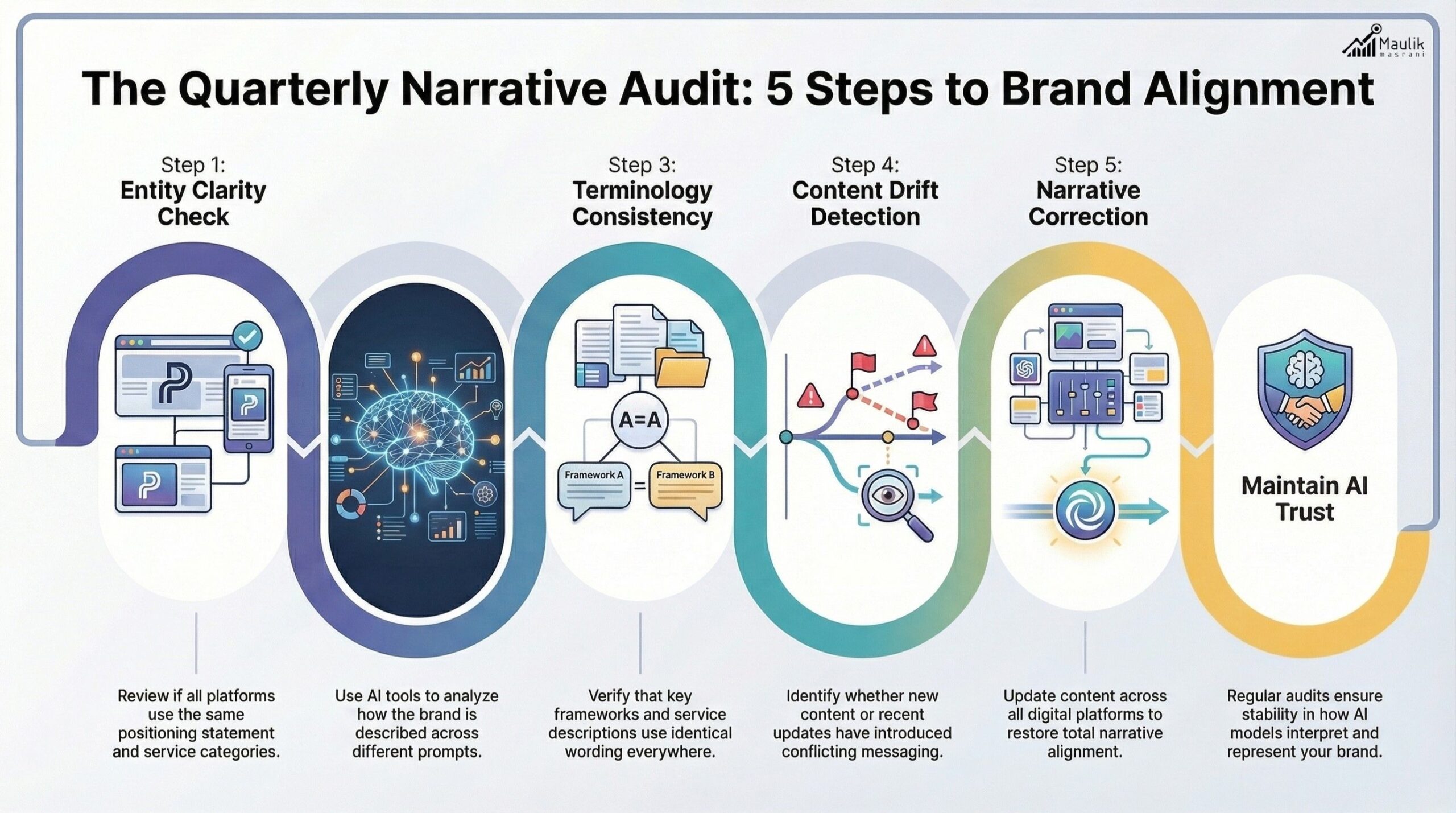
Quarterly narrative audit framework
Narrative alignment is not static. Teams publish new content, hire new contributors, and test new positioning angles. Over time, micro-shifts accumulate.
A quarterly audit prevents structural drift.
Step 1: Entity Mapping Review
Document your official positioning statement and compare it across platforms.
Evaluate:
- Headline consistency
- Category naming
- Service terminology
- Definition uniformity
Identify deviations and standardize language.
Step 2: AI Output Testing
Use generative AI prompts such as:
- “What is this company known for?”
- “Describe this brand’s specialization.”
- “What services does this entity provide?”
Run across multiple AI tools. If answers vary, your entity signals a lack of cohesion.
Step 3: Terminology Stability Scan
Check whether teams introduced new synonyms that subtly change positioning.
For example:
Switching between “AI growth consulting” and “digital performance agency” may seem minor, but to AI models, it changes classification. Stability matters more than creativity.
Step 4: Content Boundary Enforcement
Ensure new YouTube topics, LinkedIn posts, or blogs stay within your defined narrative cluster.
Expansion is allowed. Identity shifts are not. Quarterly audits preserve alignment and protect AI trust density.
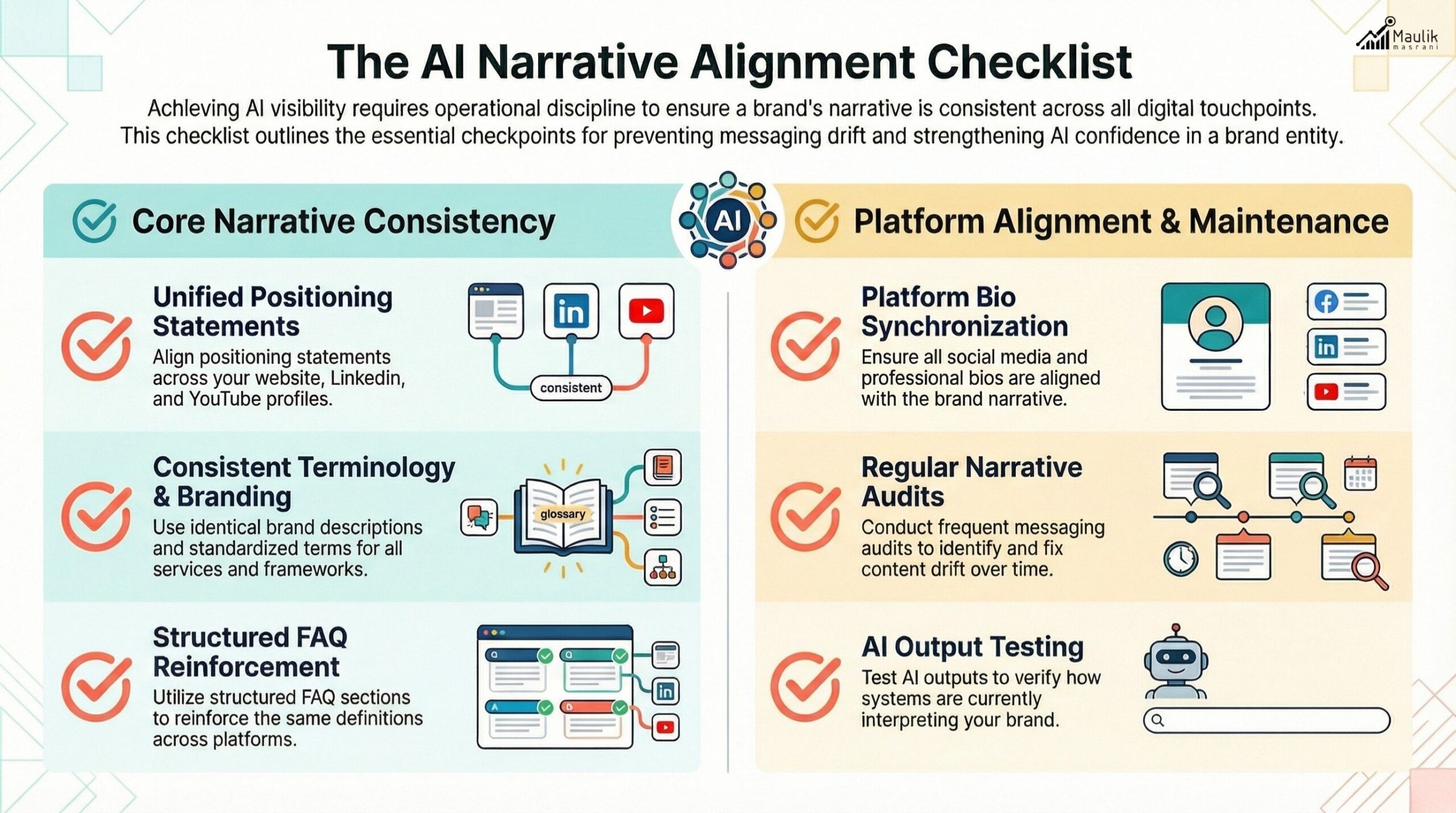
Alignment checklist
Use this structured checklist to operationalize dominance:
- Core positioning statement standardized
- Identical category naming across platforms
- Stable proprietary term definitions
- Structured FAQ blocks are deployed consistently
- Website schema reflecting entity clarity
- LinkedIn bios synchronized with website messaging
- YouTube descriptions aligned with the entity framework
- Quarterly AI prompt testing completed
- Conflicting narratives eliminated
Alignment should be documented, not assumed. If AI describes your brand identically across tools and queries, your narrative alignment is effective.
FAQs
Why narrative consistency matters in AIO?
Narrative consistency improves entity confidence across AI systems. When messaging remains aligned, AI assigns higher certainty, increasing generative visibility and citation likelihood.
How does cross-platform misalignment impact AI discovery?
Misalignment fragments entity signals, lowers topical authority, and reduces retrieval probability in AI-driven answers.
What role do FAQs play in narrative alignment?
FAQs provide structured, machine-readable clarity. Repeated, consistent definitions reinforce entity stability and strengthen AI trust.
How frequently should narrative audits occur?
A quarterly review is recommended to prevent drift, maintain terminology stability, and protect AI visibility performance.
Conclusion
Cross-platform narrative alignment is no longer a branding preference; it is an AI visibility requirement. When your messaging remains consistent across the website, LinkedIn, and YouTube, you strengthen entity clarity and improve how AI systems model your authority.
Narrative alignment AIO ensures that every platform reinforces the same core identity, reducing confusion and increasing trust signals in generative search environments. In a landscape where AI summarizes, ranks, and recommends brands based on structured patterns, alignment becomes a strategic advantage. The brands that control their narrative across channels will control their AI visibility.