

An effective AIO editorial workflow replaces keyword-first publishing with an entity-first, structure-driven system designed for AI extraction and generative visibility. By redesigning your AI content pipeline around entity mapping, structured drafting, semantic reinforcement, schema layering and AI visibility testing, organizations can build a scalable LLM-friendly writing process that AI systems consistently reward.
AIO Editorial Workflow
AI systems do not consume content the way humans do.
- They parse the structure.
- They interpret entities.
- They synthesize context.
- They reward clarity.
If your editorial process still revolves around keyword density and publishing velocity, you are optimizing for an ecosystem that is fading.
An operationally sound AIO editorial workflow is not about producing more content. It is about producing extractable, structured, semantically coherent content that AI systems can confidently use.
This guide provides a practical operational framework, not theory, to implement immediately.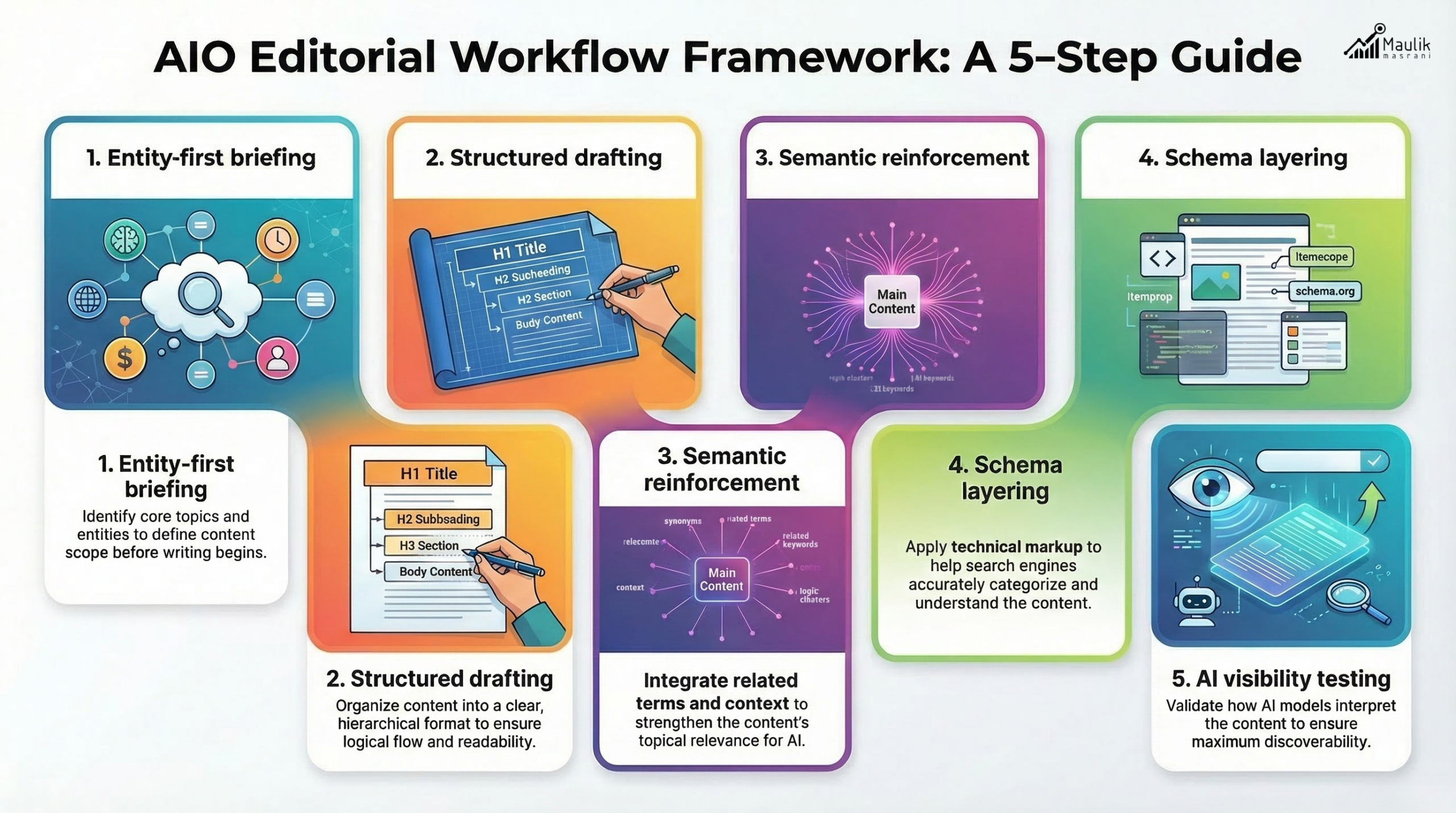
Why Traditional Content Pipelines Break in AI Search
Most editorial systems were built for a ranking-based web. That environment prioritized:
- Keyword targeting
- Content length
- Backlink accumulation
- SERP positioning
Generative AI changes the success criteria.
AI systems evaluate:
- Entity clarity
- Structural predictability
- Semantic consistency
- Extractable answer blocks
- Schema alignment
A traditional pipeline typically looks like this:
Research → Brief → Draft → Edit → Publish → Track rankings
What is missing?
- Entity mapping before writing
- Structural optimization during drafting
- Schema planning integrated into production
- AI response testing after publication
Without these layers, content may perform in rankings but fail in generative answers.
An evolved AI content pipeline addresses this gap by building AI considerations into every stage, not treating them as post publication adjustments.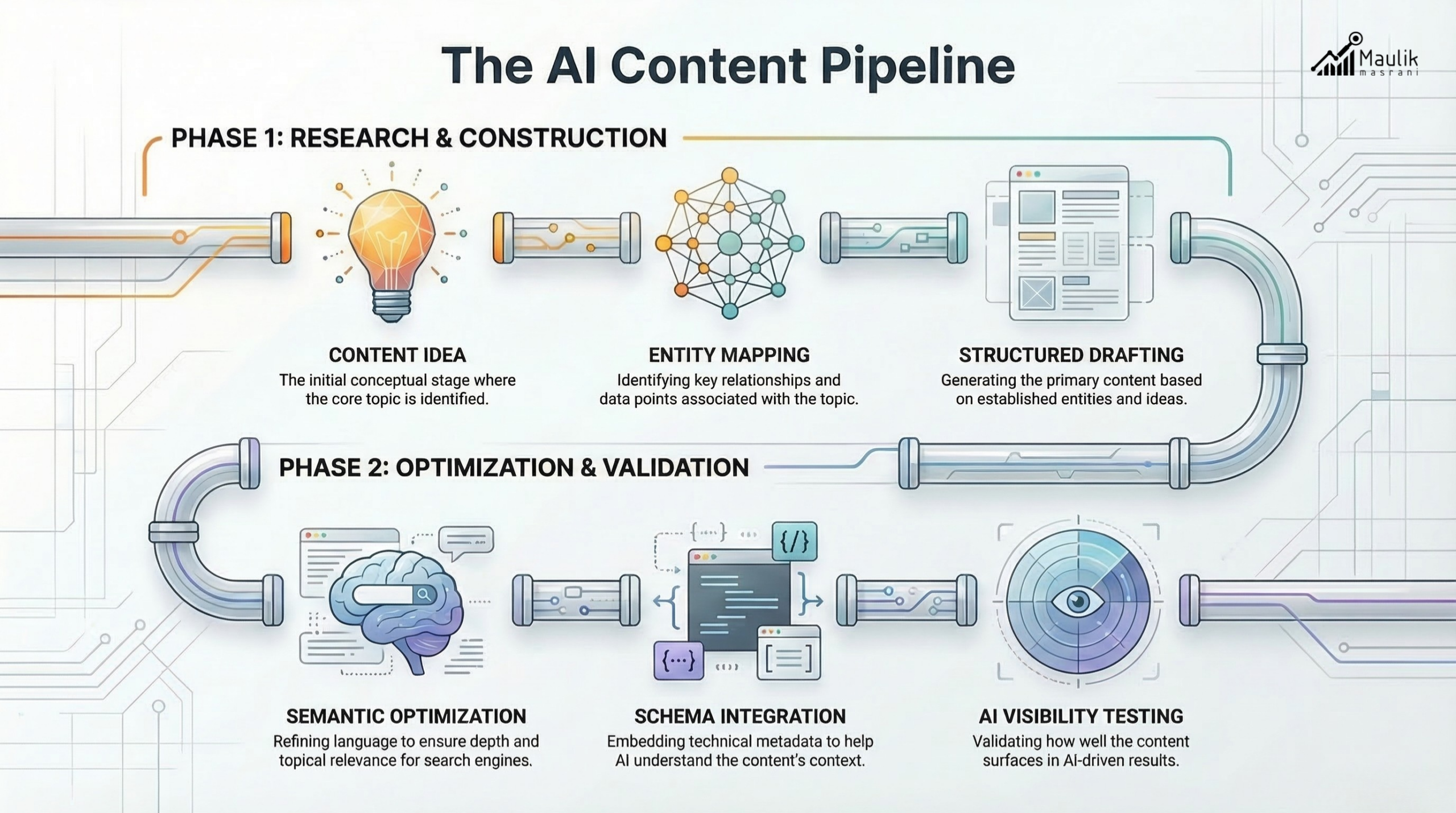
Step 1: Entity-First Briefing
The most important shift in an AIO editorial workflow happens before a single word is written.
Instead of asking:
“What keyword are we targeting?”
Ask:
“What core entity must this content establish authority around?”
Entity Briefing Framework
Before drafting, define:
- Primary Entity
- Supporting Entities
- Related Processes
- Associated Metrics
- Contextual Relationships
For example, if writing about workflow optimization, the primary entity may be the workflow system itself, while supporting entities could include structured drafting, schema integration and semantic alignment.
Document these relationships inside the brief.
Why this matters:
AI systems construct meaning through entity networks. When those networks are clear in your content planning stage, extraction accuracy increases significantly.
Entity-first briefing transforms your workflow from reactive SEO to structured AI alignment.
Step 2: Structured Drafting
Once entities are mapped drafting must follow a logical architecture.
An LLM-friendly writing process is predictable and layered.
AI systems prefer:
- Clear H1–H3 hierarchy
- Concise explanatory paragraphs
- Direct definitions
- Logical section separation
- Minimal ambiguity
Structural Drafting Rules
- Begin with a summary paragraph.
- Introduce sections with explicit topic clarity.
- Keep key explanations in short blocks.
- Use consistent terminology.
- Avoid unnecessary rhetorical flourishes.
Clarity is performance.
Structured drafting increases the likelihood that your content can be:
- Quoted in AI summaries
- Extracted into knowledge panels
- Used as answer sources
When structure improves, AI confidence increases.
Step 3: Semantic Reinforcement
Publishing structured content is not enough. Reinforcement ensures interpretive strength.
Semantic reinforcement ensures that the primary entity remains consistently contextualized throughout the article.
This does not mean repetition. It means cohesion.
Reinforcement Techniques
- Maintain consistent terminology across headings and body.
- Use related terms naturally.
- Avoid introducing unrelated conceptual noise.
- Reconnect supporting entities back to the primary focus.
Example:
If discussing an editorial workflow, ensure that related references such as content pipeline design, AI optimization stages and generative visibility consistently tie back to the workflow framework.
Inconsistent language weakens semantic authority.
Reinforced semantic clarity strengthens AI extraction probability.
Step 4: Schema Layering
Schema should be integrated, not appended.
In a refined AIO editorial workflow, schema is planned alongside content architecture.
For blog-driven educational content, two schema types are foundational:
- BlogPosting
- FAQPage
Schema layering should:
- Mirror visible content structure
- Reinforce defined entities
- Validate authorship and publication details
- Support structured interpretation
Operationally:
- Draft content.
- Align structured data fields with headings.
- Validate markup accuracy.
- Maintain consistency across site templates.
Schema increases interpretive precision. It reduces ambiguity in how AI systems classify and understand your page.
Step 5: AI Visibility Testing
The final step separates modern workflows from outdated ones.
Publishing is not the finish line. Testing is.
AI visibility testing evaluates how generative systems interpret your content.
Testing Process
Query platforms using:
- Direct entity questions
- Comparative prompts
- Definition-based queries
- Scenario-based queries
Evaluate:
- Is your terminology used?
- Are your frameworks referenced?
- Is your primary entity accurately described?
- Is your explanation simplified or distorted?
If visibility gaps exist, revisit:
- Entity clarity
- Structural predictability
- Semantic reinforcement
- Schema consistency
Testing creates a feedback loop that continuously improves AI discoverability.
This transforms your workflow from linear to adaptive.
Workflow Template
Below is an operational template designed as a downloadable checklist structure for teams implementing an AIO editorial workflow.
AIO Editorial Workflow Implementation Checklist
Phase 1: Entity Definition
- Identify primary entity
- List supporting entities
- Map relationships
- Confirm internal linking targets
Phase 2: Structured Drafting
- Write a summary paragraph
- Implement H1–H3 clarity
- Provide direct definitions
- Maintain concise paragraphs
Phase 3: Semantic Reinforcement
- Validate terminology consistency
- Add contextual related terms
- Remove conceptual ambiguity
- Align headings with entity focus
Phase 4: Schema Layering
- Apply BlogPosting schema
- Add FAQPage schema if applicable
- Validate structured data
- Ensure schema matches visible content
Phase 5: AI Visibility Testing
- Query AI systems
- Assess entity representation
- Identify summary inclusion gaps
- Document adjustments
- Iterate refinements
This checklist can be embedded into your editorial SOP, project management system, or publishing playbook.
Consistency, not intensity, drives AI visibility gains.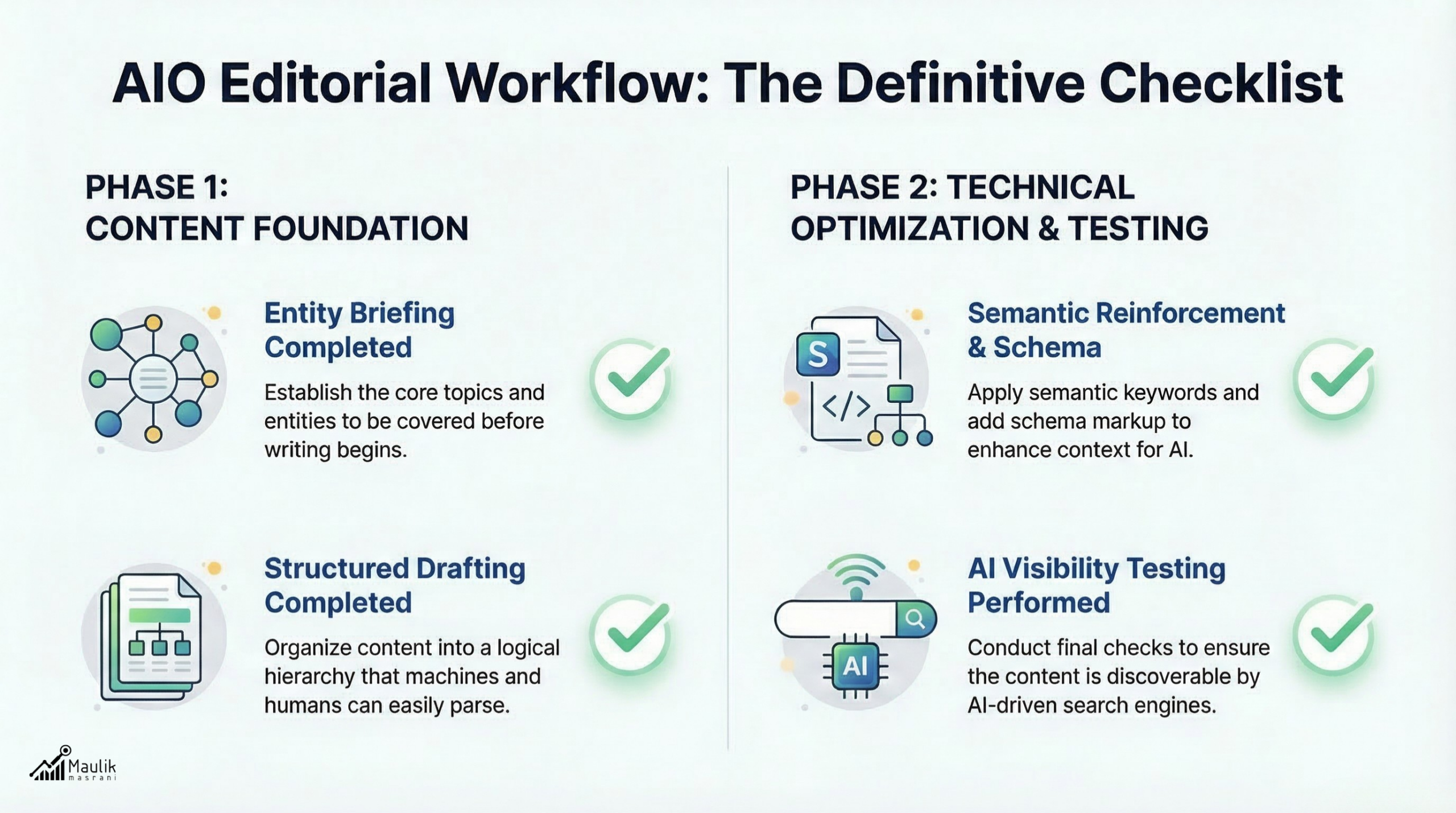
FAQs
What is an AIO workflow?
An AIO workflow is a structured editorial system designed to optimize content for AI-driven search environments. It integrates entity-first planning, structured drafting, semantic reinforcement, schema implementation and AI visibility testing.
How does an AIO editorial workflow improve AI performance?
It increases clarity, reduces ambiguity and strengthens entity relationships. This improves the likelihood that AI systems extract, summarize and reference your content accurately.
Is an AI content pipeline different from traditional SEO workflows?
Yes. A traditional workflow focuses on rankings and keywords. An AI content pipeline prioritizes structure, entity networks and generative visibility across LLM systems.
How often should AI visibility testing be performed?
Testing should occur immediately after publishing and periodically thereafter. Generative systems evolve and continuous monitoring ensures consistent visibility.
Conclusion
AI systems reward structure, clarity, and semantic consistency. An effective AIO editorial workflow transforms content production from a linear publishing task into a strategic visibility engine.
By embedding entity-first briefing, structured drafting, semantic reinforcement, schema alignment, and AI visibility testing into everyday operations, teams ensure their content is not just published, but understood and extracted by generative platforms. The brands that operationalize this workflow will build sustainable AI visibility, while others continue optimizing for a search landscape that no longer exists.