
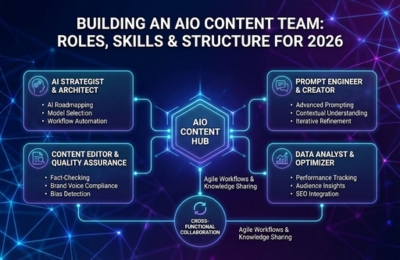
Traditional SEO teams are not designed for AI-powered search ecosystems. To compete in 2026, CMOs must build a specialized AIO content team that combines entity strategy, structured data engineering, AI-native writing, quality assurance, and LLM performance monitoring. This blueprint outlines the roles, required skills, and optimal organizational structure for SMBs and enterprises to win in generative search environments.
Building an AIO Content Team
Search is no longer just about rankings. It is about visibility inside AI systems.
As Google’s AI Overviews and LLM-powered tools like ChatGPT, Gemini and Perplexity reshape discovery, content teams must evolve beyond keyword optimization. Winning in generative search requires structured data fluency, entity precision and continuous AI response monitoring.
This is where an AIO content team becomes critical.
Unlike traditional SEO departments, AIO teams operate at the intersection of semantic architecture, AI behavior modeling and performance analytics. Their mission is simple: ensure your brand is accurately represented, cited and surfaced across AI-driven search interfaces.
For CMOs planning a 2026 strategy, this article serves as a practical blueprint.
Why Traditional SEO Teams Fail in the AI Era
Most legacy SEO teams were built around three pillars:
- Keyword research
- On-page optimization
- Backlink acquisition
That framework worked when ranking positions determined traffic.
Today, AI systems synthesize answers. They summarize. They recommend. They extract entities. They interpret the schema. Traditional SEO tactics alone are insufficient.
Three systemic gaps explain why conventional teams struggle:
1. Keyword-Centric Thinking
AI systems operate on entities and relationships, not just keyword frequency. A page that ranks may still fail to appear in generative summaries if its entity structure is weak.
2. Lack of Structured Data Expertise
Schema is no longer optional. AI models heavily rely on structured signals. Without schema engineering, your content may be invisible to AI parsers.
3. No AI Monitoring Framework
Most teams track traffic and rankings. Few monitor LLM responses or track brand mentions inside AI summaries. Yet this is where future discovery happens.
According to McKinsey AI Workforce Reports, organizations that adapt roles around AI workflows outperform peers in productivity and digital visibility. The same principle applies to search marketing. CMOs must rethink team composition, not just tools.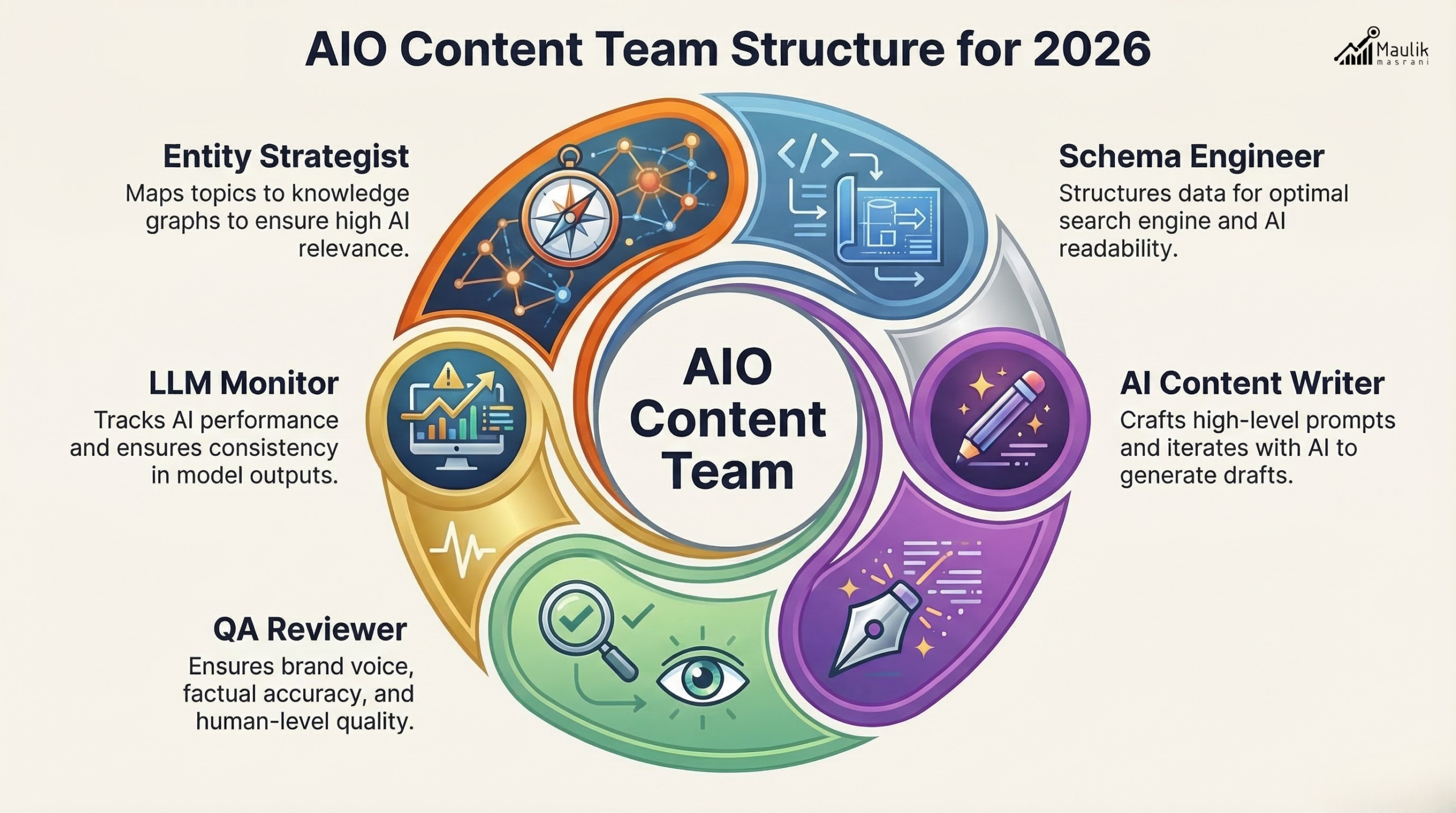
Core AIO Roles
An effective AIO content team is multidisciplinary. Below are the five core roles required for generative search success.
1. Entity Strategist
The Entity Strategist defines the brand’s semantic footprint.
Responsibilities:
- Map core entities (products, services, authors, brand attributes)
- Align entity relationships across content
- Ensure knowledge graph consistency
- Optimize internal linking architecture
This role directly influences AI citation probability and brand recognition in generative outputs.
2. Schema Engineer
The Schema Engineer operationalizes structured data.
Responsibilities:
- Implement BlogPosting, FAQPage and organizational schema
- Validate JSON-LD deployment
- Maintain structured consistency across site templates
- Optimize for AI parsing efficiency
Without this role, structured data becomes fragmented, reducing generative visibility.
3. AI Content Writer
The AI Content Writer is not simply a copywriter.
Responsibilities:
- Craft AI-native, entity-rich content
- Structure answers for featured snippets and LLM extraction
- Balance readability with semantic density
- Align content with the organization’s AI visibility goals
This role ensures your content performs across both traditional SERPs and generative engines.
4. QA Reviewer
AI publishing at scale increases risk.
The QA Reviewer safeguards quality and credibility.
Responsibilities:
- Fact-check AI-assisted content
- Validate entity accuracy
- Ensure tone consistency
- Prevent hallucination errors
This role protects brand authority and long-term trust.
5. LLM Monitor
The LLM Monitor tracks how AI systems represent your brand.
Responsibilities:
- Test brand queries across ChatGPT, Gemin and Perplexity
- Identify visibility gaps
- Track generative citations
- Feed insights back into strategy
This role directly contributes to improving your AI visibility score and long-term positioning.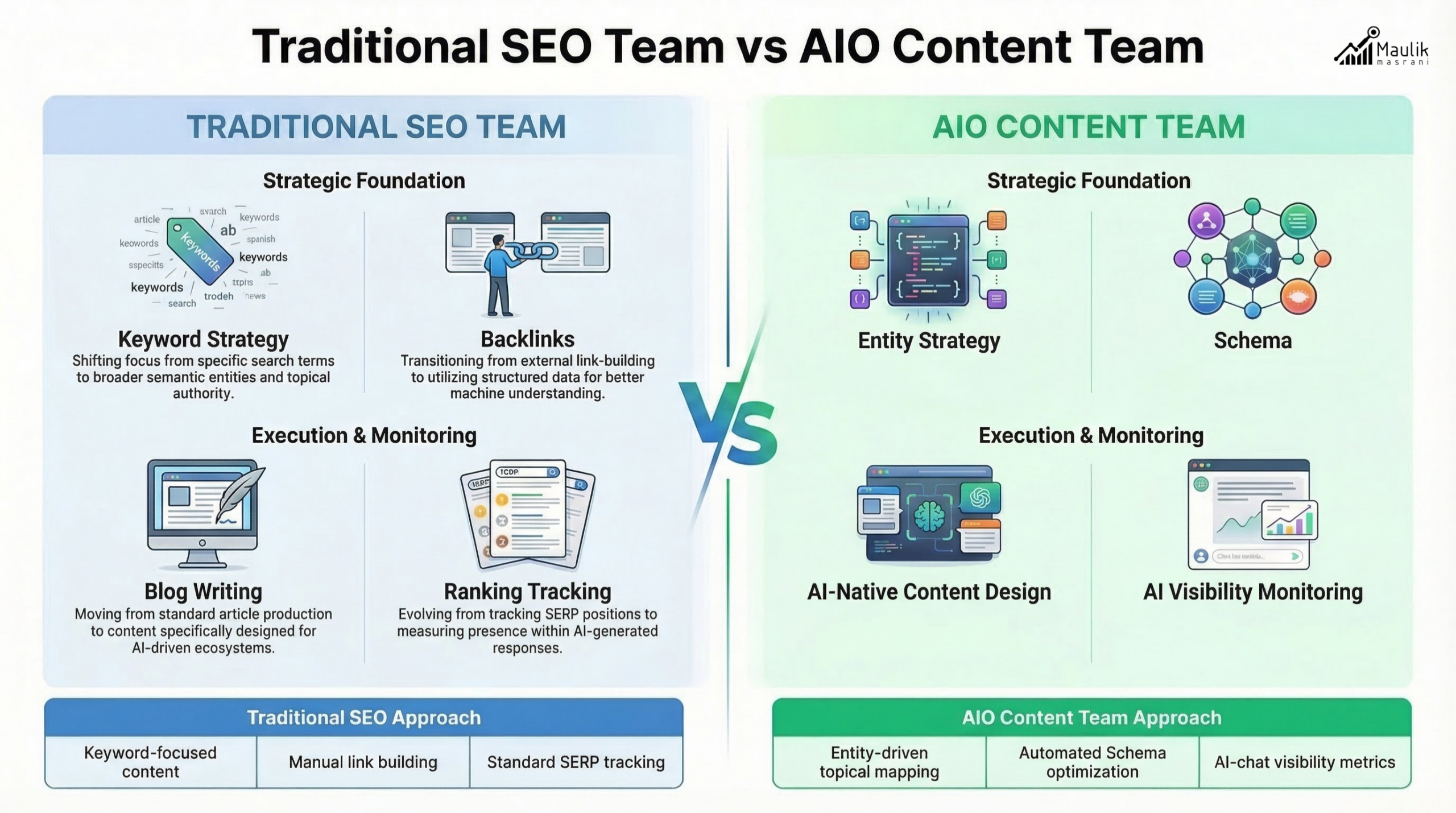
Skill Requirements Per Role
Each AIO role requires a distinct skill stack. CMOs should prioritize hybrid profiles over traditional silos.
Entity Strategist Skills
- Semantic SEO expertise
- Knowledge graph modeling
- Advanced internal linking strategy
- Competitive entity gap analysis
Schema Engineer Skills
- JSON-LD implementation
- Structured data validation tools
- Technical SEO proficiency
- CMS integration experience
AI Content Writer Skills
- Generative search optimization
- Entity-driven writing
- Conversational UX structuring
- AI prompt engineering basics
QA Reviewer Skills
- Editorial precision
- Source validation
- AI output auditing
- Risk mitigation mindset
LLM Monitor Skills
- AI query testing frameworks
- Data tracking and reporting
- SERP + AI comparative analysis
- Insight synthesis for executive reporting
The future AI SEO team structure blends content, technical and AI performance roles into one cohesive unit.
Org Structure for SMB vs Enterprise
Not every company can hire five specialists immediately. The structure must scale strategically.
SMB Structure
For smaller teams:
- 1 Hybrid AIO Lead (Entity + Strategy)
- 1 AI Content Writer
- 1 Technical SEO / Schema Consultant (part-time)
In this model, monitoring and QA are integrated into workflows.
The goal is operational efficiency without compromising AI alignment.
Enterprise Structure
Larger organizations require a more robust generative search team.
Recommended structure:
- Head of Enterprise AI SEO
- Entity Strategy Team
- Schema Engineering Team
- AI Content Production Team
- Dedicated QA Unit
- LLM Intelligence & Monitoring Team
Enterprises must integrate an AIO strategy with broader digital transformation efforts, particularly under enterprise AI SEO initiatives.
The generative search team becomes a strategic growth function, not a tactical marketing unit.
Hiring Checklist
When building your AIO content team, CMOs should evaluate candidates against these criteria:
- Do they understand entity-first SEO?
- Can they explain how AI extracts structured signals?
- Have they worked with schema beyond basic FAQ markup?
- Do they track performance beyond traffic (e.g., AI citations)?
- Can they align content production with measurable AI visibility goals?
Avoid hiring based solely on traditional SEO metrics. Prioritize adaptability, AI literacy and cross-functional thinking.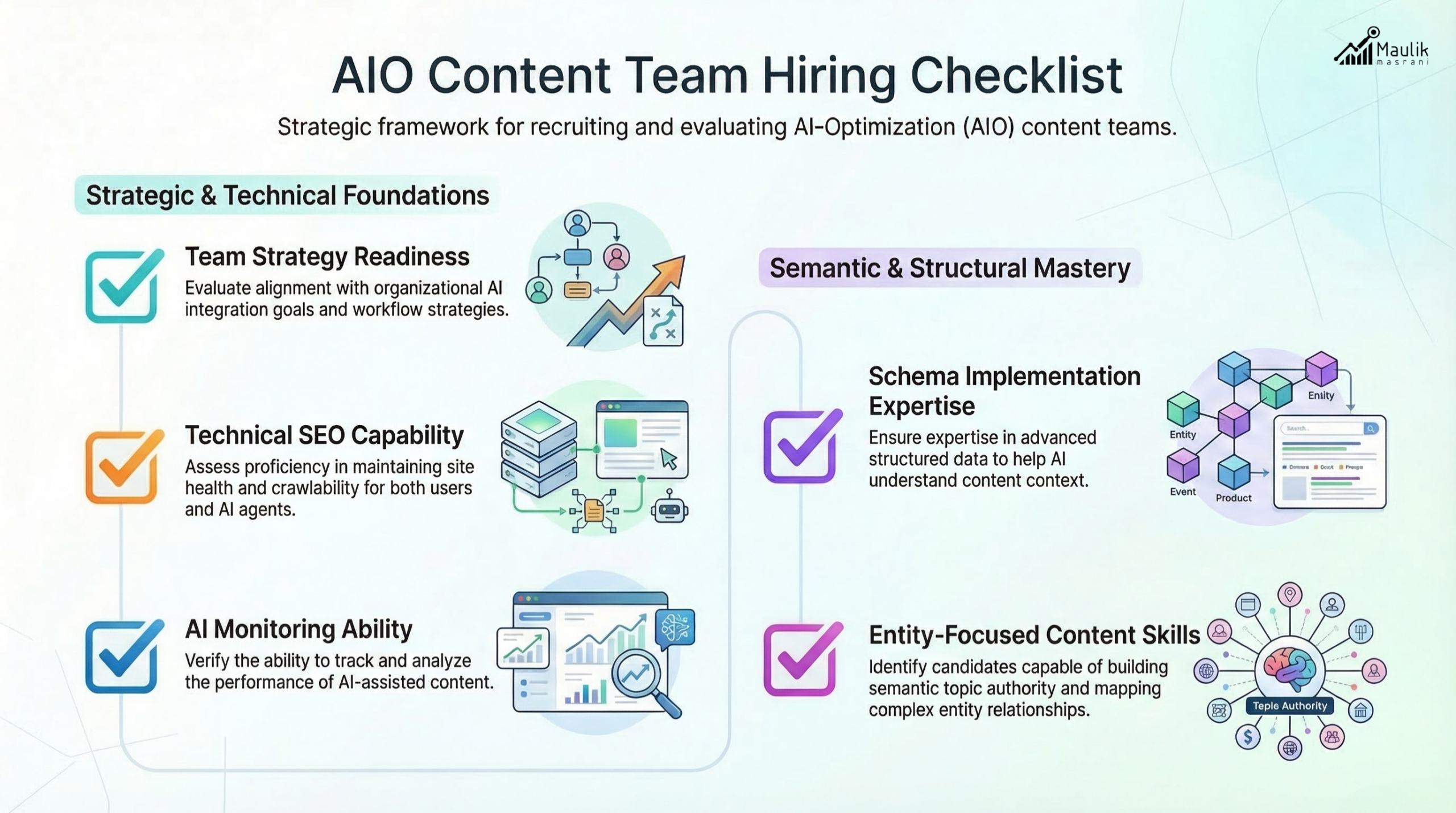
FAQs
What roles are required for AIO?
An effective AIO team requires an Entity Strategist, Schema Engineer, AI Content Writer, QA Reviewer and LLM Monitor. Together, these roles ensure content is optimized for both traditional search engines and AI-driven generative systems.
How is an AIO content team different from a traditional SEO team?
Traditional SEO teams focus on rankings and backlinks. An AIO content team prioritizes entity structure, schema implementation and AI response monitoring to improve visibility within generative search results.
Can small businesses build an AIO team?
Yes. SMBs can start with hybrid roles combining entity strategy and content production, supported by part-time schema expertise. The structure can scale as AI visibility becomes a larger revenue driver.
How do you measure AIO performance?
Performance is measured through AI citation tracking, entity presence across generative engines, structured data validation and improvements in AI visibility score alongside traditional metrics.
Conclusion
The move toward generative search is not a passing trend; it is a structural transformation in digital visibility. CMOs who treat AI optimization as a minor extension of traditional SEO will struggle to compete. Those who build a dedicated AIO content team with clearly defined roles, structured workflows, and continuous LLM monitoring will create long-term strategic advantages. As AI-generated answers increasingly influence discovery, success will depend not only on rankings but on inclusion, accuracy, and authority within generative outputs. Organizations that redesign their team architecture now will define their AI presence before competitors fully understand the shift.