
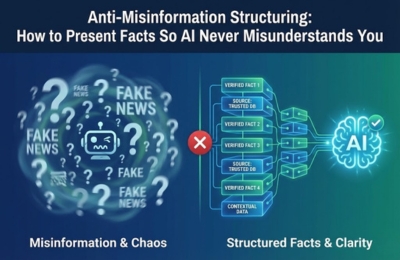
AI systems don’t “understand” facts the way humans do; they predict, infer and synthesize based on patterns. Poorly structured content increases the risk of misinformation in AI outcomes, especially in high-stakes industries. This guide explains why AI misinterprets facts, how to structure information for clarity and how layered fact delivery and accuracy reinforcement reduce ambiguity across generative search engines and LLMs.
Anti-Misinformation Structuring
AI-powered search engines and large language models now act as intermediaries between facts and users. Instead of retrieving single documents, they synthesize information from multiple sources, compress it into answers and present it with confidence.
For technical and YMYL (Your Money or Your Life) industries, this creates a new risk surface: factual accuracy can degrade if content is unclear, context-poor, or structurally ambiguous. Anti-misinformation structuring is the practice of designing content so AI systems consistently interpret facts as intended without distortion, oversimplification, or hallucination.
How AI Confuses Facts
AI confusion rarely comes from “bad intent.” It comes from a probabilistic interpretation.
Large language models operate by predicting the most likely continuation of text based on training patterns. When facts are loosely stated, implied instead of explicit, or scattered across paragraphs, AI fills gaps using statistical inference.
Common causes of confusion include:
- Context collapse: AI merges facts from different scenarios into a single generalized statement.
- Temporal ambiguity: Dates, versions, or regulatory changes are not clearly anchored in time.
- Conditional facts presented as absolutes: “In some cases” becomes “always.”
- Mixed authority signals: Expert statements appear alongside opinions without differentiation.
Research from Stanford Misinformation Lab highlights that ambiguity, not outright falsehood, is one of the strongest predictors of downstream misinformation in AI-generated summaries. When AI is forced to guess, accuracy drops.
Structuring Techniques for Clarity
Anti-misinformation structuring begins with precision. Facts should be explicit, scoped and consistently framed.
Effective fact structuring techniques include:
Single-fact sentences
Each sentence should convey one verifiable claim. This reduces combinatorial interpretation errors.
Explicit qualifiers
Clearly state conditions, limitations and applicability. Avoid implied assumptions.
Stable terminology
Use one term per concept throughout the page. Synonym swapping increases AI ambiguity removal challenges.
Cause–and–effect separation
Distinguish what is from why it happens. AI often conflates explanation with assertion.
These techniques work in tandem with broader AI visibility systems such as AIO, AEO & GEO, where clarity improves answer extraction and reduces misrepresentation in generative responses.
Layered Fact Delivery
Layered fact delivery is one of the most reliable methods for accuracy reinforcement.
Instead of presenting information in a single dense block, facts are delivered in progressive layers:
Primary fact
The core, non-negotiable statement is written in plain language.
Context layer
Supporting explanation that clarifies scope, timing and conditions.
Validation layer
Data points, references, or consensus indicators that confirm reliability.
This structure aligns with how LLMs summarize content. When layers are present, AI can select the appropriate depth without fabricating missing context.
Layered delivery also complements internal optimization signals such as AI freshness signals and LLM authority ranking, where consistency and corroboration improve trust weighting.
Critical Industries Examples
Anti-misinformation structuring is especially critical in YMYL sectors where errors have real-world consequences.
Healthcare
Ambiguous dosage guidance or generalized treatment claims can be misinterpreted as medical advice. Clear structuring separates informational content from prescriptive statements.
Finance
Interest rates, compliance rules and risk disclosures must be time-bound and jurisdiction-specific. Layered delivery prevents outdated or regionally incorrect summaries.
Legal and Compliance
AI often generalizes legal principles. Structuring statutes, exceptions and interpretations distinctly reduces the risk of overgeneralization.
Cybersecurity and Safety
Threat descriptions must differentiate between likelihood, impact and mitigation. Without this, AI may exaggerate or understate risks.
In all cases, the goal is not just human clarity, but machine interpretability.
Framework
A practical anti-misinformation structuring framework follows five steps:
- Fact isolation: Identify every core factual claim and separate it from opinion or commentary.
- Scope definition: Add explicit boundaries: who, when, where and under what conditions.
- Layered presentation
Deliver facts using primary, context and validation layers. - Consistency checks: Ensure terminology, numbers and references match across the page.
- Authority alignment: Support critical facts with recognized research bodies or consensus sources, such as the Stanford Misinformation Lab.
This framework integrates naturally into advanced AI optimization strategies without introducing unnecessary complexity.
FAQs
How do I prevent AI from spreading wrong info?
Preventing misinformation starts with explicit fact structuring. Clearly define scope, conditions and sources so AI systems do not infer missing context or generalize inaccurately.
Why does AI misinterpret accurate content?
AI relies on probability and pattern recognition. When content is ambiguous or inconsistently structured, AI fills gaps using assumptions rather than verified facts.
Is anti-misinformation structuring only for YMYL industries?
While especially critical for YMYL sectors, any brand relying on AI visibility benefits from reduced ambiguity and improved factual consistency.
Does structured content improve AI trust signals?
Yes. Clear, layered facts reinforce authority and align with trust metrics used in AI-driven ranking and summarization systems.
Conclusion
AI-driven search rewards clarity, not cleverness. As generative engines increasingly mediate how information is consumed, the cost of ambiguity continues to rise. Anti-misinformation structuring is no longer optional for technical or YMYL content it is a foundational requirement for trust, visibility and long-term authority.
By applying disciplined fact structuring, layered delivery and accuracy reinforcement, organizations can ensure their content is not only discoverable but correctly understood by both humans and machines.