
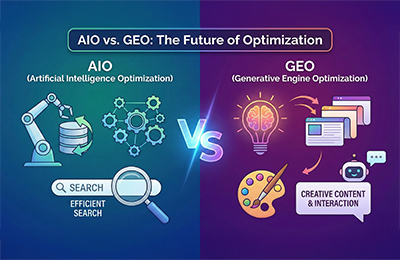
AIO vs GEO is no longer a theoretical debate. It’s a strategic decision that affects how your brand appears in Google Search and how LLMs such as ChatGPT, Gemini, Claude and Perplexity reuse your content.
AIO optimizes your brand for AI understanding (entities, authority, structured data), while GEO optimizes your content for reuse in AI-generated answers (explanations, templates, repeatable insights).
Ecommerce brands benefit from AIO’s structured clarity, B2B companies benefit from GEO’s thought-leadership reuse and local businesses need AIO first for discoverability. Most industries now win using a hybrid AIO + GEO model.
AIO vs GEO
As AI-first search takes over, brands are asking a new question:
Should we optimize for how AI understands us (AIO) or how AI reuses us (GEO)?
Both frameworks matter but they serve different purposes and deliver different outcomes. Understanding AIO vs GEO is essential for ecommerce, B2B and local businesses that want visibility in both Google Search + AI Overviews and generative engines like ChatGPT, Gemini and Claude.
Differences in purpose
AIO and GEO are complementary, but their roles are fundamentally different.
Comparison Table: AIO vs GEO
|
Feature |
AIO (Artificial Intelligence Optimization) |
GEO (Generative Engine Optimization) |
|
Primary Purpose |
Help AI systems understand your brand clearly |
Help AI systems reuse your content in generated answers |
|
Focus Area |
Entities, schema, authority signals, structured clarity |
Frameworks, templates, narrative consistency |
|
Output |
Better indexing, better recall, fewer ambiguities |
More citations inside generative search responses |
|
Best For |
Ecommerce, local businesses, service brands |
B2B, SaaS, expertise-driven industries |
|
Search Impact |
Improves visibility in Google+AI Overviews |
Improves visibility within ChatGPT, Gemini, Claude & Perplexity |
|
Goal |
“AI knows who we are.” |
“AI uses what we say.” |
Both workflows matter because search is now hybrid:
Google relies on structured entities, while LLMs rely on reusable content patterns.
Which works for ecommerce
Ecommerce brands thrive on clarity, structured product information and trust signals all strengths of AIO.
Why does ecommerce need AIO first?
- AI Overviews rely heavily on schema, product data accuracy and authoritative clarity.
- Ecommerce queries are transactional; LLMs need accurate entities before generating any advice.
- Brands with strong AIO structures see better placement in product-related AI snippets.
Where GEO helps ecommerce
While not the primary driver, GEO amplifies product education, such as:
- “How to choose the right size.”
- “What makes this material better?”
- “Best use-cases for X product”
Reusable content helps LLMs recommend your product frameworks in educational queries.
Recommendation for ecommerce
|
Ecommerce Size |
Best Framework |
|
Small stores |
AIO priority → GEO optional |
|
Mid-size brands |
AIO foundation → GEO for buying guides |
|
Enterprise ecommerce |
AIO + GEO integrated |
Which works for B2B
B2B decision cycles depend on expertise, frameworks and thought leadership exactly what GEO strengthens.
Why GEO works better for B2B
- LLMs reuse structured frameworks (e.g., “5-step evaluation model,” “X method”).
- Decision-makers search AI tools for comparisons, strategies and explanations.
- GEO ensures your POV shows up in AI-generated answers.
Where AIO supports B2B
- Establishes your company as a clear entity in AI engines.
- Improves discoverability for branded and non-branded expertise queries.
- Ensures accuracy in AI Overviews, especially for complex services.
Recommendation for B2B
|
B2B Model |
Best Framework |
|
SaaS |
GEO first → AIO second |
|
Consulting |
GEO dominant |
|
Enterprise tech |
Hybrid approach |
Which works for local businesses
Local businesses rely heavily on AI Overviews, Google Business Profiles and structured clarity making AIO essential.
Why local brands need AIO
- AI Overviews prioritize entity consistency across NAP (name, address, phone), schema, reviews and service pages.
- Local intent queries (e.g., “best dentist near me”) require precise data matching.
- AI must understand the brand before recommending it.
Where GEO fits in local marketing
GEO supports:
- FAQ-style content
- Service explanations
- Helpful step-by-step guides (“How to pick a local repair technician”)
These are frequently reused by LLMs in “how to choose” queries.
Recommendation for local businesses
|
Local Business Type |
Best Framework |
|
Clinics, salons, restaurants |
AIO priority |
|
Local consultancies |
AIO → GEO |
|
Niche service providers |
Hybrid for “how-to” queries |
Hybrid AIO + GEO use cases
Most industries now require a hybrid AI optimization approach:
1. AI Overview dominance + LLM visibility
AIO ensures your brand appears inside Google AI Overviews, while GEO ensures your insights appear in ChatGPT / Gemini-style responses.
2. Expertise + product models
Industries like beauty, automotive, finance and IT benefit when:
- AIO builds trust
- GEO builds thought leadership
3. Brands creating repeatable frameworks
Any brand with proprietary processes benefits from GEO:
- “4-step skincare routine framework”
- “5-layer cybersecurity maturity model”
- “Predictive retail merchandising model”
These get reused frequently inside LLM outputs.
4. Fast-scaling brands
Brands entering new markets need:
- AIO → for correct brand/entity orientation
- GEO → for embedding their frameworks into generative answers
Conclusion
Choosing AIO vs GEO isn’t about selecting one. It’s about aligning the right framework with your industry.
- Ecommerce: AIO first, GEO optional
- B2B: GEO first for thought leadership, AIO for credibility
- Local Businesses: AIO mandatory, GEO supportive
- Hybrid Brands: Combine both for maximum LLM and search visibility
As AI-powered search evolves, brands that optimize for understanding (AIO) + reuse (GEO) will dominate both Google and generative search.
FAQs
1. Should I choose AIO or GEO?
Choose AIO if your priority is visibility, structured clarity and accuracy in Google Search and AI Overviews. Choose GEO if your priority is thought leadership and appearing inside AI-generated answers.
2. Which industries use AIO?
Ecommerce, local service businesses, healthcare, retail and any brand needing accurate AI interpretation of its products/services rely heavily on AIO for structured clarity.
3. Is GEO replacing traditional SEO?
No. GEO complements SEO rather than replaces it. SEO helps search engines rank your pages, while GEO helps LLMs reuse your content inside generative answers.
4. Can AIO and GEO run together in the same strategy?
Yes. Most industries now use a hybrid approach where AIO establishes entity clarity for AI systems and GEO ensures your insights, frameworks and explanations get reused across AI-generated responses.