
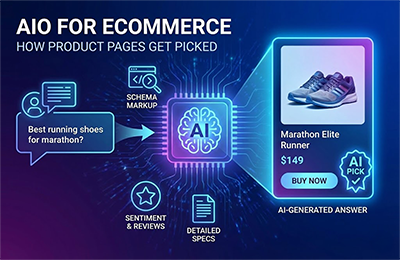
AI-powered search engines don’t “rank” ecommerce product pages the way Google traditionally does; they select them. In this guide, we break down how AIO for ecommerce works, how AI reads product data, which schema and attributes matter most and how to structure product pages so they’re eligible for AI-generated shopping answers across ChatGPT, Gemini and similar platforms.
AIO for Ecommerce
Ecommerce search is undergoing a structural shift. Instead of users scrolling through ten blue links, they’re increasingly asking AI tools direct questions like “Which running shoes are best for flat feet?” or “What’s the best noise-cancelling headphone under $300?”
In these moments, AI systems don’t browse your entire store. They extract, interpret and recommend specific product pages based on clarity, structure, and trust signals. This is where AIO for ecommerce becomes critical.
Artificial Intelligence Optimization focuses on making product pages machine-readable, context-rich and selection-ready so your products can appear in AI-generated answers, not just traditional search results.
How AI Reads Product Data
Unlike humans, AI models don’t “see” your product pages visually. They read them as structured and unstructured data layers.
AI shopping systems typically process:
- Page text (titles, descriptions, FAQs)
- Structured data (schema markup)
- Trust indicators (reviews, ratings)
- Attribute consistency (price, size, availability)
- External validation (merchant feeds, trusted sources)
Large language models build product understanding vectors, semantic summaries of what a product is, who it’s for, and when it’s the best recommendation. Pages with vague descriptions, missing attributes, or inconsistent data often get ignored, even if they rank well in traditional SEO.
This is why ecommerce LLM visibility depends more on data completeness than keyword density.
Schema for Ecommerce
Schema is the backbone of AI product comprehension. Without it, AI systems must guess. With it, they can confidently extract facts.
For ecommerce, the most influential schema types include:
- Product
- Offer
- AggregateRating
- FAQPage
Using proper product schema allows AI tools to clearly identify:
- Product name and brand
- Pricing and currency
- Availability status
- Review scores
- Variant relationships
Platforms like Shopify already support structured data natively, but default implementations are often incomplete. Enhancing schema through Shopify’s theme customization or apps and validating it via Google Merchant Center significantly improves AI shopping SEO readiness.
External documentation worth referencing includes Shopify Dev Docs for structured data best practices and Google Merchant Center for feed alignment and attribute consistency.
Product Attributes AI Values
AI doesn’t recommend products; it recommends solutions to intent. To do that, it evaluates specific attributes that signal usefulness and trust.
reviews, specs, FAQs
Reviews
AI systems prioritize products with clear social proof. It’s not just the star rating, but:
- Volume of reviews
- Recency
- Sentiment consistency
A product with 4.6 stars from 300 reviews is far more likely to be selected than one with 5 stars from 3 reviews.
Specifications
Structured, scannable specs matter more than long marketing copy. AI looks for:
- Dimensions
- Materials
- Compatibility
- Performance metrics
These details help models match products to comparison-style queries.
FAQs
FAQ sections act as pre-trained answers for AI. Well-written FAQs increase eligibility for:
- Conversational AI answers
- Comparison prompts
- “Best for” recommendations
This directly supports AI shopping SEO by aligning product pages with natural language queries.
How to Make Product Pages AI-Friendly
Optimizing for AIO doesn’t mean rewriting everything, it means restructuring with intent clarity.
Key best practices include:
- One clear primary use case per product page
- Descriptive, non-promotional product titles
- Attribute-rich descriptions written in plain language
- FAQ sections answering real buyer questions
- Consistent pricing and availability across schema, feeds and page copy
AI models favor pages that reduce ambiguity. If a product serves multiple use cases, AI often skips it in favor of a more clearly defined alternative.
This is where AIO for ecommerce differs from traditional CRO clarity beats persuasion.
Ecommerce Examples
Consider two ecommerce scenarios:
Example 1: Consumer Electronics
A headphone product page includes:
- Detailed specs (battery life, codec support, noise cancellation level)
- 250+ reviews with summarized sentiment
- FAQ answering “Is this good for calls?” and “Does it work with iOS and Android?”
This page is far more likely to appear in AI-generated shopping answers than a competitor page with only a short description and no structured FAQs.
Example 2: Apparel Ecommerce
A product page clearly defines:
- Fit type
- Fabric composition
- Climate suitability
- Care instructions
AI models can confidently recommend it for prompts like “best breathable shirts for summer travel” because the attributes align directly with intent.
These examples highlight how ecommerce LLM visibility is earned through precision, not verbosity.
Summing Up
AI-driven commerce discovery is no longer experimental; it’s already shaping how buyers find products. Ecommerce brands that rely solely on classic SEO risk invisibility in AI-generated answers.
By aligning product pages with AIO for ecommerce principles, clear structure, rich attributes and machine-readable schema, you position your catalog to be selected, not just indexed.
The future of ecommerce visibility belongs to brands that help AI understand their products better than competitors do.
FAQs
How does AI choose products?
AI selects products based on structured data, attribute clarity, reviews, FAQs and alignment with user intent not just keyword rankings.
What schema do I need?
At a minimum, ecommerce sites should implement Product, Offer, AggregateRating and FAQPage schema to support AI comprehension.
Does schema alone guarantee AI visibility?
No. Schema enables understanding, but AI also evaluates reviews, specs, and content clarity before selecting products.
Is AIO different from traditional ecommerce SEO?
Yes. AIO focuses on selection readiness for AI-generated answers, while traditional SEO focuses on rankings in search results.