
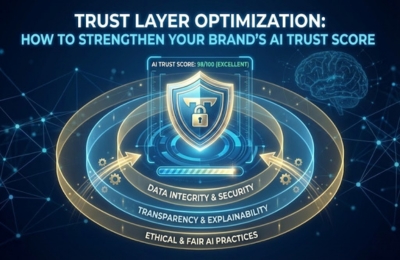
Trust Layer Optimization focuses on how AI systems evaluate whether your brand is credible, consistent and safe to reference. Your AI trust score is shaped by content reliability, entity consistency, citations and long-term signals that large language models (LLMs) learn over time. This guide explains how AI measures trust, how to strengthen your brand’s trust layer, and how to track improvements as part of AIO, AEO and GEO strategies.
Trust Layer Optimization
As AI-powered search engines and LLMs increasingly mediate how users discover information, trust has become a technical ranking signal, not a vague branding concept. Search visibility today is no longer just about keywords or backlinks. It’s about whether AI systems trust your brand enough to reuse, summarize, or recommend your content.
This is where Trust Layer Optimization comes in. It’s the practice of deliberately engineering credibility signals so AI systems can confidently treat your brand as a reliable source.
At the center of this concept is your AI trust score, an implicit evaluation formed across content, entities, citations and consistency.
What is an AI trust score?
An AI trust score is not a publicly displayed metric. Instead, it’s an inferred signal built inside LLMs and AI-powered search systems based on how consistently and reliably your brand appears across trusted contexts.
In simple terms, it answers one question:
Can this brand be safely cited, summarized, or recommended by an AI system?
AI trust scores are influenced by factors such as:
- Accuracy and stability of information over time
- Consistent brand and entity references
- Presence in authoritative datasets and publications
- Alignment between claims, evidence and citations
Unlike traditional SEO authority, trust is cumulative and memory-based. Once a brand earns trust, AI systems tend to reinforce it. Once trust erodes, recovery takes time.
How LLMs measure trust
Large language models do not “fact-check” in real time. Instead, they rely on learned patterns from their training data and reinforcement signals. Trust is inferred statistically.
From an AIO perspective, LLMs evaluate trust using three primary layers:
1. Source reliability
LLMs learn which sources historically provide accurate, low-variance information. Brands that publish stable, non-contradictory content are treated as safer references.
2. Entity coherence
When your brand, services, and expertise appear consistently connected across platforms, AI systems form a clean entity profile. Fragmented messaging weakens trust signals to AI.
3. Citation alignment
AI systems favor content that aligns with established research, standards, or institutional knowledge, especially when claims can be traced back to authoritative studies such as those referenced in Stanford AI Trust Studies.
This is why trust signals AI are not just content-related; they are structural.
Ways to strengthen the trust layer
Trust Layer Optimization is not a one-time checklist. It is an ongoing system built across content, structure and reinforcement.
Key methods include:
- Publishing definitive explanations rather than opinion-heavy content
- Avoiding speculative or exaggerated claims
- Using consistent terminology for services, products and expertise
- Aligning brand messaging across owned and earned channels
From a brand authority AIO standpoint, trust improves when AI repeatedly sees the same brand associated with the same concepts, problems and solutions without contradiction.
Content, consistency, citations
This is the operational core of trust layer optimization.
Content
Your content should resolve questions clearly and directly. AI favors pages that explain what something is, how it works and why it matters without ambiguity. This structure also supports AI overview optimization.
Consistency
Consistency applies to:
- Brand descriptions
- Service definitions
- Expertise positioning
When different pages describe the same thing in different ways, AI systems struggle to form a stable trust profile. This weakens credibility optimization efforts.
Citations
Citations act as validation anchors. Referencing established research and institutions reinforces your reliability. Even when users never click outbound links, AI systems register the alignment.
This is why internal links to concepts such as AI crawlability, AIO, AEO and GEO matter; they help AI understand how your trust signals connect across your ecosystem.
Measuring trust score over time
Because AI trust scores are implicit, measurement is indirect. However, progress can be tracked using observable signals.
Key indicators include:
- Increased inclusion in AI-generated summaries
- More frequent brand mentions without direct prompts
- Improved stability of how your brand is described by AI
- Reduced hallucinations or misattributions related to your content
From a technical standpoint, trust compounds. Brands that maintain clean, consistent trust layers often see faster indexing, stronger AI visibility and more durable rankings across AI-driven discovery systems.
FAQs
What is an AI trust score?
An AI trust score is an inferred signal that reflects how reliable and safe an AI system considers a brand when generating answers, summaries, or recommendations.
How to improve the trust layer?
Improve your trust layer by publishing accurate content, maintaining consistent brand messaging and aligning claims with authoritative citations over time.
Does trust affect AI search visibility?
Yes. Trust directly influences whether AI systems reuse your content in AI overviews, summaries and conversational answers.
Is trust layer optimization part of SEO?
It extends beyond traditional SEO. Trust layer optimization is a core component of AIO, AEO and GEO strategies designed specifically for AI-powered search.