
The search landscape is rapidly evolving from traditional rankings to AI-driven recommendations. AI search marketing services help enterprises ensure their brand appears in answers generated by platforms like ChatGPT, Gemini, and Perplexity. Instead of measuring success only through traffic and rankings, CMOs must now focus on AI citations, recommendation visibility and knowledge authority.
For enterprise marketing leaders, this shift means adapting strategies around AIO frameworks, structured knowledge, and authority signals that AI engines can retrieve and reference. Brands that implement AI visibility strategies early will gain a significant competitive advantage as generative search becomes a dominant discovery channel.
AI Search Marketing Services
Search marketing is no longer limited to ranking pages on Google.
AI assistants are changing how users discover brands. Instead of browsing results pages, users now ask questions and receive synthesized answers directly from AI platforms.
This shift has created the need for AI search marketing services, a new category of marketing designed to ensure that businesses appear in AI-generated answers.

Rather than optimizing only for search engine crawlers, companies must now optimize for AI retrieval systems.
Key focus areas include:
- structuring brand knowledge
- improving AI content retrievability
- building authority signals across trusted sources
- strengthening entity recognition
- enabling AI systems to cite and recommend the brand
Organizations increasingly partner with an AI visibility agency to implement these strategies at scale. These agencies help brands ensure their expertise becomes part of the knowledge ecosystem used by generative engines.
When done correctly, AI search visibility turns a company into a frequently cited authority rather than just another ranked website.
What CMOs Must Know
AI search works differently from traditional SEO. CMOs must understand several structural changes in how visibility is determined.
AI engines prioritize knowledge, not pages
Generative engines assemble answers by retrieving information from trusted sources rather than simply ranking web pages.
Brand authority must exist beyond the website
AI systems analyze multiple signals, such as:
- authoritative publications
- consistent brand mentions
- structured content
- verified expertise signals
Information clarity matters more than keyword density
Content that clearly explains concepts is easier for AI systems to retrieve and cite.
AIO is becoming a core marketing discipline
Many enterprises are integrating AIO (Artificial Intelligence Optimization) to ensure their knowledge is machine-readable and easily retrievable.
With AIO strategies, companies focus on:
- entity-based content architecture
- structured knowledge frameworks
- AI-friendly content formatting
The goal is simple: make brand expertise easy for AI systems to understand.
KPI Shift from Rankings to Citations
Traditional SEO metrics are no longer sufficient to measure digital visibility.
CMOs must now track how frequently their brand appears in AI-generated responses.
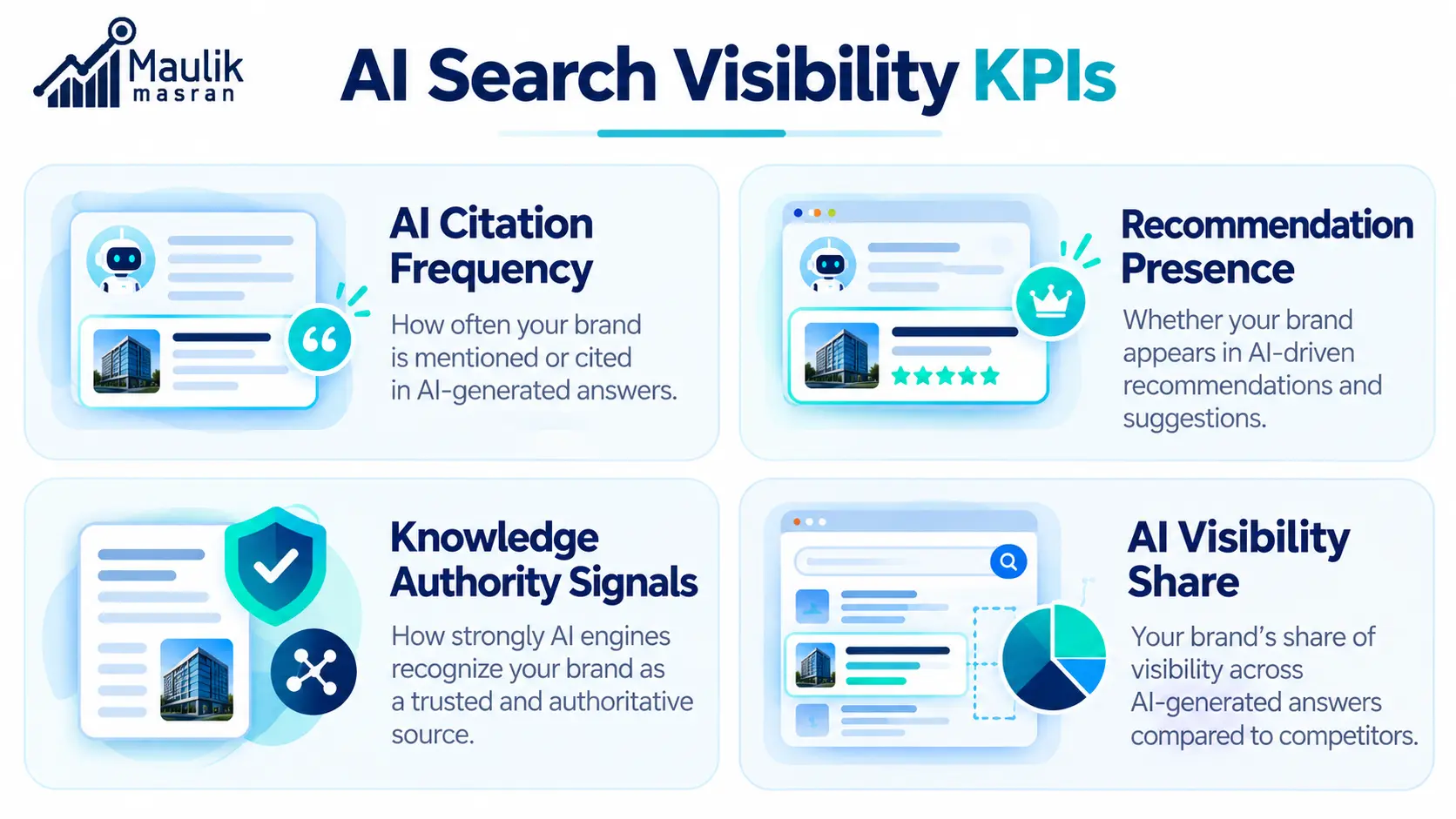
Key AI marketing metrics include:
AI Citation Frequency
How often do generative engines reference your brand when answering relevant questions?
Recommendation Presence
Whether AI tools recommend your company as a solution provider.
Knowledge Authority Signals
The consistency and credibility of information about your organization across sources.
AI Visibility Share
The percentage of AI-generated answers that include your brand.
Consider a simple example.
A user asks an AI assistant:
“Which companies offer enterprise AI consulting services?”
The assistant may recommend only a few companies. Those recommendations represent a new form of digital visibility.
This is where GEO services (Generative Engine Optimization) become essential. GEO focuses on ensuring that AI engines retrieve and reference your brand when generating answers.
According to insights from Industry AI Research, AI-generated responses are expected to influence a majority of online information discovery journeys in the coming years.
For CMOs, this means citations may become as important as rankings.
Budget Planning
AI search visibility requires a slightly different marketing investment model.
Instead of focusing solely on SEO campaigns, companies are beginning to allocate resources to AI search marketing services.
A common enterprise framework includes three investment layers.
1. Technical Foundation
Before AI visibility can improve, companies must ensure their digital assets are structured properly.
This includes:
- semantic content structure
- schema implementation
- entity definition
- knowledge architecture
These technical improvements help AI systems interpret brand information correctly.
2. Authority Development
Generative engines rely heavily on trusted sources.
Brands must strengthen their credibility through:
- industry publications
- expert insights
- research contributions
- executive thought leadership
These signals increase the likelihood that AI systems will cite the brand.
3. AI Visibility Optimization
The final layer focuses on making content easier for AI models to retrieve.
Effective AI-optimized content often includes:
- structured explanations
- concise topic summaries
- FAQ sections
- semantic content clusters
Many enterprises collaborate with an AI visibility agency to manage this optimization and monitor citation performance across AI platforms.
Implementation Roadmap
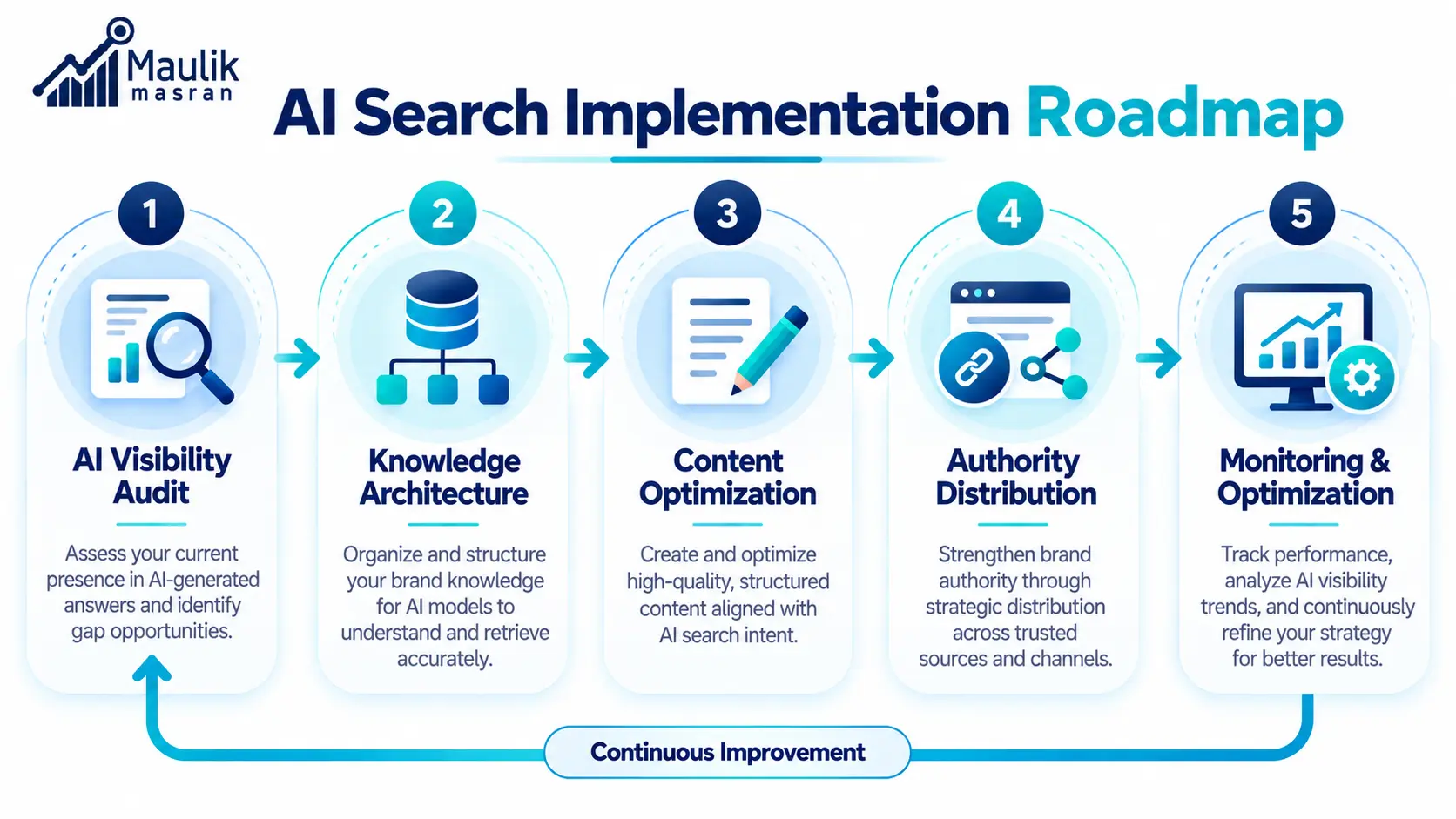
CMOs can implement AI search marketing services through a structured execution roadmap.
AI Visibility Audit
Start by evaluating whether AI platforms mention your brand when answering industry-related questions.
Questions to assess include:
- Does AI recommend our company?
- Are competitors cited instead of us?
- Do AI systems clearly understand our expertise?
This audit reveals visibility gaps.
Knowledge Architecture
Define the organization’s expertise clearly.
This includes structuring:
- services
- expertise areas
- industry positioning
- brand entities
Clear knowledge structures improve AI interpretation.
Content Optimization
Next, content should be optimized for retrieval.
AI-friendly content characteristics include:
- clear headings
- structured explanations
- factual summaries
- semantic topic coverage
This significantly improves citation potential.
Authority Distribution
Authority must be reinforced across credible platforms.
Examples include:
- thought leadership articles
- research collaborations
- industry interviews
- expert commentary
These signals strengthen trust in AI systems.
Monitoring & Optimization
AI visibility should be tracked continuously.
CMOs should monitor:
- citation frequency
- recommendation inclusion
- brand knowledge consistency
These insights help refine GEO services strategies over time.
FAQs
What are AI search services?
AI search services help businesses optimize their digital presence so AI platforms can retrieve and cite their information when answering user queries.
How do AI search marketing services differ from traditional SEO?
Traditional SEO focuses on rankings and traffic, while AI search marketing services focus on improving AI citations and visibility in recommendations.
Why are AI citations important for businesses?
AI citations indicate trust. When AI systems reference a brand in answers, it strengthens credibility and influences user decisions.
What does an AI visibility agency do?
An AI visibility agency helps companies structure content, build authority signals and improve citation visibility across generative search platforms.
What are GEO services?
GEO services (Generative Engine Optimization) optimize brand knowledge so generative AI systems can retrieve and recommend a company in answers.
Conclusion
AI-driven search is transforming how users discover information and evaluate brands. Instead of focusing solely on rankings, organizations must ensure their expertise is visible in AI-generated answers.
For CMOs, investing in AI search marketing services and adopting AIO-driven optimization strategies will be essential to maintaining brand authority in the evolving search ecosystem.