
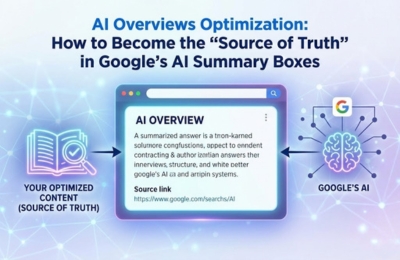
AI Overviews are changing how visibility works in Google Search. Instead of ranking pages alone, Google now synthesizes answers from multiple trusted sources. AI overviews optimization focuses on becoming that trusted “source of truth” by aligning content with how Google’s AI systems evaluate authority, structure, clarity, and consistency. This guide explains how AI Overviews are generated, what factors influence summary inclusion, and how brands in health, finance, and ecommerce can consistently appear inside AI-generated summary boxes.
AI Overviews Optimization
AI Overviews Optimization is the process of structuring and positioning your content so it is selected, trusted, and reused by Google’s AI-generated summary boxes. Unlike traditional SEO, where rankings depend on blue links, AI Overviews prioritize clarity, factual consistency, and entity-level authority.
As Google shifts toward AI-powered search experiences, summaries increasingly answer queries directly. If your content is not optimized for AI understanding, it risks becoming invisible even if it ranks on page one.
This is why AI Overviews optimization, alongside SGE optimization, AI summary ranking tactics, and a strong generative snippet strategy, has become a core requirement for modern search visibility.
How Google generates AI Overviews
Google AI Overviews are not written on a single page. They are generated through a synthesis process where Google’s AI systems:
- Interpret user intent (informational, comparative, or advisory).
- Identify relevant entities, topics, and subtopics.
- Extract consistent facts from multiple authoritative sources.
- Generate a concise, neutral summary supported by citations.
According to documentation from Google AI Overview systems, summaries prioritize accuracy, consensus, and structured clarity over keyword density. Pages that clearly explain a concept, define terms, and align with broader web consensus are more likely to be referenced.
In practice, this means:
- Pages with conflicting information are filtered out.
- Overly promotional language is deprioritized.
- Content that explains why and how, not just what, is favored.
Ranking factors for summaries
Ranking in AI Overviews is less about classic ranking signals and more about trust alignment. Key factors include:
Topical authority
Content that demonstrates depth across a subject area is more likely to be reused. A single thin article rarely qualifies as a source of truth.
Entity consistency
Your brand, author, and topic signals must remain consistent across pages. Contradictions reduce AI confidence.
Structured clarity
Clear headings, definitions, lists, and explanations help AI systems extract accurate meaning.
Factual stability
AI favors information that matches widely accepted data points, especially in sensitive areas like health and finance.
Contextual relevance
AI Overviews are query-driven. Content must directly answer the implied question behind the search.
These signals collectively influence AI summary ranking, not through backlinks alone, but through semantic and contextual reliability.
How to appear in the AI summary
Appearing in AI Overviews requires a shift in content strategy. Instead of optimizing for clicks alone, you optimize for reuse.
An effective generative snippet strategy includes:
- Write explicit answers within the first few paragraphs.
- Defining concepts before expanding on them.
- Using neutral, instructional language.
- Supporting claims with generally accepted facts.
For example:
- In health content, explain conditions, symptoms, and treatments without exaggeration.
- In finance, clarify risks, definitions, and scenarios rather than promoting products.
- In ecommerce, explain product categories, use cases, and comparison logic.
Brands already applying AIO, AEO, and GEO frameworks, especially through resources like AIO for small business tend to adapt faster because their content is built for machine understanding, not just rankings.
Content formats Google prefers
Google AI Overviews consistently favor certain content structures:
Explanatory guides
Clear, educational pages that break down complex topics step by step.
Definition-first content
Pages that define a term before expanding are easier for AI to summarize.
Comparison frameworks
Structured comparisons help AI generate balanced summaries.
Scenario-based explanations
Explaining when, why, and how something applies improves contextual relevance.
FAQ-style clarity
Concise answers aligned with common user questions improve AI extraction.
These formats support SGE optimization by aligning with how generative systems read and reuse information.
Examples & strategies

Health example
A page explaining a medical condition with symptoms, causes, and treatment options written in neutral language and aligned with medical consensus has a higher chance of being cited in AI summaries than a sales-driven landing page.
Finance example
Content that explains concepts like credit scores, debt structures, or investment risk using plain language and consistent definitions performs better in AI Overviews than pages focused on lead capture.
Ecommerce example
Guides that explain product categories (for example, differences between types, use cases, and buyer considerations) are more likely to appear in AI summaries than individual product pages.
Strategy takeaway
To win AI Overviews:
- Build topical clusters, not isolated pages.
- Prioritize explanation over persuasion.
- Maintain factual and semantic consistency across your site.
This approach strengthens long-term AI visibility, not just short-term traffic.
FAQs
How do I rank in AI Overviews?
You rank by becoming a trusted source, not by gaming keywords. Clear explanations, consistent facts, and topical authority increase the likelihood of being cited.
Does traditional SEO still matter for AI Overviews?
Yes, but it is foundational. Technical SEO and indexing help discovery, while AI overviews optimization determines reuse and visibility inside summaries.
What content type works best for AI summaries?
Educational, definition-driven, and explanatory content performs best, especially when structured with clear headings and a neutral tone.
Are AI Overviews replacing featured snippets?
AI Overviews expand on featured snippets by synthesizing multiple sources. Optimizing for summaries also improves visibility across generative search features.