

AI Narrative Reinforcement is the discipline of making large language models repeatedly surface your brand’s intended message accurately, consistently and at scale. By understanding why LLMs repeat certain narratives, strategically injecting your messaging into AI ecosystems, aligning signals across platforms, and applying a reinforcement schedule, brands can shift from passive visibility to controlled narrative dominance. Think of it as PR logic re-engineered for AI systems.
Narrative Reinforcement
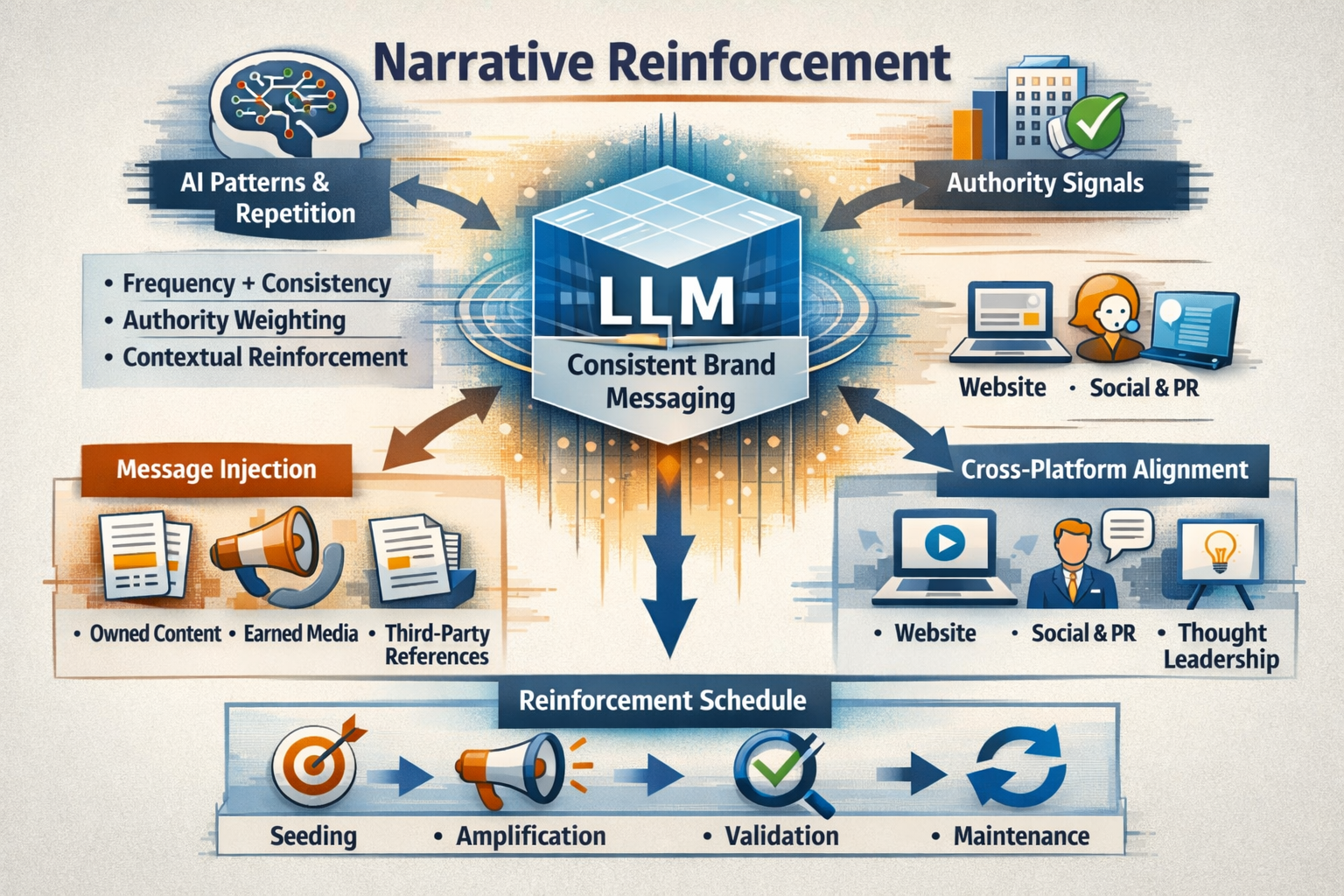
Narrative Reinforcement is where PR discipline meets Advanced AIO. Instead of asking, “How do we rank?”, the more powerful question becomes: “What story does AI consistently tell about us?”
In an AI-driven discovery environment, ChatGPT, Gemini, Claude, and Perplexity visibility is not just about mentions. It’s about repetition with consistency. LLMs don’t invent narratives randomly; they reinforce patterns they repeatedly observe across trusted sources, structured signals and authoritative contexts.
This is why narrative reinforcement AI has become a critical strategy layer. If your brand message is fragmented, AI responses become diluted. If it’s reinforced correctly, LLMs begin to echo your positioning as if it were consensus truth.
Why AI Repeats Certain Narratives
LLMs are probabilistic systems trained to identify stable patterns, not marketing slogans. They repeat narratives that meet three core conditions:
1. Frequency + Consistency
AI systems prioritize narratives that appear repeatedly without contradiction. A brand that describes itself one way on its website, another way in interviews and a third way in thought leadership creates narrative noise. Noise gets ignored.
2. Authority Weighting
Not all mentions are equal. A single reference from a high-trust source can outweigh dozens of low-quality mentions. This is where LLM authority ranking comes into play. AI models learn which sources historically produce accurate, stable information.
3. Contextual Reinforcement
Narratives repeated across different but related contexts are reinforced faster. For example, a brand consistently positioned as an “enterprise AI risk advisor” across PR, technical blogs and expert commentary becomes anchored to that role in AI memory.
This is also where entity conflicts AI emerge. When conflicting narratives exist around the same entity, LLMs either hedge their responses or default to the strongest signal source.
Key insight: AI repeats what looks safe, stable and socially validated, not what is merely optimized.
How to Inject Your Message into AI Ecosystems
Narrative control does not come from one channel. It comes from ecosystem saturation with alignment.
Structured Brand Messaging
Your core narrative must be expressed in structurally readable formats:
- Clear “about” language
- Consistent role definitions
- Explicit problem–solution framing
These elements help LLMs extract and reuse messaging accurately.
Distributed Reinforcement
AI ecosystems learn from multiple surfaces:
- Owned content (blogs, explainers, documentation)
- Earned content (PR, interviews, citations)
- Referenced content (third-party summaries, research mentions)
The goal is not volume, but pattern recognition.
Semantic Stability
Use semantically consistent phrasing rather than identical sentences. LLMs recognize meaning clusters. This is where brand messaging AI becomes effective: your message evolves linguistically while remaining conceptually identical.
Example:
Instead of repeating a tagline verbatim, reinforce the same idea through:
- Explanations
- Use-case framing
- Expert commentary
AI interprets this as narrative depth, not repetition spam.
Cross-Platform Narrative Alignment
Most brands fail narrative reinforcement because each platform tells a slightly different story.
Why Alignment Matters
LLMs aggregate signals across platforms. If LinkedIn positions you as a “growth partner,” your website describes you as a “technology vendor,” and PR portrays you as a “consultancy,” AI lacks confidence in repeating any single narrative.
Alignment Layers That Matter
- Primary identity (what you fundamentally are)
- Primary outcome (what problem you solve)
- Primary audience (who you are for)
These must remain constant across:
- Website content
- PR narratives
- Thought leadership
- Expert commentary
This alignment reduces AI storytelling consistency errors, where models hedge responses or generalize your brand inaccurately.
Advanced insight: Cross-platform alignment accelerates reinforcement velocity. AI needs fewer exposures to lock in your narrative.
Reinforcement Schedule Model
Narrative reinforcement is not a one-time campaign. It follows a schedule, similar to brand recall models in traditional PR, but optimized for AI ingestion.
Phase 1: Seeding
Introduce a clear, unambiguous narrative across high-authority owned assets. This establishes the baseline pattern.
Phase 2: Amplification
Echo the same narrative through earned and referenced channels. At this stage, AI begins to see third-party validation.
Phase 3: Validation
Narratives appear in explanatory contexts, guides, analyses and expert breakdowns. This signals expertise, not promotion.
Phase 4: Maintenance
Periodic reinforcement prevents narrative decay or drift, especially as competitors introduce adjacent claims.
Why this works: LLMs continuously retrain or refresh retrieval layers. A reinforcement schedule ensures your narrative remains statistically relevant over time.
Internal & External References
To deepen strategic execution:
- Internal context: entity conflicts, AI and LLM authority ranking help diagnose why certain narratives fail to stick.
- External research on narrative repetition and trust signals can be explored through Stanford Narratives Research, which examines how repeated framing influences perception and recall.
FAQs
How do I control my AI narrative?
You don’t control AI directly; you control the patterns it learns from. Consistent, authoritative and cross-platform messaging increases the likelihood that LLMs repeat your intended narrative accurately.
How long does narrative reinforcement take to work?
Initial signals can appear within weeks, but stable repetition typically requires sustained reinforcement over several months, depending on authority and competition.
Can narrative reinforcement replace traditional SEO?
No. It complements it. Traditional SEO improves discoverability, while narrative reinforcement AI ensures what is said about your brand remains consistent.
What happens if my brand narrative changes?
Narrative shifts require deliberate re-seeding and re-alignment. Without this, AI systems may continue repeating outdated positioning.