
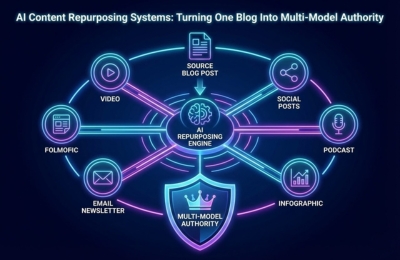
An effective AI repurposing strategy transforms a single high-quality blog into a structured ecosystem of LinkedIn posts, videos, podcasts and short-form content that reinforces your authority across AI systems. Large language models reward multi-format AIO signals, entity repetition and consistent thematic reinforcement. This guide provides a practical framework, calendar template and amplification model to scale content visibility using content scaling AI.
AI Repurposing Systems
Publishing one blog and moving on is no longer a competitive strategy.
In the AI-first discovery era, content is evaluated not just by traffic but by reinforcement across models, formats and platforms. ChatGPT, Gemini, Claude, Perplexity and other generative engines synthesize information from structured, repeated, multi-context signals.
An effective AI repurposing strategy does three things:
- Reinforces your core entities across multiple formats
- Expands semantic coverage around the same topic
- Signals authority through consistent thematic repetition
This is not duplication. It is structured amplification. Instead of “more content,” the objective is stronger reinforcement.
Why AI Prefers Multi-Format Reinforcement
AI systems are probabilistic pattern recognizers. They assign salience to entities, themes and claims based on frequency, consistency, and contextual diversity.
If your insight appears:
- In a long-form blog
- Reinforced in LinkedIn thought leadership
- Explained in a YouTube video
- Discussed in a podcast
- Structured in FAQ format
It becomes statistically stronger in the training and retrieval layer.
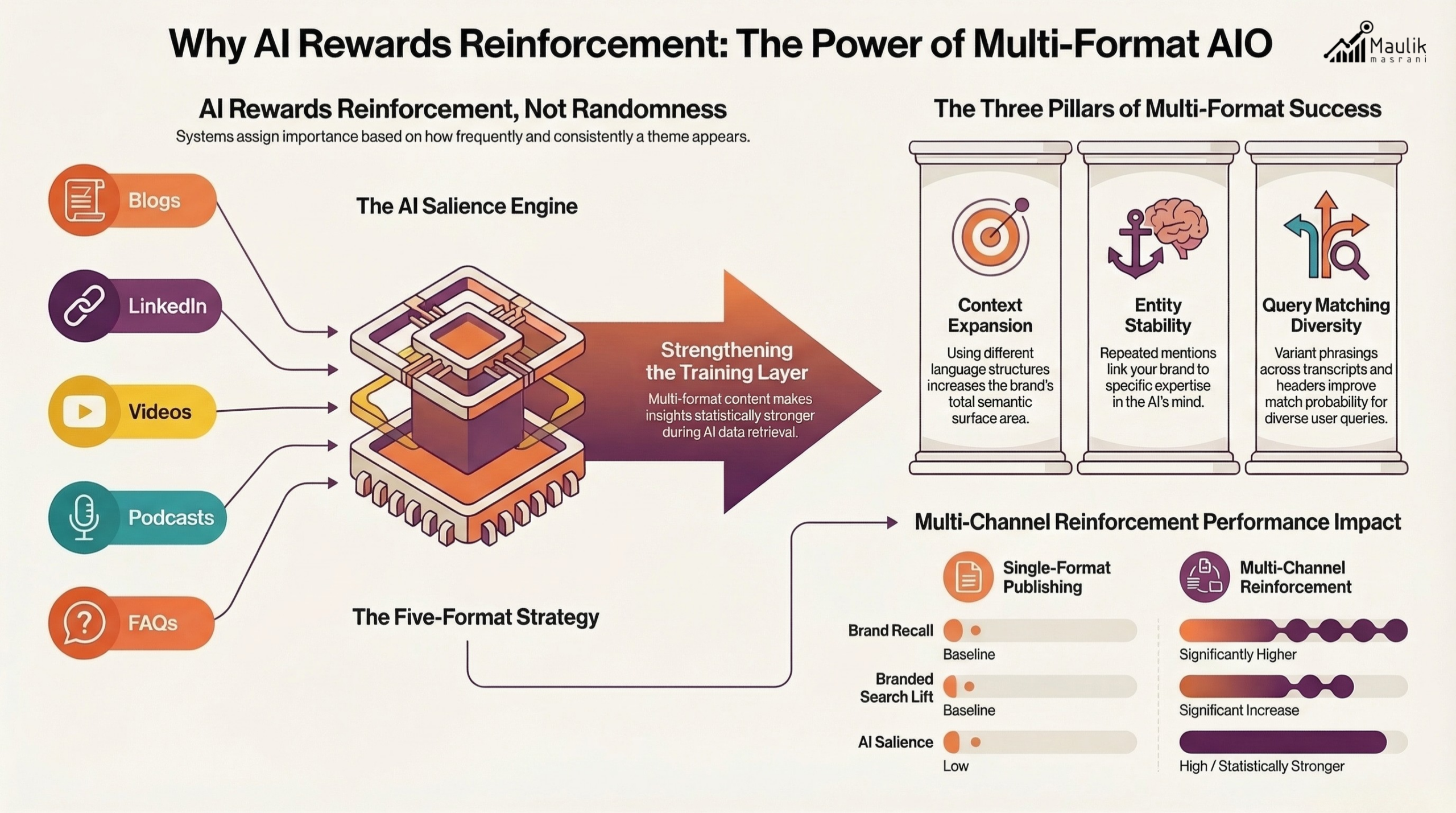
Multi-format AIO works because:
1. Context Expansion
Different formats use different language structures. A blog may define concepts formally. A LinkedIn post may simplify them. A podcast may add narrative examples. This increases semantic surface area.
2. Entity Stability
Repeated mention of the same concepts strengthens entity association. If your brand consistently discusses “AI visibility frameworks,” AI models begin linking your brand to that domain.
3. Query Matching Diversity
Video transcripts, captions, blog headers, and podcast summaries all introduce variant phrasings. This improves match probability across different query styles.
Research from content performance studies consistently shows that brands using multi-channel reinforcement experience significantly higher recall and branded search lift compared to single-format publishers.
In short: AI rewards reinforcement, not randomness.
Blog → LinkedIn → Video → Podcast Flow
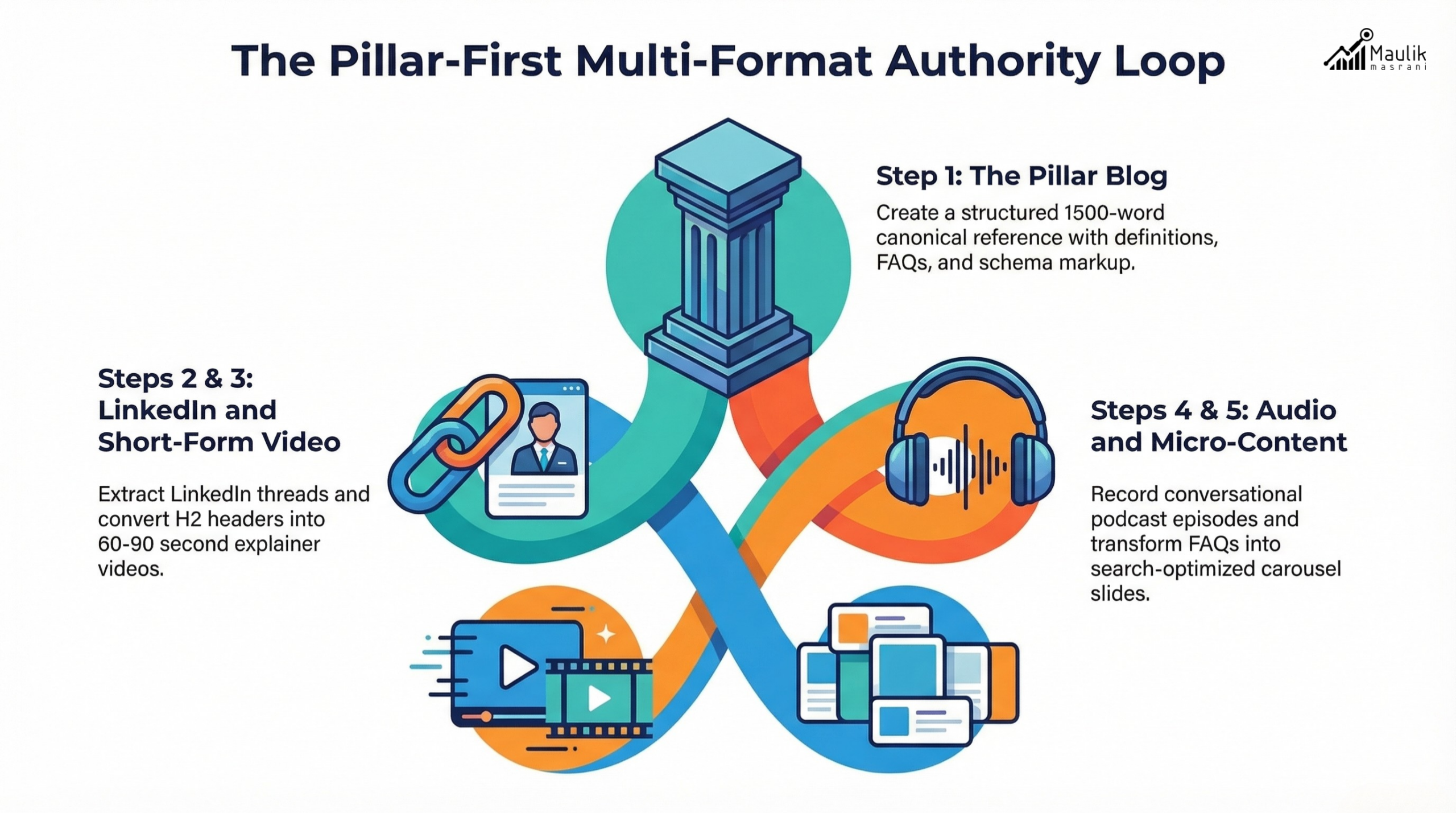
A scalable AI repurposing strategy begins with a pillar blog.
From there, content scaling AI helps transform that single asset into a multi-format authority loop.
Here is the practical flow:
Step 1: Pillar Blog (Source of Truth)
- 1200–1500 words
- Structured H1–H3 format
- Definitions, examples, FAQs
- Schema markup
This becomes the canonical reference.
Step 2: LinkedIn Authority Thread
Extract:
- 5 key insights
- 1 contrarian statement
- 1 practical framework
Structure:
- Hook
- Problem
- Framework
- Action takeaway
Link back to blog as the long-form version.
Step 3: Short-Form Video
Convert each H2 into:
- 60 to 90 second explainer video
- On-screen keywords
- Clear call-to-action
Upload with transcript for semantic indexing.
Step 4: Podcast or Audio Episode
Expand the topic conversationally:
- Add case studies
- Share failures and lessons
- Discuss real implementation
Publish show notes linking back to the blog.
Step 5: FAQ Micro Content
Turn the FAQ section into:
- Carousel slides
- Short Q&A clips
- Search-optimized snippets
Each asset links back to the main pillar. This is multi-format AIO in action. One idea. Many signals.
Content Atomization Method
Atomization is not copy-pasting. It is a systematic decomposition.
Here’s a tactical breakdown:
Layer 1: Core Thesis
Identify the central claim of the blog.
Example: “AI visibility requires reinforcement across formats.”
Layer 2: Sub-Arguments
Extract each H2 section as a standalone micro-topic.
Each becomes:
- A LinkedIn post
- A video script
- A newsletter section
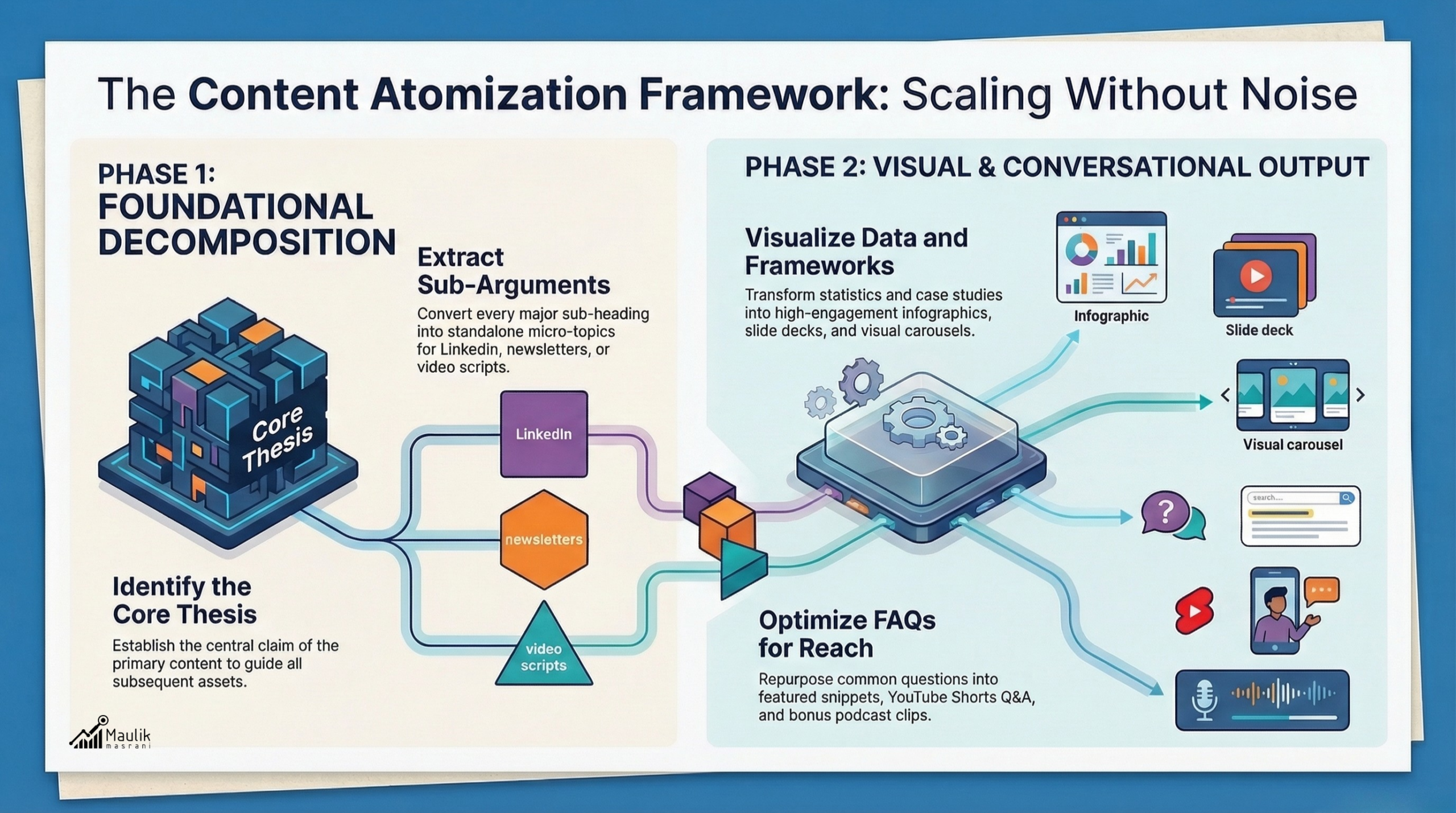
Layer 3: Data & Examples
Pull statistics, case studies, or frameworks into:
- Infographics
- Slide decks
- Visual carousels
Layer 4: FAQs
Turn into:
- Featured snippet-optimized answers
- YouTube Shorts Q&A
- Podcast bonus clips
This method ensures content scaling AI operates systematically, not reactively. The goal is a structured distribution. Not noise.
Repurposing Calendar Template
Consistency beats intensity.
Below is a 30-day reinforcement model:
Week 1
- Publish pillar blog
- Share LinkedIn post #1
- Release Video #1
Week 2
- LinkedIn post #2
- Podcast episode
- FAQ carousel
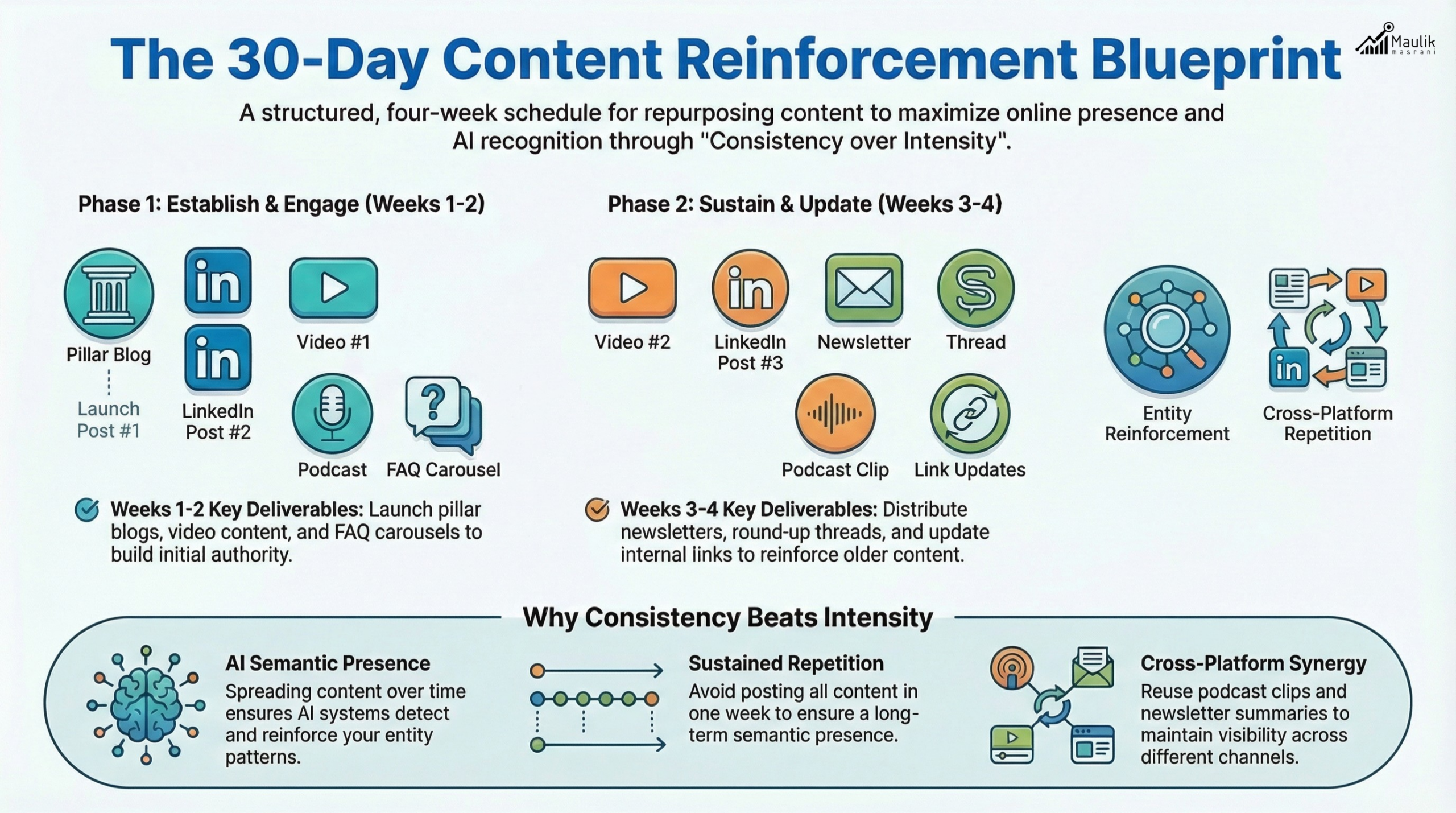
Week 3
- Video #2
- LinkedIn post #3
- Newsletter summary
Week 4
- Round-up thread
- Clip from podcast
- Internal link update to older blogs
This ensures:
- Entity reinforcement over time
- Cross-platform repetition
- Sustained semantic presence
Avoid posting everything in one week. AI systems detect patterns over time.
Amplification Model
Publishing and repurposing are only half the system.
Amplification completes the loop.
1. Internal Linking Reinforcement
Link the new pillar blog to:
- Related older blogs
- Resource pages
- Glossary definitions
This builds internal semantic density.
2. External Citations
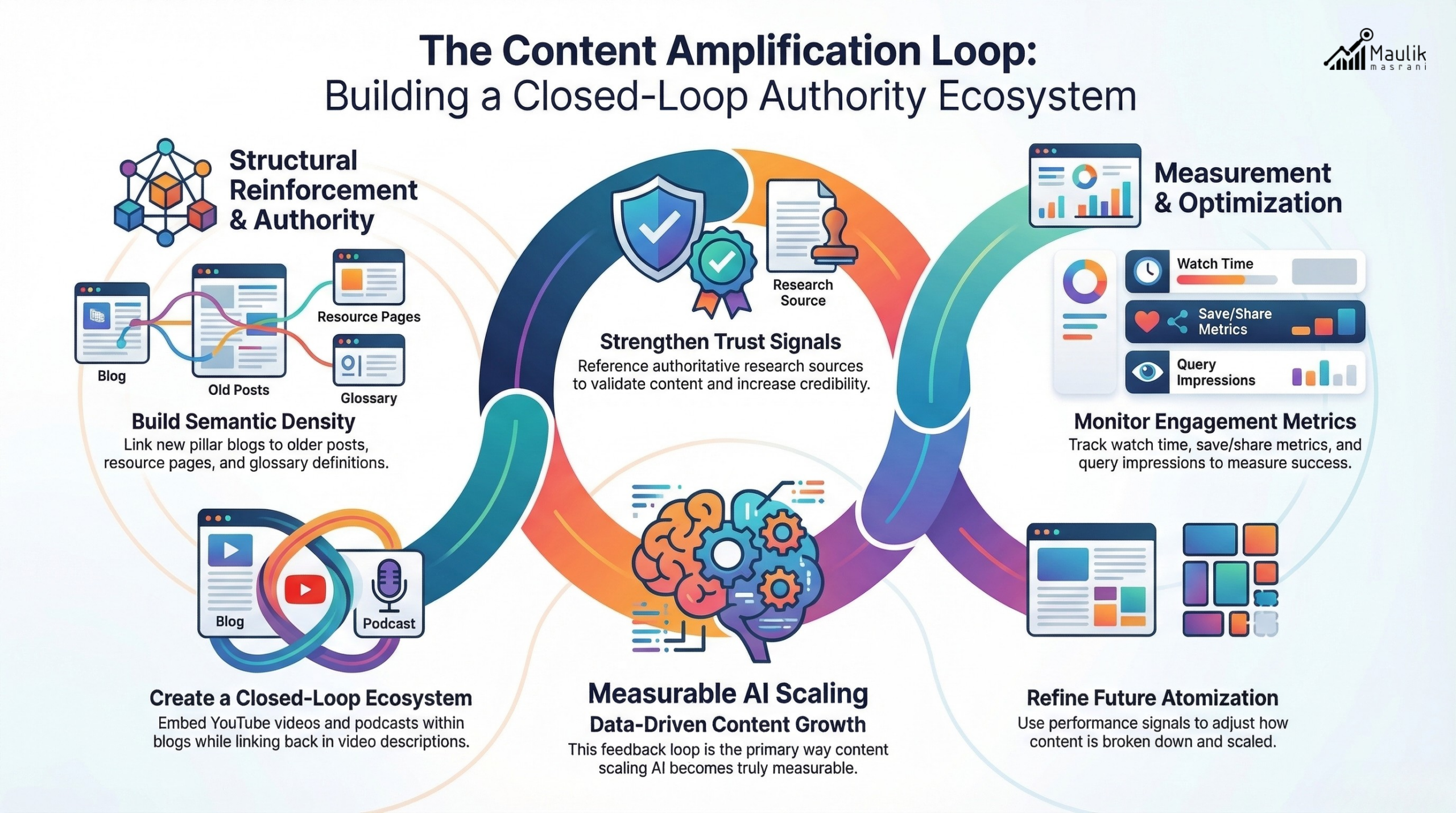
Reference authoritative research sources where relevant to strengthen trust signals.
3. Cross-Platform Embeds
- Embed YouTube in blog
- Embed podcast in blog
- Link the blog in the video description
This creates a closed-loop authority ecosystem.
4. Performance Feedback Loop
Track:
- Engagement rate
- Watch time
- Save/share metrics
- Query impressions
Refine future atomization based on performance signals.
This is how content scaling AI becomes measurable.
FAQs
How to repurpose content for AI visibility?
Start with a structured pillar blog. Break it into LinkedIn insights, short-form videos, podcasts, and FAQ snippets. Reinforce the same core entities and concepts across formats over several weeks to build multi-model authority.
What is an AI repurposing strategy?
An AI repurposing strategy is a systematic method of transforming one high-quality content asset into multiple formats to reinforce authority signals across AI search systems and generative engines.
How does multi-format AIO improve authority?
Multi-format AIO improves authority by expanding semantic coverage, reinforcing entity associations, and increasing match probability across different query styles and platforms.
Can content scaling AI replace original writing?
No. Content scaling AI enhances distribution and transformation, but strong original pillar content remains the foundation of authority.
Conclusion
AI visibility is no longer built through isolated publishing; it is built through structured reinforcement. When one high-quality blog becomes the foundation for LinkedIn insights, videos, podcasts, and FAQ-driven snippets, you create a consistent authority signal that AI systems recognize and prioritize.
A disciplined AI repurposing strategy transforms content from a single asset into a multi-format ecosystem that compounds over time. The brands that win in this environment will not be those that publish the most, but those that scale intelligently, reinforce strategically, and turn every core idea into a durable, multi-model presence.