
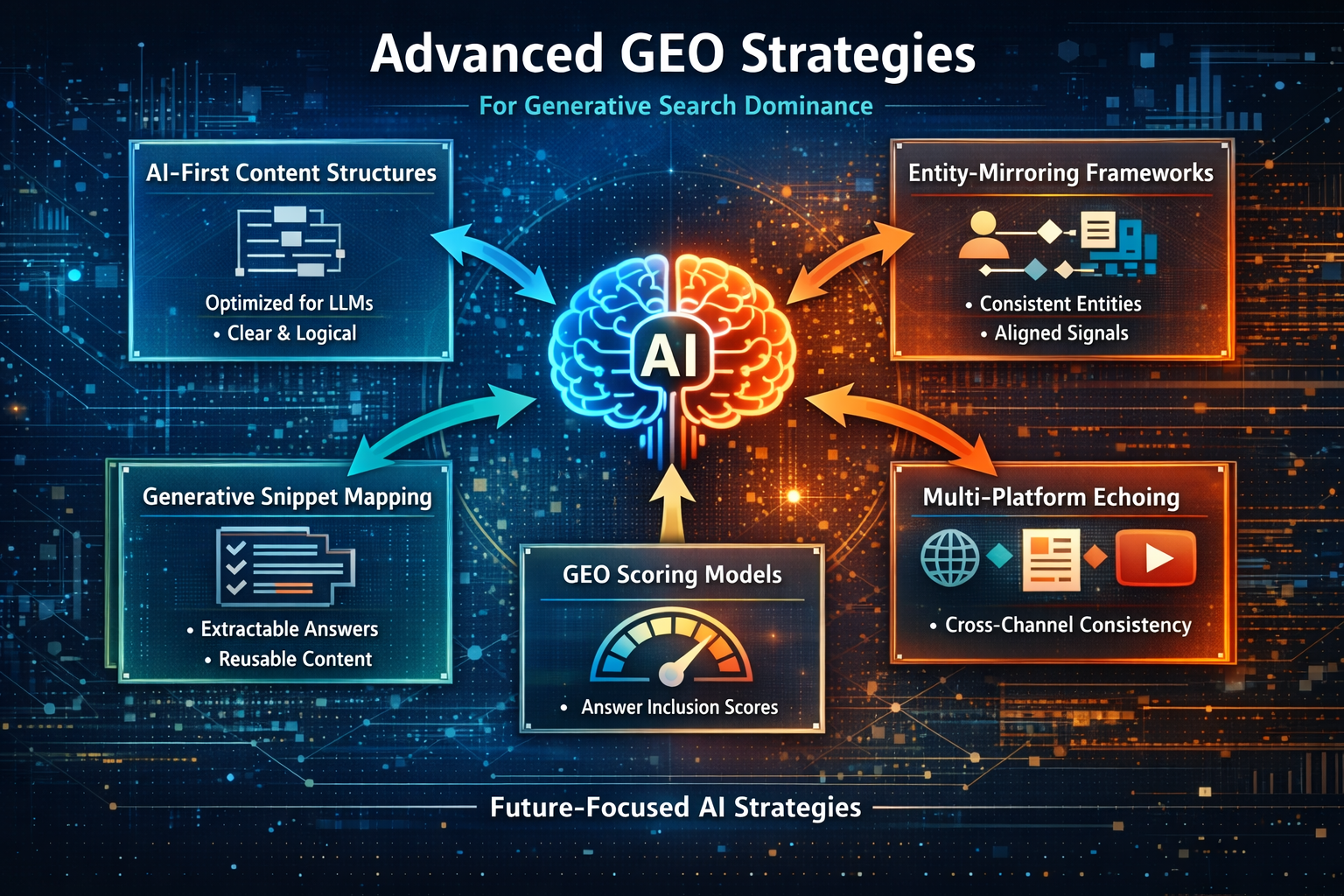
Advanced GEO is no longer about ranking pages, it’s about shaping how large language models interpret, reuse and echo your content across generative search experiences. This guide breaks down the advanced GEO frameworks that matter in 2026: AI-first content structures, entity mirroring, generative snippet mapping, cross-platform echoing and GEO scoring models. If your goal is true generative dominance, this is the playbook.
Advanced GEO Strategies
Generative search has crossed a threshold. Large language models are no longer simply summarizing top-ranking pages; they are synthesizing knowledge, prioritizing sources and selectively reusing ideas based on clarity, authority and structural trust.
This shift has made advanced GEO a discipline of its own. Instead of asking “How do I rank?”, GEO asks “How does an AI decide my content is safe, authoritative and reusable inside its answers?”
Advanced GEO strategies focus on alignment with LLM cognition rather than traditional SERP mechanics. That means optimizing for reasoning paths, entity confidence and answer construction, not just keywords.
AI-first content structures
AI-first content structures are designed for how LLMs read, not how humans skim.
Large language models ingest information hierarchically. They look for clean conceptual boundaries, predictable progression and unambiguous definitions. When content lacks this structure, models struggle to confidently reuse it even if it ranks well in traditional search.
Key characteristics of AI-first structures include:
- Clear conceptual framing early in each section
- Explicit cause–and–effect relationships rather than implied logic
- Progressive depth (basic → advanced → applied insight)
- Minimal semantic redundancy across sections
In practice, this means writing with intent clarity. Each section should answer one conceptual question completely, without drifting into adjacent topics. This reduces semantic overlap and increases extraction confidence, two critical signals for LLM optimization.
AI-first structuring also aligns closely with Generative Engine Optimization, where content is shaped to become a reliable building block inside AI-generated responses.
Entity-mirroring frameworks
Entity mirroring is one of the most powerful and misunderstood advanced GEO techniques.
LLMs don’t “understand brands” the way humans do. They understand entities: stable concepts with consistent attributes, relationships and contextual signals across the web.
An entity-mirroring framework ensures that:
- Your brand, expertise and topic entities are described consistently
- Terminology remains stable across pages and platforms
- Relationships between entities are explicit rather than assumed
For example, if your site positions GEO as a strategic discipline, every mention should reinforce that same definition, scope and purpose. When entity descriptions drift even subtly, LLMs detect inconsistency and reduce reuse probability.
Entity mirroring also extends beyond your website. Profiles, thought leadership articles and external references should echo the same conceptual framing. This multi-source alignment strengthens generative dominance by reinforcing entity confidence in training and retrieval layers.
Generative snippet mapping
Generative snippet mapping focuses on how content fragments are lifted and recombined inside AI answers.
Unlike featured snippets, generative snippets are not fixed excerpts. LLMs dynamically assemble responses by pulling micro-sections of content that cleanly answer sub-questions.
Advanced GEO practitioners design content with this in mind:
- Each subsection should stand alone as a complete idea
- Definitions should be explicit and quotable
- Lists and frameworks should be logically ordered and context-complete
This approach allows models to map your content to multiple prompt variations without distortion. When done well, your ideas become reusable “answer modules” across ChatGPT, Gemini, Claude and Perplexity.
This is a core driver of generative dominance: your content stops being a page and starts becoming a source.
Multi-platform echoing
One of the clearest trends in 2026 is that GEO performance is increasingly cross-platform.
LLMs evaluate not only what you say, but how consistently your ideas appear across the broader knowledge ecosystem. This is where multi-platform echoing comes into play.
Multi-platform echoing means:
- Publishing aligned insights across blogs, articles and professional platforms
- Maintaining consistent terminology and frameworks
- Avoiding contradictory positioning across channels
This does not mean duplicating content. It means reinforcing the same conceptual signals in different contextual formats.
Research and disclosures from organizations like OpenAI and Google increasingly point to retrieval-augmented generation systems that favor sources with strong cross-surface consistency. When your ideas echo reliably, models assign higher trust weight during answer synthesis.
GEO scoring models
Advanced GEO requires measurement, but not in the traditional SEO sense.
GEO scoring models evaluate how well your content aligns with generative reuse criteria. While proprietary tools are emerging, most scoring frameworks assess signals such as:
- Entity clarity and stability
- Structural completeness of answers
- Redundancy control and semantic precision
- Cross-platform consistency
- Update freshness relative to topic velocity
Rather than tracking rankings, GEO scores focus on answer inclusion probability. The higher your score, the more likely your content is to influence or appear inside AI-generated responses.
This represents a fundamental mindset shift: success is measured by influence, not position.
Future predictions
Looking ahead, advanced GEO will become less optional and more foundational.
Several trends are already clear:
- LLMs will reduce reliance on raw ranking signals
- Entity trust and conceptual consistency will outweigh backlink volume
- Answer-level authority will matter more than page-level authority
- GEO strategy will integrate tightly with brand positioning and thought leadership
In 2026 and beyond, the brands that win generative search will not be the loudest but the clearest. Precision, consistency and structural intelligence will define visibility.
FAQs
What is advanced GEO?
Advanced GEO is the practice of optimizing content specifically for generative AI systems, focusing on how LLMs interpret, trust and reuse information rather than how pages rank in search results.
How is GEO different from traditional SEO?
SEO targets rankings and clicks, while GEO targets answer inclusion and influence inside AI-generated responses across tools like ChatGPT and Gemini.
Does advanced GEO require technical changes?
Advanced GEO is primarily content- and strategy-driven, emphasizing structure, entity clarity and consistency rather than heavy technical modifications.
Is GEO’s strategy future-proof?
Yes. As generative search expands, GEO aligns directly with how AI systems evolve, making it a durable and scalable optimization approach.