
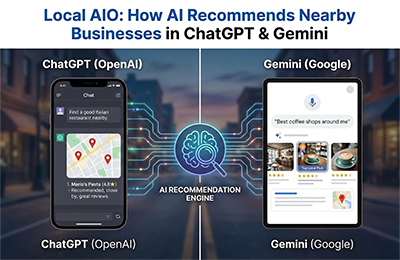
Local AIO (Artificial Intelligence Optimization) determines which nearby businesses AI tools like ChatGPT and Gemini recommend when users ask location-based questions.
Instead of relying only on maps or rankings, AI evaluates reviews, schema, entity consistency and real-world authority signals.
This guide explains how local AI recommendations work and how restaurants, clinics and salons can position themselves to be selected.
Local AIO Explained
Local search has entered a new phase. When people ask ChatGPT or Gemini questions like “best restaurant near me” or “top skin clinic in my area, ” the answer no longer comes from a simple map pack alone. It comes from local AIO on how AI models interpret, trust and recommend nearby businesses.
Unlike traditional SEO, local AIO (Artificial Intelligence Optimization) blends local SEO foundations with AI local search, entity understanding and contextual relevance. These models don’t just look for keywords or proximity; they evaluate whether a business makes sense to recommend based on structured data, real-world signals, and consistency across the web.
This shift means local visibility is no longer just about ranking; it’s about being chosen by AI systems.
How AI Recommends Local Brands
When AI platforms like ChatGPT or Gemini surface local business recommendations, they simulate a human decision-making process at scale.
Instead of crawling the web live like Google Maps, AI systems rely on:
- Learned patterns from authoritative local data
- Repeated mentions of trusted businesses
- Strong alignment between user intent and business identity
For example:
- A restaurant recommended by AI often has consistent cuisine descriptions, strong reviews and repeated mentions across platforms.
- A clinic suggested for a specific treatment usually has clearly defined services, structured healthcare information and authority signals.
- A salon recommended nearby typically shows strong brand clarity, localized content and high user trust.
This is where local generative search differs from traditional listings; it prioritizes confidence over raw rankings.
Signals AI Uses (Reviews, Schema, Authority)
AI models evaluate local businesses using a combination of semantic and trust-based signals.
1. Reviews as Reputation Signals
AI doesn’t just count star ratings. It interprets:
- Review volume consistency
- Language patterns in feedback
- Service-specific mentions (e.g., “hygienic clinic,” “friendly staff,” “quick service”)
A restaurant with detailed, recurring praise is far more likely to appear in AI local search than one with sparse or generic reviews.
2. Schema as Context
Structured data helps AI understand:
- What your business does
- Where it operates
- Who it serves
Schemas like LocalBusiness, Restaurant, MedicalBusiness, or BeautySalon act as machine-readable trust layers. Without a schema, AI must guess. With a schema, it can confidently classify and recommend.
3. Authority Beyond Links
AI values authority differently than classic SEO. It looks for:
- Brand mentions across local platforms
- Consistent citations
- Alignment between the website, reviews and third-party references
This is why AI map SEO goes beyond maps; it’s about semantic authority.
Local Entity Consistency
One of the strongest local AIO factors is entity consistency.
AI models expect the same business to appear identically across:
- Website
- Google Business Profile
- Review platforms
- Local directories
- Social mentions
Even small mismatches like variations in business name, service descriptions, or location can weaken AI confidence.
For example:
- A clinic described differently on its website versus in directories creates ambiguity.
- A salon listing outdated services confuses entity relevance.
- A restaurant with inconsistent cuisine labeling loses clarity.
Local AIO rewards clarity, repetition, and stability. The clearer the entity, the easier it is for AI to recommend.
Top Strategies for Local AIO
To improve visibility in AI local search, businesses must think beyond rankings.
1. Optimize for Meaning, Not Just Keywords
AI understands topics, not just phrases. Your content should clearly explain:
- Core services
- Who they are for
- Where they are offered
This applies to service pages, FAQs and business descriptions.
2. Strengthen Local Trust Signals
Encourage authentic reviews that mention:
- Specific services
- Location relevance
- Experience quality
AI reads these as real-world validation.
3. Use Schema Strategically
Implement a local business schema aligned with your category. This improves how AI systems interpret your business in local generative search.
4. Maintain Entity Uniformity
Audit your business presence to ensure consistency:
- Name
- Address
- Phone
- Service descriptions
Consistency directly affects local AIO confidence.
5. Build Contextual Authority
Mentions in relevant local content, guides, or directories reinforce your legitimacy even without links.
Local Business Examples
Restaurant Example
When a user asks “best family-friendly restaurant nearby, AI favors restaurants with:
- Reviews mentioning families or ambience
- Clear cuisine and dining descriptions
- Consistent local branding
Clinic Example
For queries like “trusted skin clinic near me”, AI highlights clinics that:
- Clearly define treatments
- Use medical schema
- Show expertise and patient trust signals
Salon Example
A salon recommended by AI usually has:
- Well-defined service categories
- Strong local reviews
- Consistent presence across platforms
Across all industries, AI selects businesses that reduce uncertainty.
Conclusion
Local visibility is no longer just about being found; it’s about being recommended.
Local AIO determines how AI platforms interpret, trust and suggest nearby businesses in conversational search. By focusing on entity clarity, structured data, reviews and consistent branding, businesses can align with how ChatGPT and Gemini make local recommendations.
As AI local search continues to evolve, the winners won’t be those chasing rankings but those building unmistakable local authority.
FAQs
How does AI choose local businesses?
AI evaluates entity consistency, reviews, schema and authority signals to recommend businesses that best match local intent.
How to appear in AI local search?
Focus on local AIO fundamentals: structured data, consistent business information, trusted reviews and clear service descriptions.
Is local AIO different from traditional local SEO?
Yes. Local AIO emphasizes semantic understanding and trust signals rather than just proximity and keywords.
Do reviews really impact AI recommendations?
Yes. AI analyzes review quality, relevance and sentiment, not just star ratings.