
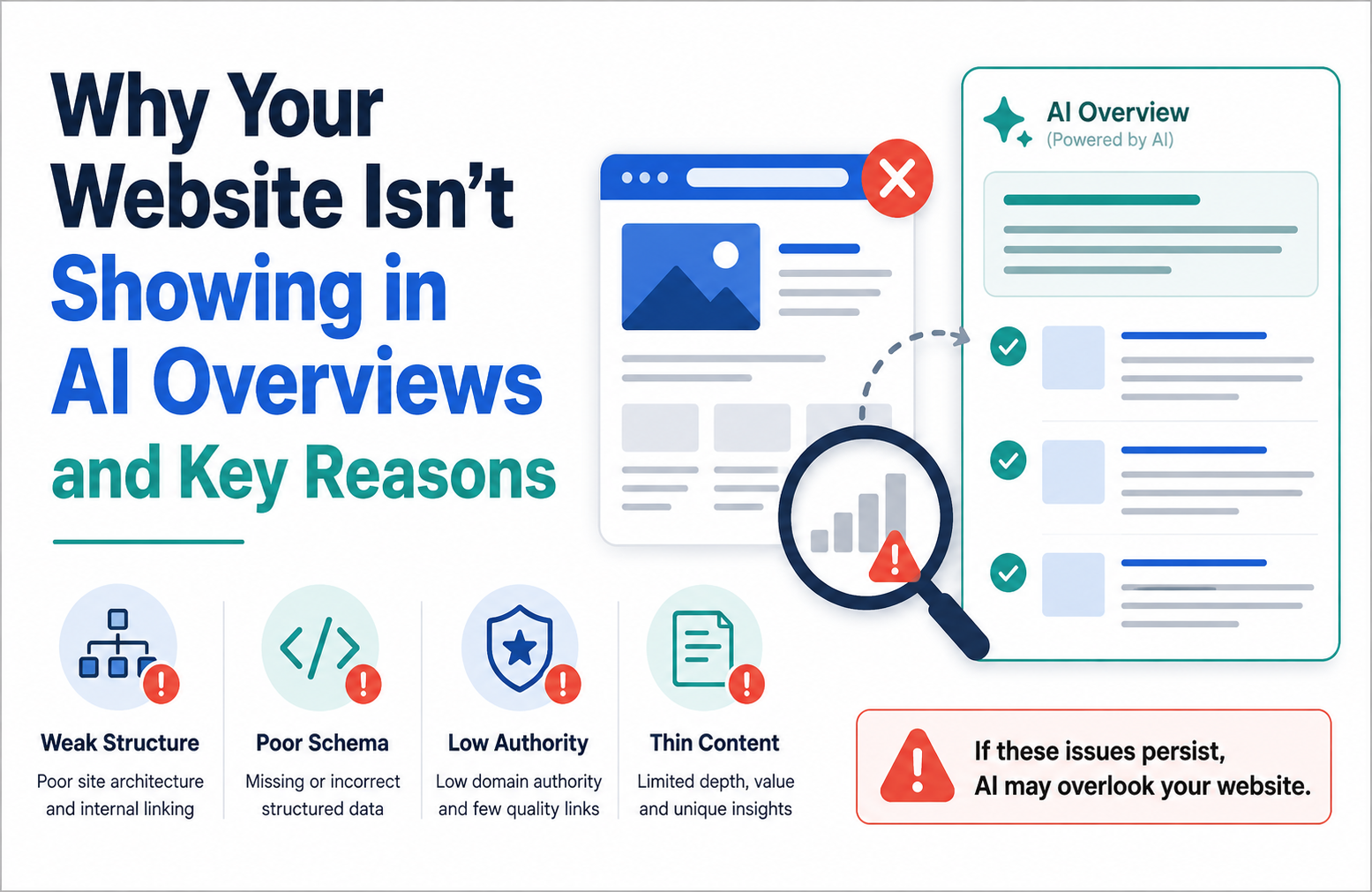
Many websites fail to appear in Google’s AI-generated answers even when their traditional rankings are strong. This happens because AI systems prioritize structured, trustworthy, and easily retrievable information rather than simple keyword optimization. AI Overviews SEO focuses on making your content understandable for AI models through schema, clear entities and authority signals.
With Google expanding AI Overviews across more queries in 2025-2026, the competition for AI citations is increasing. Websites that adapt their structure and credibility signals early will gain disproportionate visibility. Those that ignore these structural requirements may slowly disappear from AI-driven discovery.
Not Showing In AI Overviews?
A growing number of businesses are noticing a strange problem.
Their website ranks well in traditional search results.
Traffic looks stable.
Content quality seems solid.
Yet when someone searches on Google and sees an AI-generated summary at the top of the page, their brand is missing.
This is where the shift toward AI Overviews SEO becomes critical.
AI Overviews do not simply display search rankings. They generate answers using information extracted from trusted sources. Only a small set of websites becomes part of these summaries.
That means visibility is no longer only about ranking on page one. It is about being selected as a source for AI-generated answers.
And many websites fail to meet the structural and credibility requirements that AI systems rely on.
Recent search behavior studies show that users increasingly interact directly with AI summaries rather than scrolling through multiple links. This shift means that if your brand is not cited within those summaries, your visibility can decline even if your rankings remain stable.
How AI Overviews Work
To understand why your website may not appear, it helps to understand how these systems generate answers.
Google’s AI Overviews combine traditional search indexing with generative AI models. Instead of presenting a list of links, the system reads multiple documents and synthesizes a response.
During this process, several signals determine which sources are included.
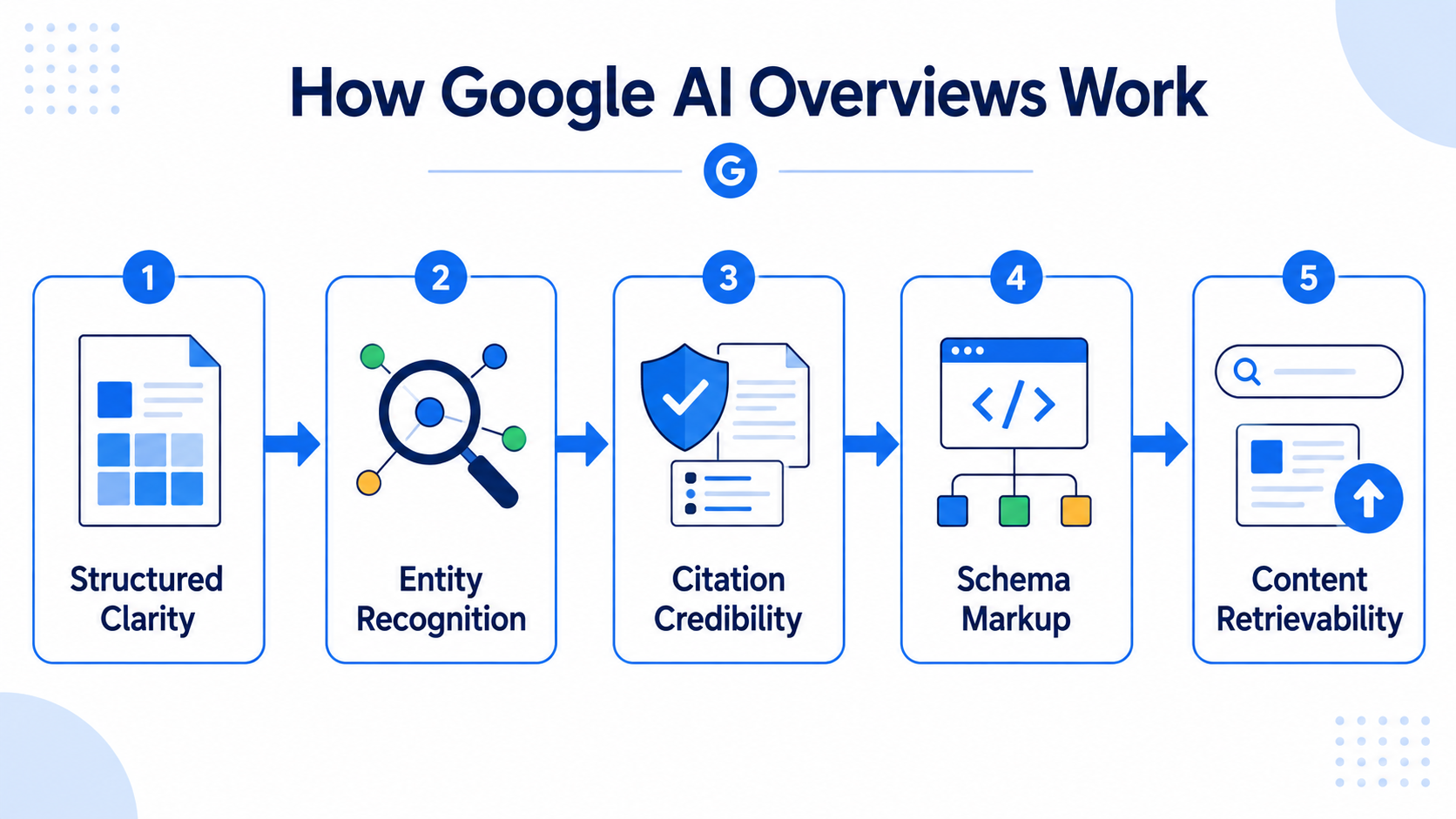
Key factors include:
- Structured clarity — AI prefers content that clearly defines concepts and answers questions
- Entity recognition — brands and topics must be identifiable within the knowledge graph
- Citation credibility — AI systems prefer sources referenced or linked by trusted websites
- Schema markup — structured data helps machines interpret information accurately
- Content retrievability — information must be easy for AI models to extract and summarize
In recent updates to Google’s AI search systems, retrieval models have become more selective. Instead of scanning only top-ranking pages, AI now evaluates whether information is well-structured and factually reliable.
Research from Industry AI Research shows that AI systems often rely on a small cluster of highly structured, authoritative sources when generating answers. Being outside that cluster dramatically reduces visibility.
Common Structural Mistakes
The most frequent reason websites fail at AI Overviews SEO is structural weakness rather than content quality.
In many cases, the information exists but is difficult for AI systems to interpret.
Some common issues include: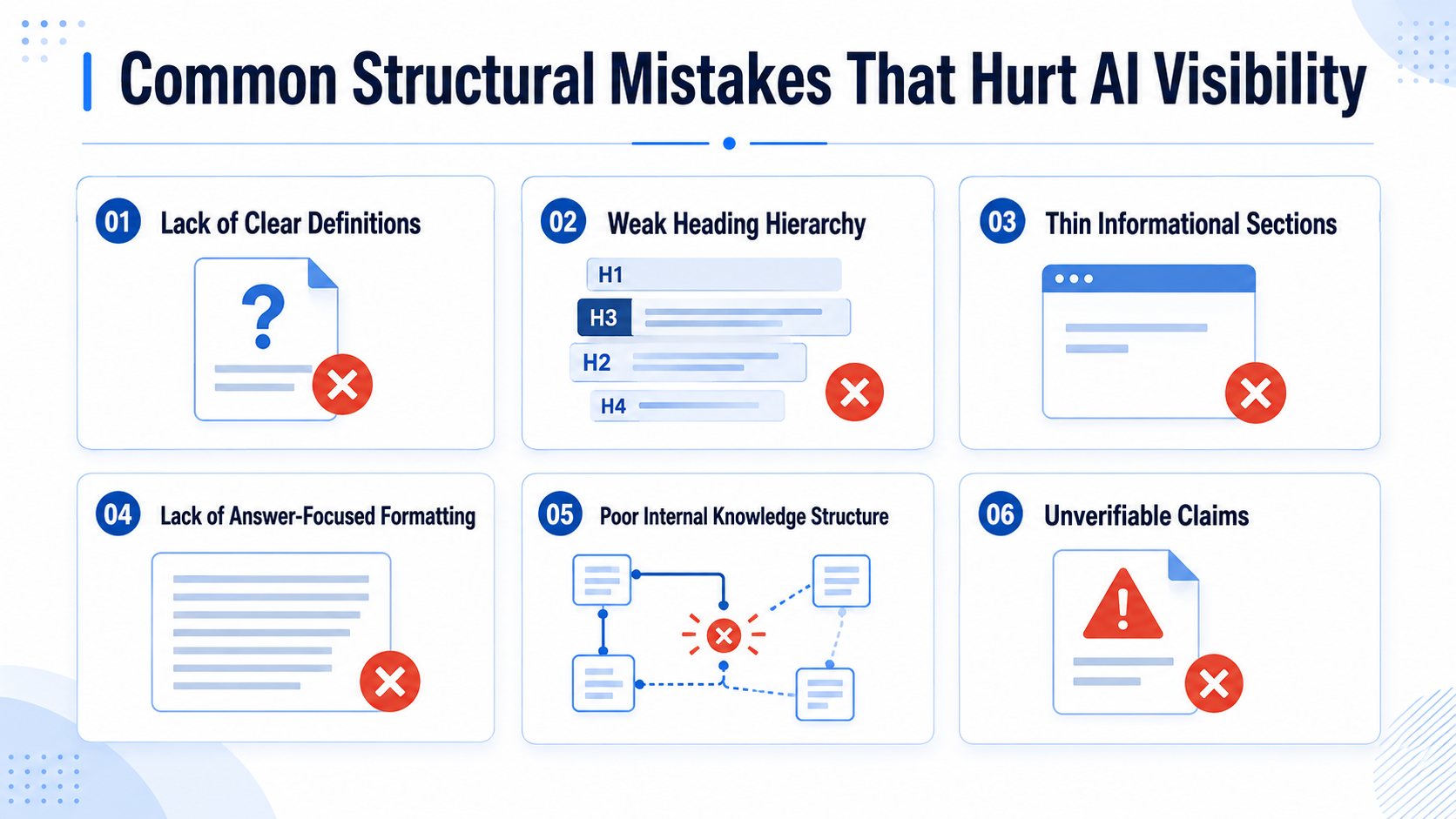
Lack of Clear Definitions
AI models prioritize pages that clearly define a topic early in the content. Many websites bury explanations deep in paragraphs instead of presenting them upfront.
Weak Heading Hierarchy
Content without logical H1–H3 structures becomes harder for AI systems to parse.
For example, AI prefers content structured like this:
- Topic definition
- Explanation of mechanisms
- Practical examples
- Supporting data
When headings are inconsistent or missing, the system struggles to identify key answers.
Thin informational sections
Many pages are optimized for keywords but lack actual depth. AI models favor pages that demonstrate topical authority rather than short summaries.
Lack of Answer-Focused Formatting
Another emerging issue is content formatting. AI systems increasingly extract answers from bullet points, concise explanations, and FAQ blocks. Long narrative paragraphs without clear answer segments are harder for AI to summarize.
Poor Internal Knowledge Structure
Another overlooked factor is how knowledge is connected across your website. AI systems evaluate whether your content forms a structured knowledge network. When related pages support each other through contextual links, the overall topical authority becomes stronger.
For example, websites that connect articles about AI visibility, search optimization, and structured content strategies, such as internal resources explaining AIO frameworks, provide clearer signals about their expertise in AI search.
Without this internal structure, even high-quality pages may appear isolated, reducing their chances of being referenced by AI systems.
Unverifiable Claims
AI systems prioritize information that can be corroborated across multiple sources. If a page contains unsupported statements or marketing-heavy language, it is less likely to be referenced.
Lack of Answer-Focused Formatting
Another emerging issue is content formatting. AI systems increasingly extract answers from bullet points, concise explanations and FAQ blocks. Long narrative paragraphs without clear answer segments are harder for AI to summarize.
Schema & FAQ Optimization
One of the strongest signals for Google AI Overviews optimization is structured data.
Schema markup acts as a translator between your content and search engines. It allows AI systems to identify important information quickly.
Several schema types are particularly useful.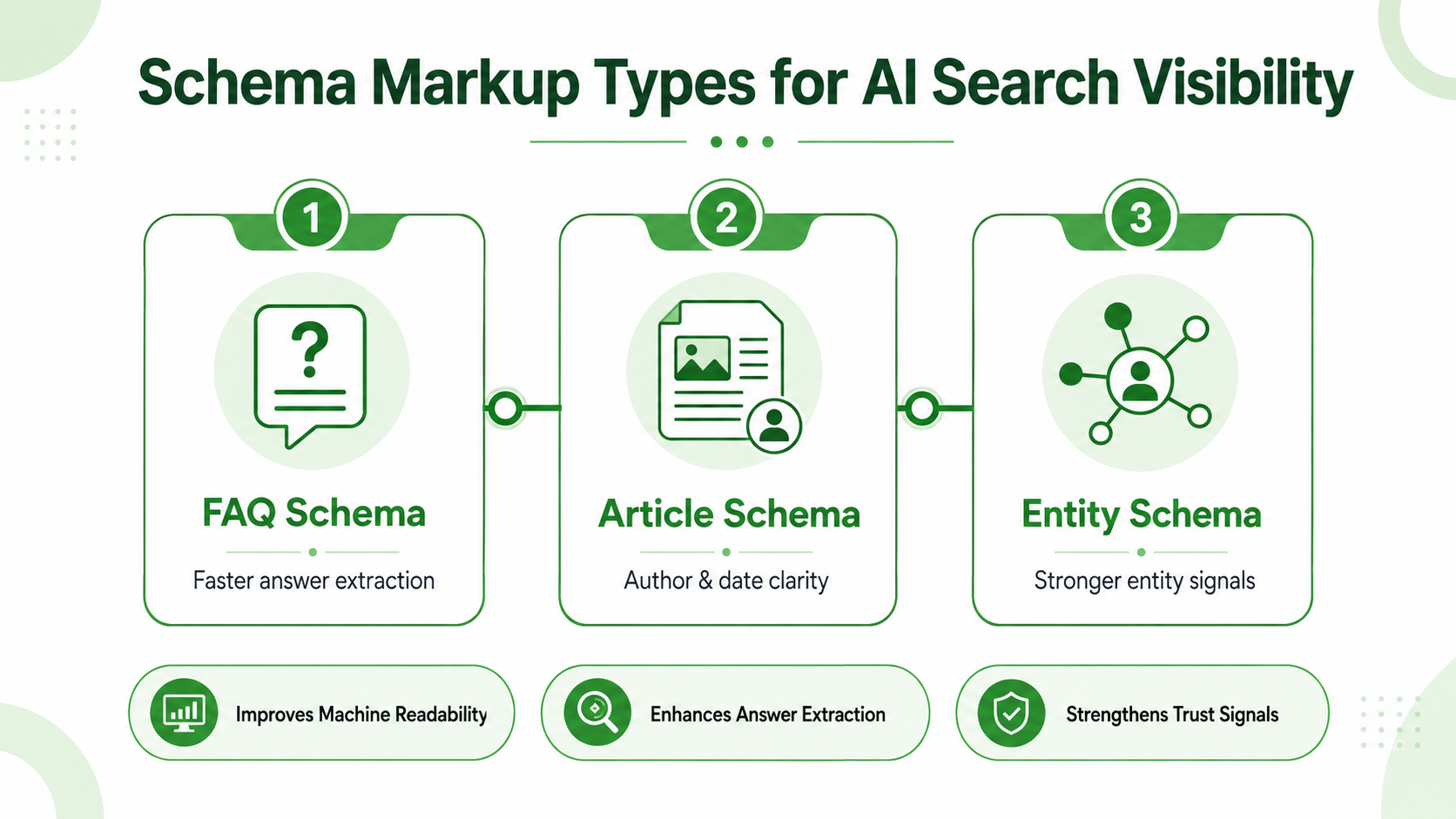
FAQ Schema
Pages that include FAQ schema help AI systems extract concise answers. This increases the probability of being referenced in AI-generated summaries.
Article Schema
Article and BlogPosting schema help search engines understand authorship, publishing dates and topical relevance.
Entity Schema
Structured data that identifies organizations, products and authors strengthens the entity signals associated with your content.
When implemented correctly, a schema does three things:
- Improves machine readability
- Enhances answer extraction
- Strengthens trust signals
Another important update is that Google’s AI systems increasingly combine schema with contextual understanding. This means structured data works best when the content itself contains clear, factual explanations rather than promotional copy.
Pages that combine FAQ schema with concise definitions are more likely to appear in AI-generated summaries.
Authority Signals Needed
Another major reason websites fail to appear in AI summaries is a lack of authority signals.
AI systems tend to prioritize sources that demonstrate expertise and credibility.
Important authority indicators include: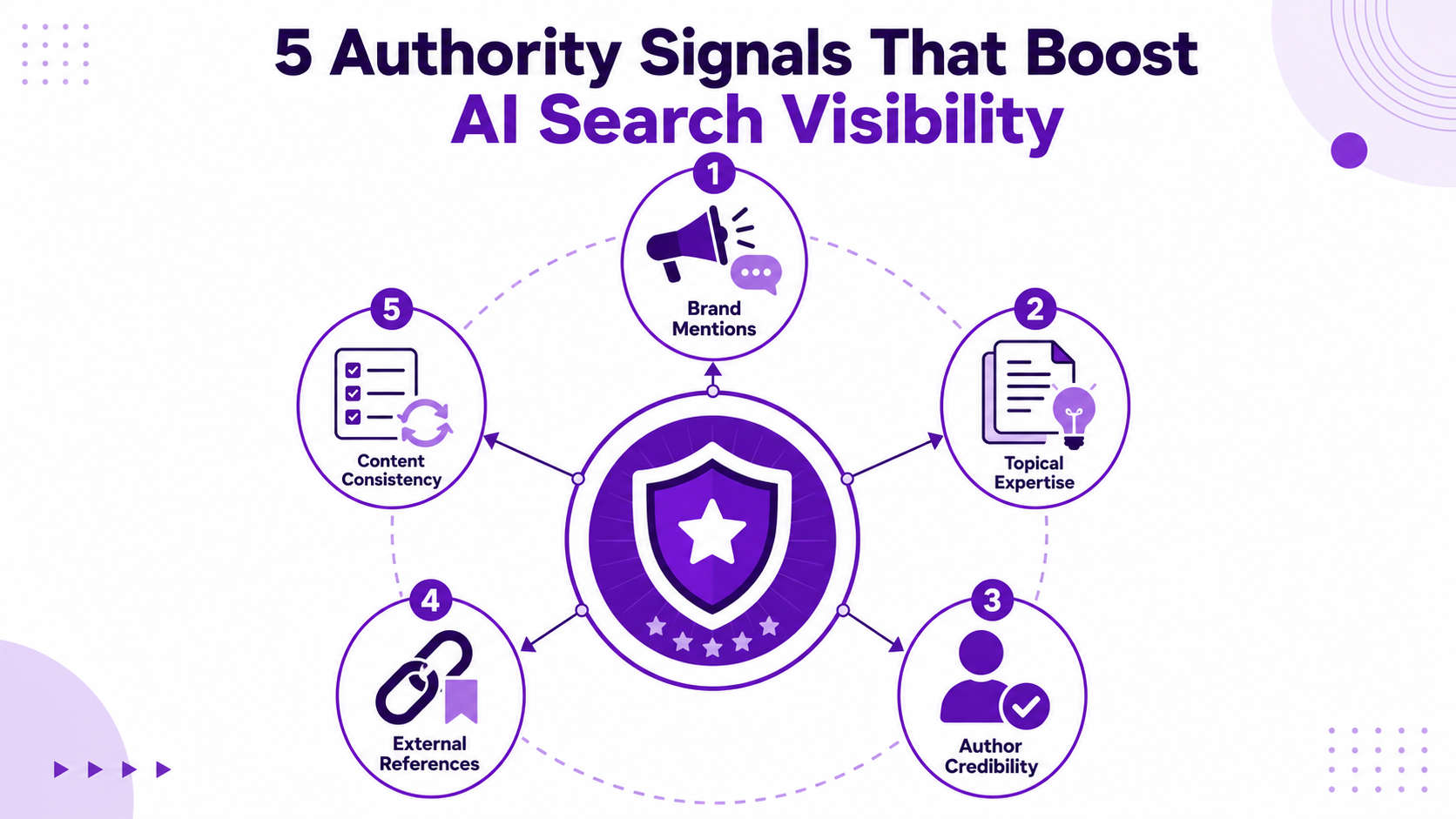
Brand Mentions Across the Web
If your brand is cited or referenced by other credible websites, AI models treat your content as more trustworthy.
Topical Expertise
Publishing consistent, in-depth content on a specific subject strengthens topical authority.
For example, websites that regularly publish insights on AI search, entity SEO, and structured optimization are more likely to appear in AI-generated answers.
Author Credibility
AI systems increasingly consider author expertise signals, such as professional profiles or published research.
External References
Citing credible sources like Industry AI Research strengthens the reliability of your content.
Content Consistency
Recent developments in AI search show that websites publishing consistent topic clusters are cited more often than sites producing scattered articles.
This means that building multiple related resources around AI visibility, optimization strategies, and structured content can strengthen your chances of being referenced.
When these signals align, your website becomes a more attractive candidate for inclusion in AI summaries.
Without them, even well-written content may remain invisible to generative search systems.
FAQs
Why does my Site not appear in AI Results?
Most websites fail to appear because their content lacks structured clarity, schema markup, or authority signals. AI systems prioritize sources that present information in a clear, verifiable format.
What is AI Overviews SEO?
AI Overviews SEO refers to optimizing content so that it can be selected and cited within AI-generated search summaries rather than only ranking in traditional search results.
How can I improve Google AI Overviews Optimization?
Focus on structured headings, schema markup, entity clarity and credible citations. These elements help AI systems interpret and trust your content.
Does ranking on Google Guarantee AI Visibility?
No. Traditional rankings and AI inclusion are not identical. A website may rank well but still fail to appear in AI summaries if it lacks structured or authoritative signals.
Conclusion
The shift toward AI-generated search results is changing how visibility works online. Traditional SEO focused primarily on rankings. Today, success increasingly depends on whether AI systems choose your content as a trusted source. Strong AI Overviews SEO combines structured content, schema markup, entity clarity, and authoritative signals across the web. Websites that adapt to these requirements early will gain disproportionate visibility as AI search continues to evolve.
Organizations that begin optimizing for Google AI Overviews today will be better positioned as AI-driven discovery becomes the dominant way users find information.