
Traditional SEO audits evaluate rankings, backlinks and page speed. But AI-driven search operates differently. Generative engines synthesize information from trusted sources, entities and structured knowledge.
That means visibility depends on whether AI systems can recognize, interpret and retrieve your information correctly.
A modern GEO audit checklist, therefore, evaluates how well your content performs inside generative systems rather than only search engines.
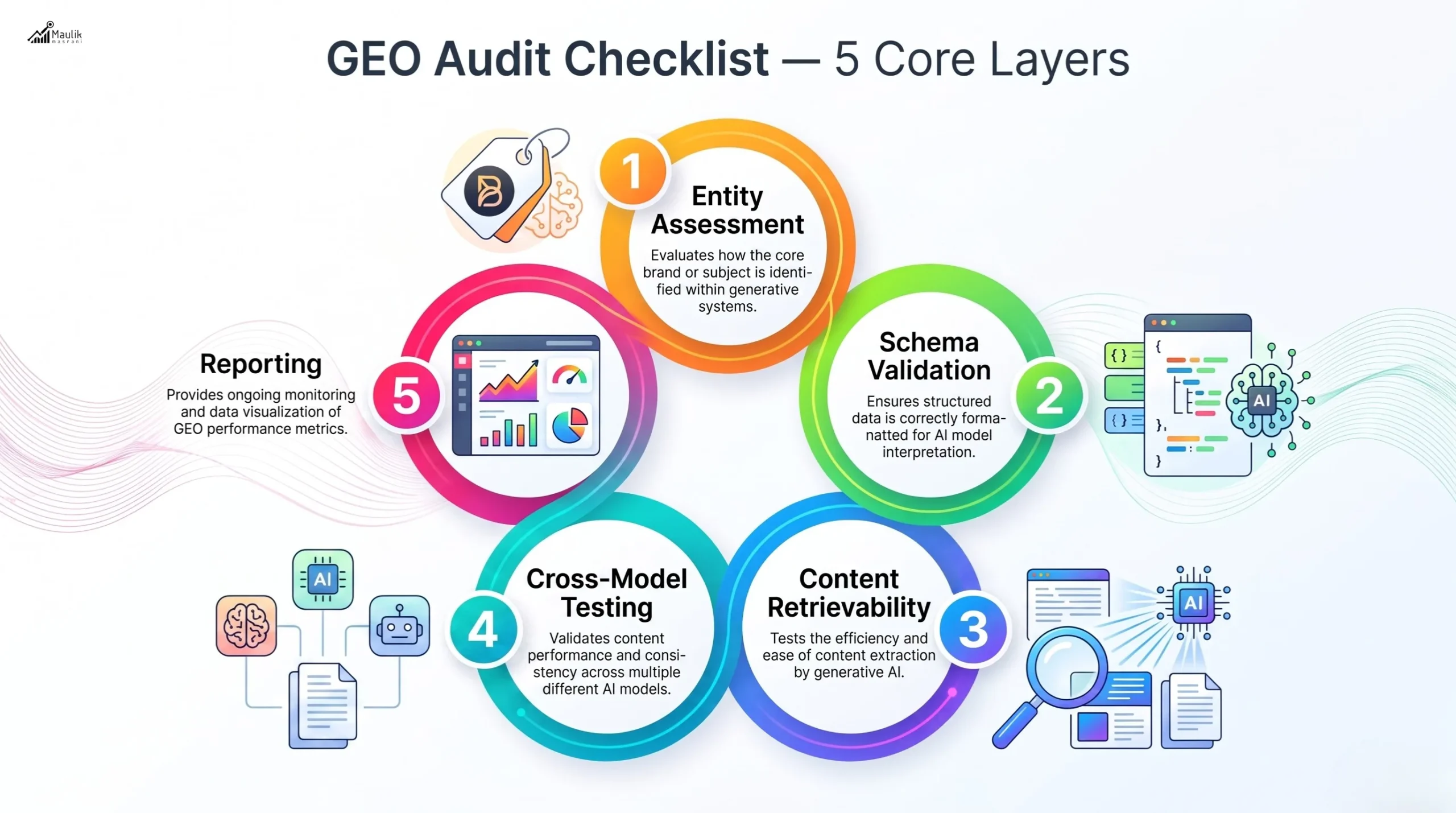
This type of AI visibility audit typically focuses on five operational layers:
- Entity assessment
- Schema validation
- Content retrievability testing
- Cross-model testing
- Reporting and monitoring
When combined, these steps help teams understand why some brands appear in AI answers while others remain invisible.
Entity Assessment
The first step in any generative SEO audit is evaluating your entity footprint.
AI search engines rely heavily on entity recognition, meaning they identify brands, organizations, products and concepts as structured knowledge objects rather than simple keywords.
If your brand is not recognized as a strong entity, AI tools may ignore your content even if it ranks on Google.
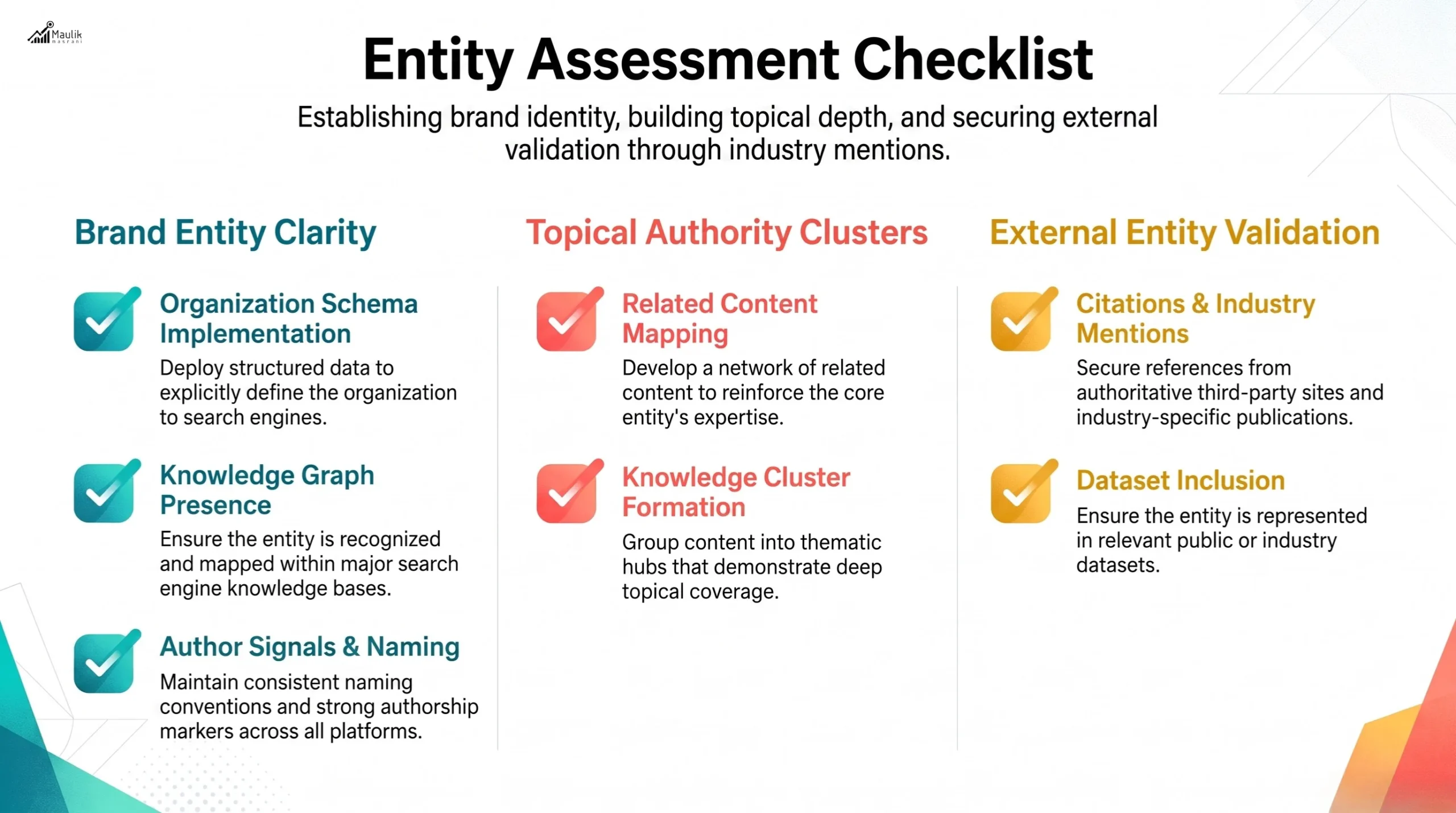
Key Checks In An Entity Assessment
- Brand entity clarity
Verify whether your brand appears consistently across the web with structured references.
Important signals include:
- Organization schema
- Wikipedia or knowledge graph presence
- Author entity signals
- Consistent brand naming across platforms
- Topical authority clusters
AI models determine authority by evaluating topic relationships.
Your site should contain clear knowledge clusters, not isolated articles.
For example, if you publish content about AI marketing, related topics should also exist, such as:
- AI search optimization
- AEO strategies
- Generative SEO frameworks
- AI content governance
This is also where content systems like scale AIO content strategies help build topical depth.
- External entity validation
AI models also analyze mentions across the broader internet.
Signals may include:
- Citations in research papers
- Mentions in industry blogs
- Inclusion in datasets used by AI tools
Resources from Industry AI Research publications can strengthen these signals.
A strong entity profile increases the probability that AI systems will reference your brand when generating answers.
Schema Validation
Schema markup is one of the most critical signals for AI interpretation.
While traditional SEO uses schema to enhance rich results, generative search uses it to understand meaning and relationships within content.
A proper AI visibility audit ensures that schema markup is correctly implemented and logically structured.
Essential Schema Types To Validate
Common schema categories that support generative search include:
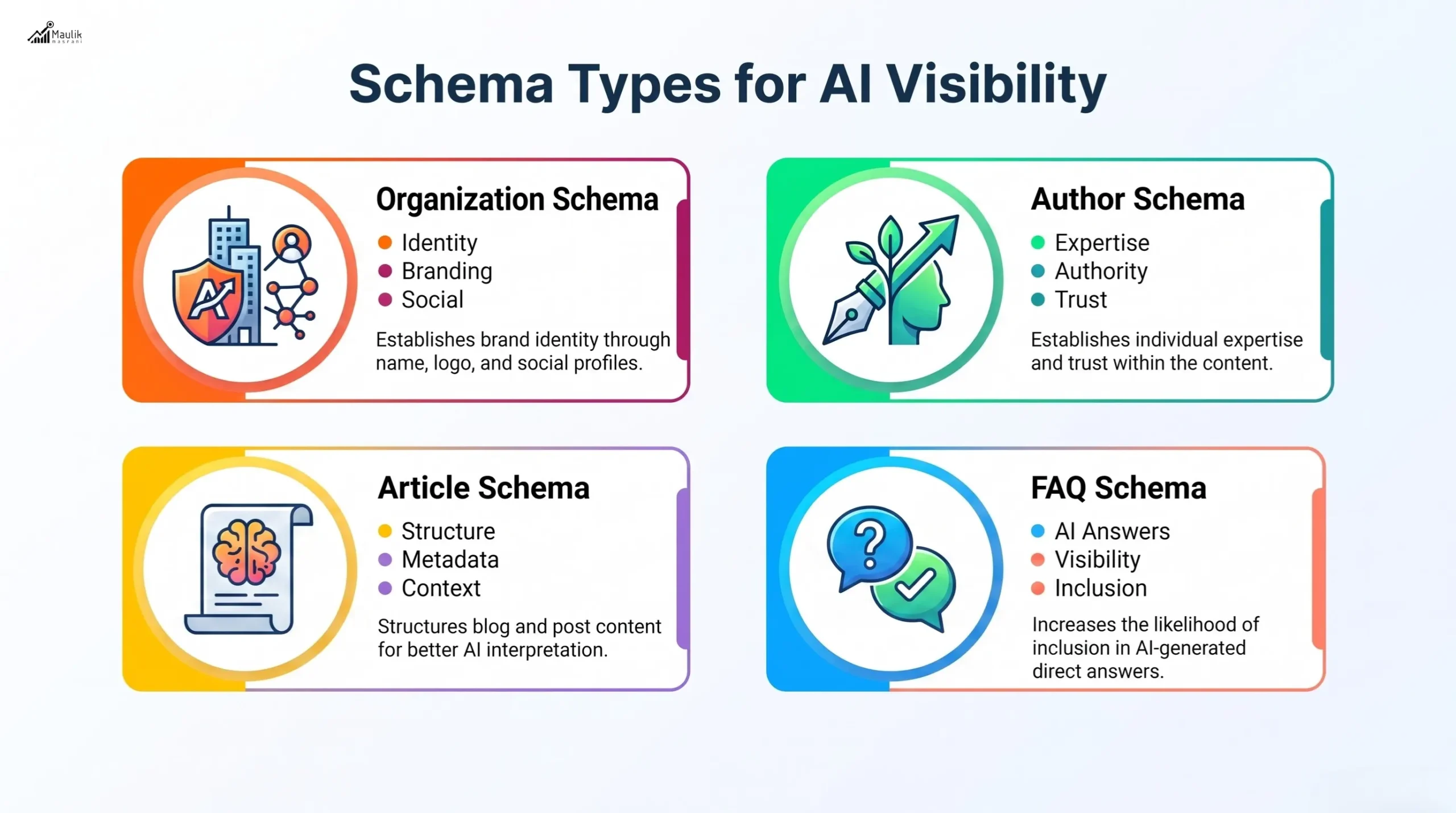
Organization Schema
Defines your company identity and brand metadata.
Important fields include:
- Name
- Logo
- Founding date
- Official website
- Social profiles
Article or BlogPosting Schema
Helps AI systems recognize structured content and attribute authorship.
FAQ Schema
Improves the chances of being used in AI-generated answers.
Author Schema
Establishes subject-matter expertise.
Many organizations overlook editorial consistency. This is where implementing an AI editorial style guide helps maintain structured content formatting across all articles.
Schema Audit Checklist
When validating the schema, confirm:
- Structured data passes validation tests
- Schema fields are complete
- Schema aligns with page intent
- Schema types match the content format
Even small structural errors can reduce how easily AI models parse your content.
Content Retrievability Test
The third stage of the GEO audit checklist focuses on retrievability.
In generative search, content must be easy for AI systems to extract, summarize and reference.
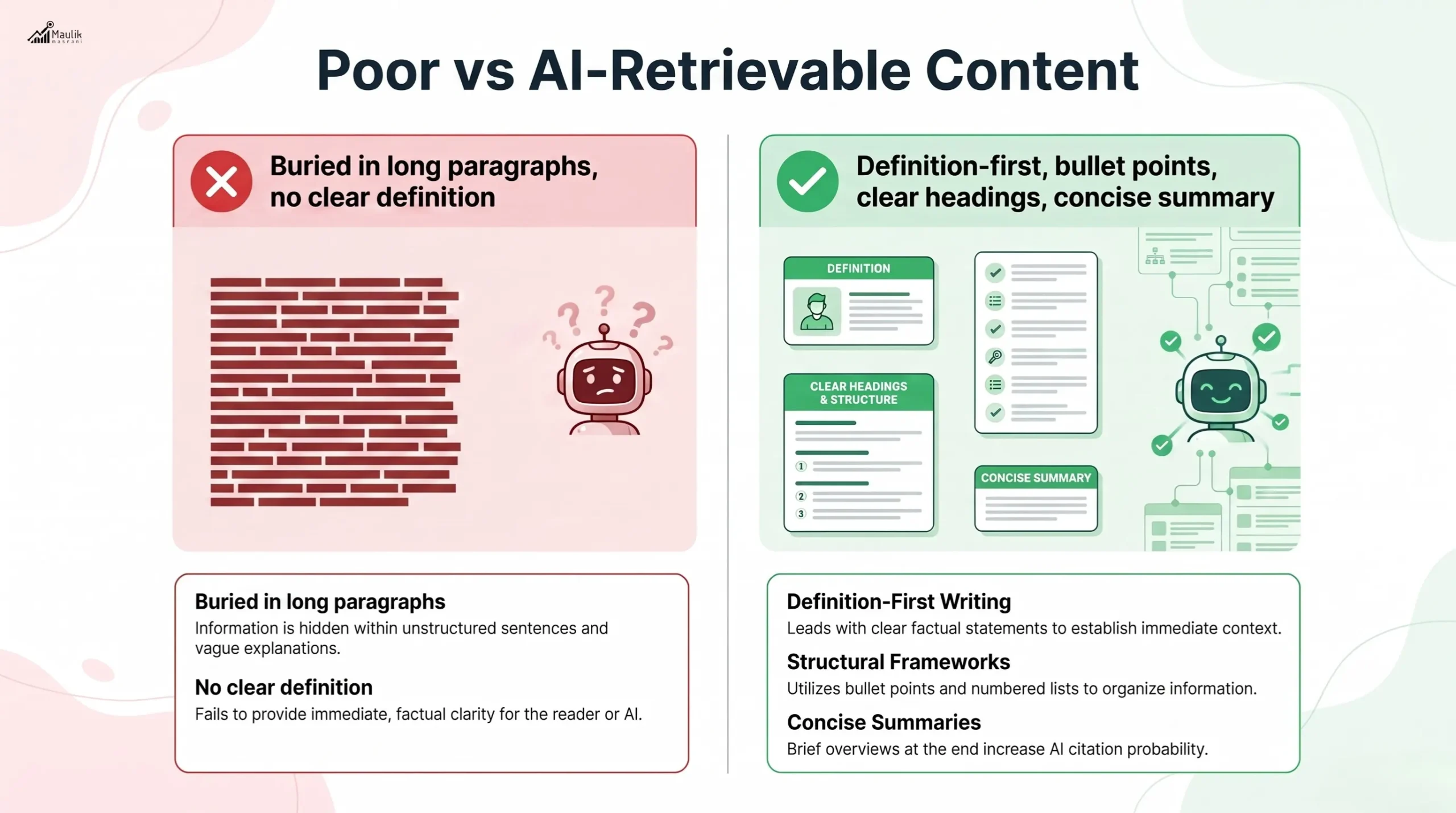
Content that is buried inside long paragraphs or unstructured layouts often becomes invisible.
Retrievability Evaluation Questions
A practical generative SEO audit should ask:
- Can AI tools easily summarize the page?
- Does the content provide clear factual statements?
- Are definitions structured early in the article?
- Are headings logically segmented?
For example, definition-first writing structures improve extraction:
Example
Poor structure:
“Many companies use different AI search techniques to improve digital visibility across modern platforms.”
Improved retrievable structure:
AI search optimization refers to the process of structuring content so AI systems can identify, summarize and cite it in generated answers.
Clear definitions improve AI comprehension and increase citation probability.
Structured formatting such as:
- Bullet lists
- Numbered frameworks
- Concise summaries
makes information easier for AI models to retrieve.
Organizations implementing AI search marketing services often prioritize retrievability improvements during audits.
Cross-Model Testing
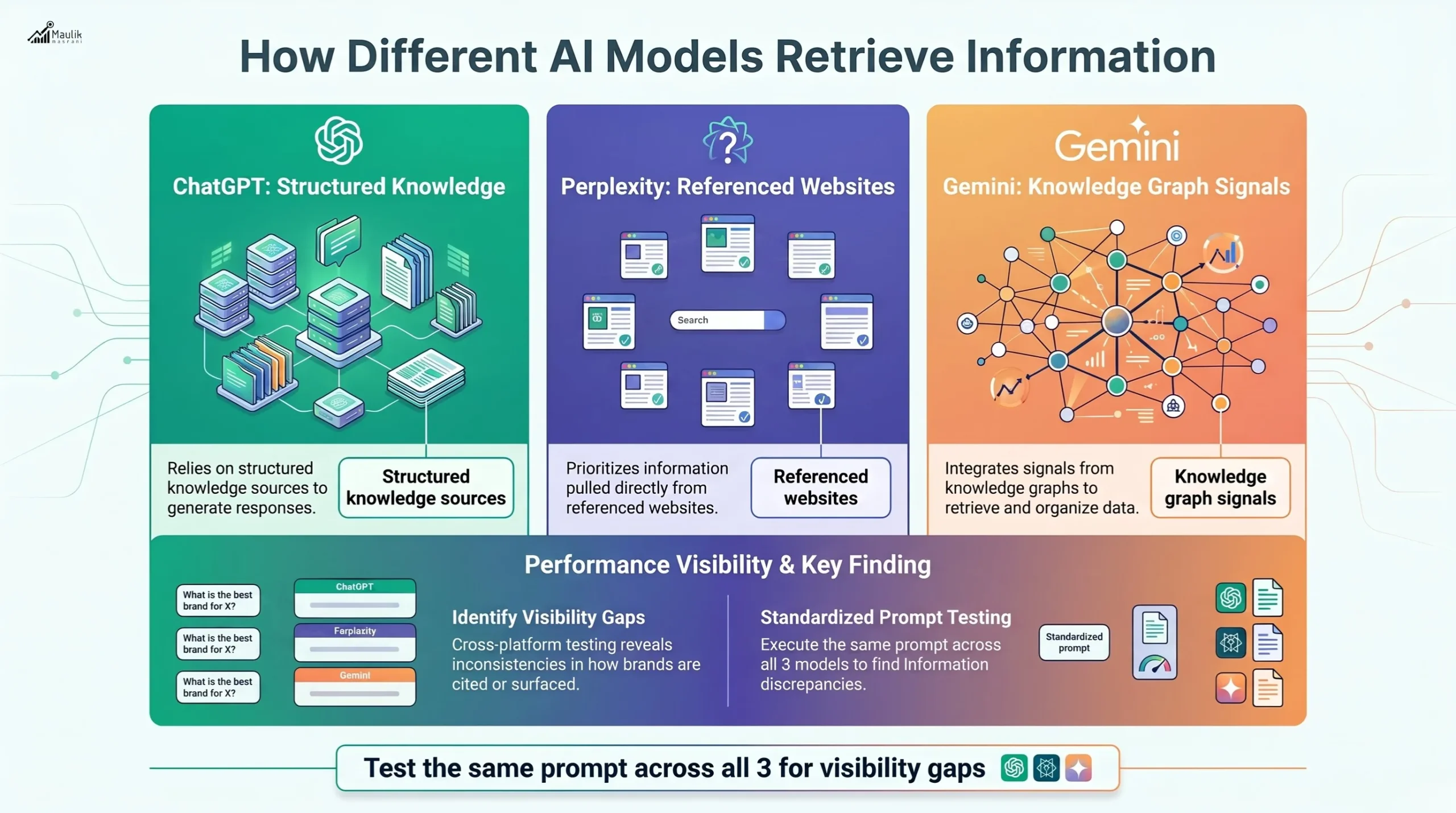
One of the most overlooked steps in a GEO audit checklist is testing across multiple AI systems.
Different models retrieve and prioritize information differently.
For example:
- ChatGPT may rely on structured knowledge sources.
- Perplexity may prioritize referenced websites.
- Gemini may integrate knowledge graph signals.
Testing visibility across multiple platforms helps identify inconsistencies.
Example Cross-Model Test
Search prompts might include:
- “What companies offer AI search optimization services?”
- “How does generative SEO work?”
- “What are best practices for GEO strategies?”
The audit should evaluate:
- Whether your brand appears in responses
- Whether your content is cited as a source
- Whether competitors dominate the answer
These tests reveal the real-world discoverability of your content inside generative environments.
For industry-specific examples, sectors like AI SEO manufacturing have begun testing AI visibility across models to measure how technical content performs.
Reporting Template
The final step of a generative SEO audit is reporting.
Without measurable benchmarks, AI visibility improvements are difficult to track.
A reporting system should focus on operational metrics rather than vanity metrics.
Suggested GEO Reporting Metrics
- AI citation frequency
How often does your brand appear in generated answers?
- Entity recognition strength
Whether AI models recognize your brand as a topic authority.
- Content retrievability score
How easily AI systems extract and summarize your information.
- Schema completeness
Percentage of pages with validated structured data.
- Cross-model visibility
Performance across tools like ChatGPT, Gemini and Perplexity.
These insights help teams identify visibility gaps and prioritize optimization tasks.
Many organizations convert these reports into dashboards that monitor AI visibility monthly.
FAQs
What is Included in a GEO Audit?
A GEO audit checklist typically includes entity assessment, schema validation, content retrievability testing, cross-model AI testing and reporting frameworks. These elements evaluate whether AI systems can understand and retrieve your content.
What is a Generative SEO Audit?
A generative SEO audit evaluates how well a website performs inside AI-powered search systems. It focuses on entity recognition, structured data and content retrievability rather than only keyword rankings.
Why is an AI Visibility Audit Important?
An AI visibility audit helps determine whether AI search tools can recognize and cite your brand when generating answers. Without proper structure and entity signals, AI systems may ignore otherwise strong content.
How often should a GEO Audit be Performed?
Most organizations perform a GEO audit checklist every quarter to track changes in AI visibility, schema performance, and generative search behavior.
Conclusion
Generative search is reshaping how users discover information online. Ranking on Google alone no longer guarantees visibility.
Brands that perform a structured GEO audit checklist can identify gaps in entity recognition, schema implementation and content retrievability. These insights help organizations align their content architecture with how AI systems process knowledge.
For teams preparing their AI search strategy, conducting a comprehensive generative SEO audit is becoming an essential step toward maintaining digital visibility in the evolving search landscape.