
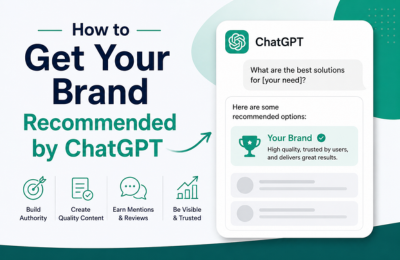
If you want to rank in ChatGPT, traditional SEO alone won’t cut it. Large Language Models prioritize entity trust, structured knowledge, and consistent brand signals across the web. By focusing on generative engine optimization, building entity authority, and structuring your content for machine readability, you increase your chances of being recommended in AI-generated answers. Brands that win are not just visible; they are understood and trusted by AI systems.
How to Get Recommended by ChatGPT
AI search is fundamentally changing how users discover brands. Instead of scanning 10 blue links, users now rely on direct recommendations generated by systems like ChatGPT, Gemini, and Perplexity.
This shift introduces a new challenge: you’re no longer just competing for rankings; you’re competing for inclusion in AI-generated answers.
To consistently rank in ChatGPT, your brand must align with how LLMs interpret authority, relevance, and trust.
How LLMs Choose Brands
Large Language Models don’t “rank” pages in the traditional sense. They retrieve, synthesize, and recommend based on patterns learned from vast datasets.
Here’s what actually influences brand selection:
Here’s what actually influences brand selection:
1. Entity Recognition
LLMs prioritize entities, not just keywords. Your brand must exist as a clearly defined entity across multiple sources:
- Website (structured pages)
- Third-party mentions
- Knowledge panels and citations
For example, if multiple trusted sources mention your brand in the context of “AI SEO services,” the model strengthens its confidence in recommending you.
2. Contextual Relevance
AI systems evaluate how well your content answers specific intents:
- Is your brand consistently associated with a topic?
- Do you provide complete, layered explanations?
Surface-level content rarely gets picked.
3. Trust Signals & Consensus
LLMs rely heavily on consensus:
- Mentions across blogs, forums, and PRs
- Consistent positioning
- Verified expertise signals
If your brand appears in multiple high-quality contexts, your probability of ranking in ChatGPT increases significantly.
Entity Authority Stacking
Entity authority stacking is the backbone of generative engine optimization. It’s about building a network of signals that reinforce your brand’s credibility.
Core Components
1. Multi-Source Validation
Your brand should be referenced across:
- Industry blogs
- Guest posts
- Press releases
- Social platforms
Each mention acts as a validation node.
2. Topical Depth
Instead of scattered content, create clusters:
- Core topic → subtopics → supporting insights
- Consistent terminology across all assets
This builds semantic clarity.
3. Brand Consistency
Your messaging must align everywhere:
- Same service positioning
- Same expertise claims
- Same terminology
Inconsistent messaging weakens entity confidence.
Example Insight
Brands that dominate AI recommendations often have:
- 50+ indexed mentions across authoritative domains
- Structured content clusters around core services
- Consistent brand language across platforms
This isn’t accidental; it’s engineered.
Structured Content Model
If entity authority is the foundation, structured content is the interface through which AI understands you.
Why Structure Matters
LLMs prefer content that is:
- Predictable
- Scannable
- Hierarchically organized
This is where most brands fail: they write for humans, but not for machines.
Key Structural Elements
1. Clear Hierarchy (H1–H3)
Your content should follow a logical flow:
- Problem → explanation → solution
- Definitions → examples → applications
This improves retrievability.
2. Schema Markup
Use structured data like:
- BlogPosting
- FAQPage
This helps AI systems interpret context and intent.
3. Modular Content Blocks
Break content into reusable units:
- FAQs
- Definitions
- Step-by-step sections
These are easier for LLMs to extract and reuse.
Monitoring AI Mentions
What gets measured gets optimized. AI visibility is not static; it evolves constantly.
What You Should Track
1. AI Citation Frequency
How often does your brand appear in:
- ChatGPT responses
- Gemini outputs
- Perplexity answers
2. Sentiment Analysis
Are you being recommended positively, neutrally, or not at all?
3. Query Coverage
Test multiple prompts:
- “Best AI SEO agencies”
- “Top generative SEO consultants”
See where your brand appears.
Practical Approach
- Run weekly prompt testing
- Document responses
- Identify gaps in visibility
Over time, this builds an AI visibility dashboard.
Key Insight
Brands that actively monitor AI mentions improve recommendation rates faster than those relying on passive SEO.
FAQs
Can brands rank in ChatGPT?
Yes, but not in the traditional sense. Instead of ranking pages, ChatGPT recommends brands based on entity authority, contextual relevance, and multi-source validation. To rank in ChatGPT, you need strong generative engine optimization strategies.
How long does it take?
Typically, noticeable improvements take 3 to 6 months. This depends on how quickly you build entity authority, publish structured content, and gain external mentions.
What is generative engine optimization?
Generative engine optimization focuses on making your brand visible and recommendable within AI-generated answers. It combines entity building, structured content, and AI-specific visibility strategies.
Is traditional SEO still relevant?
Yes, but it’s no longer sufficient alone. Traditional SEO builds discoverability, while generative engine optimization ensures your brand is recommended within AI systems.
Conclusion
Getting your brand recommended by AI systems is no longer optional; it’s becoming the primary discovery layer. To consistently rank in ChatGPT, brands must move beyond keyword strategies and focus on entity authority, structured content, and continuous AI visibility tracking. Those who adapt early will not just gain visibility; they will own the recommendation layer that defines modern search.
The shift toward generative engine optimization is accelerating, and brands that invest in structured, machine-readable content today will compound their visibility over time. In an AI-first ecosystem, the brands that are easiest to understand, validate, and trust are the ones that get recommended.