
AI-powered search systems such as ChatGPT, Gemini, and Perplexity are redefining digital competition. Instead of simply ranking websites, these systems generate answers by synthesizing information from multiple sources. A strong generative positioning strategy helps brands influence those responses by strengthening authority signals, closing knowledge gaps, and reinforcing expertise across platforms.
Businesses that optimize their content ecosystems through AEO, GEO, and AIO frameworks can improve AI competitor ranking and gradually achieve LLM visibility dominance within generative search environments.
Competitive Generative Positioning
Search behavior is evolving rapidly as generative AI becomes a primary interface for discovering information. Traditional search engines provided users with a list of links, but generative AI platforms provide summarized answers that often mention only a few trusted sources. This change significantly alters how brands compete online.
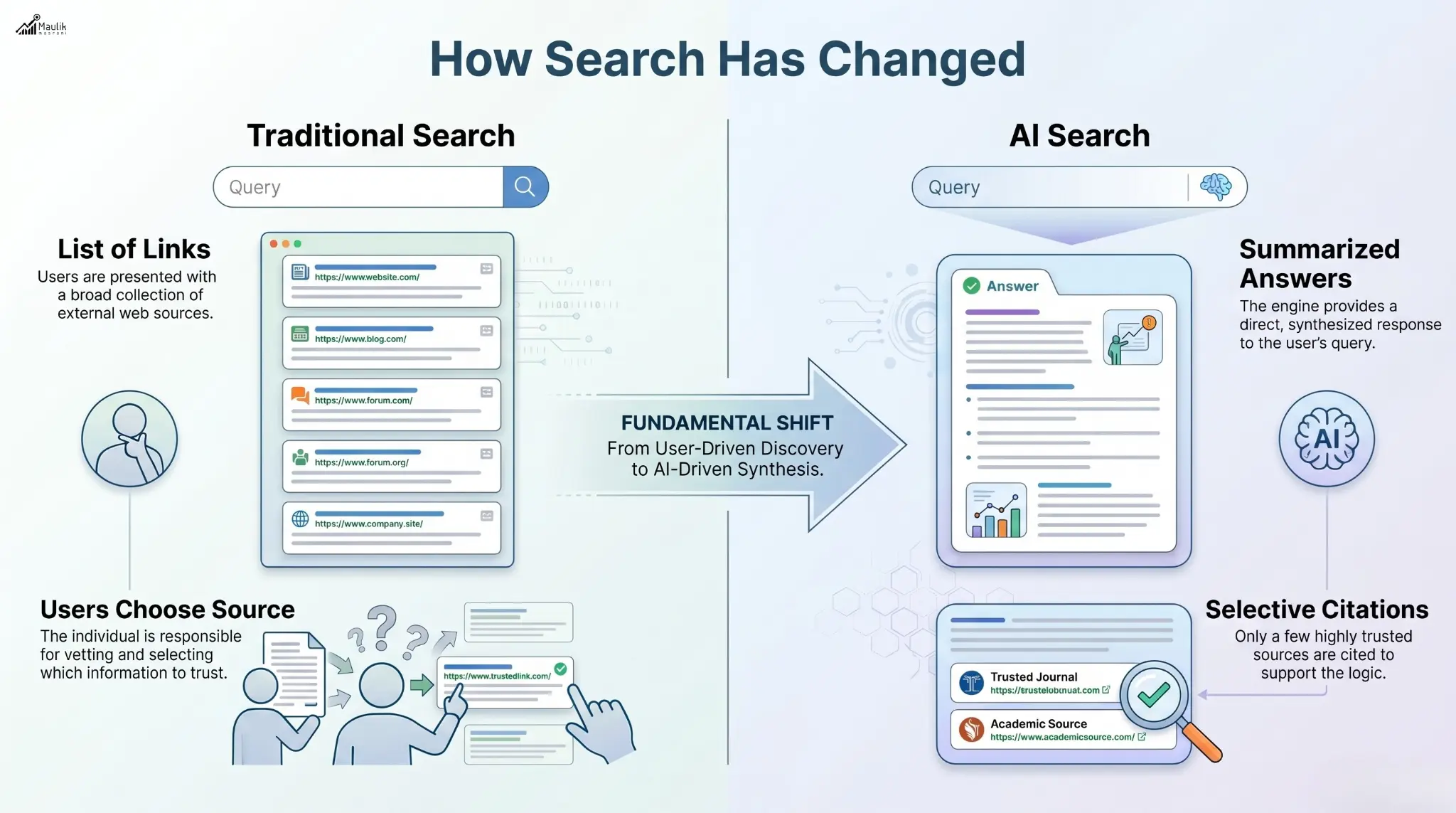
Instead of focusing only on keyword rankings, organizations must ensure that AI systems recognize their brand as a trusted authority. When generative models produce answers, they rely on signals such as topic authority, entity relationships, structured knowledge, and content credibility.
For example, when a user asks an AI assistant:
- “Which companies provide the best AI training programs?”
The AI system analyzes knowledge from multiple sources before generating a response. If competitors have stronger entity signals or broader topic coverage, they are more likely to appear in the generated answer.
This is where a generative positioning strategy becomes essential.
A well-structured strategy helps organizations influence how AI models interpret their expertise. By reinforcing authority signals across structured content, knowledge hubs, and authoritative references, brands can increase their presence within AI-generated answers.
Companies that integrate AEO (Answer Engine Optimization) and GEO (Generative Engine Optimization) into their digital strategy gain a clear advantage because their information becomes easier for AI models to understand, summarize, and reference.
Over time, this visibility creates stronger brand recognition across AI-driven search environments.
Mapping Competitor Entities
Before improving generative visibility, organizations must first understand how competitors appear inside AI answers.
Large language models rely heavily on entity recognition. Entities represent identifiable concepts such as organizations, technologies, products and industry experts. When a brand is consistently associated with a topic across multiple trusted sources, AI systems begin recognizing it as a reliable authority.
Competitor entity mapping involves studying how rival companies appear within generative search results.
When performing this analysis, businesses should evaluate several key signals.
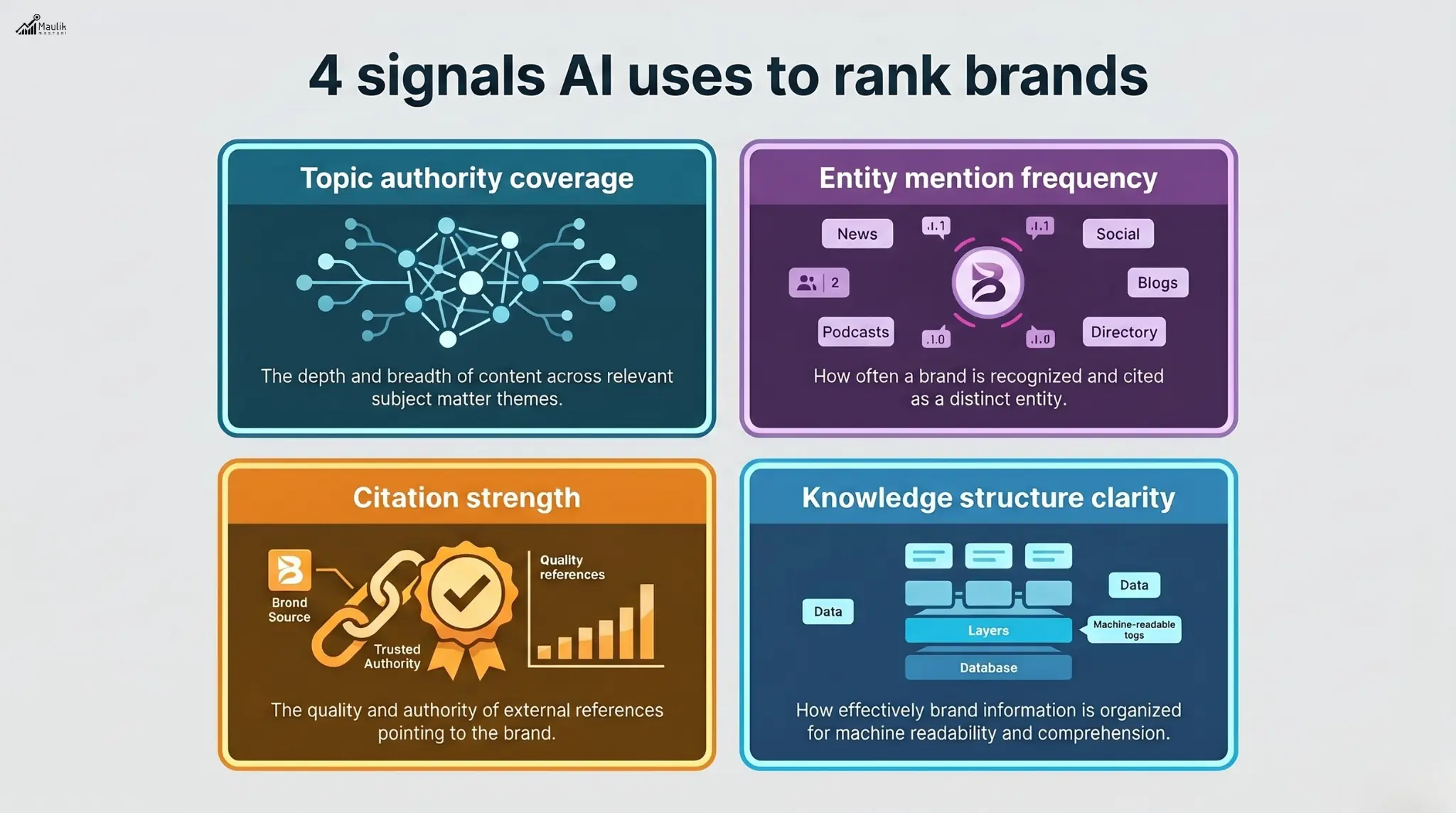
Key signals to analyze include:
- Topic authority coverage
Identify which competitors dominate conversations around important industry subjects. - Entity mention frequency
Measure how often competitor brands appear in AI-generated answers. - Citation strength
Determine whether competitors are referenced in research articles, industry blogs, or expert discussions. - Knowledge structure clarity
Review how competitors structure their content using schema markup, FAQs, and knowledge-based resources.
Understanding these signals helps organizations identify which competitors currently control the narrative within AI-generated responses.
Once these patterns become clear, companies can begin designing strategies to strengthen their own authority signals.
Reinforcement Gap Analysis
After mapping competitor entities, the next step is identifying reinforcement gaps.
A reinforcement gap occurs when competitors have stronger authority signals around a particular subject or expertise area. AI systems tend to favor brands that consistently reinforce their knowledge through structured content and repeated references.
Several types of reinforcement gaps commonly affect organizations.
1. Content Depth Gaps
Competitors often dominate AI responses because they publish extensive topic coverage. If a rival brand has multiple resources covering the same subject, AI models may associate that topic primarily with that company.
2. Knowledge Consistency Gaps
Organizations that publish irregularly often lose visibility signals. Consistent content publication reinforces entity recognition within generative models.
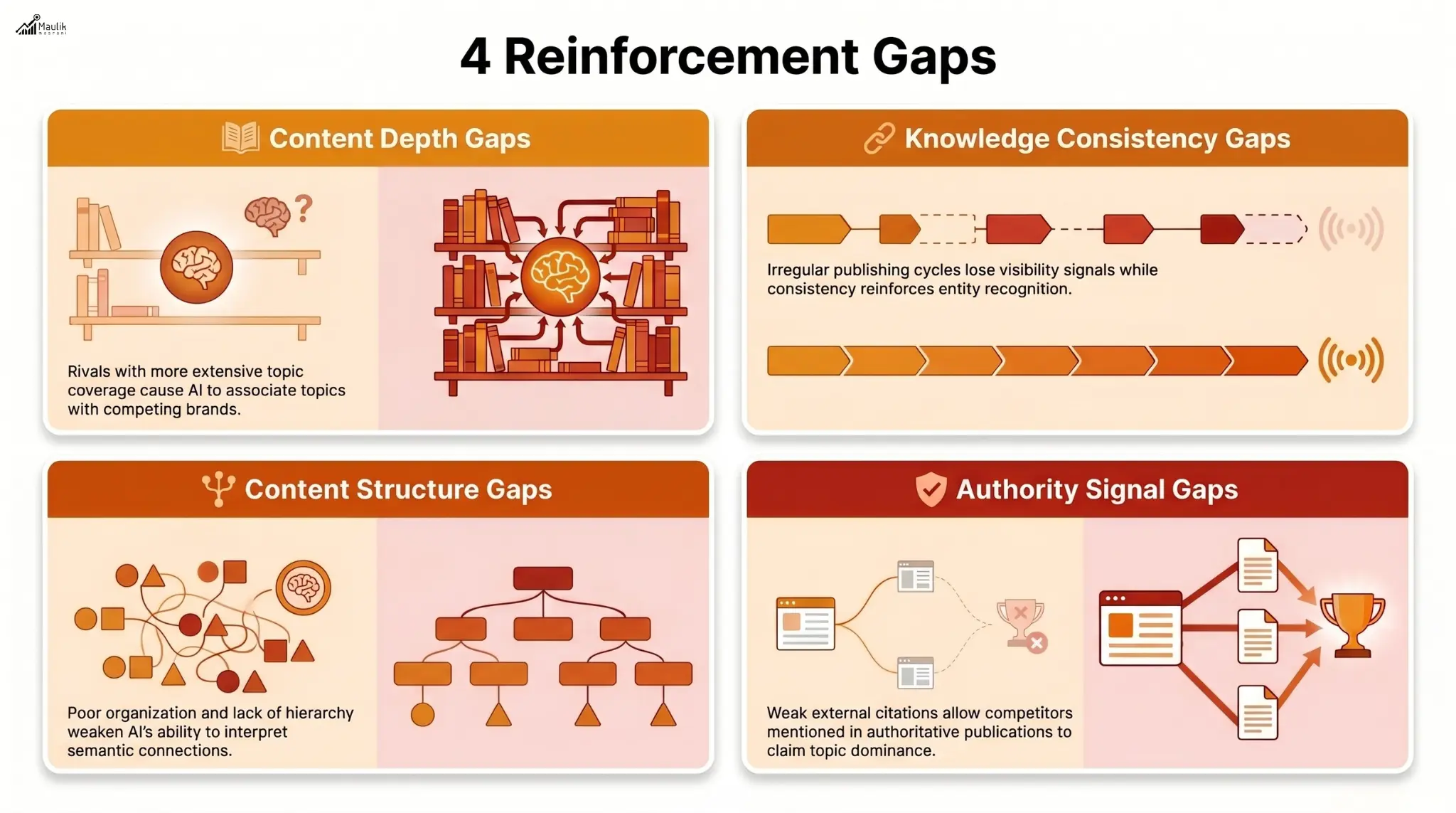
3. Content Structure Gaps
Even if a brand produces valuable content, poor structure can weaken AI interpretation. Without clear topic hierarchies or semantic connections, AI systems may struggle to understand the brand’s expertise.
4. Authority Signal Gaps
Some competitors benefit from stronger external signals such as citations, mentions in industry discussions, and references in authoritative publications.
Closing these gaps requires a deliberate strategy rather than simply increasing publishing volume. Businesses must reinforce topics strategically, so AI systems repeatedly associate their brand with specific expertise areas.
Authority Stacking Method
Authority stacking is one of the most effective approaches for improving generative visibility.
Instead of relying on a single piece of content, authority stacking builds a layered ecosystem of knowledge signals around a topic.
This method strengthens the relationship between a brand and a specific subject by creating multiple interconnected resources.
For example, a company building authority in AI governance might create:
- Core thought-leadership articles explaining industry trends
- Educational guides that simplify complex frameworks
- FAQ sections optimized for AEO
- Expert commentary analyzing industry developments
- Knowledge resources that explain practical implementation strategies
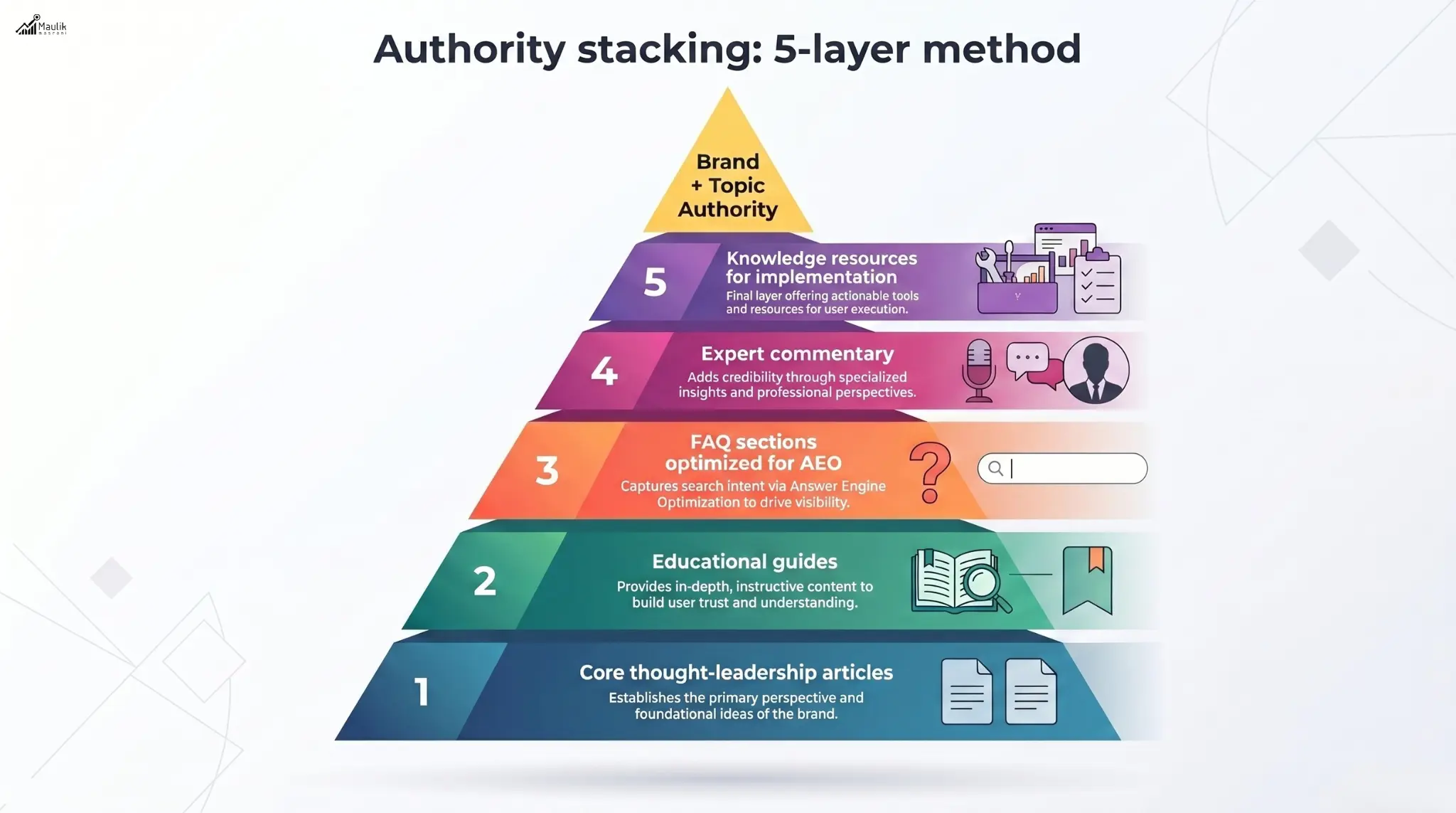
Each resource reinforces the others.
When AI systems analyze this interconnected structure, they detect stronger entity relationships between the brand and the topic.
Over time, this accumulation of signals increases the likelihood that generative AI systems will reference the brand when producing answers related to that subject.
Authority stacking also aligns with AIO principles, where brands optimize their digital presence specifically for AI-driven discovery rather than traditional search rankings alone.
Cross-Model Testing Strategy
One important reality of generative search is that different AI platforms produce different results.
ChatGPT, Gemini, Claude, and Perplexity often generate different answers to the same question. Each model relies on different training signals, knowledge retrieval methods, and ranking mechanisms.
Because of this variation, organizations must perform cross-model testing.
Cross-model testing involves running industry queries across multiple AI systems and analyzing which brands appear in the responses.
Typical queries used in testing include:
- “Best AI training providers”
- “Top AI certification platforms”
- “Leading companies in AI governance consulting”
Testing responses across models helps identify patterns.
For example, a brand may appear consistently in ChatGPT responses but rarely appear in Gemini results. This indicates that the brand’s authority signals are stronger in one knowledge ecosystem than another.
The benefits of cross-model testing include:
- Identifying competitors dominating specific AI platforms
- Detecting gaps in generative visibility
- Understanding which topics drive the most recommendations
- Evaluating the effectiveness of GEO strategies
Regular testing ensures that generative positioning strategies remain aligned with the evolving behavior of AI search platforms.
Visibility Escalation Plan
Once reinforcement gaps are closed and authority signals strengthened, organizations must execute a long-term visibility escalation plan.
Generative visibility rarely improves immediately. AI systems gradually update their understanding of brands as new authority signals accumulate.
A structured escalation plan usually progresses through several stages.
| Stage | Objective |
| Foundation | Strengthen entity clarity and knowledge structure |
| Expansion | Publish supporting content clusters |
| Authority Reinforcement | Increase citations and references |
| AI Testing | Evaluate visibility across AI platforms |
| Optimization | Continuously refine content and authority signals |
Over time, these efforts help AI systems consistently associate the brand with specific expertise areas.
As the brand becomes more embedded in generative knowledge systems, its presence within AI answers becomes stronger and more consistent.
FAQs
How to outrank competitors in AI answers?
Outranking competitors in AI answers requires strengthening entity authority signals through structured content, topic clusters, and consistent knowledge reinforcement. A strong generative positioning strategy ensures AI systems recognize your brand as a credible source.
Why do some companies appear more often in AI responses?
AI systems prioritize sources that demonstrate strong expertise signals, structured knowledge frameworks, and consistent references across authoritative platforms.
What role does AEO play in AI search?
AEO focuses on optimizing content so AI systems can easily extract and summarize answers. This improves the chances of appearing in AI-generated responses.
How often should AI visibility be monitored?
Organizations should evaluate AI visibility every quarter to track improvements in AI competitor ranking and identify new opportunities for visibility growth.
Conclusion
Generative AI is transforming how users discover brands and expertise online. Instead of navigating multiple websites, users increasingly rely on AI assistants to provide direct answers. This means visibility now depends not only on traditional SEO rankings but also on how generative systems interpret and summarize information.
Organizations that implement a strong generative positioning strategy can strengthen their authority signals and influence how AI models reference their brand. By reinforcing expertise and maintaining a structured knowledge ecosystem, businesses can gradually improve their presence in AI-generated answers and achieve stronger LLM visibility dominance.