
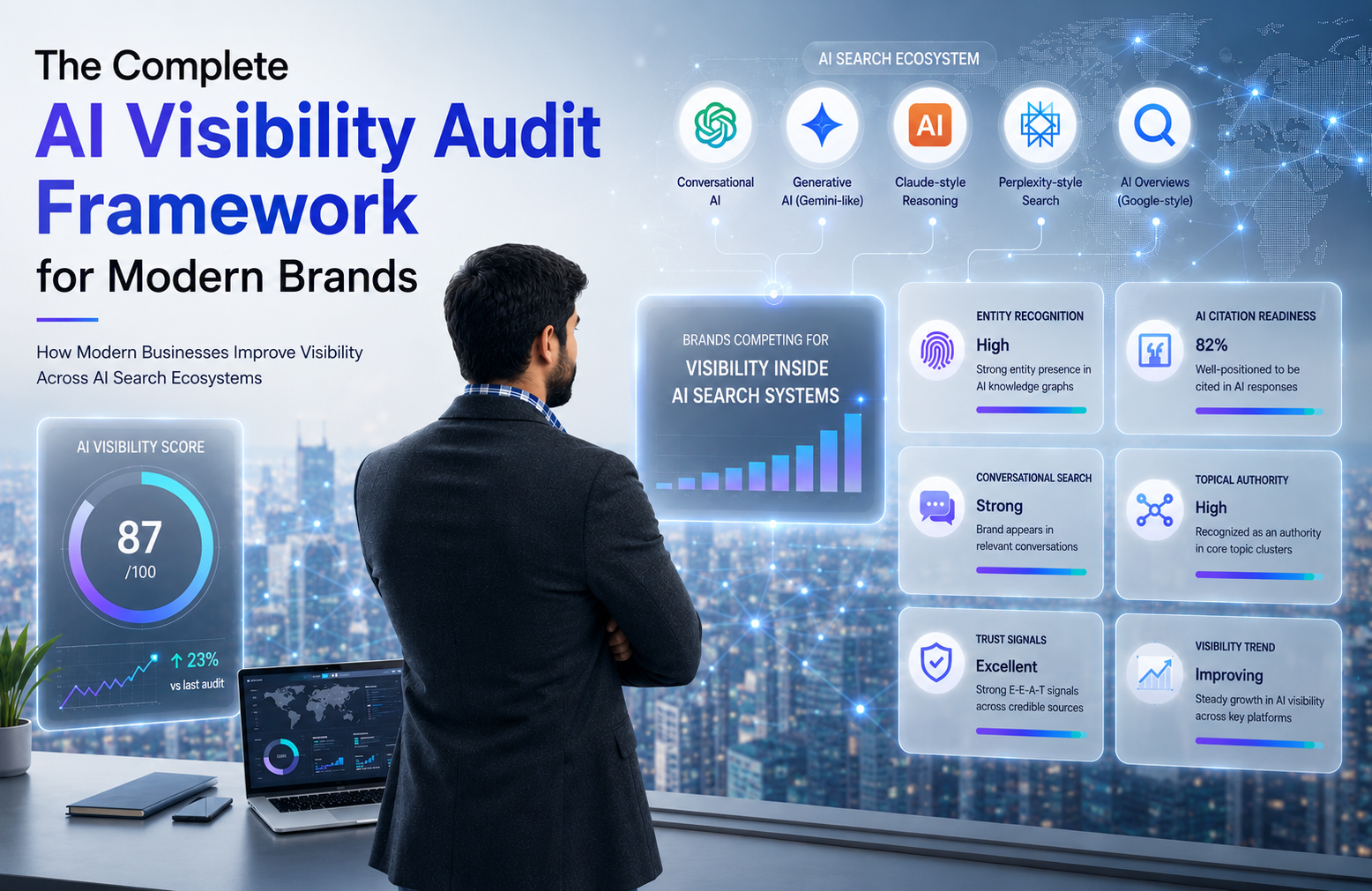
Your website may still rank on Google while remaining almost invisible inside AI-generated search experiences.
That is the shift many brands are beginning to notice. Traditional SEO metrics may still look healthy, rankings may still exist, and organic traffic may still arrive, but AI platforms like ChatGPT, Gemini, Claude, Perplexity, and Google AI Overviews are changing how users discover information, evaluate brands, and make decisions. Search behavior is no longer limited to blue links.
Users now ask AI systems direct questions such as:
- Which cybersecurity companies are best for enterprises?
- What is the best AI certification provider?
- Which SaaS tools are trusted by marketing teams?
- What are the best SEO agencies for AI search optimization?
Instead of showing ten website links, AI systems generate summarized answers. If your brand is not properly understood, structured, trusted, or contextually connected across the web, your visibility inside these AI-driven environments becomes extremely limited.
This is where the concept of an AI visibility audit becomes critical.
Traditional SEO audits focus heavily on rankings, backlinks, indexing, and technical optimization. Modern AI search ecosystems evaluate brands differently. AI systems rely on semantic understanding, entity recognition, topical authority, trust signals, contextual relationships, and retrievable information architecture.
A business can rank on Google and still fail AI retrieval systems completely. That creates a major visibility gap.
As AI-generated search experiences continue expanding across search engines, assistants, productivity tools, browsers, and enterprise systems, brands that fail to optimize for AI visibility risk losing discoverability long before they notice traffic decline in analytics.
This guide breaks down the complete AI Visibility Framework modern brands can use to evaluate, measure, and improve their presence across AI-powered search ecosystems.
What Is an AI Visibility Audit?
An AI visibility audit is the process of evaluating how effectively AI systems can discover, interpret, trust, retrieve, and reference your brand across AI-driven search environments.
Unlike traditional SEO audits, an AI visibility audit goes beyond rankings and crawlers. It examines whether large language models and AI search systems can actually understand your brand well enough to include it in generated answers.
A traditional SEO audit usually focuses on:
- rankings
- backlinks
- indexing
- technical errors
- page speed
- metadata
- keyword targeting
An AI visibility audit evaluates broader signals such as:
- entity clarity
- semantic relationships
- topical authority
- conversational relevance
- AI citation readiness
- structured information architecture
- trust consistency
- AI retrievability
- contextual brand mentions
This distinction is extremely important.
Search engines traditionally ranked webpages. AI systems retrieve and synthesize information.
That means visibility now depends on how well your content contributes to machine-generated understanding.
For example, a cybersecurity company may rank for several transactional keywords but still fail to appear when users ask AI systems:
- Which cybersecurity firms are trusted for enterprise digital forensics?
- Which companies specialize in AI governance consulting?
- What are the top AI compliance service providers?
If AI systems cannot confidently connect your brand to those topics, visibility disappears at the retrieval layer.
This is why businesses are increasingly investing in:
- AI SEO audit
- AI search optimization
- AI website optimization
- AI content optimization
- AI visibility scoring
- AI audit reports
The objective is no longer only ranking webpages.
The objective is to become visible inside AI-generated discovery systems.
Why Traditional SEO Is No Longer Enough
SEO is not disappearing.
But search behavior is evolving faster than most businesses expected.
For years, search optimization focused heavily on one predictable model:
- A user enters keywords into Google
- Google displays webpage listings
- The user clicks a result
- The website receives traffic
AI-powered search experiences are reshaping that model.
Today, users increasingly interact with:
- AI-generated summaries
- conversational answers
- synthesized recommendations
- zero-click search experiences
- AI assistants
- integrated productivity AI systems
This creates a major visibility shift.
In many cases, users receive complete answers without ever visiting a website.
That means ranking alone is no longer enough.
A brand now needs to become:
- understandable
- retrievable
- trusted
- contextually associated
- citation-ready
inside AI ecosystems.
This is one of the biggest reasons why many SEO strategies are starting to lose effectiveness despite maintaining strong rankings.
The issue is not always a traffic decline immediately.
The issue is discoverability erosion.
Many businesses still optimize only for search engines, while AI systems are increasingly influencing:
- product discovery
- service recommendations
- vendor evaluations
- software comparisons
- educational research
- enterprise buying decisions
A user asking ChatGPT for “best AI adoption consulting firms” may never even see traditional search results.
That changes everything.
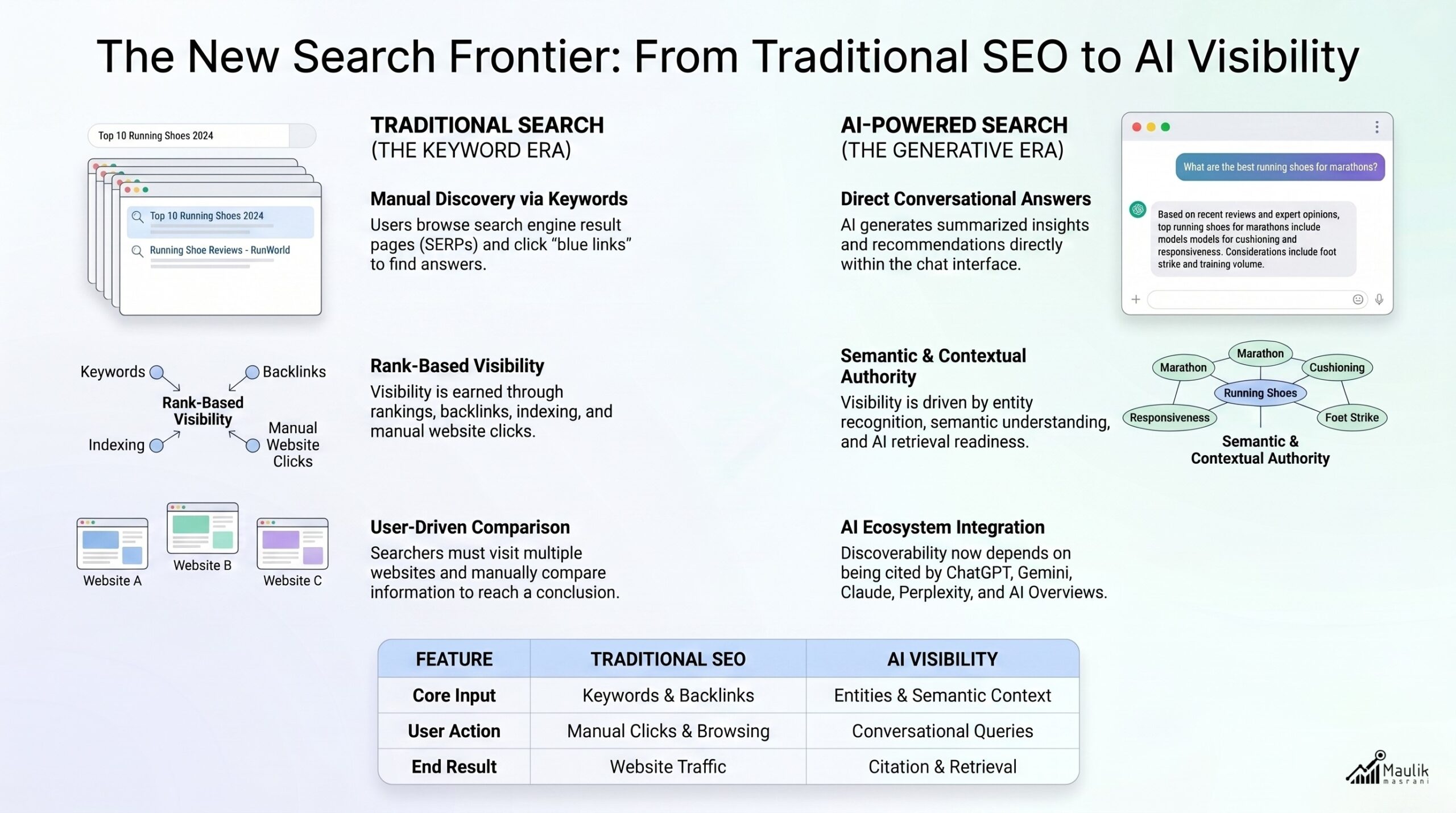
Modern visibility now operates across two environments:
| Traditional Search | AI Search |
| Ranking webpages | Retrieving contextual answers |
| Keyword matching | Semantic understanding |
| Click-focused | Answer-focused |
| SERP competition | AI retrieval competition |
| Search listings | AI-generated responses |
This transition is exactly why businesses are now exploring:
- AI SEO strategy
- AI search optimization
- AI visibility audit
- AI website audit
- AI content optimization
The brands that adapt early will build stronger long-term discoverability across evolving AI ecosystems.
How AI Search Engines Understand Websites and Brands
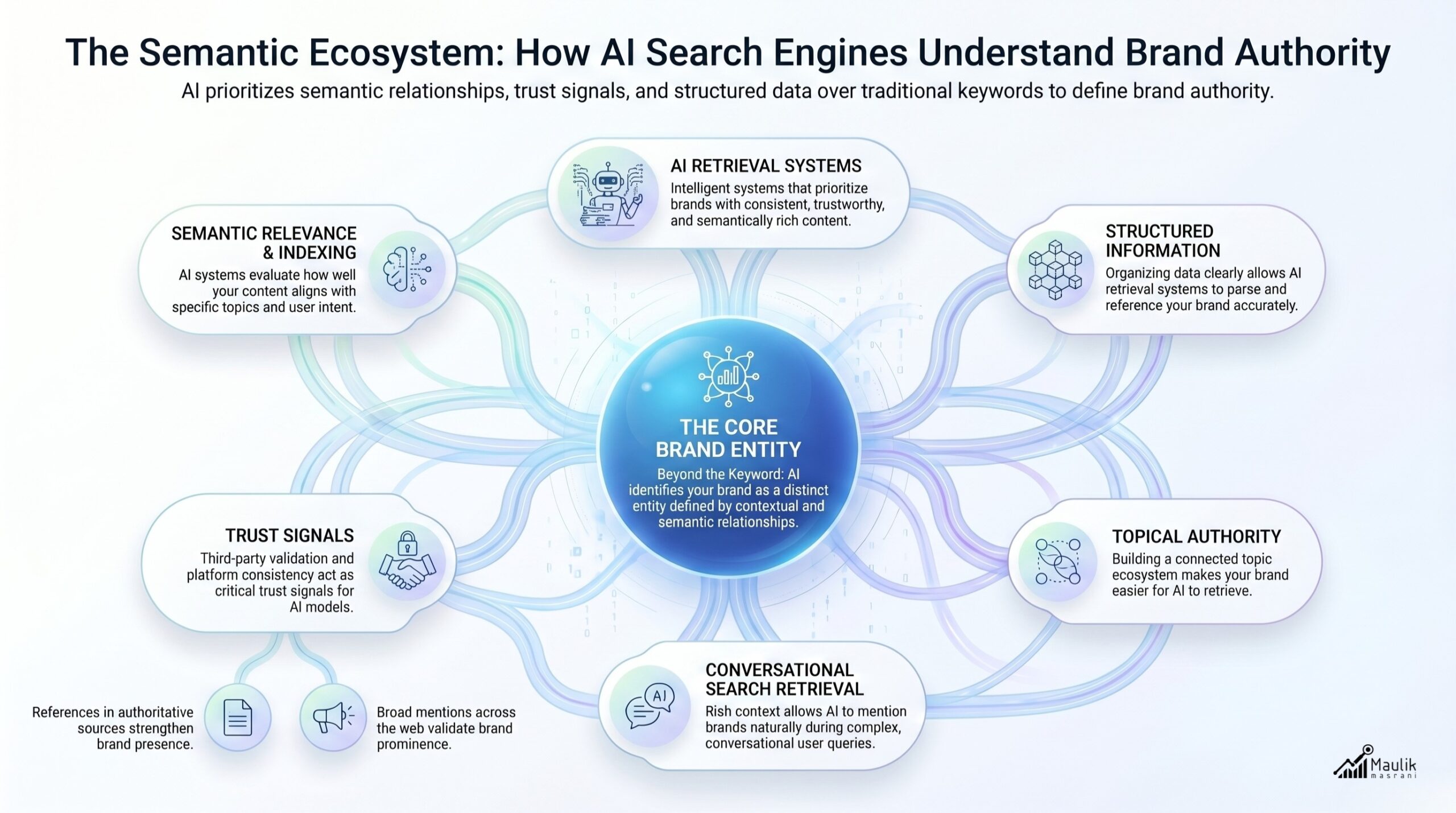
AI systems do not evaluate websites the same way traditional search algorithms historically did.
They build contextual understanding.
Modern AI retrieval systems analyze relationships between:
- topics
- entities
- expertise
- contextual authority
- brand consistency
- trust signals
- structured knowledge
This is why many websites with strong SEO foundations still struggle with AI visibility.
Their content may rank, but it lacks retrieval intelligence.
Entity Recognition Matters More Than Ever
AI systems attempt to understand who your brand is, what expertise you represent, and which topics your business genuinely owns.
This is called entity recognition.
For example, if your company consistently publishes high-quality content around:
- AI governance
- AI adoption
- enterprise transformation
- AI compliance
- generative AI operations
AI systems begin associating your brand with those themes.
Over time, that strengthens topical identity.
Without strong entity clarity, AI systems struggle to confidently reference your brand inside generated responses.
Topical Authority Is Becoming More Important Than Keyword Density
Traditional SEO often overemphasized keyword placement. AI systems prioritize depth, contextual relevance, and semantic coverage.
A website publishing scattered content across unrelated subjects creates weak topical authority. A website deeply covering interconnected themes creates stronger retrievability.
This is one reason pillar content and cluster structures are becoming increasingly valuable.
Strong AI retrieval systems prefer brands that demonstrate consistent expertise across entire topical ecosystems.
Conversational Search Is Reshaping Optimization
Users no longer search only with short keywords.
They ask complete questions.
Examples:
- Which AI SEO strategies actually improve AI visibility?
- How can SaaS companies optimize for AI-generated search?
- Why are brands disappearing from ChatGPT answers?
AI systems analyze intent differently from traditional search engines.
That means content structure must become more conversational, contextual, and explanation-driven.
Rigid keyword-focused pages often struggle in conversational retrieval environments.
Trust Signals Influence AI Visibility
AI systems evaluate trust across multiple dimensions:
- author credibility
- consistent expertise
- structured information
- reliable citations
- external mentions
- contextual consistency
- semantic relationships
Generic AI-generated filler content weakens trust significantly.
This is why many brands producing large volumes of low-depth content are seeing diminishing visibility impact despite publishing aggressively.
AI retrieval systems increasingly reward clarity, usefulness, authority, and contextual depth.
Introducing the AI Visibility Framework
Modern brands need a structured system to evaluate AI discoverability properly.
That is where the AI Visibility Framework becomes useful.
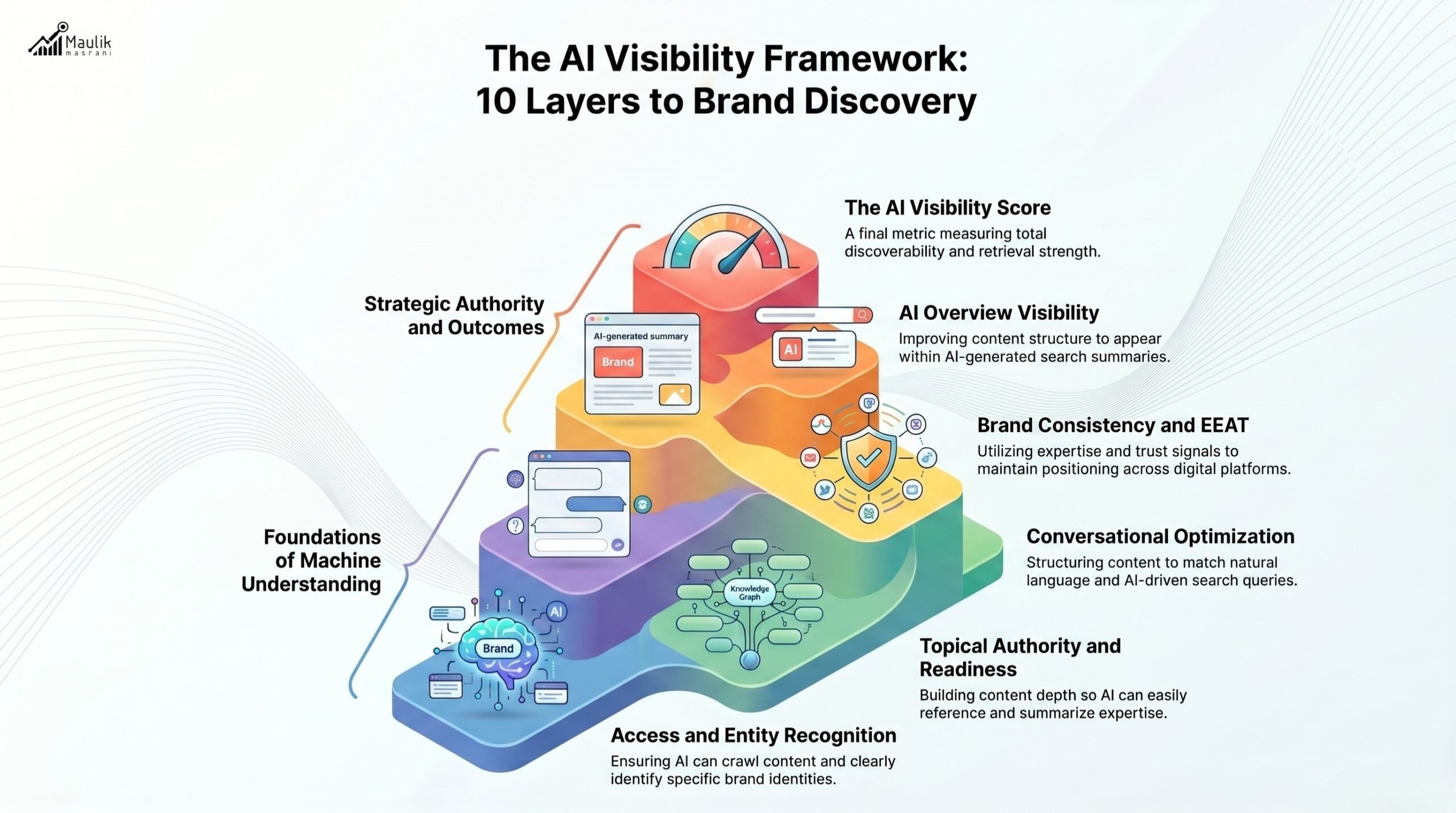
Instead of focusing only on rankings, this framework evaluates how AI ecosystems interpret and retrieve your brand across conversational search environments.
The framework consists of ten foundational layers.
Layer 1 — AI Crawlability
Before AI systems can retrieve information, they must access and process it properly.
Poor site architecture, blocked content, fragmented structures, or weak indexing foundations reduce retrievability.
Important evaluation areas include:
- crawl accessibility
- clean architecture
- structured content hierarchy
- technical clarity
- indexable information depth
Layer 2 — Entity Recognition
AI systems need a clear understanding of:
- who your brand is
- What you specialize in
- Which expertise areas do you own
Weak positioning creates weak entity association.
Strong entity recognition requires:
- consistent topical alignment
- semantic clarity
- contextual brand mentions
- authoritative content ecosystems
Layer 3 — Topical Authority
Publishing isolated content pieces is no longer enough.
Brands need interconnected topic ecosystems.
AI systems reward businesses that deeply cover related themes rather than producing disconnected content across unrelated industries.
Topical authority grows when:
- Content clusters connect logically
- semantic depth increases
- expertise remains consistent
- contextual relationships strengthen
Layer 4 — AI Citation Readiness
AI-generated answers often synthesize information from multiple trusted sources.
Your content must become easy to retrieve, understand, and reference.
Strong citation-ready content typically includes:
- clear explanations
- structured formatting
- semantic clarity
- factual depth
- concise insights
- framework-driven information
Layer 5 — Conversational Search Optimization
AI systems interpret natural language differently from keyword-driven search.
Content optimized only for exact-match keywords may struggle in conversational retrieval environments.
Brands should optimize for:
- natural language queries
- question-based retrieval
- contextual explanations
- conversational phrasing
- intent-driven structure
Layer 6 — Brand Mention Consistency
AI systems evaluate consistency across the broader web ecosystem.
Conflicting positioning weakens trust.
Brands should maintain alignment across:
- website messaging
- social platforms
- guest content
- PR mentions
- directory listings
- thought leadership assets
Layer 7 — AI Content Optimization
Publishing AI-generated content without strategic depth often creates retrieval weakness.
AI systems increasingly detect patterns associated with low-value content.
Strong AI content optimization focuses on:
- originality
- expertise
- contextual insights
- semantic coverage
- practical usefulness
- information architecture
Layer 8 — AI Overview Visibility
Google AI Overviews are changing visibility patterns dramatically.
Brands now need content structured for summarization and extraction.
Important optimization factors include:
- concise explanations
- scannable formatting
- contextual clarity
- snippet-ready sections
- structured answers
Layer 9 — EEAT & Trust Signals
Experience, expertise, authority, and trust remain critical.
AI systems attempt to prioritize reliable information sources.
Trust signals increasingly influence:
- AI citations
- retrieval confidence
- summarization inclusion
- recommendation visibility
Layer 10 — AI Visibility Score
An AI visibility score helps businesses evaluate overall discoverability strength across AI ecosystems.
This scoring model may include factors such as:
- topical authority
- AI retrievability
- conversational relevance
- citation readiness
- semantic depth
- entity consistency
- trust architecture
A strong score indicates stronger potential visibility across AI-generated search environments.
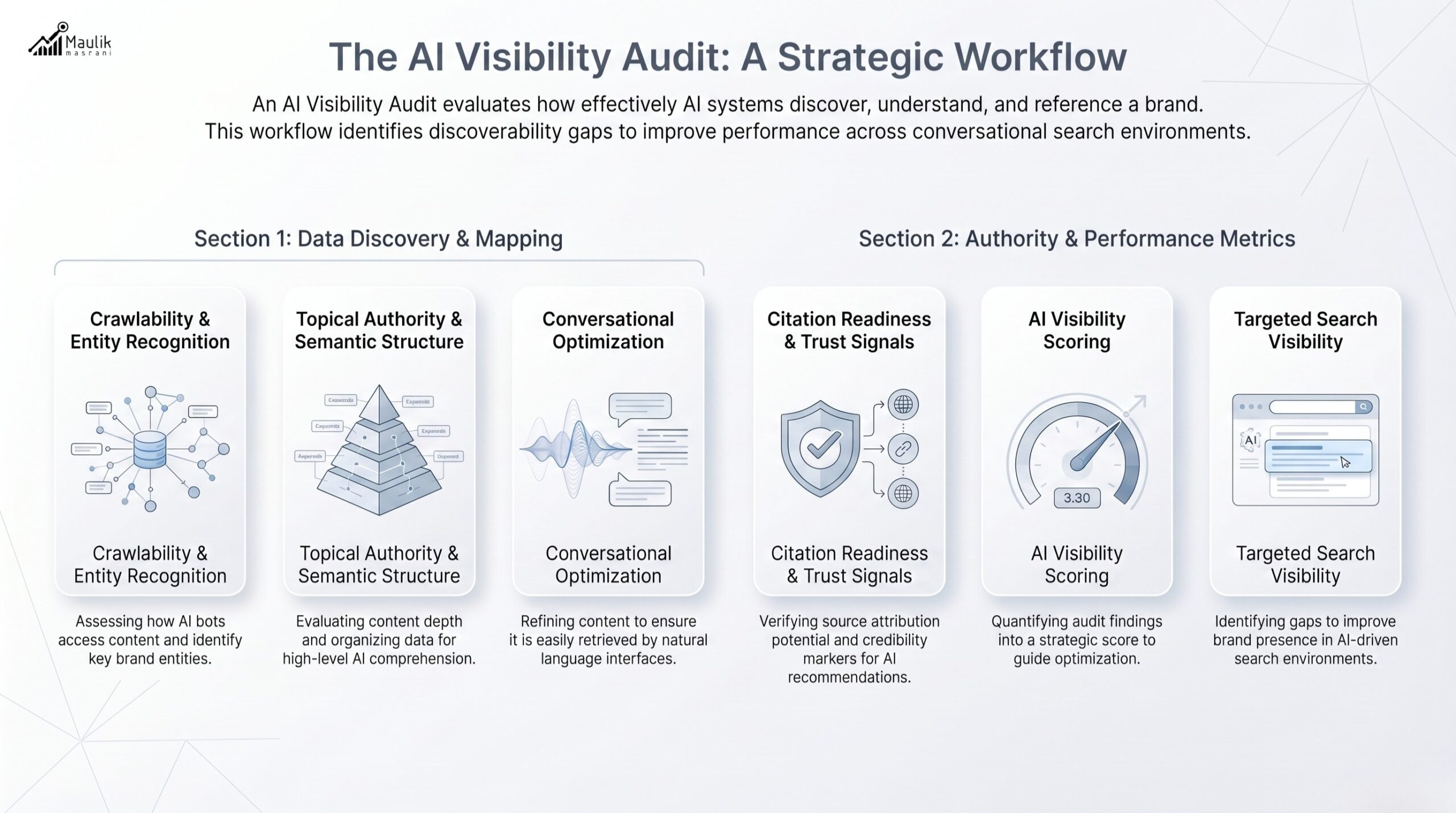
How an AI Visibility Audit Works
A modern AI SEO audit requires far more than technical analysis.
It evaluates whether your digital ecosystem is structured for AI understanding.
A typical audit process may include:
| Audit Area | Evaluation Focus |
| Entity Clarity | Does AI understand your brand expertise? |
| Topical Authority | Are your topics deeply connected? |
| AI Retrieval Structure | Can AI systems extract your information? |
| Conversational Optimization | Does content align with natural language queries? |
| Trust Signals | Does your content demonstrate authority? |
| Citation Readiness | Can AI systems reference your content easily? |
| Semantic Consistency | Are topics contextually aligned? |
The final AI audit report should identify:
- visibility gaps
- weak retrieval areas
- topical fragmentation
- AI citation limitations
- semantic weaknesses
- trust inconsistencies
This allows businesses to prioritize improvements strategically instead of randomly publishing more content.
Common Reasons Brands Fail AI Visibility
Many businesses unknowingly weaken their AI discoverability despite investing heavily in SEO.
Generic AI-Generated Content
Mass-produced low-depth articles often fail retrieval systems because they lack expertise, originality, and contextual value.
Weak Topic Clustering
Publishing unrelated blogs without semantic relationships weakens topical authority.
Poor Entity Positioning
If your expertise positioning changes constantly, AI systems struggle to confidently associate your brand with specific subjects.
Thin Authority Signals
Limited thought leadership, weak trust indicators, and inconsistent expertise reduce AI retrieval confidence.
Over-Optimized SEO Writing
Content written purely for keyword insertion often performs poorly in conversational AI environments.
Weak Information Architecture
Unstructured content reduces extraction efficiency for AI systems.
AI SEO Optimization Checklist for Modern Brands
Use this checklist to improve your AI search optimization strategy.
| Optimization Area | Priority |
| Build topic clusters | High |
| Improve semantic depth | High |
| Optimize conversational queries | High |
| Strengthen EEAT signals | High |
| Improve entity consistency | High |
| Create citation-ready content | Medium |
| Structure content clearly | High |
| Reduce thin AI-generated content | High |
| Add expert-driven insights | High |
| Improve internal linking | Medium |
AI Search Statistics Businesses Should Know
AI-driven search behavior continues growing rapidly across industries.
Several important shifts are becoming visible:
- Users increasingly prefer conversational search experiences
- AI Overviews are changing click behavior
- Decision-making journeys are becoming shorter
- AI-generated summaries influence vendor evaluation
- Information searches are increasingly zero-click
Businesses that fail to adapt to these changes may eventually lose discoverability even while maintaining traditional rankings.
This is why many forward-looking companies are investing in:
- AI SEO services
- AI website optimization
- AI visibility audits
- AI content optimization
- AI search strategies
before competitors fully adjust.
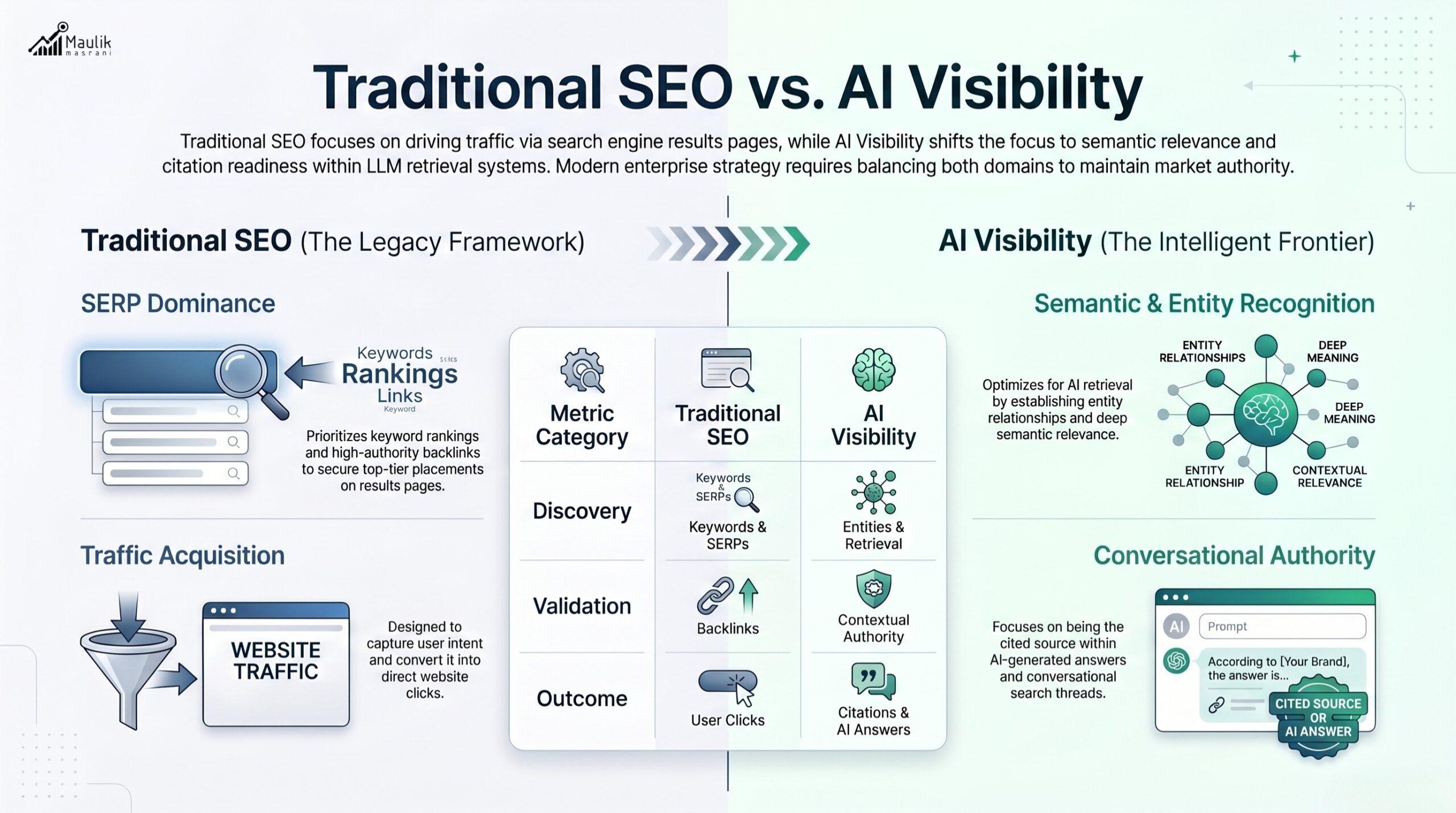
AI Visibility vs Traditional SEO
Understanding the difference between traditional SEO and AI visibility is critical.
| Traditional SEO | AI Visibility |
| Optimizes rankings | Optimizes retrieval |
| Focuses on keywords | Focuses on entities |
| Competes for clicks | Competes for citations |
| Measures rankings | Measures discoverability |
| Prioritizes SERPs | Prioritizes AI answers |
| Focuses on indexing | Focuses on contextual understanding |
The future of search is not replacing SEO completely. It is expanding visibility requirements beyond rankings.
The Future of SEO Belongs to AI Visibility
The next generation of digital visibility will not belong to brands producing the highest quantity of content.
It will belong to brands that become:
- contextually understood
- semantically trusted
- topically authoritative
- conversationally retrievable
inside AI ecosystems.
As AI-generated search experiences continue evolving, businesses that adapt early will build stronger long-term discoverability advantages.
The brands still relying only on traditional SEO metrics may eventually realize that rankings alone no longer guarantee visibility.
AI systems are becoming the discovery layer of the internet.
And visibility inside those systems is rapidly becoming a competitive advantage.
Is Your Brand Visible in AI Search?
An effective AI visibility audit helps businesses understand how AI systems interpret, retrieve, and reference their brand across platforms like ChatGPT, Gemini, Claude, Perplexity, and AI Overviews.
A strategic audit can help identify:
- AI visibility gaps
- weak topical authority
- retrieval limitations
- citation weaknesses
- semantic inconsistencies
- AI search optimization opportunities
As AI search ecosystems continue evolving, brands that improve AI discoverability early will be positioned more strongly for the future of digital search.
Frequently Asked Questions
What is an AI visibility audit?
An AI visibility audit is a process used to evaluate how effectively AI systems like ChatGPT, Gemini, Claude, and Google AI Overviews can understand, retrieve, and reference your brand across AI-powered search experiences. It focuses on areas like semantic relevance, topical authority, conversational optimization, and trust signals.
How is an AI SEO audit different from a traditional SEO audit?
A traditional SEO audit mainly focuses on rankings, backlinks, technical SEO, and indexing. An AI SEO audit evaluates broader AI search factors such as entity recognition, AI retrievability, citation readiness, conversational search optimization, and contextual authority.
Why is AI visibility important for businesses?
AI visibility is becoming important because users increasingly rely on AI-generated answers instead of traditional search results. If your brand is not visible inside AI systems, potential customers may never discover your business during research or buying decisions.
What is an AI visibility score?
An AI visibility score is a measurement used to evaluate how discoverable and retrievable a brand is across AI search ecosystems. It may include factors such as semantic depth, topical authority, conversational relevance, citation readiness, and trust consistency.
Can a website rank on Google but still fail AI search visibility?
Yes. Many websites still rank well on Google but struggle inside AI-generated search environments because AI systems evaluate content differently. Weak entity clarity, poor topical authority, and low conversational relevance can reduce AI retrievability.
What is conversational search optimization?
Conversational search optimization focuses on structuring content in a way that aligns with how users naturally ask questions inside AI systems. This includes natural language phrasing, contextual explanations, and intent-driven formatting.
What is an AI audit report?
An AI audit report is a detailed evaluation document that analyzes how effectively a website or brand performs across AI-powered search environments. It identifies visibility gaps, retrieval issues, semantic weaknesses, trust signals, and opportunities to improve AI discoverability.
Why do businesses need an AI audit report?
Businesses need an AI audit report to understand whether AI systems like ChatGPT, Gemini, Claude, and Google AI Overviews can properly retrieve, understand, and reference their content during AI-generated searches.
Can an AI audit report improve AI search visibility?
Yes. A properly structured AI audit report helps businesses identify weaknesses affecting AI discoverability and provides strategic recommendations to improve visibility across AI-powered search ecosystems.
Summing up
Search visibility is no longer limited to traditional rankings. AI-powered search platforms are changing how users discover brands, compare services, evaluate expertise, and make decisions. Businesses that continue optimizing only for search engines may eventually face declining discoverability across AI-driven environments without realizing it immediately.
An effective AI visibility audit helps brands understand whether AI systems can properly retrieve, interpret, trust, and reference their content across platforms like ChatGPT, Gemini, Claude, Perplexity, and Google AI Overviews. From entity recognition and topical authority to conversational optimization and citation readiness, modern visibility now depends on far more than keywords and backlinks alone.
The brands that adapt early will gain stronger long-term advantages in AI search visibility, digital authority, and future search discoverability. Building a structured AI Visibility Framework today can help businesses strengthen their presence across the next generation of search experiences before competition becomes significantly harder.