
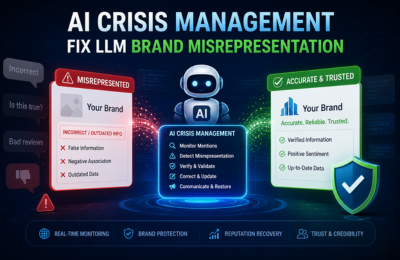
If large language models misrepresent your brand, speed and structure matter. Effective AI crisis management requires identifying misinformation patterns, executing a rapid response protocol, publishing reinforcement content, correcting schema signals and monitoring AI outputs until stabilization. Brands that treat AI search as a governed visibility system, not a passive channel, recover faster and strengthen long-term authority across AIO and GEO environments.
AI Crisis Management Framework
AI-generated answers now influence purchasing decisions, investor perception, recruitment and media narratives. When LLM misinformation appears, it spreads silently, often before your team notices.
Unlike traditional PR crises, AI-driven misrepresentation does not originate from a single article. It results from training data synthesis, entity confusion, outdated web content, or ambiguous schema signals.
This is where structured AI crisis management becomes essential.
How LLM Misrepresentation Happens
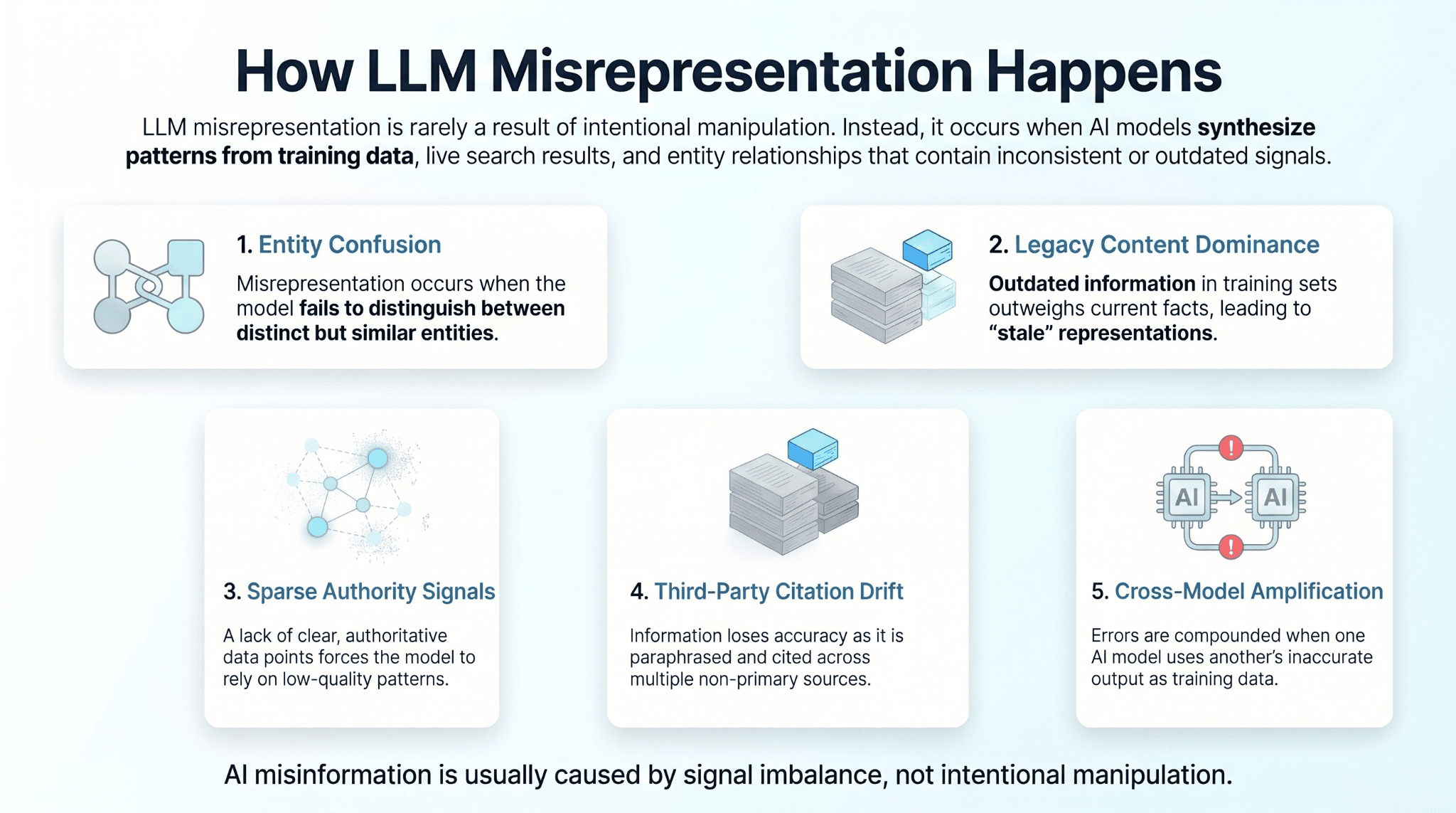
Large language models don’t “fact-check” in real time. They synthesize probabilistic patterns from training corpora, live search augmentation and entity relationships.
Common causes of misrepresentation include:
- Entity confusion – Similar brand names, outdated acquisitions, or geographic overlap.
- Legacy content dominance – Old press releases or negative mentions ranking higher than updated information.
- Sparse authority signals – Weak schema markup or inconsistent entity reinforcement.
- Third-party citation drift – Forums, scraped directories, or aggregator sites influencing AI responses.
- Cross-model amplification – Errors from one model appearing in others through web indexing loops.
Recent industry analyses show that over 20% of AI-generated brand summaries contain partially outdated or contextually incorrect information when not actively maintained. In regulated sectors like healthcare or fintech, that risk is even higher.
This is not a content issue alone. It’s an ecosystem signal issue involving AIO (Artificial Intelligence Optimization) and GEO (Generative Engine Optimization).
Identifying Misinformation Patterns
Before reacting, diagnose the problem precisely.
Use a structured audit process:
- Query your brand across multiple LLM platforms.
- Capture answer variations and inconsistencies.
- Identify recurring incorrect claims.
- Categorize errors (outdated, fabricated, conflated, exaggerated).
Look for patterns such as:
- Incorrect founding dates.
- Wrong service descriptions.
- Merged data from competitors.
- Outdated executive listings.
- Incorrect geographic presence.
Document these inconsistencies in a visibility log. Treat it like a forensic analysis rather than a reputation panic.
In many cases, misinformation is not malicious; it is simply a signal imbalance.
Immediate Response Protocol
Time is critical in AI crisis management.
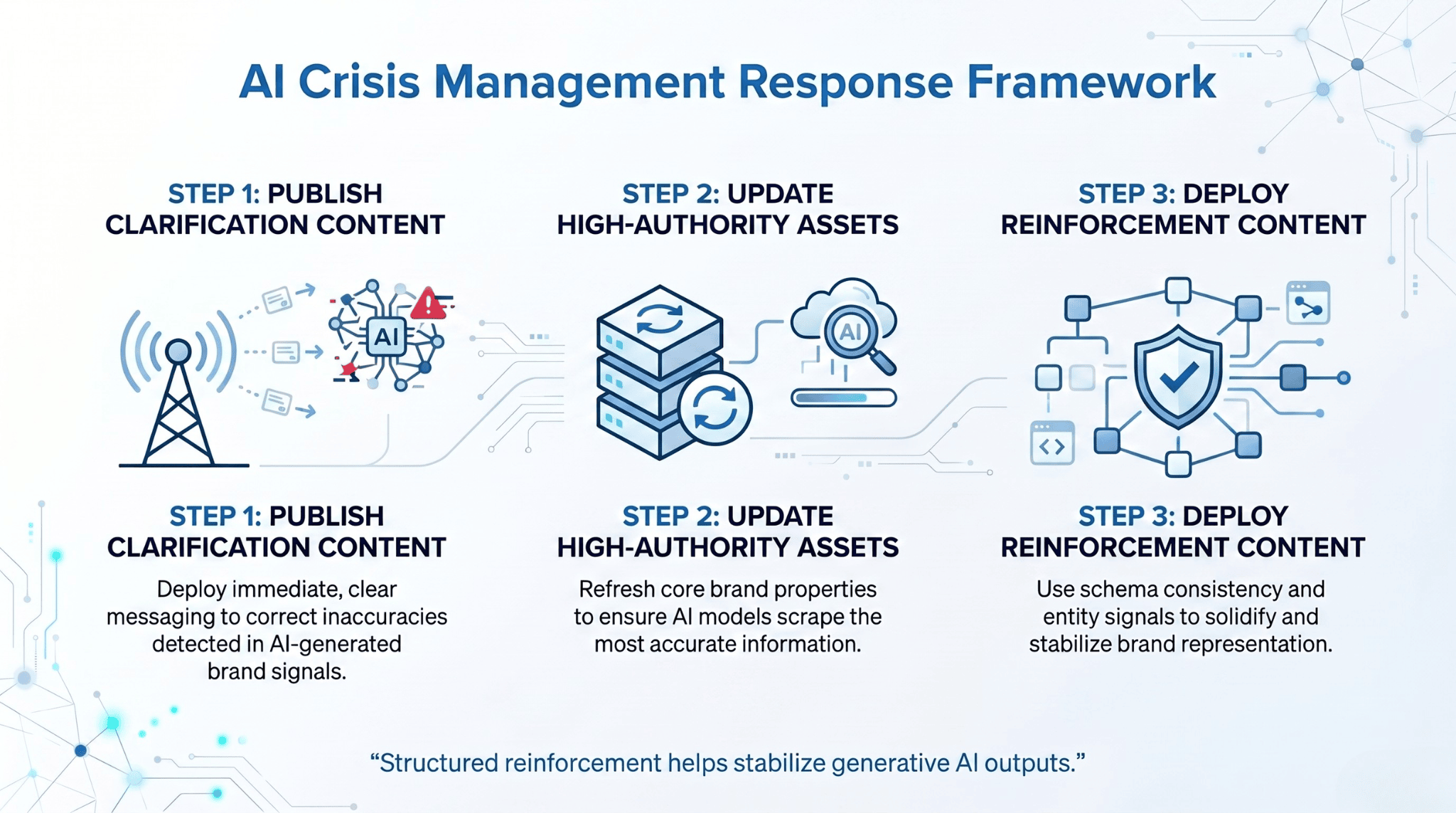
Here is the rapid response model:
Step 1: Publish Clarification Content
Create a clearly structured, authoritative correction page. Include:
- Verified business information.
- Timestamped updates.
- Transparent clarifications.
- Executive validation if needed.
Structure the page to be citation-ready for AI systems.
Step 2: Update High-Authority Assets
Revise:
- About page
- Leadership pages
- Press releases
- Structured FAQs
- Google Business Profile
- Knowledge panels
Ensure consistency across every controlled asset.
Step 3: Deploy Reinforcement Content
Publish supporting articles clarifying your positioning. Reinforce entity associations with:
- Clear brand definitions
- Service taxonomy
- Geographic identifiers
- Industry alignment
The goal is not denial. The goal is signal dominance.
Reinforcement Publishing Strategy
Correction alone does not stabilize LLM outputs. You must publish layered reinforcement content.
This includes:
- Authoritative blog posts.
- Structured Q&A content.
- Updated case studies.
- Industry citations.
- Third-party coverage alignment.
Each asset should repeat core brand facts consistently. In the AIO strategy, repetition is not redundancy; it is entity strengthening.
In GEO environments, generative systems reward clarity, consistency and structured authority. When your content ecosystem reinforces the same structured truth repeatedly, misinformation loses probable weight.
Schema Correction Techniques
One of the most overlooked components of AI brand correction is schema refinement.
Implement or update:
- Organization schema
- FAQPage schema
- Article schema
- SameAs properties linking verified platforms
- Author schema for executives
- Updated contact and location schema
Ensure that:
- The business name is standardized.
- The founding year is consistent.
- Industry classification is accurate.
- Parent/subsidiary relationships are explicit.
A schema acts as machine-readable clarity. When implemented correctly, it improves AI crawlability, reduces entity confusion and strengthens generative retrieval accuracy.
This is a core GEO stabilization mechanism.
Monitoring & Stabilization Timeline
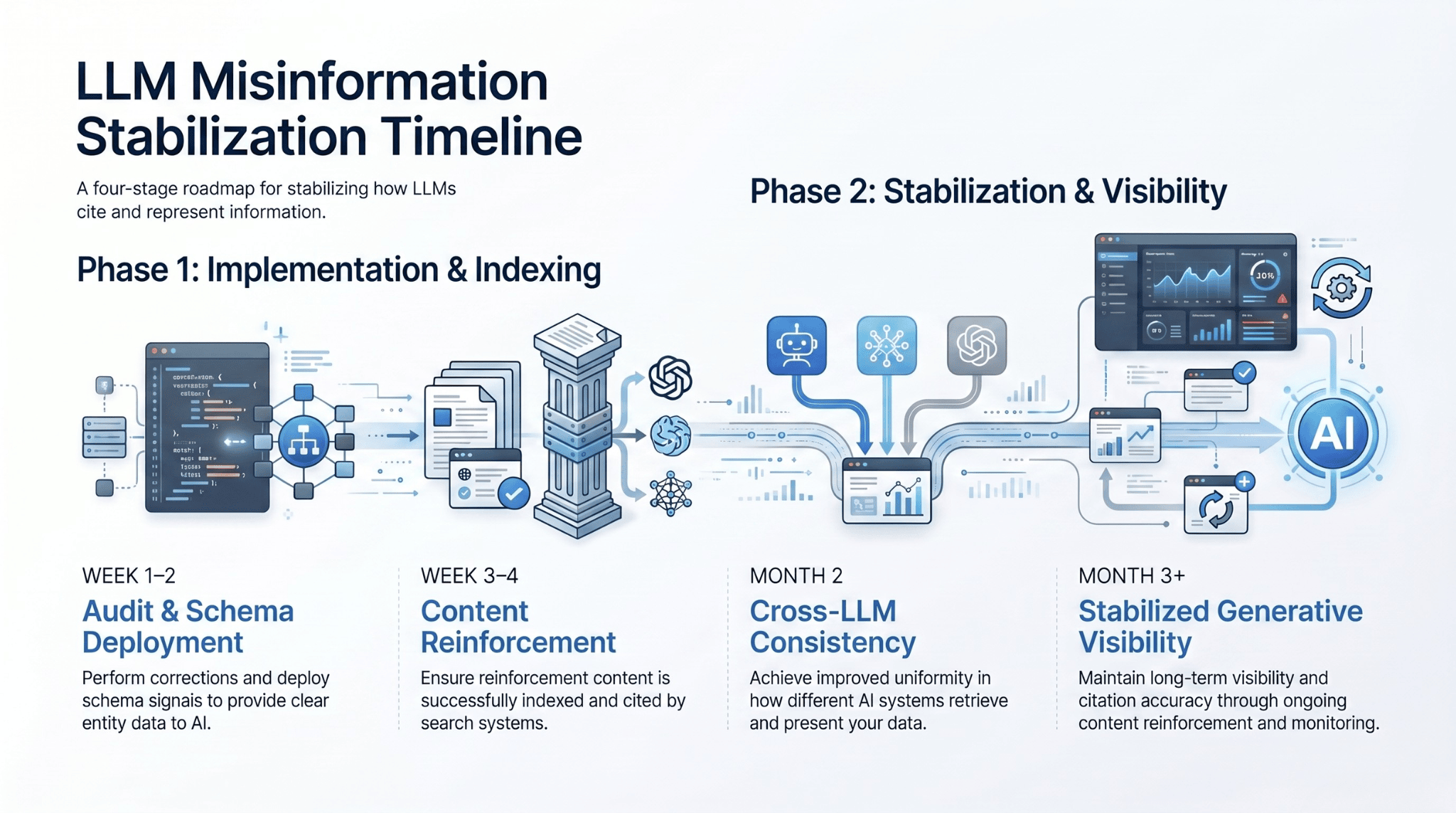
Recovery is not instant. A typical stabilization cycle looks like this:
Week 1–2:
Audit, correction, publishing and schema deployment.
Week 3–4:
Reinforcement content indexed and cited.
Month 2:
Improved cross-LLM consistency.
Month 3+:
Stabilized generative visibility if reinforcement continues.
Monitoring must include:
- Weekly LLM query testing.
- Citation tracking.
- Entity salience review.
- Search console behavior signals.
- AI snippet comparison logs.
Treat it like a brand health dashboard. AI ecosystems evolve continuously. Stabilization is ongoing governance, not a one-time fix.
FAQs
What if AI gives wrong info about my business?
Start with structured AI crisis management. Audit the misinformation across multiple LLM platforms, publish verified clarification content, correct schema signals and reinforce entity authority consistently until generative outputs stabilize.
How long does it take to correct LLM misinformation?
Minor inaccuracies may be corrected within 2-4 weeks after reinforcement publishing. Complex entity confusion can take 2-3 months, depending on signal strength and content authority.
Can I request that AI platforms remove incorrect information?
Some platforms allow feedback submission, but direct removal is rare. The more effective method is signal correction through authoritative publishing and structured schema updates.
Does traditional SEO fix AI misinformation?
Traditional SEO helps, but it is not enough. You need structured AIO and GEO strategies focused on entity clarity, machine-readable schema and reinforcement publishing tailored for generative systems.
Conclusion
AI-driven search has created a new kind of reputation risk where incorrect information can spread through automated answers rather than traditional media channels. That is why AI crisis management is no longer optional for modern brands.
When LLM misinformation appears, organizations must respond quickly by identifying the root cause, publishing authoritative corrections, strengthening entity signals and maintaining consistent monitoring across AI platforms. With a structured approach that aligns with AIO and GEO practices, businesses can correct inaccurate narratives, restore trust and ensure that AI systems represent their brand with clarity and accuracy over time.