
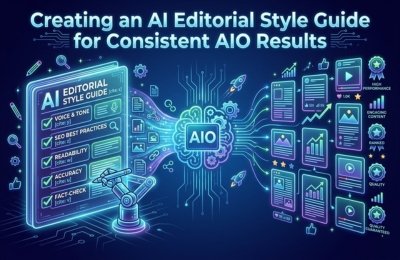
An AI editorial style guide is no longer optional for brands serious about Artificial Intelligence Optimization (AIO). In AI search environments, consistency beats creativity. This guide outlines actionable AIO writing standards, structural formatting rules, definition-first frameworks, FAQ and schema embedding practices, and a ready-to-use template so your content performs reliably across Google and LLM-driven platforms.
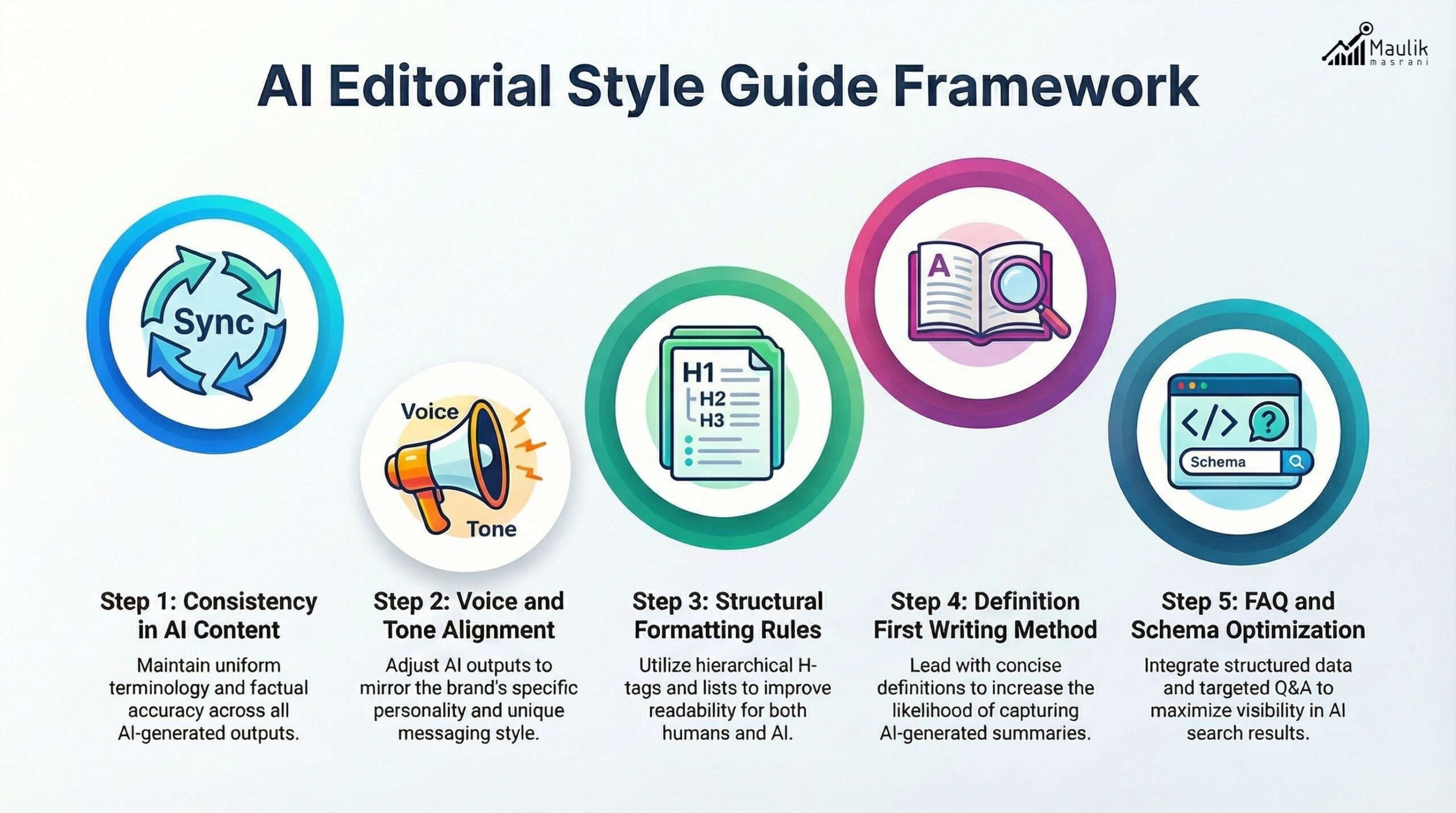
AI Editorial Style Guide for AIO
Search engines are evolving. Large Language Models (LLMs) like ChatGPT, Gemini, Claude, and Perplexity are not just indexing pages; they’re synthesizing answers. That means your content must be structured, semantically clear, and consistently formatted to be surfaced, cited, and trusted.
An AI editorial style guide defines the operational standards your team follows when producing content for AI-first visibility. It ensures alignment across blogs, landing pages, FAQs, and multi-platform assets while maintaining entity clarity and schema readiness.
Organizations that implement structured writing systems typically experience higher citation frequency in generative results and more stable visibility over time. According to industry research on AI search adoption, over 60% of users now rely on AI-generated summaries before clicking a source. That makes consistency your competitive advantage.
Why consistency beats creativity in AI search
In traditional SEO, creative differentiation helped content stand out. In AI search, predictability and clarity improve machine interpretation.
LLMs reward
- Stable heading hierarchies
- Definition-first structures
- Clean entity references
- Consistent formatting patterns
- Explicit context signals
When your formatting varies widely across pages, AI systems struggle to map your authority signals. AIO writing standards reduce ambiguity.
For example:
Inconsistent format
Page A: Conversational intro → bullets → no definitions
Page B: Technical intro → long paragraphs → no schema
Page C: No headings
Consistent format
Every page:
- TL;DR
- Definition-first paragraph
- Structured H2–H3 hierarchy
- FAQ block
- Schema-ready markup
Consistency improves model confidence.
If you are building a broader AI visibility ecosystem, align this editorial framework with your internal content systems, such as an internal knowledge base for AIO and structured governance processes.
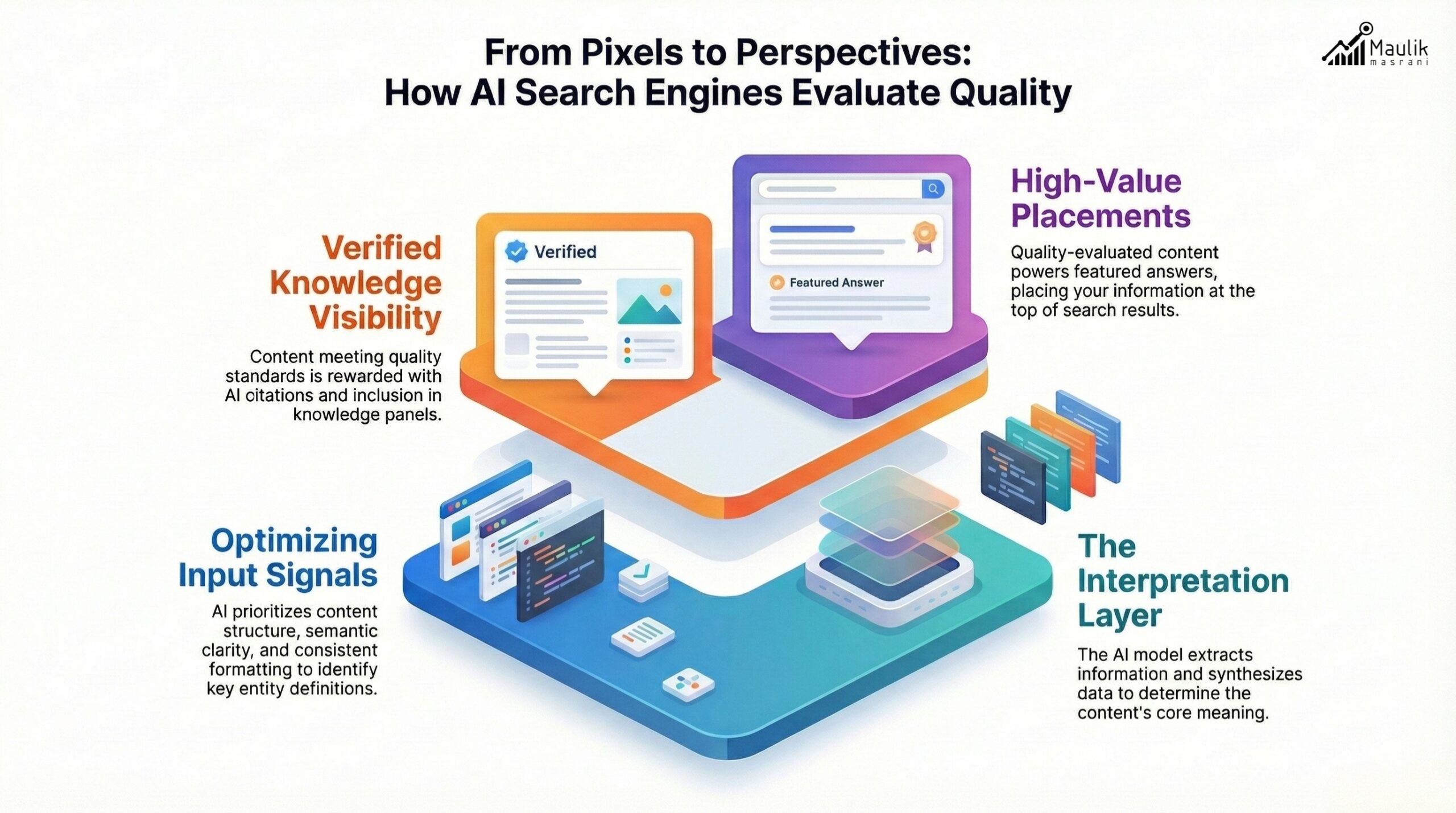
Voice & tone alignment across platforms
Voice fragmentation weakens authority.
Your AI editorial style guide must define:
- Brand positioning (technical, strategic, operational, visionary)
- Sentence complexity range
- Average paragraph length
- Use of definitions
- Use of statistics
- Tone (confident, neutral, analytical)
For AIO, clarity > cleverness.
Recommended operational tone structure:
- First paragraph: Define the topic.
- Second paragraph: Contextualize importance.
- Third paragraph: Present practical framework.
Maintain alignment across:
- Blog posts
- LinkedIn repurposing
- Video scripts
- Podcast summaries
If you use an AI repurposing strategy, ensure that formatting remains consistent across all channels. Multi-format reinforcement strengthens entity association in generative systems.
Structural formatting rules
AI systems parse structure before meaning. Formatting is a ranking signal in AIO environments.
Your AI content formatting rules should include:
1. Heading hierarchy discipline
- One H1
- Logical H2 progression
- H3 only under relevant H2
2. Definition-first paragraphs
Each major section should start with a concise definition.
Example:
An AI editorial style guide is a documented framework that standardizes structure, tone, and formatting for AI-optimized content.
3. Controlled paragraph length
- 2- 4 lines per paragraph
- Avoid dense blocks
4. Bullet clarity
- 3-7 bullets per section
- No vague statements
5. Consistent internal linking
Link to:
- Related frameworks
- Supporting strategy articles
- Operational templates
6. External credibility references
Cite credible research sources to reinforce factual grounding.
Structural stability increases machine readability and improves the probability of citation in generative outputs.
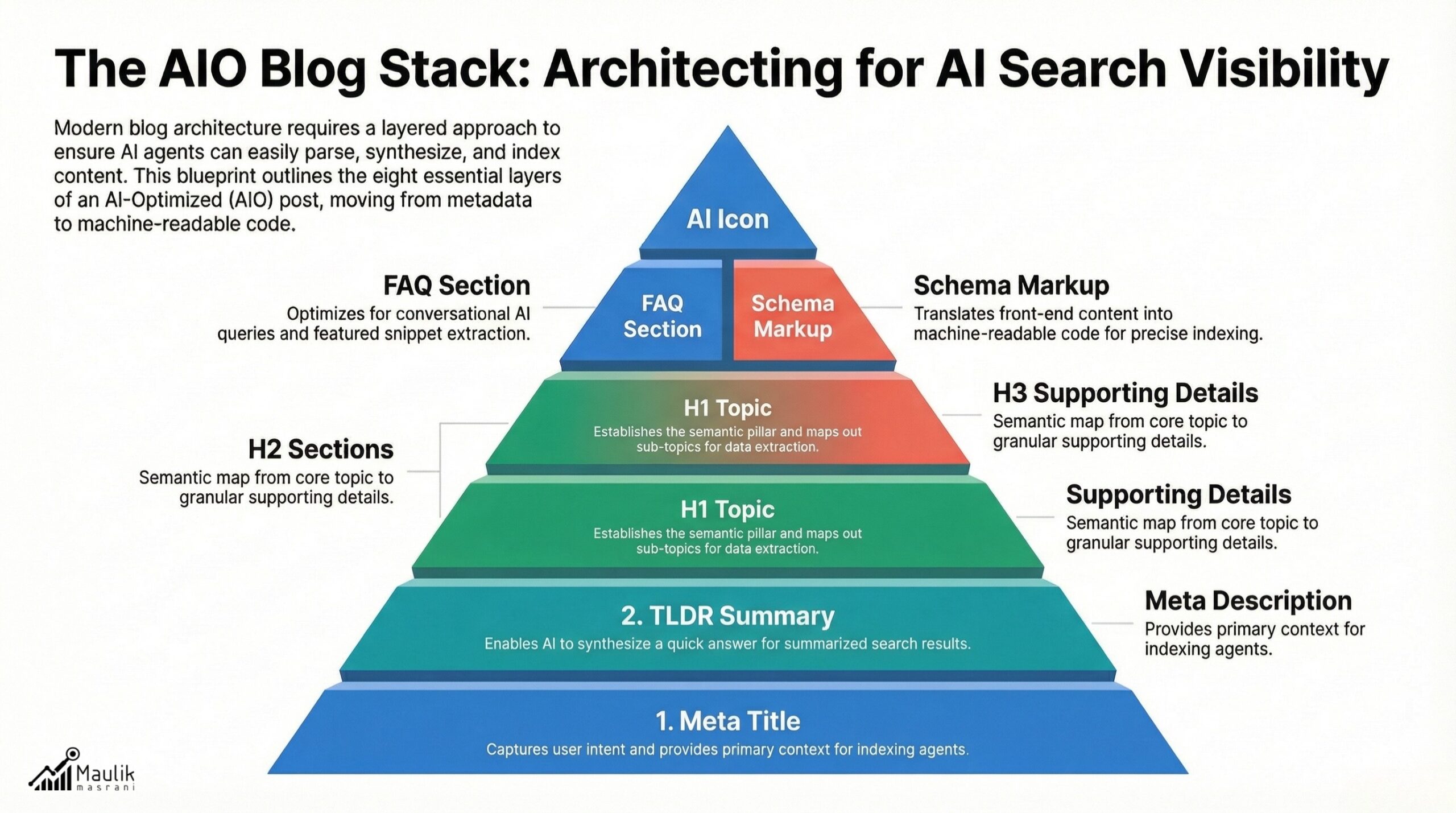
Definition-first writing method
The definition-first method is foundational to AIO writing standards.
Every major concept should be introduced with:
- A direct definition
- A contextual explanation
- A practical implication
Example:
What is an AI editorial style guide
An AI editorial style guide is a standardized documentation system that governs how content is structured, written, and formatted for optimal visibility in AI-driven search engines.
- It ensures clarity, consistency, and semantic alignment across all published materials.
- The implication: stronger AI citation probability and reduced content drift.
- This method reduces ambiguity and supports entity reinforcement across topic clusters.
FAQ + schema embedding rules
FAQ blocks are not decorative; they are machine signals.
Your editorial guide must mandate:
- 3-5 FAQs per page
- Direct, concise answers (40-60 words ideal)
- Question phrased in natural language
- Structured data implementation
Schema Type required:
- BlogPosting
- FAQPage
FAQ sections increase the likelihood of:
- Featured snippet capture
- AI answer extraction
- Cross-platform citation
Additionally, embed structured internal links inside FAQs where relevant.
For enterprise-level consistency, align this with your generative governance framework, so FAQ logic remains standardized across teams.
Sample template
Below is a simplified template your team can implement immediately:
AI Editorial Style Guide Page Template
- Meta Title (<60 characters) : Include primary keyword.
- Meta Description (<160 characters) : Benefit-driven summary.
- TL;DR (1 paragraph) : Clear outcome summary.
- H1 : Primary topic headline.
- H2 Sections : Each begins with a definition-first paragraph.
- Data / Insight Inclusion : Add at least one statistic or research reference.
- Internal Links (2-3) : Strategic cluster linking.
- External Link (1) : Industry research source.
- FAQ Block (3-5 questions) : Snippet-optimized answers.
- Schema Implementation : BlogPosting + FAQPage.
This templated approach transforms content production from creative chaos into operational precision.
FAQs
What is an AI editorial style guide?
An AI editorial style guide is a documented framework that standardizes how content is structured, formatted, and written to perform consistently in AI-driven search environments. It defines tone, heading hierarchy, formatting rules, FAQ inclusion, and schema practices.
Why are AIO writing standards important?
AIO writing standards ensure structural clarity, reduce ambiguity, and improve machine readability. Consistent formatting increases the likelihood of citation by generative AI systems and stabilizes long-term visibility.
How does AI content formatting affect rankings?
AI content formatting influences how models interpret and summarize content. Clear hierarchies, definition-first sections, and structured FAQs improve extraction quality and featured snippet potential.
How many FAQs should an AIO page include?
An optimized AIO page typically includes 3-5 concise FAQs. Each answer should be direct, definition-focused, and structured for schema markup to enhance snippet eligibility.
Conclusion
Creativity drives branding. Consistency drives AI visibility. An operational AI editorial style guide transforms your content engine into a structured, machine-aligned authority system.
By implementing AIO writing standards, enforcing AI content formatting discipline, applying the definition-first method, and embedding structured FAQ schema, your brand becomes easier for AI systems to interpret, trust and cite. In an AI-first search ecosystem, structure is strategy.